Methods of Sterilization and Disinfection
M.Sc I Microbiology (Unit-1)
Dr. Anjali Sharma
Terms:
• Sterilization: Article, surface, or medium is freed of all living
microorganisms either in the vegetative or in the spore state
• Used only in absolute sense
• Disinfection: Destruction of microorganisms, especially potential
pathogens, on the surfaces of inanimate objects or in the
environment
• Reduce the microbial population, not bacterial endospores on
inanimate surfaces or in organic materials
• Antisepsis: Destruction or inhibition of microorganisms on living
tissues by chemicals (non-toxic and non-irritating)
• Chemical agents- Antiseptics
..
• Germicide/microbicide: chemical agent that kills
pathogenic microorganisms
• Sepsis: growth of microorganisms in the body or the
presence of microbial toxins in blood and other
tissues
• Asepsis: Practice to prevent entry of infectious
agents into sterile tissues and thus prevents
infection
• Sanitization: Cleansing technique that mechanically
removes microorganisms to reduce the level of
contaminants
• Sanitizer- compound (e.g., soap or detergent)
Uses of Sterilization
• 1. Sterilization for Surgical Procedures and
Gloves, aprons,
syringes, drugs and
surgical
other
medicines:
instruments,
supplies etc.
2. Sterilization in Microbiological works:
Preparation of culture media, reagents and
equipments
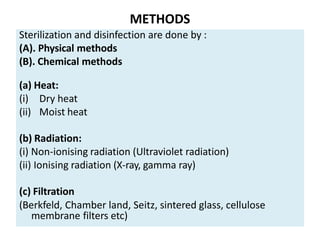
METHODS
Sterilization and disinfection are done by :
(A). Physical methods
(B). Chemical methods
(a) Heat:
(i) Dry heat
(ii) Moist heat
(b) Radiation:
(i) Non-ionising radiation (Ultraviolet radiation)
(ii) Ionising radiation (X-ray, gamma ray)
(c) Filtration
(Berkfeld, Chamber land, Seitz, sintered glass, cellulose
membrane filters etc)
Heat
• Mostly used method
• Highly effective and most reliable process
• Two major methods:
• Dry heat and moist heat
• Dry heat induces:
• Denaturation of protein, oxidative damage and toxic
effect
due to the high level of electrolytes
• Also damage the DNA of the microorganism
• As a result, the microorganism got killed
..
• Moist Heat:
kills the microorganisms by denaturation and
coagulation of proteins
• Temperature required to kill microbe by dry heat more
than moist heat
• Thermal death time-
Minimum time required to kill a suspension of
organisms at a predetermined temperature in a specified
environment
Factors affecting sterilization by heat
• Nature of heat: Moist heat is more effective
• Temperature and time: inversely proportional
• Number of microorganisms: More number- higher temperature
or
longer duration
• Nature of microorganism: Species and strain, Spores highly
resistant
• Type of material: heavily contaminated,
higher
temperature/prolonged exposure
• Certain heat sensitive articles sterilized at lower temperature
• Presence of organic material: Organic materials (protein, sugars,
oils and fats) increase the time required
DRY HEAT:
• ..
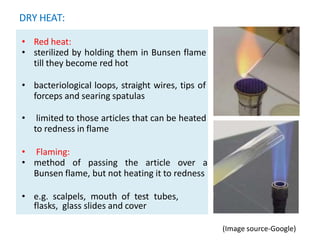
• Red heat:
• sterilized by holding them in Bunsen flame
till they become red hot
• bacteriological loops, straight wires, tips of
forceps and searing spatulas
• limited to those articles that can be heated
to redness in flame
• Flaming:
• method of passing the article over a
Bunsen flame, but not heating it to redness
• e.g. scalpels, mouth of test tubes,
flasks, glass slides and cover
(Image source-Google)
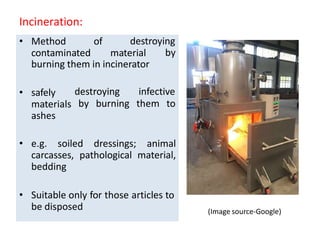
Incineration:
destroying
• Method of
contaminated material by
burning them in incinerator
destroying infective
by burning them to
• safely
materials
ashes
• e.g. soiled dressings; animal
carcasses, pathological material,
bedding
• Suitable only for those articles to
be disposed (Image source-Google)
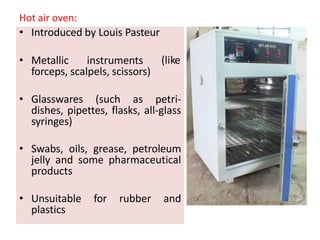
Hot air oven:
• Introduced by Louis Pasteur
(like
• Metallic instruments
forceps, scalpels, scissors)
• Glasswares (such as petri-
dishes, pipettes, flasks, all-glass
syringes)
• Swabs, oils, grease, petroleum
jelly and some pharmaceutical
products
• Unsuitable for rubber and
plastics
..
• Exposed to high temperature in an electrically heated oven
• Air poor conductor of heat, even distribution of heat throughout
the chamber by a fan
• fitted with a thermostat control, temperature indicator, meshed
shelves or trays
• Oven not overloaded
• Materials perfectly dry and arranged to allows free circulation of air
inside the chamber
• Mouths of flasks, test tubes and both ends of pipettes must be
plugged with cotton
• Petri dishes and pipettes wrapped in a paper
..
• 1600C for two hours, 1700C for 1 hour and 1800C for 30
minutes
• Increasing temperature by 10 degrees shortens the sterilizing
time by 50 percent
• The hot air oven must not be opened until the temperature
inside has fallen below 60o C to prevent breakage of glassware
• To determine the efficacy of sterilization
- Thermocouples, chemical indicators, and bacteriological
spores of Bacillus subtilis as sterilization controls
Sterilization by moist heat
• In the form of
• hot water
• boiling water
• steam (vaporized water)
• In practice, the temperature of moist heat usually ranges from 60 to 135°C
• Adjustment of pressure in a closed container- regulate the temperature of
steam
• kills microorganisms by denaturation and coagulation of proteins
• Sterilization by moist heat:
• temperature <100°C
• temperature of 100°C
• temperature >100°C
At temperature below 100o C
• Pasteurization:
• originally employed by Louis Pasteur
• employed in food and dairy industry
• Two methods of pasteurization
• holder method (heated at 63o C for 30 minutes)
• flash method (heated at 72o C for 15 seconds)
followed by quickly cooling to 13o C
• Suitable to destroy most milk borne pathogens (Mycobacteria, Streptococci,
Staphylococci, Brucella etc.)
• Inactivates most viruses and destroys the vegetative stages of 97–99% of bacteria,
fungi, does not kill endospores or thermoduric species
• Efficacy tested by phosphatase test and methylene blue test
• Newer techniques: Ultra-High Temperature (UHT), 134°C for 1–2 second
Vaccine bath:
• The contaminating bacteria in a vaccine
preparation can be inactivated by heating in a
water bath at 60o C for one hr
• Only vegetative bacteria are killed and spores
survive
Serum bath:
• The contaminating bacteria in a serum
preparation can be inactivated by heating in a
water bath at 56o C for one hour on several
successive days
• Proteins in the serum will coagulate at higher
temperature
• Only vegetative bacteria are killed and spores
survive
Inspissation:
• Egg and serum containing media(Lowenstein- Jensen’s; Loeffler’s
serum)
• Inspissation means stiffening of protein without coagulation
• Placed in an inspissator and heated at 80-85o C for 30 minutes on
three successive days
• On the first day, the vegetative bacteria would die and those spores
that germinate by next day are then killed the following day
• The process depends on germination of spores in between
inspissation
At temperature 100o C
Boiling:
• Boiling water (100o C) for 10–30 minutes kills most vegetative bacteria and
viruses
• Certain bacterial toxins such as Staphylococcal enterotoxin heat resistant
• Some bacterial spores are resistant to boiling and survive
• Not a substitute for sterilization
• The killing activity can be enhanced by addition of 2% sodium bicarbonate
• Certain metal articles and glasswares disinfected by placing them in
boiling water for 10-20 minutes
• The lid of the boiler must not be opened during the period
• Syringes, forceps, scissors etc.
Steam at 100o C
• Subjected to free steam at 100o C
• Traditionally Arnold’s and Koch’s steamers were used
• A steamer is a metal cabinet with perforated trays to hold
the articles and a conical lid
• The bottom of steamer is filled with water and heated
• The steam generated sterilizes the articles when exposed
for a period of 90 minutes
• Media such as TCBS, DCA and Selenite broth are sterilized
by steaming
Tyndallisation:
• Heat labile media like those containing sugar, milk, gelatin
• Tyndallisation (after John Tyndall)/ fractional sterilization/
intermittent sterilization
• Steaming at 100°C is done in steam sterilizer for 20 minutes
followed by incubation at 37°C overnight
• Repeated for another 2 successive days
• The vegetative bacteria are killed in the first exposure and the
spores that germinate by next day are killed in subsequent days
• The success of process depends on the germination of spores
Autoclave
(Image source-Google)
Autoclave
• Vertical or horizontal cylindrical body
• Articles sterilized: Culture media, dressings, certain
equipment, linen, rubber (gloves), heat-resistant plastics,
liquids etc.
• Ineffective for sterilizing substances that repel moisture
(oils, waxes, or powders)
• Kills all the vegetative as well as spore forms of bacteria
• Sterilization controls:
(a) Thermocouples
(b) Chemical indicators- Brown’s tube No.1 (black spot)
(c) Bacteriological spores- Bacillus stearothermophilus

vnd.openxmlformats-officedocument.presentationml.presentation&rendition=1-2.pptx

  • 1.
    Methods of Sterilizationand Disinfection M.Sc I Microbiology (Unit-1) Dr. Anjali Sharma
  • 2.
    Terms: • Sterilization: Article,surface, or medium is freed of all living microorganisms either in the vegetative or in the spore state • Used only in absolute sense • Disinfection: Destruction of microorganisms, especially potential pathogens, on the surfaces of inanimate objects or in the environment • Reduce the microbial population, not bacterial endospores on inanimate surfaces or in organic materials • Antisepsis: Destruction or inhibition of microorganisms on living tissues by chemicals (non-toxic and non-irritating) • Chemical agents- Antiseptics
  • 3.
    .. • Germicide/microbicide: chemicalagent that kills pathogenic microorganisms • Sepsis: growth of microorganisms in the body or the presence of microbial toxins in blood and other tissues • Asepsis: Practice to prevent entry of infectious agents into sterile tissues and thus prevents infection • Sanitization: Cleansing technique that mechanically removes microorganisms to reduce the level of contaminants • Sanitizer- compound (e.g., soap or detergent)
  • 4.
    Uses of Sterilization •1. Sterilization for Surgical Procedures and Gloves, aprons, syringes, drugs and surgical other medicines: instruments, supplies etc. 2. Sterilization in Microbiological works: Preparation of culture media, reagents and equipments
  • 5.
    METHODS Sterilization and disinfectionare done by : (A). Physical methods (B). Chemical methods (a) Heat: (i) Dry heat (ii) Moist heat (b) Radiation: (i) Non-ionising radiation (Ultraviolet radiation) (ii) Ionising radiation (X-ray, gamma ray) (c) Filtration (Berkfeld, Chamber land, Seitz, sintered glass, cellulose membrane filters etc)
  • 6.
    Heat • Mostly usedmethod • Highly effective and most reliable process • Two major methods: • Dry heat and moist heat • Dry heat induces: • Denaturation of protein, oxidative damage and toxic effect due to the high level of electrolytes • Also damage the DNA of the microorganism • As a result, the microorganism got killed
  • 7.
    .. • Moist Heat: killsthe microorganisms by denaturation and coagulation of proteins • Temperature required to kill microbe by dry heat more than moist heat • Thermal death time- Minimum time required to kill a suspension of organisms at a predetermined temperature in a specified environment
  • 8.
    Factors affecting sterilizationby heat • Nature of heat: Moist heat is more effective • Temperature and time: inversely proportional • Number of microorganisms: More number- higher temperature or longer duration • Nature of microorganism: Species and strain, Spores highly resistant • Type of material: heavily contaminated, higher temperature/prolonged exposure • Certain heat sensitive articles sterilized at lower temperature • Presence of organic material: Organic materials (protein, sugars, oils and fats) increase the time required
  • 9.
    DRY HEAT: • .. •Red heat: • sterilized by holding them in Bunsen flame till they become red hot • bacteriological loops, straight wires, tips of forceps and searing spatulas • limited to those articles that can be heated to redness in flame • Flaming: • method of passing the article over a Bunsen flame, but not heating it to redness • e.g. scalpels, mouth of test tubes, flasks, glass slides and cover (Image source-Google)
  • 10.
    Incineration: destroying • Method of contaminatedmaterial by burning them in incinerator destroying infective by burning them to • safely materials ashes • e.g. soiled dressings; animal carcasses, pathological material, bedding • Suitable only for those articles to be disposed (Image source-Google)
  • 11.
    Hot air oven: •Introduced by Louis Pasteur (like • Metallic instruments forceps, scalpels, scissors) • Glasswares (such as petri- dishes, pipettes, flasks, all-glass syringes) • Swabs, oils, grease, petroleum jelly and some pharmaceutical products • Unsuitable for rubber and plastics
  • 12.
    .. • Exposed tohigh temperature in an electrically heated oven • Air poor conductor of heat, even distribution of heat throughout the chamber by a fan • fitted with a thermostat control, temperature indicator, meshed shelves or trays • Oven not overloaded • Materials perfectly dry and arranged to allows free circulation of air inside the chamber • Mouths of flasks, test tubes and both ends of pipettes must be plugged with cotton • Petri dishes and pipettes wrapped in a paper
  • 13.
    .. • 1600C fortwo hours, 1700C for 1 hour and 1800C for 30 minutes • Increasing temperature by 10 degrees shortens the sterilizing time by 50 percent • The hot air oven must not be opened until the temperature inside has fallen below 60o C to prevent breakage of glassware • To determine the efficacy of sterilization - Thermocouples, chemical indicators, and bacteriological spores of Bacillus subtilis as sterilization controls
  • 14.
    Sterilization by moistheat • In the form of • hot water • boiling water • steam (vaporized water) • In practice, the temperature of moist heat usually ranges from 60 to 135°C • Adjustment of pressure in a closed container- regulate the temperature of steam • kills microorganisms by denaturation and coagulation of proteins • Sterilization by moist heat: • temperature <100°C • temperature of 100°C • temperature >100°C
  • 15.
    At temperature below100o C • Pasteurization: • originally employed by Louis Pasteur • employed in food and dairy industry • Two methods of pasteurization • holder method (heated at 63o C for 30 minutes) • flash method (heated at 72o C for 15 seconds) followed by quickly cooling to 13o C • Suitable to destroy most milk borne pathogens (Mycobacteria, Streptococci, Staphylococci, Brucella etc.) • Inactivates most viruses and destroys the vegetative stages of 97–99% of bacteria, fungi, does not kill endospores or thermoduric species • Efficacy tested by phosphatase test and methylene blue test • Newer techniques: Ultra-High Temperature (UHT), 134°C for 1–2 second
  • 16.
    Vaccine bath: • Thecontaminating bacteria in a vaccine preparation can be inactivated by heating in a water bath at 60o C for one hr • Only vegetative bacteria are killed and spores survive Serum bath: • The contaminating bacteria in a serum preparation can be inactivated by heating in a water bath at 56o C for one hour on several successive days • Proteins in the serum will coagulate at higher temperature • Only vegetative bacteria are killed and spores survive
  • 17.
    Inspissation: • Egg andserum containing media(Lowenstein- Jensen’s; Loeffler’s serum) • Inspissation means stiffening of protein without coagulation • Placed in an inspissator and heated at 80-85o C for 30 minutes on three successive days • On the first day, the vegetative bacteria would die and those spores that germinate by next day are then killed the following day • The process depends on germination of spores in between inspissation
  • 18.
    At temperature 100oC Boiling: • Boiling water (100o C) for 10–30 minutes kills most vegetative bacteria and viruses • Certain bacterial toxins such as Staphylococcal enterotoxin heat resistant • Some bacterial spores are resistant to boiling and survive • Not a substitute for sterilization • The killing activity can be enhanced by addition of 2% sodium bicarbonate • Certain metal articles and glasswares disinfected by placing them in boiling water for 10-20 minutes • The lid of the boiler must not be opened during the period • Syringes, forceps, scissors etc.
  • 19.
    Steam at 100oC • Subjected to free steam at 100o C • Traditionally Arnold’s and Koch’s steamers were used • A steamer is a metal cabinet with perforated trays to hold the articles and a conical lid • The bottom of steamer is filled with water and heated • The steam generated sterilizes the articles when exposed for a period of 90 minutes • Media such as TCBS, DCA and Selenite broth are sterilized by steaming
  • 20.
    Tyndallisation: • Heat labilemedia like those containing sugar, milk, gelatin • Tyndallisation (after John Tyndall)/ fractional sterilization/ intermittent sterilization • Steaming at 100°C is done in steam sterilizer for 20 minutes followed by incubation at 37°C overnight • Repeated for another 2 successive days • The vegetative bacteria are killed in the first exposure and the spores that germinate by next day are killed in subsequent days • The success of process depends on the germination of spores
  • 21.
  • 22.
    Autoclave • Vertical orhorizontal cylindrical body • Articles sterilized: Culture media, dressings, certain equipment, linen, rubber (gloves), heat-resistant plastics, liquids etc. • Ineffective for sterilizing substances that repel moisture (oils, waxes, or powders) • Kills all the vegetative as well as spore forms of bacteria • Sterilization controls: (a) Thermocouples (b) Chemical indicators- Brown’s tube No.1 (black spot) (c) Bacteriological spores- Bacillus stearothermophilus