Methods of Sterilization and Disinfection
Veterinary Microbiology (Unit-1)
Dr. Savita Kumari
Department of Veterinary Microbiology
Bihar Veterinary College, BASU, Patna
Terms:
• Sterilization: Article, surface, or medium is freed of all living
microorganisms either in the vegetative or in the spore state
• Used only in absolute sense
• Disinfection: Destruction of microorganisms, especially potential
pathogens, on the surfaces of inanimate objects or in the
environment
• Reduce the microbial population, not bacterial endospores on
inanimate surfaces or in organic materials
• Antisepsis: Destruction or inhibition of microorganisms on living
tissues by chemicals (non-toxic and non-irritating)
• Chemical agents- Antiseptics
..
• Germicide/microbicide: chemical agent that kills
pathogenic microorganisms
• Sepsis: growth of microorganisms in the body or the
presence of microbial toxins in blood and other
tissues
• Asepsis: Practice to prevent entry of infectious
agents into sterile tissues and thus prevents
infection
• Sanitization: Cleansing technique that mechanically
removes microorganisms to reduce the level of
contaminants
• Sanitizer- compound (e.g., soap or detergent)
Uses of Sterilization
• 1. Sterilization for Surgical Procedures and
medicines: Gloves, aprons, surgical
instruments, syringes, drugs and other
supplies etc.
2. Sterilization in Microbiological works:
Preparation of culture media, reagents and
equipments
METHODS
Sterilization and disinfection are done by :
(A). Physical methods
(B). Chemical methods
(a) Heat:
(i) Dry heat
(ii) Moist heat
(b) Radiation:
(i) Non-ionising radiation (Ultraviolet radiation)
(ii) Ionising radiation (X-ray, gamma ray)
(c) Filtration
(Berkfeld, Chamber land, Seitz, sintered glass, cellulose
membrane filters etc)
Heat
• Mostly used method
• Highly effective and most reliable process
• Two major methods:
• Dry heat and moist heat
• Dry heat induces:
• Denaturation of protein, oxidative damage and toxic effect
due to the high level of electrolytes
• Also damage the DNA of the microorganism
• As a result, the microorganism got killed
..
• Moist Heat:
kills the microorganisms by denaturation and
coagulation of proteins
• Temperature required to kill microbe by dry heat more
than moist heat
• Thermal death time-
Minimum time required to kill a suspension of
organisms at a predetermined temperature in a specified
environment
Factors affecting sterilization by heat
• Nature of heat: Moist heat is more effective
• Temperature and time: inversely proportional
• Number of microorganisms: More number- higher temperature or
longer duration
• Nature of microorganism: Species and strain, Spores highly resistant
• Type of material: heavily contaminated, higher
temperature/prolonged exposure
• Certain heat sensitive articles sterilized at lower temperature
• Presence of organic material: Organic materials (protein, sugars, oils
and fats) increase the time required
DRY HEAT:
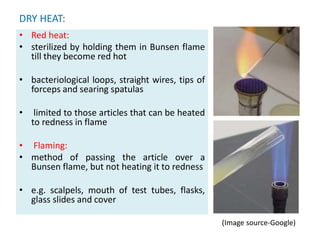
• Red heat:
• sterilized by holding them in Bunsen flame
till they become red hot
• bacteriological loops, straight wires, tips of
forceps and searing spatulas
• limited to those articles that can be heated
to redness in flame
• Flaming:
• method of passing the article over a
Bunsen flame, but not heating it to redness
• e.g. scalpels, mouth of test tubes, flasks,
glass slides and cover
• ..
(Image source-Google)
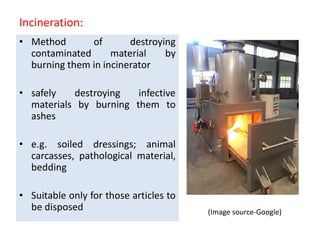
Incineration:
• Method of destroying
contaminated material by
burning them in incinerator
• safely destroying infective
materials by burning them to
ashes
• e.g. soiled dressings; animal
carcasses, pathological material,
bedding
• Suitable only for those articles to
be disposed (Image source-Google)
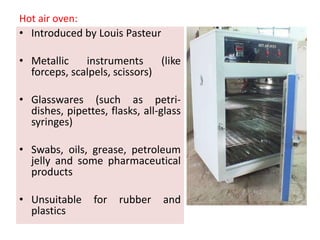
Hot air oven:
• Introduced by Louis Pasteur
• Metallic instruments (like
forceps, scalpels, scissors)
• Glasswares (such as petri-
dishes, pipettes, flasks, all-glass
syringes)
• Swabs, oils, grease, petroleum
jelly and some pharmaceutical
products
• Unsuitable for rubber and
plastics
..
• Exposed to high temperature in an electrically heated oven
• Air poor conductor of heat, even distribution of heat throughout
the chamber by a fan
• fitted with a thermostat control, temperature indicator, meshed
shelves or trays
• Oven not overloaded
• Materials perfectly dry and arranged to allows free circulation of air
inside the chamber
• Mouths of flasks, test tubes and both ends of pipettes must be
plugged with cotton
• Petri dishes and pipettes wrapped in a paper
..
• 1600C for two hours, 1700C for 1 hour and 1800C for 30
minutes
• Increasing temperature by 10 degrees shortens the sterilizing
time by 50 percent
• The hot air oven must not be opened until the temperature
inside has fallen below 60o C to prevent breakage of glassware
• To determine the efficacy of sterilization
- Thermocouples, chemical indicators, and bacteriological
spores of Bacillus subtilis as sterilization controls
Infra red rays:
• Sterilization by generation of heat
• Articles placed in a moving conveyer
belt and passed through a tunnel
that is heated by infrared radiators
to a temperature of 180o C
• The articles are exposed to that
temperature for a period of 7.5
minutes
• Articles sterilized: metallic
instruments and glassware
• Requires special equipment
• Efficiency can be checked using
Browne’s tube No.4 (blue spot)
Sterilization by moist heat
• In the form of
• hot water
• boiling water
• steam (vaporized water)
• In practice, the temperature of moist heat usually ranges from 60 to 135°C
• Adjustment of pressure in a closed container- regulate the temperature of
steam
• kills microorganisms by denaturation and coagulation of proteins
• Sterilization by moist heat:
• temperature <100°C
• temperature of 100°C
• temperature >100°C
At temperature below 100o C
• Pasteurization:
• originally employed by Louis Pasteur
• employed in food and dairy industry
• Two methods of pasteurization
• holder method (heated at 63o C for 30 minutes)
• flash method (heated at 72o C for 15 seconds)
followed by quickly cooling to 13o C
• Suitable to destroy most milk borne pathogens (Mycobacteria, Streptococci,
Staphylococci, Brucella etc.)
• Inactivates most viruses and destroys the vegetative stages of 97–99% of bacteria,
fungi, does not kill endospores or thermoduric species
• Efficacy tested by phosphatase test and methylene blue test
• Newer techniques: Ultra-High Temperature (UHT), 134°C for 1–2 second
Vaccine bath:
• The contaminating bacteria in a vaccine
preparation can be inactivated by heating in a
water bath at 60o C for one hr
• Only vegetative bacteria are killed and spores
survive
Serum bath:
• The contaminating bacteria in a serum
preparation can be inactivated by heating in a
water bath at 56o C for one hour on several
successive days
• Proteins in the serum will coagulate at higher
temperature
• Only vegetative bacteria are killed and spores
survive
Inspissation:
• Egg and serum containing media(Lowenstein- Jensen’s; Loeffler’s
serum)
• Inspissation means stiffening of protein without coagulation
• Placed in an inspissator and heated at 80-85o C for 30 minutes on
three successive days
• On the first day, the vegetative bacteria would die and those spores
that germinate by next day are then killed the following day
• The process depends on germination of spores in between
inspissation
At temperature 100o C
Boiling:
• Boiling water (100o C) for 10–30 minutes kills most vegetative bacteria and
viruses
• Certain bacterial toxins such as Staphylococcal enterotoxin heat resistant
• Some bacterial spores are resistant to boiling and survive
• Not a substitute for sterilization
• The killing activity can be enhanced by addition of 2% sodium bicarbonate
• Certain metal articles and glasswares disinfected by placing them in
boiling water for 10-20 minutes
• The lid of the boiler must not be opened during the period
• Syringes, forceps, scissors etc.
Steam at 100o C
• Subjected to free steam at 100o C
• Traditionally Arnold’s and Koch’s steamers were used
• A steamer is a metal cabinet with perforated trays to hold
the articles and a conical lid
• The bottom of steamer is filled with water and heated
• The steam generated sterilizes the articles when exposed
for a period of 90 minutes
• Media such as TCBS, DCA and Selenite broth are sterilized
by steaming
Tyndallisation:
• Heat labile media like those containing sugar, milk, gelatin
• Tyndallisation (after John Tyndall)/ fractional sterilization/
intermittent sterilization
• Steaming at 100°C is done in steam sterilizer for 20 minutes
followed by incubation at 37°C overnight
• Repeated for another 2 successive days
• The vegetative bacteria are killed in the first exposure and the
spores that germinate by next day are killed in subsequent days
• The success of process depends on the germination of spores
At temperature above 100o C:
• Sterilization by steam under pressure
• When a gas is compressed, its temperature rises in
direct relation to the amount of pressure
• 5 psi above normal atmospheric pressure- 109°C
• 10 psi above normal- 115°C
• 15 psi - 121°C
• Pressure–temperature combinations achieved with
special device “Autoclave”
• At 15 lb per sq. inch pressure, 121°C temperatures is
obtained, kept for 15 minutes for sterilization
Autoclave
(Image source-Google)
Autoclave
• Vertical or horizontal cylindrical body
• Articles sterilized: Culture media, dressings, certain
equipment, linen, rubber (gloves), heat-resistant plastics,
liquids etc.
• Ineffective for sterilizing substances that repel moisture
(oils, waxes, or powders)
• Kills all the vegetative as well as spore forms of bacteria
• Sterilization controls:
(a) Thermocouples
(b) Chemical indicators- Brown’s tube No.1 (black spot)
(c) Bacteriological spores- Bacillus stearothermophilus
RADIATION:
• Ionizing and non-ionizing
Non-ionizing rays
• low energy rays, poor penetrative power
• Rays of wavelength longer than visible light
• Microbicidal
• wavelength of UV rays: 200-280 nm, 260 nm most effective
• UV rays induce formation of thymine-thymine dimers, ultimately inhibits
DNA replication
• UV readily induces mutations in cells
• Don’t kill spores
Uses of UV radiation:
• Disinfection of closed areas in microbiology laboratory,
inoculation hoods, laminar flow, and operating theaters
• Harmful to skin and eyes
• Doesn't penetrate glass, paper or plastic
• Of use in surface disinfection
• Generated using a high-pressure mercury vapor lamp
Ionizing rays
• High-energy rays, good penetrative power
• Radiation does not generate heat- "cold sterilization“
• e.g. (a) X-rays, (b) gamma rays, and (c) cosmic rays
• Gamma radiation from cobalt-60 source-
sterilization of antibiotics, hormones, vitamins, sutures, catheters,
animal feeds, metal foils, and plastic disposables, such as syringes,
petri dishes
• A dosage of 2.5 megarads kills all bacteria, fungi, viruses and spores
• Also used for meat and other food items
• Damage the nucleic acid of the microorganism
FILTRATION:
• Does not kill microbes, it separates them out
• Membrane filters with pore sizes between 0.2-0.45 μm
• used to remove microbes from heat labile liquids such as serum,
antibiotic solutions, sugar solutions, urea solution
• For removing bacteria from ingredients of culture media,
preparing suspensions of viruses and phages
• Aided by using either positive or negative pressure using vacuum
pumps
• Older filters made of earthenware or asbestos- depth filters
Types of filters
1. Earthenware filters:
• Made up of diatomaceous earth or
porcelain
• usually baked into the shape of candle
a. Pasteur-Chamberland filter:
• Candle filters from France, of
porcelain
• Various porosities, graded as L1, L1a,
L2, L3, L5, L7, L9 and L11
• Similar filter from Britain is Doulton;
P2, P5 and P11
• ..
(Image source: https://www.nlm.nih.gov)
..
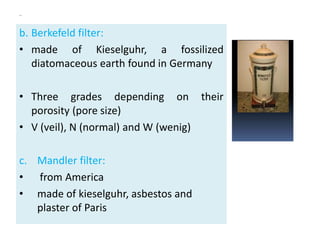
b. Berkefeld filter:
• made of Kieselguhr, a fossilized
diatomaceous earth found in Germany
• Three grades depending on their
porosity (pore size)
• V (veil), N (normal) and W (wenig)
c. Mandler filter:
• from America
• made of kieselguhr, asbestos and
plaster of Paris
Asbestos filters:
• Made up of asbestos such as magnesium silicate
• Examples- Seitz and Sterimat filters
• Disposable, single-use discs in different grades
• Tend to alkalinize the filtered fluid
• Use limited, carcinogenic potential of asbestos
Sintered glass filters:
• Made up of finely powdered glass particles,
which are fused together
• Available in different pore sizes
Membrane filters:
• made up of
• (a) Cellulose acetate
• (b) Cellulose nitrate,
• (c) Polycarbonate
• (d)Polyvinylidene fluoride,
• (e) Other synthetic materials
• Widely used, circular porous membranes, usually 0.1 mm
thick
• Variety of pore sizes (0.015–12 μm)
• Membranes with pores about 0.2 μm are used, smaller
than the size of bacteria
Uses of membrane filters
• Sterilize pharmaceutical
substances, ophthalmic
solutions, liquid culture
media, oils, antibiotics,
and other heat-sensitive
solutions
• To obtain bacterial free
filtrates of clinical
specimens for virus
isolation
• To separate toxins and
bacteriophages from
bacteria
Chemical Methods of Sterilization
• Several chemical agents- antiseptics/ disinfectants
Properties of Ideal Disinfectant
• Wide spectrum of antimicrobial activity
• Should act in the presence of organic matter
• Non-toxic, non-corrosive
• Stable upon storage, no chemical change
• Odorless or with a pleasant odor
• Soluble in water, lipids for penetration into microorganisms
• Effective in acidic as well as in alkaline media
• Speedy action, relatively inexpensive
Action of Disinfectants
• Damage to the cell wall and alter permeability of the cell membrane, resulting in
exposure, damage, or loss of the cellular contents
• Alter proteins and form protein salts or cause coagulation of proteins
• Inhibit enzyme action, nucleic acid synthesis or alter nucleic acid molecules
• Cause oxidation or hydrolysis
Factors Influencing Activity of Disinfectants
• Temperature: Increase in temp. increases the efficiency of disinfectants
• Type of microorganism: Vegetative cells more susceptible than spores. Spores may
be resistant
• Physiological state of cell: Young and metabolically active cells more sensitive
• Environment: Physical or chemical properties of medium or substance
e.g., pH of the medium and presence of extraneous materials
Types of Disinfectants
• (a) phenolic compounds
• (b) halogens
• (c) alcohols
• (d) aldehydes
• (e) gases
• (f) surface active agents
• (g) oxidizing agents
• (h) dyes
• (i) heavy metals
• (j) acids and alkalis
ALCOHOLS:
Mode of action:
• Alcohols dehydrate cells, disrupt membranes and cause coagulation of
protein
Examples:
Ethyl alcohol, isopropyl alcohol and methyl alcohol
Application:
• 70% ethyl alcohol (spirit) is used as antiseptic on skin
• Isopropyl alcohol is preferred to ethanol
• Also used to disinfect surfaces
• Used to disinfect clinical thermometers
• Methyl alcohol kills fungal spores, hence is useful in disinfecting
inoculation hoods
Disadvantages:
• Skin irritant, volatile (evaporates rapidly), inflammable
ALDEHYDES:
Mode of action:
Acts through alkylation of amino-, carboxyl- or hydroxyl group, damages nucleic acids.
It kills all microorganisms, including spores
Examples:
Formaldehyde, Glutaraldehyde
Application:
• Bactericidal, sporicidal, and also effective against viruses
• Can also be used as chemical sterilants
40% Formaldehyde (formalin): for surface disinfection and fumigation
• 10% formalin with 0.5% tetraborate sterilizes clean metal instruments
2% glutaraldehyde
• To disinfect hospital and laboratory equipments
• An exposure of at least 3 hours at alkaline pH is required for action by
glutaraldehyde
• Especially effective against tubercle bacilli, fungi, and viruses
PHENOL:
• Mode of action:
• Act by disruption of membranes, precipitation of proteins and inactivation
of enzymes
• Examples:
• 5% phenol, 1-5% Cresol, 5% Lysol, hexachlorophene, chlorhexidine,
chloroxylenol
• Applications:
• As disinfectants at high concentration and as antiseptics at low
concentrations
• Bactericidal, fungicidal, but are inactive against spores and most viruses
• Effective in the presence of organic material and remain active on surfaces
long after application
HALOGENS:
• Mode of action:
• Oxidizing agents and cause damage by oxidation of
essential sulfydryl groups of enzymes
• Chlorine reacts with water to form hypochlorous acid,
microbicidal
• Examples:
• Chlorine compounds (chlorine, bleach, hypochlorite) and
iodine compounds (tincture iodine, iodophores)
• Application:
• Effective disinfectants and antiseptics
• Microbicidal
• Also sporicidal with longer exposure
HEAVY METALS:
• Mode of action:
• Act by precipitation of proteins and oxidation of sulfydryl groups
• They are bacteriostatic
• Examples:
• Mercuric chloride, silver nitrate, copper sulfate, organic mercury
salts (e.g., mercurochrome, merthiolate)
• Applications:
• Silver compounds as antiseptics
• Silver sulfadiazine for burns
• Silver nitrate in eye infection
• Merthiolate in 1:10000 -preservation of serum
• Copper salts as a fungicide
SURFACE ACTIVE AGENTS:
• Mode of actions:
• Disrupt membrane resulting in leakage of cell constituents
• Examples:
• Soaps or detergents, anionic or cationic
• Anionic detergents- soaps and bile salts
• Cationic detergents are known as quaternary ammonium
compounds (or quat)
• Cetrimide and benzalkonium chloride act as cationic detergents
• Application:
• active against vegetative cells, Mycobacteria and enveloped viruses
• As disinfectants at dilution of 1-2% for domestic use and in hospitals
DYES:
• Acridine dyes, Aniline dyes
• Act by interfering with the synthesis of nucleic acids and proteins in
bacterial cells
• Acridine dyes such as acriflavin and aminacrine
• More effective against gram positive bacteria than gram negative bacteria
and are more bacteriostatic in action
• Aniline dyes (such as gentian violent, crystal violet, and malachite green)
• Also more active against Gram-positive bacteria than against Gram-
negative organisms
• Applications:
• Topically as antiseptics, on skin treat bacterial skin infections
• The dyes are used as selective agents in certain selective media
HYDROGEN PEROXIDE:
• Mode of action:
• Release of nascent oxygen, that damages proteins and DNA of microorganisms
• Application:
• 6% concentration to decontaminate the instruments, equipments such as
ventilators
• 3% for skin disinfection and deodorising wounds and ulcers
• Strong solutions are sporicidal
BETA-PROPIOLACTONE (BPL):
Mode of action:
• Acts through alkylation of carboxyl- and hydroxyl- groups
Application:
• Effective sporicidal agent, broad-spectrum activity, 0.2% to sterilize
biological products
• Carcinogen
ETHYLENE OXIDE (EO):
• Mode of action:
• by alkylating sulfydryl-, amino-, carboxyl- and hydroxyl- groups
• Application:
• Effective chemisterilant, capable of killing spores rapidly
• Highly flammable, used as 10% CO2+ 90% EO) or
dichlorodifluoromethane
• Used to sterilize heat labile articles such as bedding, textiles,
rubber, plastics, syringes, disposable petri dishes, respiratory and
dental equipments
• Highly toxic, irritating to eyes, skin, highly flammable, mutagenic
and carcinogenic

Methods_of_Sterilization_and_Disinfection-1_230910_154305.pdf

  • 1.
    Methods of Sterilizationand Disinfection Veterinary Microbiology (Unit-1) Dr. Savita Kumari Department of Veterinary Microbiology Bihar Veterinary College, BASU, Patna
  • 2.
    Terms: • Sterilization: Article,surface, or medium is freed of all living microorganisms either in the vegetative or in the spore state • Used only in absolute sense • Disinfection: Destruction of microorganisms, especially potential pathogens, on the surfaces of inanimate objects or in the environment • Reduce the microbial population, not bacterial endospores on inanimate surfaces or in organic materials • Antisepsis: Destruction or inhibition of microorganisms on living tissues by chemicals (non-toxic and non-irritating) • Chemical agents- Antiseptics
  • 3.
    .. • Germicide/microbicide: chemicalagent that kills pathogenic microorganisms • Sepsis: growth of microorganisms in the body or the presence of microbial toxins in blood and other tissues • Asepsis: Practice to prevent entry of infectious agents into sterile tissues and thus prevents infection • Sanitization: Cleansing technique that mechanically removes microorganisms to reduce the level of contaminants • Sanitizer- compound (e.g., soap or detergent)
  • 4.
    Uses of Sterilization •1. Sterilization for Surgical Procedures and medicines: Gloves, aprons, surgical instruments, syringes, drugs and other supplies etc. 2. Sterilization in Microbiological works: Preparation of culture media, reagents and equipments
  • 5.
    METHODS Sterilization and disinfectionare done by : (A). Physical methods (B). Chemical methods (a) Heat: (i) Dry heat (ii) Moist heat (b) Radiation: (i) Non-ionising radiation (Ultraviolet radiation) (ii) Ionising radiation (X-ray, gamma ray) (c) Filtration (Berkfeld, Chamber land, Seitz, sintered glass, cellulose membrane filters etc)
  • 6.
    Heat • Mostly usedmethod • Highly effective and most reliable process • Two major methods: • Dry heat and moist heat • Dry heat induces: • Denaturation of protein, oxidative damage and toxic effect due to the high level of electrolytes • Also damage the DNA of the microorganism • As a result, the microorganism got killed
  • 7.
    .. • Moist Heat: killsthe microorganisms by denaturation and coagulation of proteins • Temperature required to kill microbe by dry heat more than moist heat • Thermal death time- Minimum time required to kill a suspension of organisms at a predetermined temperature in a specified environment
  • 8.
    Factors affecting sterilizationby heat • Nature of heat: Moist heat is more effective • Temperature and time: inversely proportional • Number of microorganisms: More number- higher temperature or longer duration • Nature of microorganism: Species and strain, Spores highly resistant • Type of material: heavily contaminated, higher temperature/prolonged exposure • Certain heat sensitive articles sterilized at lower temperature • Presence of organic material: Organic materials (protein, sugars, oils and fats) increase the time required
  • 9.
    DRY HEAT: • Redheat: • sterilized by holding them in Bunsen flame till they become red hot • bacteriological loops, straight wires, tips of forceps and searing spatulas • limited to those articles that can be heated to redness in flame • Flaming: • method of passing the article over a Bunsen flame, but not heating it to redness • e.g. scalpels, mouth of test tubes, flasks, glass slides and cover • .. (Image source-Google)
  • 10.
    Incineration: • Method ofdestroying contaminated material by burning them in incinerator • safely destroying infective materials by burning them to ashes • e.g. soiled dressings; animal carcasses, pathological material, bedding • Suitable only for those articles to be disposed (Image source-Google)
  • 11.
    Hot air oven: •Introduced by Louis Pasteur • Metallic instruments (like forceps, scalpels, scissors) • Glasswares (such as petri- dishes, pipettes, flasks, all-glass syringes) • Swabs, oils, grease, petroleum jelly and some pharmaceutical products • Unsuitable for rubber and plastics
  • 12.
    .. • Exposed tohigh temperature in an electrically heated oven • Air poor conductor of heat, even distribution of heat throughout the chamber by a fan • fitted with a thermostat control, temperature indicator, meshed shelves or trays • Oven not overloaded • Materials perfectly dry and arranged to allows free circulation of air inside the chamber • Mouths of flasks, test tubes and both ends of pipettes must be plugged with cotton • Petri dishes and pipettes wrapped in a paper
  • 13.
    .. • 1600C fortwo hours, 1700C for 1 hour and 1800C for 30 minutes • Increasing temperature by 10 degrees shortens the sterilizing time by 50 percent • The hot air oven must not be opened until the temperature inside has fallen below 60o C to prevent breakage of glassware • To determine the efficacy of sterilization - Thermocouples, chemical indicators, and bacteriological spores of Bacillus subtilis as sterilization controls
  • 14.
    Infra red rays: •Sterilization by generation of heat • Articles placed in a moving conveyer belt and passed through a tunnel that is heated by infrared radiators to a temperature of 180o C • The articles are exposed to that temperature for a period of 7.5 minutes • Articles sterilized: metallic instruments and glassware • Requires special equipment • Efficiency can be checked using Browne’s tube No.4 (blue spot)
  • 15.
    Sterilization by moistheat • In the form of • hot water • boiling water • steam (vaporized water) • In practice, the temperature of moist heat usually ranges from 60 to 135°C • Adjustment of pressure in a closed container- regulate the temperature of steam • kills microorganisms by denaturation and coagulation of proteins • Sterilization by moist heat: • temperature <100°C • temperature of 100°C • temperature >100°C
  • 16.
    At temperature below100o C • Pasteurization: • originally employed by Louis Pasteur • employed in food and dairy industry • Two methods of pasteurization • holder method (heated at 63o C for 30 minutes) • flash method (heated at 72o C for 15 seconds) followed by quickly cooling to 13o C • Suitable to destroy most milk borne pathogens (Mycobacteria, Streptococci, Staphylococci, Brucella etc.) • Inactivates most viruses and destroys the vegetative stages of 97–99% of bacteria, fungi, does not kill endospores or thermoduric species • Efficacy tested by phosphatase test and methylene blue test • Newer techniques: Ultra-High Temperature (UHT), 134°C for 1–2 second
  • 17.
    Vaccine bath: • Thecontaminating bacteria in a vaccine preparation can be inactivated by heating in a water bath at 60o C for one hr • Only vegetative bacteria are killed and spores survive Serum bath: • The contaminating bacteria in a serum preparation can be inactivated by heating in a water bath at 56o C for one hour on several successive days • Proteins in the serum will coagulate at higher temperature • Only vegetative bacteria are killed and spores survive
  • 18.
    Inspissation: • Egg andserum containing media(Lowenstein- Jensen’s; Loeffler’s serum) • Inspissation means stiffening of protein without coagulation • Placed in an inspissator and heated at 80-85o C for 30 minutes on three successive days • On the first day, the vegetative bacteria would die and those spores that germinate by next day are then killed the following day • The process depends on germination of spores in between inspissation
  • 19.
    At temperature 100oC Boiling: • Boiling water (100o C) for 10–30 minutes kills most vegetative bacteria and viruses • Certain bacterial toxins such as Staphylococcal enterotoxin heat resistant • Some bacterial spores are resistant to boiling and survive • Not a substitute for sterilization • The killing activity can be enhanced by addition of 2% sodium bicarbonate • Certain metal articles and glasswares disinfected by placing them in boiling water for 10-20 minutes • The lid of the boiler must not be opened during the period • Syringes, forceps, scissors etc.
  • 20.
    Steam at 100oC • Subjected to free steam at 100o C • Traditionally Arnold’s and Koch’s steamers were used • A steamer is a metal cabinet with perforated trays to hold the articles and a conical lid • The bottom of steamer is filled with water and heated • The steam generated sterilizes the articles when exposed for a period of 90 minutes • Media such as TCBS, DCA and Selenite broth are sterilized by steaming
  • 21.
    Tyndallisation: • Heat labilemedia like those containing sugar, milk, gelatin • Tyndallisation (after John Tyndall)/ fractional sterilization/ intermittent sterilization • Steaming at 100°C is done in steam sterilizer for 20 minutes followed by incubation at 37°C overnight • Repeated for another 2 successive days • The vegetative bacteria are killed in the first exposure and the spores that germinate by next day are killed in subsequent days • The success of process depends on the germination of spores
  • 22.
    At temperature above100o C: • Sterilization by steam under pressure • When a gas is compressed, its temperature rises in direct relation to the amount of pressure • 5 psi above normal atmospheric pressure- 109°C • 10 psi above normal- 115°C • 15 psi - 121°C • Pressure–temperature combinations achieved with special device “Autoclave” • At 15 lb per sq. inch pressure, 121°C temperatures is obtained, kept for 15 minutes for sterilization
  • 23.
  • 24.
    Autoclave • Vertical orhorizontal cylindrical body • Articles sterilized: Culture media, dressings, certain equipment, linen, rubber (gloves), heat-resistant plastics, liquids etc. • Ineffective for sterilizing substances that repel moisture (oils, waxes, or powders) • Kills all the vegetative as well as spore forms of bacteria • Sterilization controls: (a) Thermocouples (b) Chemical indicators- Brown’s tube No.1 (black spot) (c) Bacteriological spores- Bacillus stearothermophilus
  • 25.
    RADIATION: • Ionizing andnon-ionizing Non-ionizing rays • low energy rays, poor penetrative power • Rays of wavelength longer than visible light • Microbicidal • wavelength of UV rays: 200-280 nm, 260 nm most effective • UV rays induce formation of thymine-thymine dimers, ultimately inhibits DNA replication • UV readily induces mutations in cells • Don’t kill spores
  • 26.
    Uses of UVradiation: • Disinfection of closed areas in microbiology laboratory, inoculation hoods, laminar flow, and operating theaters • Harmful to skin and eyes • Doesn't penetrate glass, paper or plastic • Of use in surface disinfection • Generated using a high-pressure mercury vapor lamp
  • 27.
    Ionizing rays • High-energyrays, good penetrative power • Radiation does not generate heat- "cold sterilization“ • e.g. (a) X-rays, (b) gamma rays, and (c) cosmic rays • Gamma radiation from cobalt-60 source- sterilization of antibiotics, hormones, vitamins, sutures, catheters, animal feeds, metal foils, and plastic disposables, such as syringes, petri dishes • A dosage of 2.5 megarads kills all bacteria, fungi, viruses and spores • Also used for meat and other food items • Damage the nucleic acid of the microorganism
  • 28.
    FILTRATION: • Does notkill microbes, it separates them out • Membrane filters with pore sizes between 0.2-0.45 μm • used to remove microbes from heat labile liquids such as serum, antibiotic solutions, sugar solutions, urea solution • For removing bacteria from ingredients of culture media, preparing suspensions of viruses and phages • Aided by using either positive or negative pressure using vacuum pumps • Older filters made of earthenware or asbestos- depth filters
  • 29.
    Types of filters 1.Earthenware filters: • Made up of diatomaceous earth or porcelain • usually baked into the shape of candle a. Pasteur-Chamberland filter: • Candle filters from France, of porcelain • Various porosities, graded as L1, L1a, L2, L3, L5, L7, L9 and L11 • Similar filter from Britain is Doulton; P2, P5 and P11 • .. (Image source: https://www.nlm.nih.gov)
  • 30.
    .. b. Berkefeld filter: •made of Kieselguhr, a fossilized diatomaceous earth found in Germany • Three grades depending on their porosity (pore size) • V (veil), N (normal) and W (wenig) c. Mandler filter: • from America • made of kieselguhr, asbestos and plaster of Paris
  • 31.
    Asbestos filters: • Madeup of asbestos such as magnesium silicate • Examples- Seitz and Sterimat filters • Disposable, single-use discs in different grades • Tend to alkalinize the filtered fluid • Use limited, carcinogenic potential of asbestos Sintered glass filters: • Made up of finely powdered glass particles, which are fused together • Available in different pore sizes
  • 32.
    Membrane filters: • madeup of • (a) Cellulose acetate • (b) Cellulose nitrate, • (c) Polycarbonate • (d)Polyvinylidene fluoride, • (e) Other synthetic materials • Widely used, circular porous membranes, usually 0.1 mm thick • Variety of pore sizes (0.015–12 μm) • Membranes with pores about 0.2 μm are used, smaller than the size of bacteria
  • 33.
    Uses of membranefilters • Sterilize pharmaceutical substances, ophthalmic solutions, liquid culture media, oils, antibiotics, and other heat-sensitive solutions • To obtain bacterial free filtrates of clinical specimens for virus isolation • To separate toxins and bacteriophages from bacteria
  • 34.
    Chemical Methods ofSterilization • Several chemical agents- antiseptics/ disinfectants Properties of Ideal Disinfectant • Wide spectrum of antimicrobial activity • Should act in the presence of organic matter • Non-toxic, non-corrosive • Stable upon storage, no chemical change • Odorless or with a pleasant odor • Soluble in water, lipids for penetration into microorganisms • Effective in acidic as well as in alkaline media • Speedy action, relatively inexpensive
  • 35.
    Action of Disinfectants •Damage to the cell wall and alter permeability of the cell membrane, resulting in exposure, damage, or loss of the cellular contents • Alter proteins and form protein salts or cause coagulation of proteins • Inhibit enzyme action, nucleic acid synthesis or alter nucleic acid molecules • Cause oxidation or hydrolysis Factors Influencing Activity of Disinfectants • Temperature: Increase in temp. increases the efficiency of disinfectants • Type of microorganism: Vegetative cells more susceptible than spores. Spores may be resistant • Physiological state of cell: Young and metabolically active cells more sensitive • Environment: Physical or chemical properties of medium or substance e.g., pH of the medium and presence of extraneous materials
  • 36.
    Types of Disinfectants •(a) phenolic compounds • (b) halogens • (c) alcohols • (d) aldehydes • (e) gases • (f) surface active agents • (g) oxidizing agents • (h) dyes • (i) heavy metals • (j) acids and alkalis
  • 37.
    ALCOHOLS: Mode of action: •Alcohols dehydrate cells, disrupt membranes and cause coagulation of protein Examples: Ethyl alcohol, isopropyl alcohol and methyl alcohol Application: • 70% ethyl alcohol (spirit) is used as antiseptic on skin • Isopropyl alcohol is preferred to ethanol • Also used to disinfect surfaces • Used to disinfect clinical thermometers • Methyl alcohol kills fungal spores, hence is useful in disinfecting inoculation hoods Disadvantages: • Skin irritant, volatile (evaporates rapidly), inflammable
  • 38.
    ALDEHYDES: Mode of action: Actsthrough alkylation of amino-, carboxyl- or hydroxyl group, damages nucleic acids. It kills all microorganisms, including spores Examples: Formaldehyde, Glutaraldehyde Application: • Bactericidal, sporicidal, and also effective against viruses • Can also be used as chemical sterilants 40% Formaldehyde (formalin): for surface disinfection and fumigation • 10% formalin with 0.5% tetraborate sterilizes clean metal instruments 2% glutaraldehyde • To disinfect hospital and laboratory equipments • An exposure of at least 3 hours at alkaline pH is required for action by glutaraldehyde • Especially effective against tubercle bacilli, fungi, and viruses
  • 39.
    PHENOL: • Mode ofaction: • Act by disruption of membranes, precipitation of proteins and inactivation of enzymes • Examples: • 5% phenol, 1-5% Cresol, 5% Lysol, hexachlorophene, chlorhexidine, chloroxylenol • Applications: • As disinfectants at high concentration and as antiseptics at low concentrations • Bactericidal, fungicidal, but are inactive against spores and most viruses • Effective in the presence of organic material and remain active on surfaces long after application
  • 40.
    HALOGENS: • Mode ofaction: • Oxidizing agents and cause damage by oxidation of essential sulfydryl groups of enzymes • Chlorine reacts with water to form hypochlorous acid, microbicidal • Examples: • Chlorine compounds (chlorine, bleach, hypochlorite) and iodine compounds (tincture iodine, iodophores) • Application: • Effective disinfectants and antiseptics • Microbicidal • Also sporicidal with longer exposure
  • 41.
    HEAVY METALS: • Modeof action: • Act by precipitation of proteins and oxidation of sulfydryl groups • They are bacteriostatic • Examples: • Mercuric chloride, silver nitrate, copper sulfate, organic mercury salts (e.g., mercurochrome, merthiolate) • Applications: • Silver compounds as antiseptics • Silver sulfadiazine for burns • Silver nitrate in eye infection • Merthiolate in 1:10000 -preservation of serum • Copper salts as a fungicide
  • 42.
    SURFACE ACTIVE AGENTS: •Mode of actions: • Disrupt membrane resulting in leakage of cell constituents • Examples: • Soaps or detergents, anionic or cationic • Anionic detergents- soaps and bile salts • Cationic detergents are known as quaternary ammonium compounds (or quat) • Cetrimide and benzalkonium chloride act as cationic detergents • Application: • active against vegetative cells, Mycobacteria and enveloped viruses • As disinfectants at dilution of 1-2% for domestic use and in hospitals
  • 43.
    DYES: • Acridine dyes,Aniline dyes • Act by interfering with the synthesis of nucleic acids and proteins in bacterial cells • Acridine dyes such as acriflavin and aminacrine • More effective against gram positive bacteria than gram negative bacteria and are more bacteriostatic in action • Aniline dyes (such as gentian violent, crystal violet, and malachite green) • Also more active against Gram-positive bacteria than against Gram- negative organisms • Applications: • Topically as antiseptics, on skin treat bacterial skin infections • The dyes are used as selective agents in certain selective media
  • 44.
    HYDROGEN PEROXIDE: • Modeof action: • Release of nascent oxygen, that damages proteins and DNA of microorganisms • Application: • 6% concentration to decontaminate the instruments, equipments such as ventilators • 3% for skin disinfection and deodorising wounds and ulcers • Strong solutions are sporicidal BETA-PROPIOLACTONE (BPL): Mode of action: • Acts through alkylation of carboxyl- and hydroxyl- groups Application: • Effective sporicidal agent, broad-spectrum activity, 0.2% to sterilize biological products • Carcinogen
  • 45.
    ETHYLENE OXIDE (EO): •Mode of action: • by alkylating sulfydryl-, amino-, carboxyl- and hydroxyl- groups • Application: • Effective chemisterilant, capable of killing spores rapidly • Highly flammable, used as 10% CO2+ 90% EO) or dichlorodifluoromethane • Used to sterilize heat labile articles such as bedding, textiles, rubber, plastics, syringes, disposable petri dishes, respiratory and dental equipments • Highly toxic, irritating to eyes, skin, highly flammable, mutagenic and carcinogenic