Stereochemistry in Main Group
Compounds.
Dr.S. H. Burungale
VSEPR THEORY
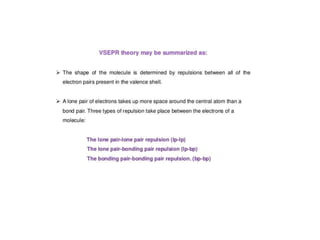
This theory was given by Gillespie and Nyholm. According to
this theory the geometry of a molecule depends upon the
number of bonding and non-bonding electron pairs in the central
atom. These arrange themselves in such a way that there is a
minimum repulsion between them so that the molecule has
minimum energy (i.e. maximum stability).
The following rules have been reported by Gillespie to explain the shape of some
covalent molecules:
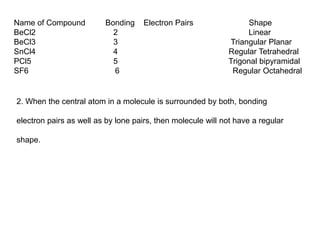
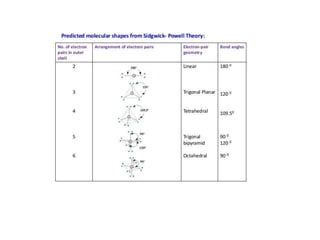
1. If the central atom of a molecule is surrounded only by bonding
electron pairs and not by non-bonding electron pairs (lone pairs),
the geometry of the molecule will be regular. In other words we
can say that the shape of covalent molecule will be linear for 2
bonding electron pairs, triangular for 3 bonding electron pairs.
tetrahedral for 4 bonding electron pairs, trigonal bipyramidal for 5
bonding electron pairs:
Name of Compound Bonding Electron Pairs Shape
BeCl2 2 Linear
BeCl3 3 Triangular Planar
SnCl4 4 Regular Tetrahedral
PCl5 5 Trigonal bipyramidal
SF6 6 Regular Octahedral
2. When the central atom in a molecule is surrounded by both, bonding
electron pairs as well as by lone pairs, then molecule will not have a regular
shape.
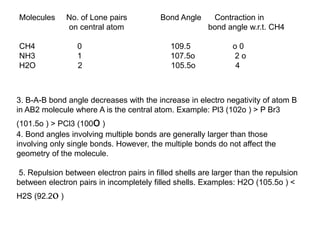
Molecules No. of Lone pairs Bond Angle Contraction in
on central atom bond angle w.r.t. CH4
CH4 0 109.5 o 0
NH3 1 107.5o 2 o
H2O 2 105.5o 4
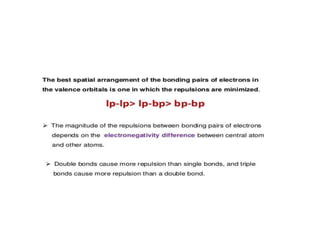
3. B-A-B bond angle decreases with the increase in electro negativity of atom B
in AB2 molecule where A is the central atom. Example: Pl3 (102o ) > P Br3
(101.5o ) > PCl3 (100o )
4. Bond angles involving multiple bonds are generally larger than those
involving only single bonds. However, the multiple bonds do not affect the
geometry of the molecule.
5. Repulsion between electron pairs in filled shells are larger than the repulsion
between electron pairs in incompletely filled shells. Examples: H2O (105.5o ) <
H2S (92.2o )
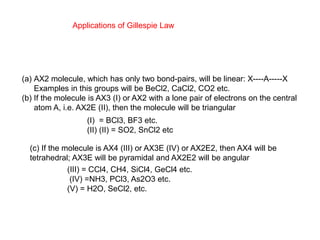
Applications of Gillespie Law
(a) AX2 molecule, which has only two bond-pairs, will be linear: X----A-----X
Examples in this groups will be BeCl2, CaCl2, CO2 etc.
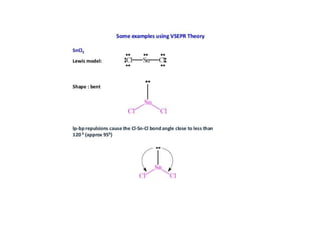
(b) If the molecule is AX3 (I) or AX2 with a lone pair of electrons on the central
atom A, i.e. AX2E (II), then the molecule will be triangular
(I) = BCl3, BF3 etc.
(II) (II) = SO2, SnCl2 etc
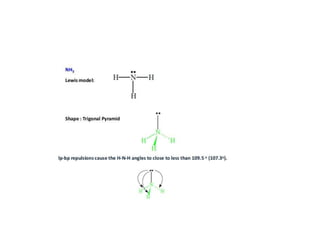
(c) If the molecule is AX4 (III) or AX3E (IV) or AX2E2, then AX4 will be
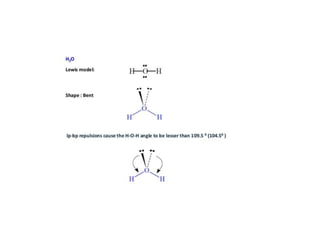
tetrahedral; AX3E will be pyramidal and AX2E2 will be angular
(III) = CCl4, CH4, SiCl4, GeCl4 etc.
(IV) =NH3, PCl3, As2O3 etc.
(V) = H2O, SeCl2, etc.
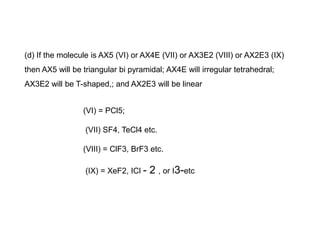
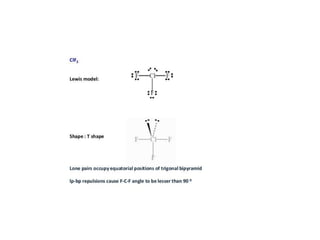
(d) If the molecule is AX5 (VI) or AX4E (VII) or AX3E2 (VIII) or AX2E3 (IX)
then AX5 will be triangular bi pyramidal; AX4E will irregular tetrahedral;
AX3E2 will be T-shaped,; and AX2E3 will be linear
(VI) = PCl5;
(VII) SF4, TeCl4 etc.
(VIII) = ClF3, BrF3 etc.
(IX) = XeF2, ICl - 2 , or I3-etc
(e) If the molecule is AX6 (X) or AX5E (XI) or
AX4E2 (XII) then AX6 will be octahedral, AX5E
will be square pyramidal; and AX4E2 will be
square planar. (
(X) = SF6, WF6, etc. (XI) = BrF5, IF5 etc.
(XII) = ICl4 - , XeF 2 etc.
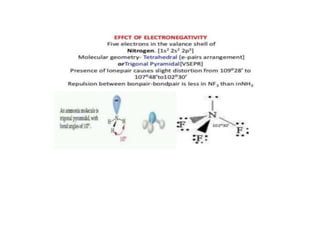
Comparison of CH4, NH3, H2O and H3O
In all these molecules, the central atom (C, N and O respectively) is sp 3
hybridised. But they differ in the number of lone pair (s) present on the
central atom,
zero in CH4,
one in NH3 and
two in case of H2O.
Thus the repulsive force between electron
pairs gradually increases in these
molecules from CH4 to H2O, resulting in
the change of geometry and the bond
angles
A- CH4, Tetrahedral, bond angle 109.5o
B- NH4, Pyramidal, bond angle ~107o
C- H2O, Angular, bond angle ~105o
D- H3O + , Pyramidal, bond angle ~107
Comparison of PF5, SF4, ClF3 and [ICl2 - ]
a) PF5, Trigonal bipyamidal
b) (b) SF4, Irregular tetrahedral
c) (c) ClF3, T-Shaped
d) (d) [ICl2] - , Linear
Limitations of VSEPR Theory
1. This theory is not able to predict the shapes of certain transition element
complexes.
2. This theory is unable to explain the shapes of certain molecules with an inert
pair of electrons.
3. This theory is unable to explain the shapes of molecules having extensive
delocalised -electron system.
4. This theory can not explain the shapes of molecules which have highly polar
bonds.
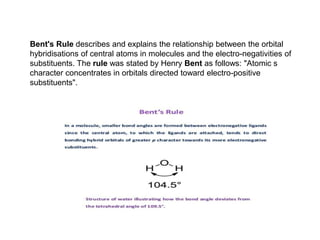
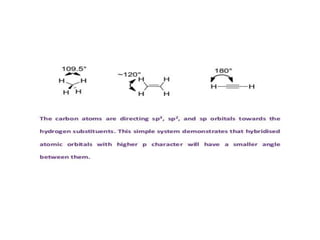
Bent's Rule describes and explains the relationship between the orbital
hybridisations of central atoms in molecules and the electro-negativities of
substituents. The rule was stated by Henry Bent as follows: "Atomic s
character concentrates in orbitals directed toward electro-positive
substituents".
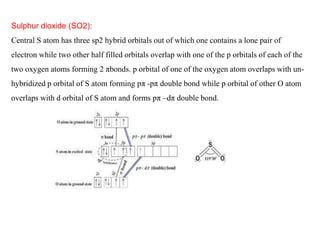
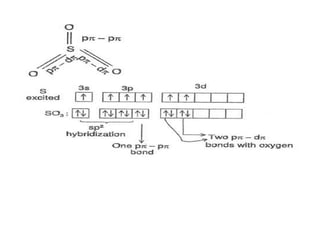
Sulphur dioxide (SO2):
Central S atom has three sp2 hybrid orbitals out of which one contains a lone pair of
electron while two other half filled orbitals overlap with one of the p orbitals of each of the
two oxygen atoms forming 2 πbonds. p orbital of one of the oxygen atom overlaps with un-
hybridized p orbital of S atom forming pπ -pπ double bond while p orbital of other O atom
overlaps with d orbital of S atom and forms pπ –dπ double bond.
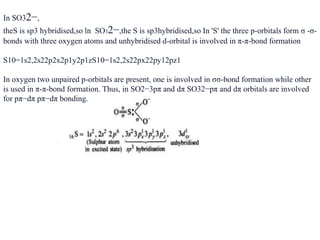
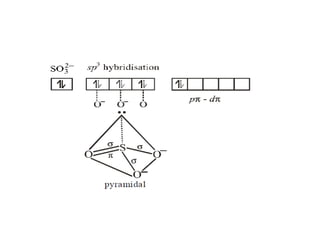
In SO32−,
theS is sp3 hybridised,so ln SO32−,the S is sp3hybridised,so In 'S' the three p-orbitals form σ -σ-
bonds with three oxygen atoms and unhybridised d-orbital is involved in π-π-bond formation
S10=1s2,2s22p2x2p1y2p1zS10=1s2,2s22px22py12pz1
In oxygen two unpaired p-orbitals are present, one is involved in σσ-bond formation while other
is used in π-π-bond formation. Thus, in SO2−3pπ and dπ SO32−pπ and dπ orbitals are involved
for pπ−dπ pπ−dπ bonding.
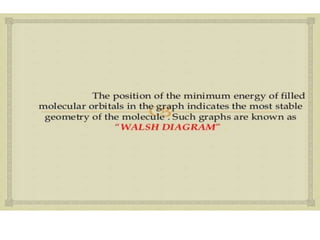
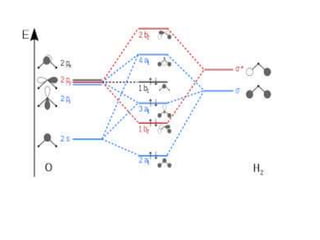
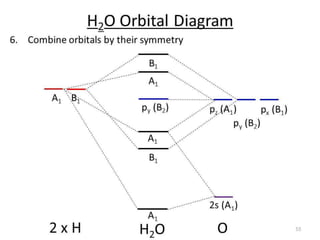
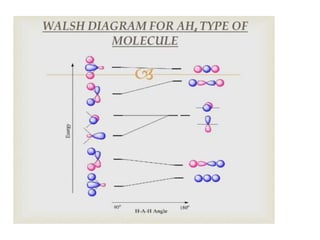
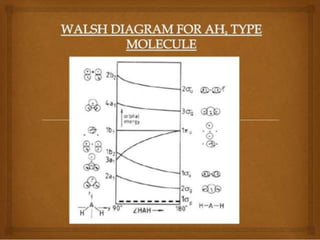
Walsh diagrams propose a simple pictoral
approach to determine the geometry of a
molecule considering and calculating the energies
of molecular orbitals of the molecule. The
molecule will have that geometry in which the
energies of the molecular orbitals used are
minimum. Using this concept we can understand
why H2O is angular and BeH2 is linear; or why
CH4 is tetrahedral and SF4 is distorted
tetrahedral.
SOME SIMPLE REACTIONS OF
COVALENTLY BONDED MOLECULES
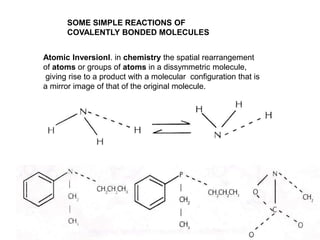
Atomic InversionI. in chemistry the spatial rearrangement
of atoms or groups of atoms in a dissymmetric molecule,
giving rise to a product with a molecular configuration that is
a mirror image of that of the original molecule.
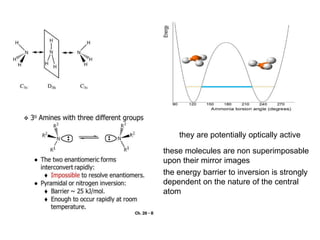
they are potentially optically active
these molecules are non superimposable
upon their mirror images
the energy barrier to inversion is strongly
dependent on the nature of the central
atom
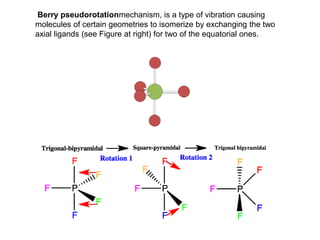
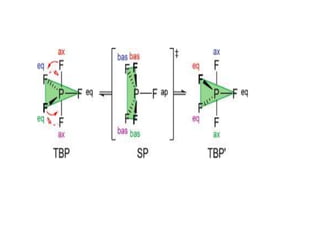
Berry pseudorotationmechanism, is a type of vibration causing
molecules of certain geometries to isomerize by exchanging the two
axial ligands (see Figure at right) for two of the equatorial ones.
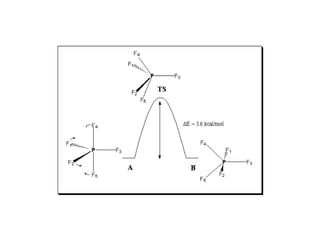
The process of pseudorotation occurs when the two axial ligands
close like a pair of scissors pushing their way in between two of the
equatorial groups which scissor out to accommodate them. Both the
axial and equatorial constituents move at the same rate of increasing
the angle between the other axial or equatorial constituent. This
forms a square based pyramid where the base is the four
interchanging ligands and the tip is the pivot ligand, which has not
moved. The two originally equatorial ligands then open out until
they are 180 degrees apart, becoming axial groups perpendicular to
where the axial groups were before the pseudorotation. This
requires about 3.6 kcal/mol in PF5
Single-crystal X-ray studies indicate that the PF5 has trigonal bipyramidal
geometry. Thus it has two distinct types of P−F bonds (axial and
equatorial): the length of an axial P−F bond is distinct from the equatorial
P-F bond in the solid phase, but not the liquid or gas phases due to
Pseudo Berry Rotation.
Fluorine-19 NMR spectroscopy, even at temperatures as low as −100 °C,
fails to distinguish the axial from the equatorial fluorine environments. The
apparent equivalency arises from the low barrier for pseudorotation via
the Berry mechanism, by which the axial and equatorial fluorine atoms
rapidly exchange positions. The apparent equivalency of the F centers in
PF5 was first noted by Gutowsky.[3]The explanation was first described
by R. Stephen Berry, after whom the Berry mechanism is named. Berry
pseudorotation influences the 19F NMR spectrum of PF5 since NMR
spectroscopy operates on a millisecond timescale. Electron diffraction and
X-ray crystallography do not detect this effect as the solid state structures
are, relative to a molecule in solution, static and can not undergo the
necessary changes in atomic position.
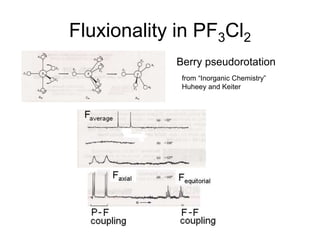
Fluxionality in PF3Cl2
from “Inorganic Chemistry”
Huheey and Keiter
Berry pseudorotation
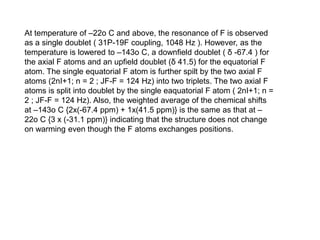
At temperature of –22o C and above, the resonance of F is observed
as a single doublet ( 31P-19F coupling, 1048 Hz ). However, as the
temperature is lowered to –143o C, a downfield doublet ( δ -67.4 ) for
the axial F atoms and an upfield doublet (δ 41.5) for the equatorial F
atom. The single equatorial F atom is further spilt by the two axial F
atoms (2nI+1; n = 2 ; JF-F = 124 Hz) into two triplets. The two axial F
atoms is split into doublet by the single eaquatorial F atom ( 2nI+1; n =
2 ; JF-F = 124 Hz). Also, the weighted average of the chemical shifts
at –143o C {2x(-67.4 ppm) + 1x(41.5 ppm)} is the same as that at –
22o C {3 x (-31.1 ppm)} indicating that the structure does not change
on warming even though the F atoms exchanges positions.
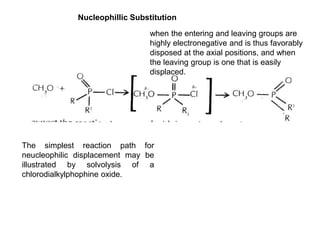
Nucleophillic Substitution
The simplest reaction path for
neucleophilic displacement may be
illustrated by solvolysis of a
chlorodialkylphophine oxide.
when the entering and leaving groups are
highly electronegative and is thus favorably
disposed at the axial positions, and when
the leaving group is one that is easily
displaced.
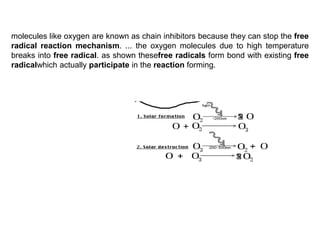
molecules like oxygen are known as chain inhibitors because they can stop the free
radical reaction mechanism. ... the oxygen molecules due to high temperature
breaks into free radical. as shown thesefree radicals form bond with existing free
radicalwhich actually participate in the reaction forming.
Stereochemistry in main group compounds.

Stereochemistry in main group compounds.

  • 1.
    Stereochemistry in MainGroup Compounds. Dr.S. H. Burungale
  • 3.
    VSEPR THEORY This theorywas given by Gillespie and Nyholm. According to this theory the geometry of a molecule depends upon the number of bonding and non-bonding electron pairs in the central atom. These arrange themselves in such a way that there is a minimum repulsion between them so that the molecule has minimum energy (i.e. maximum stability).
  • 4.
    The following ruleshave been reported by Gillespie to explain the shape of some covalent molecules: 1. If the central atom of a molecule is surrounded only by bonding electron pairs and not by non-bonding electron pairs (lone pairs), the geometry of the molecule will be regular. In other words we can say that the shape of covalent molecule will be linear for 2 bonding electron pairs, triangular for 3 bonding electron pairs. tetrahedral for 4 bonding electron pairs, trigonal bipyramidal for 5 bonding electron pairs:
  • 5.
    Name of CompoundBonding Electron Pairs Shape BeCl2 2 Linear BeCl3 3 Triangular Planar SnCl4 4 Regular Tetrahedral PCl5 5 Trigonal bipyramidal SF6 6 Regular Octahedral 2. When the central atom in a molecule is surrounded by both, bonding electron pairs as well as by lone pairs, then molecule will not have a regular shape.
  • 6.
    Molecules No. ofLone pairs Bond Angle Contraction in on central atom bond angle w.r.t. CH4 CH4 0 109.5 o 0 NH3 1 107.5o 2 o H2O 2 105.5o 4 3. B-A-B bond angle decreases with the increase in electro negativity of atom B in AB2 molecule where A is the central atom. Example: Pl3 (102o ) > P Br3 (101.5o ) > PCl3 (100o ) 4. Bond angles involving multiple bonds are generally larger than those involving only single bonds. However, the multiple bonds do not affect the geometry of the molecule. 5. Repulsion between electron pairs in filled shells are larger than the repulsion between electron pairs in incompletely filled shells. Examples: H2O (105.5o ) < H2S (92.2o )
  • 7.
    Applications of GillespieLaw (a) AX2 molecule, which has only two bond-pairs, will be linear: X----A-----X Examples in this groups will be BeCl2, CaCl2, CO2 etc. (b) If the molecule is AX3 (I) or AX2 with a lone pair of electrons on the central atom A, i.e. AX2E (II), then the molecule will be triangular (I) = BCl3, BF3 etc. (II) (II) = SO2, SnCl2 etc (c) If the molecule is AX4 (III) or AX3E (IV) or AX2E2, then AX4 will be tetrahedral; AX3E will be pyramidal and AX2E2 will be angular (III) = CCl4, CH4, SiCl4, GeCl4 etc. (IV) =NH3, PCl3, As2O3 etc. (V) = H2O, SeCl2, etc.
  • 8.
    (d) If themolecule is AX5 (VI) or AX4E (VII) or AX3E2 (VIII) or AX2E3 (IX) then AX5 will be triangular bi pyramidal; AX4E will irregular tetrahedral; AX3E2 will be T-shaped,; and AX2E3 will be linear (VI) = PCl5; (VII) SF4, TeCl4 etc. (VIII) = ClF3, BrF3 etc. (IX) = XeF2, ICl - 2 , or I3-etc
  • 9.
    (e) If themolecule is AX6 (X) or AX5E (XI) or AX4E2 (XII) then AX6 will be octahedral, AX5E will be square pyramidal; and AX4E2 will be square planar. ( (X) = SF6, WF6, etc. (XI) = BrF5, IF5 etc. (XII) = ICl4 - , XeF 2 etc.
  • 10.
    Comparison of CH4,NH3, H2O and H3O In all these molecules, the central atom (C, N and O respectively) is sp 3 hybridised. But they differ in the number of lone pair (s) present on the central atom, zero in CH4, one in NH3 and two in case of H2O. Thus the repulsive force between electron pairs gradually increases in these molecules from CH4 to H2O, resulting in the change of geometry and the bond angles A- CH4, Tetrahedral, bond angle 109.5o B- NH4, Pyramidal, bond angle ~107o C- H2O, Angular, bond angle ~105o D- H3O + , Pyramidal, bond angle ~107
  • 11.
    Comparison of PF5,SF4, ClF3 and [ICl2 - ] a) PF5, Trigonal bipyamidal b) (b) SF4, Irregular tetrahedral c) (c) ClF3, T-Shaped d) (d) [ICl2] - , Linear
  • 12.
    Limitations of VSEPRTheory 1. This theory is not able to predict the shapes of certain transition element complexes. 2. This theory is unable to explain the shapes of certain molecules with an inert pair of electrons. 3. This theory is unable to explain the shapes of molecules having extensive delocalised -electron system. 4. This theory can not explain the shapes of molecules which have highly polar bonds.
  • 22.
    Bent's Rule describesand explains the relationship between the orbital hybridisations of central atoms in molecules and the electro-negativities of substituents. The rule was stated by Henry Bent as follows: "Atomic s character concentrates in orbitals directed toward electro-positive substituents".
  • 25.
    Sulphur dioxide (SO2): CentralS atom has three sp2 hybrid orbitals out of which one contains a lone pair of electron while two other half filled orbitals overlap with one of the p orbitals of each of the two oxygen atoms forming 2 πbonds. p orbital of one of the oxygen atom overlaps with un- hybridized p orbital of S atom forming pπ -pπ double bond while p orbital of other O atom overlaps with d orbital of S atom and forms pπ –dπ double bond.
  • 26.
    In SO32−, theS issp3 hybridised,so ln SO32−,the S is sp3hybridised,so In 'S' the three p-orbitals form σ -σ- bonds with three oxygen atoms and unhybridised d-orbital is involved in π-π-bond formation S10=1s2,2s22p2x2p1y2p1zS10=1s2,2s22px22py12pz1 In oxygen two unpaired p-orbitals are present, one is involved in σσ-bond formation while other is used in π-π-bond formation. Thus, in SO2−3pπ and dπ SO32−pπ and dπ orbitals are involved for pπ−dπ pπ−dπ bonding.
  • 33.
    Walsh diagrams proposea simple pictoral approach to determine the geometry of a molecule considering and calculating the energies of molecular orbitals of the molecule. The molecule will have that geometry in which the energies of the molecular orbitals used are minimum. Using this concept we can understand why H2O is angular and BeH2 is linear; or why CH4 is tetrahedral and SF4 is distorted tetrahedral.
  • 44.
    SOME SIMPLE REACTIONSOF COVALENTLY BONDED MOLECULES Atomic InversionI. in chemistry the spatial rearrangement of atoms or groups of atoms in a dissymmetric molecule, giving rise to a product with a molecular configuration that is a mirror image of that of the original molecule.
  • 45.
    they are potentiallyoptically active these molecules are non superimposable upon their mirror images the energy barrier to inversion is strongly dependent on the nature of the central atom
  • 46.
    Berry pseudorotationmechanism, isa type of vibration causing molecules of certain geometries to isomerize by exchanging the two axial ligands (see Figure at right) for two of the equatorial ones.
  • 49.
    The process ofpseudorotation occurs when the two axial ligands close like a pair of scissors pushing their way in between two of the equatorial groups which scissor out to accommodate them. Both the axial and equatorial constituents move at the same rate of increasing the angle between the other axial or equatorial constituent. This forms a square based pyramid where the base is the four interchanging ligands and the tip is the pivot ligand, which has not moved. The two originally equatorial ligands then open out until they are 180 degrees apart, becoming axial groups perpendicular to where the axial groups were before the pseudorotation. This requires about 3.6 kcal/mol in PF5
  • 50.
    Single-crystal X-ray studiesindicate that the PF5 has trigonal bipyramidal geometry. Thus it has two distinct types of P−F bonds (axial and equatorial): the length of an axial P−F bond is distinct from the equatorial P-F bond in the solid phase, but not the liquid or gas phases due to Pseudo Berry Rotation. Fluorine-19 NMR spectroscopy, even at temperatures as low as −100 °C, fails to distinguish the axial from the equatorial fluorine environments. The apparent equivalency arises from the low barrier for pseudorotation via the Berry mechanism, by which the axial and equatorial fluorine atoms rapidly exchange positions. The apparent equivalency of the F centers in PF5 was first noted by Gutowsky.[3]The explanation was first described by R. Stephen Berry, after whom the Berry mechanism is named. Berry pseudorotation influences the 19F NMR spectrum of PF5 since NMR spectroscopy operates on a millisecond timescale. Electron diffraction and X-ray crystallography do not detect this effect as the solid state structures are, relative to a molecule in solution, static and can not undergo the necessary changes in atomic position.
  • 51.
    Fluxionality in PF3Cl2 from“Inorganic Chemistry” Huheey and Keiter Berry pseudorotation
  • 52.
    At temperature of–22o C and above, the resonance of F is observed as a single doublet ( 31P-19F coupling, 1048 Hz ). However, as the temperature is lowered to –143o C, a downfield doublet ( δ -67.4 ) for the axial F atoms and an upfield doublet (δ 41.5) for the equatorial F atom. The single equatorial F atom is further spilt by the two axial F atoms (2nI+1; n = 2 ; JF-F = 124 Hz) into two triplets. The two axial F atoms is split into doublet by the single eaquatorial F atom ( 2nI+1; n = 2 ; JF-F = 124 Hz). Also, the weighted average of the chemical shifts at –143o C {2x(-67.4 ppm) + 1x(41.5 ppm)} is the same as that at – 22o C {3 x (-31.1 ppm)} indicating that the structure does not change on warming even though the F atoms exchanges positions.
  • 53.
    Nucleophillic Substitution The simplestreaction path for neucleophilic displacement may be illustrated by solvolysis of a chlorodialkylphophine oxide. when the entering and leaving groups are highly electronegative and is thus favorably disposed at the axial positions, and when the leaving group is one that is easily displaced.
  • 54.
    molecules like oxygenare known as chain inhibitors because they can stop the free radical reaction mechanism. ... the oxygen molecules due to high temperature breaks into free radical. as shown thesefree radicals form bond with existing free radicalwhich actually participate in the reaction forming.