Solvent Extraction
Dr. Shivaji. H. Burungale
Solvent Extraction
Chemical analysis :1) Separation
2) Estimation
Methods of estimation: 1) Spectrographic
2) Spectrophotometric
3) Polarographic
Minimize the need for separation steps preceding the measurement step.
Rapid growth of chemical technology, the analytical chemist is called
upon to deal with mixtures of increasing complexity.
Analytical chemist is called is forced to take cognizance of the following
elements in his analytical schemes.
Ti, Ta, Nb, Zr – Pure metals or high temp. alloy constituents.
Ge – transistor material (rapidly growing)
U, Th, the lanthanides and actinides – Nuclear energy programme.
Elements: Industrial significance
Separation process is vital important to analytical chemist.
Lecture:1
Highlights of Solvent Extraction
Versatile and popular method of separation.
Does not need any sophisticated apparatus or
instrumentation excepting a separatory funnel.
Applicable to both tracer and macro amounts of metal ions.
Useful for purpose of preparation, purification
Enrichment, Separation and analysis (micro, macro)
Elegant, simple, rapid and wide scope.
Principles of Solvent Extraction
As per the phase rule of Gibb's et. al.
P + V = C + 2
Where P = Phase, C= components , V = degree of freedom.
In solvent extraction, P = 2 phase namely aqueous and
organic phase, the components is C = 1 viz. solute,
in solvent and water phase and at constant temp. and
pressures V = 1 thus
2+ 1 = 1+ 2
i.e. P + V = C + 2
According to Nernst distribution law if [X1] is concentration of
solute in phase 1 and if [X2] is the concentration of solute in phase
2 at equilibrium X1, X2
i.e [X2]
KD = --------------- KD = Partition coefficient
[X1]
This partition or distribution coefficient is independent of the
total solute concentration in either of the phases. In the above
expression for KD. We have not considered the activity coefficient
of the species in the organic as well as in the aqueous phase.
We therefore use the term distribution ratio (D) to account for
the total concentration of the species in two phases. In the
circumstances we have distribution ratio (D) as
Total concentration of species in the organic phase
D= -------------------------------------------------------------------------
Total concentration of species in the aqueous phase
Now assuming if there is no association dissociation or
polymerization in the phase
Then under the idealized condition KD = D
one prefers to use term percentage extraction (%E) . This is
related to distribution ratio (D) by an expression as
(Vw / Vo ) . E Vw = Vol. of aq. Phase.
D = -------------------- Vo = Vol. of org. Phase.
(100 – E)
When volume of organic and aqueous phases are equal i.e.
Vo = Vw , D reduces to
D = [E / (100 – E)]
Further the extraction is considered to be quantitative
when E = 100
D = [100 / 100 – 100]
= 100 / 0 = ∞ ( if Vo = Vw )
• Fig: Relation of
distribution ratio to
percentage
extraction
100 D
• % E = ---------------
D + (Vw / Vo)
D1 Kf1 KDx1
• α = ----- = -------------
D2 Kf2 KDx2
• α = Separation factor % Extraction
D
0.0 50 100
Classification of Extraction Systems
The extraction systems can be classified on the basis of nature
of extraction species formed such as chelate extraction or
ion association system.
However the present day classification is based up on
the process of classification
Chelate Extraction : Formation of chelate of close ring
structure is called as chelate extraction.
e.g. 1) The extraction of Uranium with 8 – hydroxy quinoline
(oxine)
2) Extraction of Iron (III) with cupferron in CCl4 as the solvent
N
O
UO2/2
N
N O
O
Fe/3
Lecture:2
Formation of Metal Complexes
• 1. Coordination Complexes
• A. Acid base character : G.N. Lewis –electron donor and acceptor
• Coordination number- size of metal and ligans.
• Nature of Bonds- Covalent
• Polarization of metal and ligands.
• Factors: stabilty and coordination number depends upon-
• a.) Acidity of metal ion –Higher Oxidation state and smaller size
• b) Basicity of ligands- more electron rich and smaller size
• Configuration of resultant complex –Tetrhedral,square planar and
octahedral complex.and its bond strength.
2. Chelate Complxes
Chelating agents and its functional groups
1.Both acidic
2. One acidic and one neutral
3. Both neutral
4 Five or six membered ring-stability
5. Proton Affinities more
6. pKa values more
Factors-1.lower Electronegativity of Donor atom- stronger covalent
2. Chelate stability –size of the ring and minimum strain.
3. Acidity of metal ion
4.Resonace effect –
Lecture: 3
2) Extraction by solvation : The extracted species
gets solvated into the organic phase. e.g.
Extraction of Iron (III) from 6M HCl with diethyl
ether
• Fe 3+ + 4 Cl- FeCl4
-
• FeCl4
- + H+ [H+, FeCl4
- ]
• {(C2H5)2O : H+, FeCl4 [(C2H5)2O]2
-
• Oxygen atom of the solvent molecule coordinate
with metal ion – oxonium extraction system.
Factors affecting on the
stability of metal complexes .
1.Basic Strength of the Chelating group : stability of
metal complexes increases with increasing basic strength
of ligand measured pKa values.
2.The Nature of Donor Atoms in the Chelating Agents --
Soft acid and Soft Base and Hard acid and Hard Base.
3.Ring Size : Five or Six membered conjugated chelate
ring ----minimum strain
4. Resonance and Steric Effects: maximum resonance
and minimum hindrance
Lecture:4
3) Ion - pair formation : The extraction proceed with the
formation of neutral unchanged species gets extracted into
organic phase.
Mn+ + b B MBb
n+
MBb
n+ + nX- (MBb
n+, nX- ) cationic complex
Where B = Neutral ligand X = anion M = metal
Mn+ + (n-a)X- Mxa-
n+a
Mxa-
n+a+ aY+ (aY+, MXa-
n+a) anionic complex
e.g. 1) Extraction of Cu(II) with 1, 10- phenanthroline in CHCl3.
[Cu (Phen)2
+; 2ClO4
-] Cationic complex.
2) Iron (III) with ether is anionic type.
[H(ether)+, FeCl4 (ether)-]
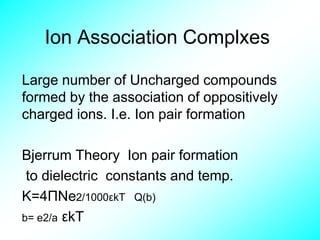
Ion Association Complxes
Large number of Uncharged compounds
formed by the association of oppositively
charged ions. I.e. Ion pair formation
Bjerrum Theory Ion pair formation
to dielectric constants and temp.
K=4ΠNe2/1000εkT Q(b)
b= e2/a εkT
N= Avogadros Number
E= Unit charge
K=Boltzmann constant T=Absolute temp
A and from varies 5 to 7 A0
K is range between 1015
Ion association is depends on size on anions
Ion association decreses with increase in anionic size.
(C4H9)4 N< C4H9)4 P <C4H9)4 As
Substitutation of negative groups in anions decreases the association.
Acetates > Chloracetates.
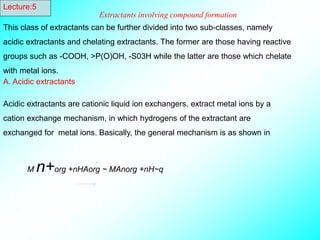
Extractants involving compound formation
This class of extractants can be further divided into two sub-classes, namely
acidic extractants and chelating extractants. The former are those having reactive
groups such as -COOH, >P(O)OH, -S03H while the latter are those which chelate
with metal ions.
A. Acidic extractants
Acidic extractants are cationic liquid ion exchangers, extract metal ions by a
cation exchange mechanism, in which hydrogens of the extractant are
exchanged for metal ions. Basically, the general mechanism is as shown in
M n+org +nHAorg ~ MAnorg +nH~q
Lecture:5
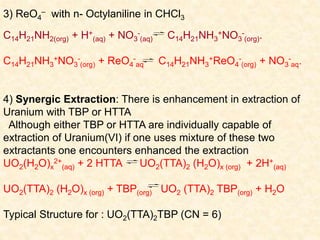
3) ReO4
– with n- Octylaniline in CHCl3
C14H21NH2(org) + H+
(aq) + NO3
-
(aq) C14H21NH3
+NO3
-
(org).
C14H21NH3
+NO3
-
(org) + ReO4
-
aq C14H21NH3
+ReO4
-
(org) + NO3
-
aq.
4) Synergic Extraction: There is enhancement in extraction of
Uranium with TBP or HTTA
Although either TBP or HTTA are individually capable of
extraction of Uranium(VI) if one uses mixture of these two
extractants one encounters enhanced the extraction
UO2(H2O)x
2+
(aq) + 2 HTTA UO2(TTA)2 (H2O)x (org) + 2H+
(aq)
UO2(TTA)2 (H2O)x (org) + TBP(org) UO2 (TTA)2 TBP(org) + H2O
Typical Structure for : UO2(TTA)2TBP (CN = 6)
Stripping
Lecture:6
Diluents
Modifiers
Lecture:7
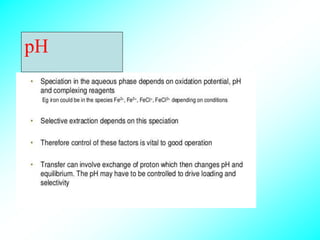
pH
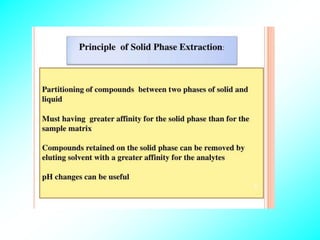
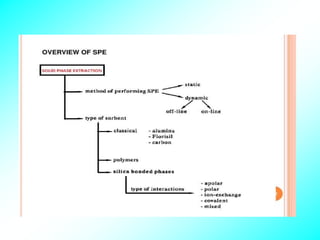
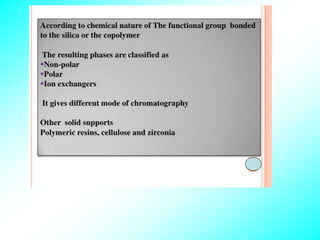
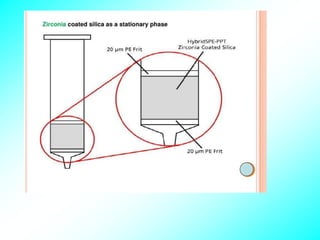
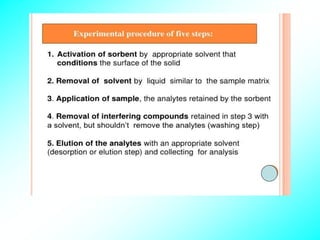
Solid Phase Extraction
Lecture:8
A solid phase extraction consists
of a liquid or gaseous sample in
contact with a solid phase .
Lecture:9
Thank you

Solvent extraction

  • 1.
  • 2.
    Solvent Extraction Chemical analysis:1) Separation 2) Estimation Methods of estimation: 1) Spectrographic 2) Spectrophotometric 3) Polarographic Minimize the need for separation steps preceding the measurement step. Rapid growth of chemical technology, the analytical chemist is called upon to deal with mixtures of increasing complexity. Analytical chemist is called is forced to take cognizance of the following elements in his analytical schemes. Ti, Ta, Nb, Zr – Pure metals or high temp. alloy constituents. Ge – transistor material (rapidly growing) U, Th, the lanthanides and actinides – Nuclear energy programme. Elements: Industrial significance Separation process is vital important to analytical chemist. Lecture:1
  • 3.
    Highlights of SolventExtraction Versatile and popular method of separation. Does not need any sophisticated apparatus or instrumentation excepting a separatory funnel. Applicable to both tracer and macro amounts of metal ions. Useful for purpose of preparation, purification Enrichment, Separation and analysis (micro, macro) Elegant, simple, rapid and wide scope.
  • 4.
    Principles of SolventExtraction As per the phase rule of Gibb's et. al. P + V = C + 2 Where P = Phase, C= components , V = degree of freedom. In solvent extraction, P = 2 phase namely aqueous and organic phase, the components is C = 1 viz. solute, in solvent and water phase and at constant temp. and pressures V = 1 thus 2+ 1 = 1+ 2 i.e. P + V = C + 2
  • 5.
    According to Nernstdistribution law if [X1] is concentration of solute in phase 1 and if [X2] is the concentration of solute in phase 2 at equilibrium X1, X2 i.e [X2] KD = --------------- KD = Partition coefficient [X1] This partition or distribution coefficient is independent of the total solute concentration in either of the phases. In the above expression for KD. We have not considered the activity coefficient of the species in the organic as well as in the aqueous phase. We therefore use the term distribution ratio (D) to account for the total concentration of the species in two phases. In the circumstances we have distribution ratio (D) as Total concentration of species in the organic phase D= ------------------------------------------------------------------------- Total concentration of species in the aqueous phase
  • 6.
    Now assuming ifthere is no association dissociation or polymerization in the phase Then under the idealized condition KD = D one prefers to use term percentage extraction (%E) . This is related to distribution ratio (D) by an expression as (Vw / Vo ) . E Vw = Vol. of aq. Phase. D = -------------------- Vo = Vol. of org. Phase. (100 – E) When volume of organic and aqueous phases are equal i.e. Vo = Vw , D reduces to D = [E / (100 – E)] Further the extraction is considered to be quantitative when E = 100 D = [100 / 100 – 100] = 100 / 0 = ∞ ( if Vo = Vw )
  • 7.
    • Fig: Relationof distribution ratio to percentage extraction 100 D • % E = --------------- D + (Vw / Vo) D1 Kf1 KDx1 • α = ----- = ------------- D2 Kf2 KDx2 • α = Separation factor % Extraction D 0.0 50 100
  • 8.
    Classification of ExtractionSystems The extraction systems can be classified on the basis of nature of extraction species formed such as chelate extraction or ion association system. However the present day classification is based up on the process of classification Chelate Extraction : Formation of chelate of close ring structure is called as chelate extraction. e.g. 1) The extraction of Uranium with 8 – hydroxy quinoline (oxine) 2) Extraction of Iron (III) with cupferron in CCl4 as the solvent N O UO2/2 N N O O Fe/3 Lecture:2
  • 9.
    Formation of MetalComplexes • 1. Coordination Complexes • A. Acid base character : G.N. Lewis –electron donor and acceptor • Coordination number- size of metal and ligans. • Nature of Bonds- Covalent • Polarization of metal and ligands. • Factors: stabilty and coordination number depends upon- • a.) Acidity of metal ion –Higher Oxidation state and smaller size • b) Basicity of ligands- more electron rich and smaller size • Configuration of resultant complex –Tetrhedral,square planar and octahedral complex.and its bond strength.
  • 10.
    2. Chelate Complxes Chelatingagents and its functional groups 1.Both acidic 2. One acidic and one neutral 3. Both neutral 4 Five or six membered ring-stability 5. Proton Affinities more 6. pKa values more Factors-1.lower Electronegativity of Donor atom- stronger covalent 2. Chelate stability –size of the ring and minimum strain. 3. Acidity of metal ion 4.Resonace effect – Lecture: 3
  • 11.
    2) Extraction bysolvation : The extracted species gets solvated into the organic phase. e.g. Extraction of Iron (III) from 6M HCl with diethyl ether • Fe 3+ + 4 Cl- FeCl4 - • FeCl4 - + H+ [H+, FeCl4 - ] • {(C2H5)2O : H+, FeCl4 [(C2H5)2O]2 - • Oxygen atom of the solvent molecule coordinate with metal ion – oxonium extraction system.
  • 12.
    Factors affecting onthe stability of metal complexes . 1.Basic Strength of the Chelating group : stability of metal complexes increases with increasing basic strength of ligand measured pKa values. 2.The Nature of Donor Atoms in the Chelating Agents -- Soft acid and Soft Base and Hard acid and Hard Base. 3.Ring Size : Five or Six membered conjugated chelate ring ----minimum strain 4. Resonance and Steric Effects: maximum resonance and minimum hindrance Lecture:4
  • 13.
    3) Ion -pair formation : The extraction proceed with the formation of neutral unchanged species gets extracted into organic phase. Mn+ + b B MBb n+ MBb n+ + nX- (MBb n+, nX- ) cationic complex Where B = Neutral ligand X = anion M = metal Mn+ + (n-a)X- Mxa- n+a Mxa- n+a+ aY+ (aY+, MXa- n+a) anionic complex e.g. 1) Extraction of Cu(II) with 1, 10- phenanthroline in CHCl3. [Cu (Phen)2 +; 2ClO4 -] Cationic complex. 2) Iron (III) with ether is anionic type. [H(ether)+, FeCl4 (ether)-]
  • 14.
    Ion Association Complxes Largenumber of Uncharged compounds formed by the association of oppositively charged ions. I.e. Ion pair formation Bjerrum Theory Ion pair formation to dielectric constants and temp. K=4ΠNe2/1000εkT Q(b) b= e2/a εkT
  • 15.
    N= Avogadros Number E=Unit charge K=Boltzmann constant T=Absolute temp A and from varies 5 to 7 A0 K is range between 1015 Ion association is depends on size on anions Ion association decreses with increase in anionic size. (C4H9)4 N< C4H9)4 P <C4H9)4 As Substitutation of negative groups in anions decreases the association. Acetates > Chloracetates.
  • 16.
    Extractants involving compoundformation This class of extractants can be further divided into two sub-classes, namely acidic extractants and chelating extractants. The former are those having reactive groups such as -COOH, >P(O)OH, -S03H while the latter are those which chelate with metal ions. A. Acidic extractants Acidic extractants are cationic liquid ion exchangers, extract metal ions by a cation exchange mechanism, in which hydrogens of the extractant are exchanged for metal ions. Basically, the general mechanism is as shown in M n+org +nHAorg ~ MAnorg +nH~q Lecture:5
  • 17.
    3) ReO4 – withn- Octylaniline in CHCl3 C14H21NH2(org) + H+ (aq) + NO3 - (aq) C14H21NH3 +NO3 - (org). C14H21NH3 +NO3 - (org) + ReO4 - aq C14H21NH3 +ReO4 - (org) + NO3 - aq. 4) Synergic Extraction: There is enhancement in extraction of Uranium with TBP or HTTA Although either TBP or HTTA are individually capable of extraction of Uranium(VI) if one uses mixture of these two extractants one encounters enhanced the extraction UO2(H2O)x 2+ (aq) + 2 HTTA UO2(TTA)2 (H2O)x (org) + 2H+ (aq) UO2(TTA)2 (H2O)x (org) + TBP(org) UO2 (TTA)2 TBP(org) + H2O Typical Structure for : UO2(TTA)2TBP (CN = 6)
  • 18.
  • 19.
  • 20.
  • 21.
  • 22.
  • 23.
    A solid phaseextraction consists of a liquid or gaseous sample in contact with a solid phase .
  • 26.
  • 30.