M. Sc. Part – II (Semester – III)
Paper No. ACH–XIIA: ENVIRONMENTAL CHEMICAL ANALYSIS
AND CONTROL
College : Yashwantrao Chavan College of Science Karad
Time: 1 hour MARKS :50
Instruction :
1. Answer in one sentence ( Two mark for each question )
2. Solve any 50 out of 30 question
3. Choose the correct alternatives from following and Tick mark √ the correct answer
=============================================================
1. Which of the following is called the secondary air pollutant?
(a) PANs
(b) Ozone
(c) Carbon monoxide
(d) Nitrogen Dioxide
2. Which of the following particles is called the particulate pollutants?
(a) Ozone
(b) Radon
(c) Fly Ash
(d) Ethylene
3. Which of the following agents is responsible for turning the Taj Mahal
yellow?
(a) Sulphur
(b) Chlorine
(c) Sulphur dioxide
(d) Nitrogen dioxide
4. The major photochemical smog is________.
(a) Hydrogen peroxide
(b) Chlorofluorocarbon
(c) Peroxyacetyl nitrate
(d) All of the above
5. Which of the following diseases are caused by smog?
(a) Rickets
(b) Bronchitis
(c) Breathing Problems
(d) All of the above
6. Which of the following agents is mainly responsible for the secondary
pollutants?
(a) Smog and Ozone
(b) Sulphur trioxide
(c) Nitrogen dioxide
(d) All of the above
7. Smoke, fumes, ash, dust, nitric oxide and sulphur dioxide are the main
sources of ________.
(a) Primary Pollutants
(b) Secondary pollutants
(c) Bio-Degradable Pollutants
(d) None of the above
Sol: (a) Primary Pollutants.
8. Which of the following industries plays a major role in polluting air and
increasing air pollution?
(a) Brick manufacturing industries
(b) Manufacture of gases industries
(c) Electrical appliances and electrical goods industries
(d) All of the above
9. Which of the following gas is more in percentage in the air?
(a) Oxygen gas
(b) Nitrogen gas
(c) Water vapour
(d) Carbon dioxide gas
10.Increased levels of air pollution results in _______.
(a) Soil erosion
(b) Global warming
(c) Respiratory problems
(d) All of the above
11.Which of the following gases are called Greenhouse gases?
(a) Methane
(b) Nitrogen
(c) Carbon dioxide
(d) Both a and c
12.sampling of gases by
a. plastic bag
b.stainless container
c. centrifugal Collector
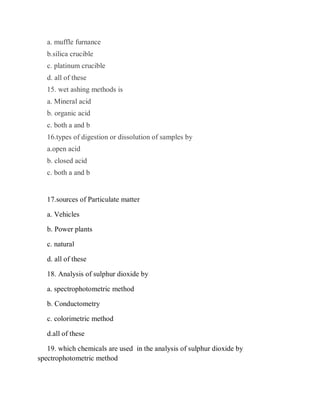
d.all of these
13. Method of ashing
a.dry ashing
b. wet ashing
c. Both of these
14. dry ashing by
a. muffle furnance
b.silica crucible
c. platinum crucible
d. all of these
15. wet ashing methods is
a. Mineral acid
b. organic acid
c. both a and b
16.types of digestion or dissolution of samples by
a.open acid
b. closed acid
c. both a and b
17.sources of Particulate matter
a. Vehicles
b. Power plants
c. natural
d. all of these
18. Analysis of sulphur dioxide by
a. spectrophotometric method
b. Conductometry
c. colorimetric method
d.all of these
19. which chemicals are used in the analysis of sulphur dioxide by
spectrophotometric method
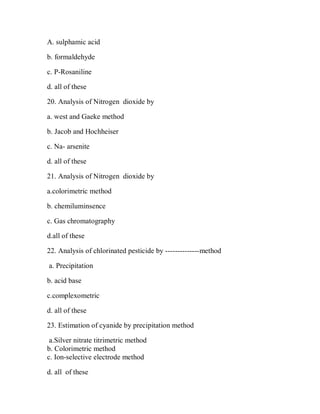
A. sulphamic acid
b. formaldehyde
c. P-Rosaniline
d. all of these
20. Analysis of Nitrogen dioxide by
a. west and Gaeke method
b. Jacob and Hochheiser
c. Na- arsenite
d. all of these
21. Analysis of Nitrogen dioxide by
a.colorimetric method
b. chemiluminsence
c. Gas chromatography
d.all of these
22. Analysis of chlorinated pesticide by --------------method
a. Precipitation
b. acid base
c.complexometric
d. all of these
23. Estimation of cyanide by precipitation method
a.Silver nitrate titrimetric method
b. Colorimetric method
c. Ion-selective electrode method
d. all of these
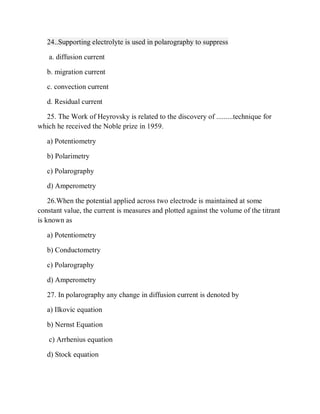
24..Supporting electrolyte is used in polarography to suppress
a. diffusion current
b. migration current
c. convection current
d. Residual current
25. The Work of Heyrovsky is related to the discovery of .........technique for
which he received the Noble prize in 1959.
a) Potentiometry
b) Polarimetry
c) Polarography
d) Amperometry
26.When the potential applied across two electrode is maintained at some
constant value, the current is measures and plotted against the volume of the titrant
is known as
a) Potentiometry
b) Conductometry
c) Polarography
d) Amperometry
27. In polarography any change in diffusion current is denoted by
a) Ilkovic equation
b) Nernst Equation
c) Arrhenius equation
d) Stock equation
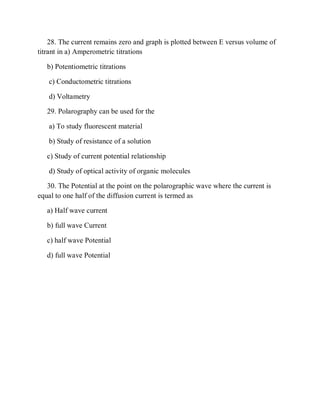
28. The current remains zero and graph is plotted between E versus volume of
titrant in a) Amperometric titrations
b) Potentiometric titrations
c) Conductometric titrations
d) Voltametry
29. Polarography can be used for the
a) To study fluorescent material
b) Study of resistance of a solution
c) Study of current potential relationship
d) Study of optical activity of organic molecules
30. The Potential at the point on the polarographic wave where the current is
equal to one half of the diffusion current is termed as
a) Half wave current
b) full wave Current
c) half wave Potential
d) full wave Potential

Analytical Chemistry (Questions )

  • 1.
    M. Sc. Part– II (Semester – III) Paper No. ACH–XIIA: ENVIRONMENTAL CHEMICAL ANALYSIS AND CONTROL College : Yashwantrao Chavan College of Science Karad Time: 1 hour MARKS :50 Instruction : 1. Answer in one sentence ( Two mark for each question ) 2. Solve any 50 out of 30 question 3. Choose the correct alternatives from following and Tick mark √ the correct answer ============================================================= 1. Which of the following is called the secondary air pollutant? (a) PANs (b) Ozone (c) Carbon monoxide (d) Nitrogen Dioxide 2. Which of the following particles is called the particulate pollutants? (a) Ozone (b) Radon (c) Fly Ash (d) Ethylene 3. Which of the following agents is responsible for turning the Taj Mahal yellow? (a) Sulphur (b) Chlorine (c) Sulphur dioxide (d) Nitrogen dioxide 4. The major photochemical smog is________.
  • 2.
    (a) Hydrogen peroxide (b)Chlorofluorocarbon (c) Peroxyacetyl nitrate (d) All of the above 5. Which of the following diseases are caused by smog? (a) Rickets (b) Bronchitis (c) Breathing Problems (d) All of the above 6. Which of the following agents is mainly responsible for the secondary pollutants? (a) Smog and Ozone (b) Sulphur trioxide (c) Nitrogen dioxide (d) All of the above 7. Smoke, fumes, ash, dust, nitric oxide and sulphur dioxide are the main sources of ________. (a) Primary Pollutants (b) Secondary pollutants (c) Bio-Degradable Pollutants (d) None of the above Sol: (a) Primary Pollutants. 8. Which of the following industries plays a major role in polluting air and increasing air pollution? (a) Brick manufacturing industries (b) Manufacture of gases industries (c) Electrical appliances and electrical goods industries
  • 3.
    (d) All ofthe above 9. Which of the following gas is more in percentage in the air? (a) Oxygen gas (b) Nitrogen gas (c) Water vapour (d) Carbon dioxide gas 10.Increased levels of air pollution results in _______. (a) Soil erosion (b) Global warming (c) Respiratory problems (d) All of the above 11.Which of the following gases are called Greenhouse gases? (a) Methane (b) Nitrogen (c) Carbon dioxide (d) Both a and c 12.sampling of gases by a. plastic bag b.stainless container c. centrifugal Collector d.all of these 13. Method of ashing a.dry ashing b. wet ashing c. Both of these 14. dry ashing by
  • 4.
    a. muffle furnance b.silicacrucible c. platinum crucible d. all of these 15. wet ashing methods is a. Mineral acid b. organic acid c. both a and b 16.types of digestion or dissolution of samples by a.open acid b. closed acid c. both a and b 17.sources of Particulate matter a. Vehicles b. Power plants c. natural d. all of these 18. Analysis of sulphur dioxide by a. spectrophotometric method b. Conductometry c. colorimetric method d.all of these 19. which chemicals are used in the analysis of sulphur dioxide by spectrophotometric method
  • 5.
    A. sulphamic acid b.formaldehyde c. P-Rosaniline d. all of these 20. Analysis of Nitrogen dioxide by a. west and Gaeke method b. Jacob and Hochheiser c. Na- arsenite d. all of these 21. Analysis of Nitrogen dioxide by a.colorimetric method b. chemiluminsence c. Gas chromatography d.all of these 22. Analysis of chlorinated pesticide by --------------method a. Precipitation b. acid base c.complexometric d. all of these 23. Estimation of cyanide by precipitation method a.Silver nitrate titrimetric method b. Colorimetric method c. Ion-selective electrode method d. all of these
  • 6.
    24..Supporting electrolyte isused in polarography to suppress a. diffusion current b. migration current c. convection current d. Residual current 25. The Work of Heyrovsky is related to the discovery of .........technique for which he received the Noble prize in 1959. a) Potentiometry b) Polarimetry c) Polarography d) Amperometry 26.When the potential applied across two electrode is maintained at some constant value, the current is measures and plotted against the volume of the titrant is known as a) Potentiometry b) Conductometry c) Polarography d) Amperometry 27. In polarography any change in diffusion current is denoted by a) Ilkovic equation b) Nernst Equation c) Arrhenius equation d) Stock equation
  • 7.
    28. The currentremains zero and graph is plotted between E versus volume of titrant in a) Amperometric titrations b) Potentiometric titrations c) Conductometric titrations d) Voltametry 29. Polarography can be used for the a) To study fluorescent material b) Study of resistance of a solution c) Study of current potential relationship d) Study of optical activity of organic molecules 30. The Potential at the point on the polarographic wave where the current is equal to one half of the diffusion current is termed as a) Half wave current b) full wave Current c) half wave Potential d) full wave Potential