PRESENTATION ON
RESEARCH PROCESS.
• .
.
Prepared by
Nasir Mughal
M.Sc MCWM
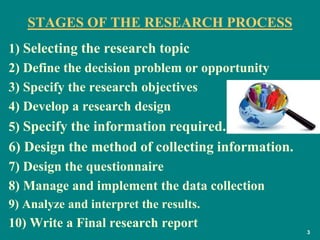
What is research……….???
 Systematic search for knowledge
through method of study,
observation, comparison &
experiment.
What is research process……???
 Series of various actions,
which are necessary to
effective research work.
3
STAGES OF THE RESEARCH PROCESS
1) Selecting the research topic
2) Define the decision problem or opportunity
3) Specify the research objectives
4) Develop a research design
5) Specify the information required.
6) Design the method of collecting information.
7) Design the questionnaire
8) Manage and implement the data collection
9) Analyze and interpret the results.
10) Write a Final research report
Step 1 – Selecting the research topic
• Basic Step in research
• Research is possible in Marketing, banking
insurance, transport, export etc
• For e.g.: In marketing we have areas of
research such as product research, price
research, etc….
• Primary decision in a research process is to
select the research area.
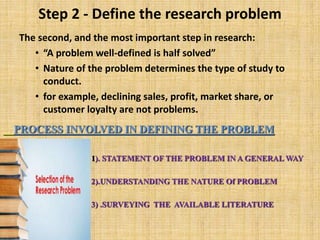
Step 2 - Define the research problem
The second, and the most important step in research:
• “A problem well-defined is half solved”
• Nature of the problem determines the type of study to
conduct.
• for example, declining sales, profit, market share, or
customer loyalty are not problems.
PROCESS INVOLVED IN DEFINING THE PROBLEM
• 1). STATEMENT OF THE PROBLEM IN A GENERAL WAY
• .
• 2).UNDERSTANDING THE NATURE Of PROBLEM
• 3) .SURVEYING THE AVAILABLE LITERATURE
Step 3: Establish Research Objectives
• If you do not know what you are looking for, you won’t find it”
• In establishing research objectives, the researcher must answer the
following questions:
i) What specific information should the project provide?
ii) If more than one type of information will be developed from
the study, which is the most important? and finally,
iii) What are the priorities?
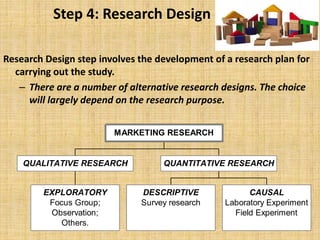
EXPLORATORY
Focus Group;
Observation;
Others.
QUALITATIVE RESEARCH
DESCRIPTIVE
Survey research
CAUSAL
Laboratory Experiment
Field Experiment
QUANTITATIVE RESEARCH
MARKETING RESEARCH
Step 4: Research Design
Research Design step involves the development of a research plan for
carrying out the study.
– There are a number of alternative research designs. The choice
will largely depend on the research purpose.
Step 5: Specify the information required.
After defining the problem the researcher must determine
what kind of information will best meet the research
objectives.
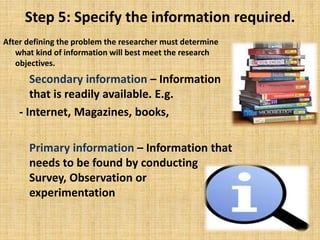
Secondary information – Information
that is readily available. E.g.
- Internet, Magazines, books,
Primary information – Information that
needs to be found by conducting
Survey, Observation or
experimentation
Step 6: Design the method of collecting the
needed information.
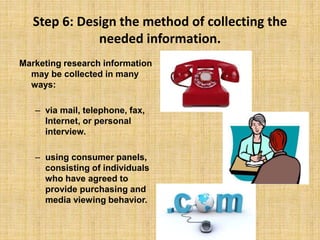
Marketing research information
may be collected in many
ways:
– via mail, telephone, fax,
Internet, or personal
interview.
– using consumer panels,
consisting of individuals
who have agreed to
provide purchasing and
media viewing behavior.
Step 7: Design the questionnaire.
• You need to have a questionnaire to collect Primary data
• A primary responsibilities of a marketing researcher is to
design the data collection instrument or questionnaire in a
manner so that it is easily understood by the respondent
and administered to them.
11
• Have you ever ........?
• Do you ever ........?
• Who do you know ........?
• When did you last ........?
• Which do you do most often ........?
• Who does it ........?
• How many ........?
• Do you have ........?
• In what way do you do it ........?
• In the future will you ........?
Behavioral questions address the following:
They determine people's
actions in terms of what they
have eaten (or drunk), bought,
used, visited, seen, read or
heard. Behavioral questions
record facts and not matters of
opinion.
12
• What do you think of ........?
• Why do you ........?
• Do you agree of disagree ........?
• How do you rate ........?
• Which is best (or worst) for ........?
Attitudinal questions address the following:
Attitudes are opinions or basic
beliefs which people have about
the products
they buy, the companies they
deal with and it is attitudes that
motivates people
in their actions.
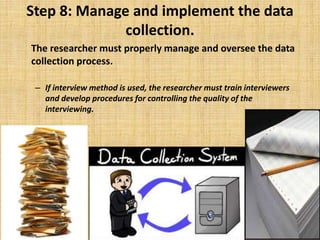
Step 8: Manage and implement the data
collection.
The researcher must properly manage and oversee the data
collection process.
– If interview method is used, the researcher must train interviewers
and develop procedures for controlling the quality of the
interviewing.
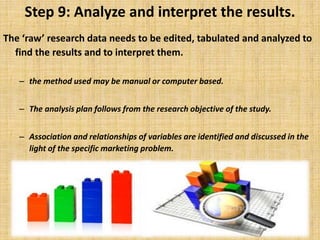
Step 9: Analyze and interpret the results.
The ‘raw’ research data needs to be edited, tabulated and analyzed to
find the results and to interpret them.
– the method used may be manual or computer based.
– The analysis plan follows from the research objective of the study.
– Association and relationships of variables are identified and discussed in the
light of the specific marketing problem.
15
ANALYZE DATA
• This process is the most important process in the research
as the results are generated on the basis of data preparation.
• After the data collecting stage the collected data is
– edited,
– Coded,
– transcribed
– corrected if required and
– validated.
• Uni/multivariate techniques are used for analyzing data
when there is a single/multiple measurement of each
element or unit in the sample data.
16
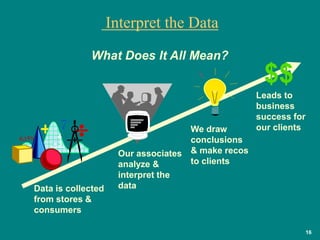
Data is collected
from stores &
consumers
Our associates
analyze &
interpret the
data
We draw
conclusions
& make recos
to clients
$$
Leads to
business
success for
our clients
What Does It All Mean?
Interpret the Data
Step 10:Prepare & Present the Final Research Report
Findings are presented often by research
,objective should be in clear and concise way
It is a report that communicates properly and
result to clients
Steps in research process

Steps in research process

  • 1.
    PRESENTATION ON RESEARCH PROCESS. •. . Prepared by Nasir Mughal M.Sc MCWM
  • 2.
    What is research……….??? Systematic search for knowledge through method of study, observation, comparison & experiment. What is research process……???  Series of various actions, which are necessary to effective research work.
  • 3.
    3 STAGES OF THERESEARCH PROCESS 1) Selecting the research topic 2) Define the decision problem or opportunity 3) Specify the research objectives 4) Develop a research design 5) Specify the information required. 6) Design the method of collecting information. 7) Design the questionnaire 8) Manage and implement the data collection 9) Analyze and interpret the results. 10) Write a Final research report
  • 4.
    Step 1 –Selecting the research topic • Basic Step in research • Research is possible in Marketing, banking insurance, transport, export etc • For e.g.: In marketing we have areas of research such as product research, price research, etc…. • Primary decision in a research process is to select the research area.
  • 5.
    Step 2 -Define the research problem The second, and the most important step in research: • “A problem well-defined is half solved” • Nature of the problem determines the type of study to conduct. • for example, declining sales, profit, market share, or customer loyalty are not problems. PROCESS INVOLVED IN DEFINING THE PROBLEM • 1). STATEMENT OF THE PROBLEM IN A GENERAL WAY • . • 2).UNDERSTANDING THE NATURE Of PROBLEM • 3) .SURVEYING THE AVAILABLE LITERATURE
  • 6.
    Step 3: EstablishResearch Objectives • If you do not know what you are looking for, you won’t find it” • In establishing research objectives, the researcher must answer the following questions: i) What specific information should the project provide? ii) If more than one type of information will be developed from the study, which is the most important? and finally, iii) What are the priorities?
  • 7.
    EXPLORATORY Focus Group; Observation; Others. QUALITATIVE RESEARCH DESCRIPTIVE Surveyresearch CAUSAL Laboratory Experiment Field Experiment QUANTITATIVE RESEARCH MARKETING RESEARCH Step 4: Research Design Research Design step involves the development of a research plan for carrying out the study. – There are a number of alternative research designs. The choice will largely depend on the research purpose.
  • 8.
    Step 5: Specifythe information required. After defining the problem the researcher must determine what kind of information will best meet the research objectives. Secondary information – Information that is readily available. E.g. - Internet, Magazines, books, Primary information – Information that needs to be found by conducting Survey, Observation or experimentation
  • 9.
    Step 6: Designthe method of collecting the needed information. Marketing research information may be collected in many ways: – via mail, telephone, fax, Internet, or personal interview. – using consumer panels, consisting of individuals who have agreed to provide purchasing and media viewing behavior.
  • 10.
    Step 7: Designthe questionnaire. • You need to have a questionnaire to collect Primary data • A primary responsibilities of a marketing researcher is to design the data collection instrument or questionnaire in a manner so that it is easily understood by the respondent and administered to them.
  • 11.
    11 • Have youever ........? • Do you ever ........? • Who do you know ........? • When did you last ........? • Which do you do most often ........? • Who does it ........? • How many ........? • Do you have ........? • In what way do you do it ........? • In the future will you ........? Behavioral questions address the following: They determine people's actions in terms of what they have eaten (or drunk), bought, used, visited, seen, read or heard. Behavioral questions record facts and not matters of opinion.
  • 12.
    12 • What doyou think of ........? • Why do you ........? • Do you agree of disagree ........? • How do you rate ........? • Which is best (or worst) for ........? Attitudinal questions address the following: Attitudes are opinions or basic beliefs which people have about the products they buy, the companies they deal with and it is attitudes that motivates people in their actions.
  • 13.
    Step 8: Manageand implement the data collection. The researcher must properly manage and oversee the data collection process. – If interview method is used, the researcher must train interviewers and develop procedures for controlling the quality of the interviewing.
  • 14.
    Step 9: Analyzeand interpret the results. The ‘raw’ research data needs to be edited, tabulated and analyzed to find the results and to interpret them. – the method used may be manual or computer based. – The analysis plan follows from the research objective of the study. – Association and relationships of variables are identified and discussed in the light of the specific marketing problem.
  • 15.
    15 ANALYZE DATA • Thisprocess is the most important process in the research as the results are generated on the basis of data preparation. • After the data collecting stage the collected data is – edited, – Coded, – transcribed – corrected if required and – validated. • Uni/multivariate techniques are used for analyzing data when there is a single/multiple measurement of each element or unit in the sample data.
  • 16.
    16 Data is collected fromstores & consumers Our associates analyze & interpret the data We draw conclusions & make recos to clients $$ Leads to business success for our clients What Does It All Mean? Interpret the Data
  • 17.
    Step 10:Prepare &Present the Final Research Report Findings are presented often by research ,objective should be in clear and concise way It is a report that communicates properly and result to clients