1
Marketing research
• What is marketing?
• What is the marketing concept?
• What is marketing strategy ?
2
What is Marketing?
• Marketing has been defined by the AMA as an organizational
function and a set of processes for creating, communicating
and delivering value to customers and for managing customer
relationships in ways that benefit the organization and its
stakeholders.
3
What is Marketing Strategy?
• A Marketing Strategy consists of selecting a segment of the
market as the company’s target market and designing the
proper “mix” of the product/service, price, promotion, and
distribution system to meet the wants and needs of the
consumers within the target market.
4
What is Marketing Research?
• Definition 1
“Marketing research is the process of designing, gathering,
analyzing, and reporting information that may be used to
solve a specific marketing problem”
( Burns and Bush).
Definition 2
Marketing research: the function that links the consumer,
customer, and public to the marketer through
information – information used to identify and define
marketing opportunities and problems; generate,
refine, and evaluate marketing actions; monitor
marketing performance; and improve the
understanding of marketing as a process.
5
6
Objectives of
Marketing Research
• Identify marketing opportunities and problems.
• Generate, refine, and evaluate potential marketing actions.
• Monitor marketing performance.
• Improve marketing as a process.
• To link the consumer to the marketer by providing information
that can be used in making marketing decisions.
Application of Marketing
Research
• Application of marketing research can be divided
into two broad areas:
• Strategic
• Tactical
7
1. Strategic
Among the strategic areas marketing research applications would be
• demand forecasting,
• sales forecasting,
• segmentation studies,
• identification of target markets for a given product,
• positioning strategies identification.
8
2. Tactical
In tactical application, we would have applications such as
• product testing,
• pricing research,
• advertising research,
• promotional research,
• distribution and logistics related research
9
Some examples of application of Marketing
Research
• A study of consumer buying habits for detergents-frequency ,pack size,
effect of promotion, brand loyalty and so forth.
• To find out the potential demand for ready-to-eat chapattis in Mumbai
City.
• To determine which of the three proposed ingredients-tulsi, coconut oil or
neem, the consumer would like to have in toilet soap.
• To find the effectiveness of the advertising campaign for a car brand.
• To determine brand awareness and brand loyalty for branded PC.
10
Limitation of marketing research
• As marketing research can be extremely
rewarding to a Customer Competition firm, it
is wise to know that it is subject to certain
limitations.
• Marketing research tends to be fragmentary in
its approach as a result of which it becomes
difficult to have an overall perspective in which
a marketing problem is to be viewed and
studied.
11
• Marketing research is criticized on the ground
that it becomes too superficial and faculty in
industry.
• There is an absence of a meaningful dialogue
between the marketing management and the
marketing research team. As a result,
marketing researchers get divorced form the
main stream of marketing
12
Marketing Research during different
phases of the administrative process
• Phase I –Setting goals and establishing strategies
• Phase 2- Developing a plan
• Phase 3- Putting the plan into action
• Phase 4 –Evaluating the plans effectiveness
13
Phase 1-Setting goals and
establishing strategies
• Dissatisfaction and needs in relevant market
segment.
• Demand size and trend
• Industry/market strucutre composition , competition
• Technological and materials innovations
• Distribution, environmental and legal developments.
14
Phase 2 – Developing a plan
• Identify key market segments by product
category.
• Identify market segment attitudes toward
present products, promotions and advertising.
• Test the effectiveness of advertising and
promotion .
• Evaluate the needs and attitudes of channel
members.
15
Phase -3- Putting the plan into
action
• Total industry and product class sales.
• Firm’s sales, by product and market
• Product availability in retail stores , shelf
space, retailer support, and so on
• Awareness and trial in relevant market
segments.
16
Phase 4 – Evaluating the plan’s
effectiveness
• End of period compilation and
aggregation of operating data to present
and accurate picture of performance.
• Also summary of survey findings on
consumer awareness, trial attitudes,
preferences, repurchase rates, and so
on.
17
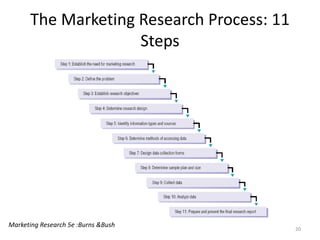
The Marketing Research Process: 11
Steps
18
 Step One: Establishing the Need for Marketing Research
 Step Two: Defining the Problem
 Step Three: Establishing Research Objectives
 Step Four: Determining Research Design
 Step Five: Identifying Information Types and Sources
 Step Six: Determining Methods of Accessing Data
The Marketing Research Process:
11 Steps
19
• Step Seven: Designing Data Collection Forms
• Step Eight: Determining Sample Plan and Size
• Step Nine: Collecting Data
• Step Ten: Analyzing Data
• Step Eleven: Preparing and Presenting the Final Report
The Marketing Research Process: 11
Steps
20
Marketing Research 5e :Burns &Bush
Step 1: Establish the Need for
Marketing Research
21
• Is there a real need for marketing research?
• Research takes time and costs money.
• Marketing research is not always needed.
Step 1: Establish the Need for
Marketing Research
22
• When is marketing research not needed?
– The information is already available.
– Decisions must be made now.
– We can’t afford research.
– Costs outweigh the value of marketing
research.
Step 2: Define the Problem
23
• This is the most important of the 11 steps.
• If the problem is incorrectly defined, all else is
wasted effort.
• Problems may be either specific or general.
Step 2: Define the Problem
24
• Problems stem from gaps between what is
supposed to happen and what did happen and
gaps between what did happen and what could
be happening.
Step 3: Establish Objectives
25
• Research objectives, when achieved, provide the
information necessary to solve the problem identified
in step 2.
• Research objectives state what the researchers must
do.
Step Four: Determine Research Design
26
• Exploratory Research: collecting information in an
unstructured and informal manner.
• Descriptive Research refers to a set of methods and
procedures describing marketing variables.
• Causal Research (experiments): allows isolation of
causes and effects.
Step 5: Identify Information Types
and Sources
27
• Primary information: information collected
specifically for the problem at hand.
• Secondary information: information already
collected
Step 6: Determine Methods of
Accessing Data
28
 Secondary data is relatively easy to access;
primary data is more complex.
 Three main choices for primary data:
Have a person ask questions
Use computer assisted or direct questioning
Allow respondents to answer questions
themselves without computer assistance
Step 7: Design Data Collection
Forms
29
• Questionnaire must be worded objectively, clearly, and
without bias in order to communicate with
respondents.
• Software programs are available to assist marketing
researchers in preparing forms.
Step 8: Determine Sample Plan and
Size
30
• Sample plan refers to the process used to select units
from the population to be included in the sample.
• Sample size refers to determining how many elements
of the population should be included in the sample.
Step 9: Collect Data
31
• Data collection is very important because, regardless of
the data analysis methods used, data analysis cannot
fix bad data.
• Nonsampling errors may occur during data collection.
Step 9: Collect Data
32
• Data collection errors may be attributed to field
workers or respondents.
• Researchers must know the sources of these errors
and the controls to minimize them.
Step 10: Analyze Data
33
• Data analysis involves entering data into computer
files, inspecting data for errors, and running
tabulations and various statistical tests.
• Data cleaning is a process by which raw data are
checked to verify that the data have been correctly
inputted from the data collection form to the
computer software program.
Step 11: Prepare and Present the
Final Research Report
34
• The last step is one of the most important phases of
marketing research.
• Its importance cannot be overstated because it is the
report, or its presentation, that properly
communicates the results to the client.

Session 8.ppt

  • 1.
    1 Marketing research • Whatis marketing? • What is the marketing concept? • What is marketing strategy ?
  • 2.
    2 What is Marketing? •Marketing has been defined by the AMA as an organizational function and a set of processes for creating, communicating and delivering value to customers and for managing customer relationships in ways that benefit the organization and its stakeholders.
  • 3.
    3 What is MarketingStrategy? • A Marketing Strategy consists of selecting a segment of the market as the company’s target market and designing the proper “mix” of the product/service, price, promotion, and distribution system to meet the wants and needs of the consumers within the target market.
  • 4.
    4 What is MarketingResearch? • Definition 1 “Marketing research is the process of designing, gathering, analyzing, and reporting information that may be used to solve a specific marketing problem” ( Burns and Bush).
  • 5.
    Definition 2 Marketing research:the function that links the consumer, customer, and public to the marketer through information – information used to identify and define marketing opportunities and problems; generate, refine, and evaluate marketing actions; monitor marketing performance; and improve the understanding of marketing as a process. 5
  • 6.
    6 Objectives of Marketing Research •Identify marketing opportunities and problems. • Generate, refine, and evaluate potential marketing actions. • Monitor marketing performance. • Improve marketing as a process. • To link the consumer to the marketer by providing information that can be used in making marketing decisions.
  • 7.
    Application of Marketing Research •Application of marketing research can be divided into two broad areas: • Strategic • Tactical 7
  • 8.
    1. Strategic Among thestrategic areas marketing research applications would be • demand forecasting, • sales forecasting, • segmentation studies, • identification of target markets for a given product, • positioning strategies identification. 8
  • 9.
    2. Tactical In tacticalapplication, we would have applications such as • product testing, • pricing research, • advertising research, • promotional research, • distribution and logistics related research 9
  • 10.
    Some examples ofapplication of Marketing Research • A study of consumer buying habits for detergents-frequency ,pack size, effect of promotion, brand loyalty and so forth. • To find out the potential demand for ready-to-eat chapattis in Mumbai City. • To determine which of the three proposed ingredients-tulsi, coconut oil or neem, the consumer would like to have in toilet soap. • To find the effectiveness of the advertising campaign for a car brand. • To determine brand awareness and brand loyalty for branded PC. 10
  • 11.
    Limitation of marketingresearch • As marketing research can be extremely rewarding to a Customer Competition firm, it is wise to know that it is subject to certain limitations. • Marketing research tends to be fragmentary in its approach as a result of which it becomes difficult to have an overall perspective in which a marketing problem is to be viewed and studied. 11
  • 12.
    • Marketing researchis criticized on the ground that it becomes too superficial and faculty in industry. • There is an absence of a meaningful dialogue between the marketing management and the marketing research team. As a result, marketing researchers get divorced form the main stream of marketing 12
  • 13.
    Marketing Research duringdifferent phases of the administrative process • Phase I –Setting goals and establishing strategies • Phase 2- Developing a plan • Phase 3- Putting the plan into action • Phase 4 –Evaluating the plans effectiveness 13
  • 14.
    Phase 1-Setting goalsand establishing strategies • Dissatisfaction and needs in relevant market segment. • Demand size and trend • Industry/market strucutre composition , competition • Technological and materials innovations • Distribution, environmental and legal developments. 14
  • 15.
    Phase 2 –Developing a plan • Identify key market segments by product category. • Identify market segment attitudes toward present products, promotions and advertising. • Test the effectiveness of advertising and promotion . • Evaluate the needs and attitudes of channel members. 15
  • 16.
    Phase -3- Puttingthe plan into action • Total industry and product class sales. • Firm’s sales, by product and market • Product availability in retail stores , shelf space, retailer support, and so on • Awareness and trial in relevant market segments. 16
  • 17.
    Phase 4 –Evaluating the plan’s effectiveness • End of period compilation and aggregation of operating data to present and accurate picture of performance. • Also summary of survey findings on consumer awareness, trial attitudes, preferences, repurchase rates, and so on. 17
  • 18.
    The Marketing ResearchProcess: 11 Steps 18  Step One: Establishing the Need for Marketing Research  Step Two: Defining the Problem  Step Three: Establishing Research Objectives  Step Four: Determining Research Design  Step Five: Identifying Information Types and Sources  Step Six: Determining Methods of Accessing Data
  • 19.
    The Marketing ResearchProcess: 11 Steps 19 • Step Seven: Designing Data Collection Forms • Step Eight: Determining Sample Plan and Size • Step Nine: Collecting Data • Step Ten: Analyzing Data • Step Eleven: Preparing and Presenting the Final Report
  • 20.
    The Marketing ResearchProcess: 11 Steps 20 Marketing Research 5e :Burns &Bush
  • 21.
    Step 1: Establishthe Need for Marketing Research 21 • Is there a real need for marketing research? • Research takes time and costs money. • Marketing research is not always needed.
  • 22.
    Step 1: Establishthe Need for Marketing Research 22 • When is marketing research not needed? – The information is already available. – Decisions must be made now. – We can’t afford research. – Costs outweigh the value of marketing research.
  • 23.
    Step 2: Definethe Problem 23 • This is the most important of the 11 steps. • If the problem is incorrectly defined, all else is wasted effort. • Problems may be either specific or general.
  • 24.
    Step 2: Definethe Problem 24 • Problems stem from gaps between what is supposed to happen and what did happen and gaps between what did happen and what could be happening.
  • 25.
    Step 3: EstablishObjectives 25 • Research objectives, when achieved, provide the information necessary to solve the problem identified in step 2. • Research objectives state what the researchers must do.
  • 26.
    Step Four: DetermineResearch Design 26 • Exploratory Research: collecting information in an unstructured and informal manner. • Descriptive Research refers to a set of methods and procedures describing marketing variables. • Causal Research (experiments): allows isolation of causes and effects.
  • 27.
    Step 5: IdentifyInformation Types and Sources 27 • Primary information: information collected specifically for the problem at hand. • Secondary information: information already collected
  • 28.
    Step 6: DetermineMethods of Accessing Data 28  Secondary data is relatively easy to access; primary data is more complex.  Three main choices for primary data: Have a person ask questions Use computer assisted or direct questioning Allow respondents to answer questions themselves without computer assistance
  • 29.
    Step 7: DesignData Collection Forms 29 • Questionnaire must be worded objectively, clearly, and without bias in order to communicate with respondents. • Software programs are available to assist marketing researchers in preparing forms.
  • 30.
    Step 8: DetermineSample Plan and Size 30 • Sample plan refers to the process used to select units from the population to be included in the sample. • Sample size refers to determining how many elements of the population should be included in the sample.
  • 31.
    Step 9: CollectData 31 • Data collection is very important because, regardless of the data analysis methods used, data analysis cannot fix bad data. • Nonsampling errors may occur during data collection.
  • 32.
    Step 9: CollectData 32 • Data collection errors may be attributed to field workers or respondents. • Researchers must know the sources of these errors and the controls to minimize them.
  • 33.
    Step 10: AnalyzeData 33 • Data analysis involves entering data into computer files, inspecting data for errors, and running tabulations and various statistical tests. • Data cleaning is a process by which raw data are checked to verify that the data have been correctly inputted from the data collection form to the computer software program.
  • 34.
    Step 11: Prepareand Present the Final Research Report 34 • The last step is one of the most important phases of marketing research. • Its importance cannot be overstated because it is the report, or its presentation, that properly communicates the results to the client.