The Marketing Research Process
Marketing Research: Definition Many definitions of Marketing Research:   “ Marketing research is the systematic design, collection,   analysis and reporting of data and findings relevant to a specific marketing situation facing the company.”  Marketing research is the process of designing, gathering, analyzing, and reporting information that may be used to solve a specific marketing problem.
Need For Marketing Research Why do businesses need accurate and up-to-date information? To undertake marketing effectively Changes in technology  Changes in consumer tastes  Market demand Changes in the product ranges of competitors  Changes in economic conditions  Distribution channels
Purpose Of Marketing Research Gain a more detailed understanding of consumers’ needs:  e.g., views on products’ prices, packaging, recent advertising campaigns Reduce the risk of product/business failure: there is no guarantee that any new idea will be  a commercial success Can help to achieve commercial success  Forecast future trends: it can also be used to anticipate future customer needs
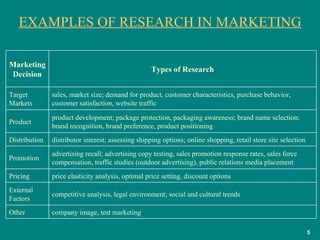
EXAMPLES OF RESEARCH IN MARKETING company image, test marketing Other competitive analysis, legal environment; social and cultural trends External Factors price elasticity analysis, optimal price setting, discount options Pricing advertising recall; advertising copy testing, sales promotion response rates, sales force compensation, traffic studies (outdoor advertising), public relations media placement Promotion distributor interest; assessing shipping options; online shopping, retail store site selection Distribution product development; package protection, packaging awareness; brand name selection; brand recognition, brand preference, product positioning Product sales, market size; demand for product, customer characteristics, purchase behavior, customer satisfaction, website traffic Target Markets Types of Research Marketing Decision
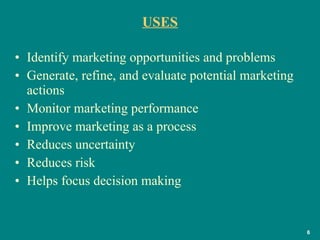
USES Identify marketing opportunities and problems Generate, refine, and evaluate potential marketing actions Monitor marketing performance Improve marketing as a process Reduces uncertainty Reduces risk Helps focus decision making
OVERVIEW OF THE MARKETING RESEARCH PROCESS Why should we do research? What research should be done? Is it worth doing the research? How should the research be designed to achieve the research objectives? What will we do with the research?
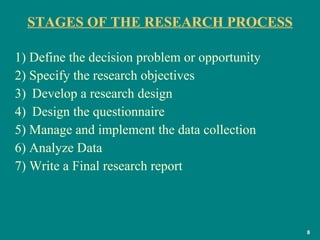
STAGES OF THE RESEARCH PROCESS 1) Define the decision problem or opportunity 2) Specify the research objectives Develop a research design Design the questionnaire  5) Manage and implement the data collection 6) Analyze Data 7) Write a Final research report
PROBLEM DEFINITION Problem means management problem “ A problem well-defined is half solved”  Identifying and defining the problem or opportunity is a crucial first step in the marketing research process. When defining the problem, it is important to think broadly about the possible causes. Defining the Problem Results in Clear Cut Research Objectives. Marketing problems may be difficulty-related or opportunity-related. For both, the prerequisite of defining the problem is to identify and diagnose it.
SPECIFY THE RESEARCH OBJECTIVES What specific information should the project provide?  If more than one type of information will be developed from   the study, which is the most important? and  What are the priorities?  When specifying research objectives, development of    hypotheses, might be very helpful. When achieved, objectives provide the necessary information    to solve the problem.
DEVELOP A RESEARCH DESIGN A research design is a framework or blueprint for conducting the marketing research project.
DESIGN THE QUESTIONNAIRE Questionnaire design is one of the basic building blocks of marketing research. Its first and prime role is to draw accurate information from the respondent. There are 3 different types of Question Classifications: Behavioral Attitudinal Classification
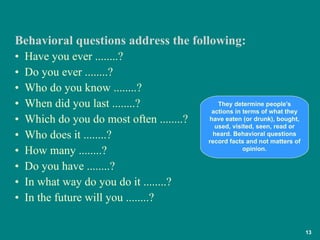
•  Have you ever ........? •  Do you ever ........? •  Who do you know ........? •  When did you last ........? •  Which do you do most often ........? •  Who does it ........? •  How many ........? •  Do you have ........? •  In what way do you do it ........? •  In the future will you ........? Behavioral questions address the following: They determine people's actions in terms of what they have eaten (or drunk), bought, used, visited, seen, read or heard. Behavioral questions record facts and not matters of opinion.
What do you think of ........? Why do you ........? Do you agree of disagree ........? How do you rate ........? Which is best (or worst) for ........? Attitudinal questions address the following: Attitudes are opinions or basic beliefs which people have about the products they buy, the companies they deal with and it is attitudes that motivates people in their actions.
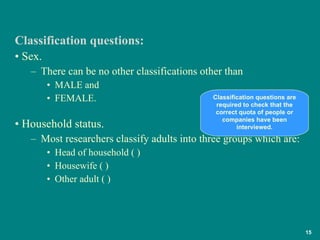
Sex.  There can be no other classifications other than  MALE and  FEMALE. Household status.  Most researchers classify adults into three groups which are: Head of household ( ) Housewife ( ) Other adult ( ) Classification questions: Classification questions are required to check that the correct quota of people or companies have been interviewed.
MANAGE AND IMPLEMENT THE DATA COLLECTION This process includes field work and desk work for collecting all    relevant data and information Field work includes interviewing the personals by interacting    them face to face by visiting them in home or offices or arranging    group meetings at any preferred place. Desk work includes contacting personals over telephone or via    series of emails and web meetings.
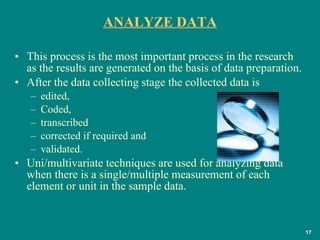
ANALYZE DATA This process is the most important process in the research as the results are generated on the basis of data preparation.  After the data collecting stage the collected data is  edited,  Coded,  transcribed corrected if required and  validated. Uni/multivariate techniques are used for analyzing data when there is a single/multiple measurement of each element or unit in the sample data.
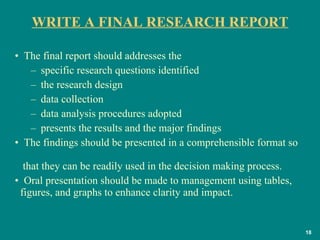
WRITE A FINAL RESEARCH REPORT The final report should addresses the  specific research questions identified  the research design  data collection  data analysis procedures adopted  presents the results and the major findings  The findings should be presented in a comprehensible format so    that they can be readily used in the decision making process. Oral presentation should be made to management using tables,    figures, and graphs to enhance clarity and impact.
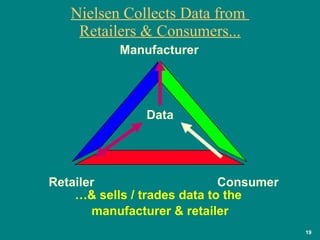
Nielsen Collects Data from  Retailers & Consumers... … & sells / trades data to the  manufacturer & retailer Consumer Manufacturer Retailer Data
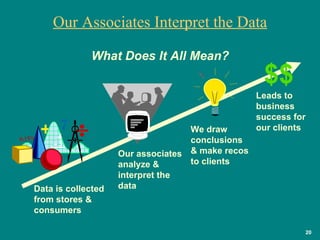
Our Associates Interpret the Data Data is collected from stores & consumers  Our associates analyze & interpret the data We draw conclusions  & make recos to clients $$ Leads to business success for our clients What Does It All Mean?
Thank You

Marketing research process

  • 1.
  • 2.
    Marketing Research: DefinitionMany definitions of Marketing Research: “ Marketing research is the systematic design, collection, analysis and reporting of data and findings relevant to a specific marketing situation facing the company.” Marketing research is the process of designing, gathering, analyzing, and reporting information that may be used to solve a specific marketing problem.
  • 3.
    Need For MarketingResearch Why do businesses need accurate and up-to-date information? To undertake marketing effectively Changes in technology Changes in consumer tastes Market demand Changes in the product ranges of competitors Changes in economic conditions Distribution channels
  • 4.
    Purpose Of MarketingResearch Gain a more detailed understanding of consumers’ needs: e.g., views on products’ prices, packaging, recent advertising campaigns Reduce the risk of product/business failure: there is no guarantee that any new idea will be a commercial success Can help to achieve commercial success Forecast future trends: it can also be used to anticipate future customer needs
  • 5.
    EXAMPLES OF RESEARCHIN MARKETING company image, test marketing Other competitive analysis, legal environment; social and cultural trends External Factors price elasticity analysis, optimal price setting, discount options Pricing advertising recall; advertising copy testing, sales promotion response rates, sales force compensation, traffic studies (outdoor advertising), public relations media placement Promotion distributor interest; assessing shipping options; online shopping, retail store site selection Distribution product development; package protection, packaging awareness; brand name selection; brand recognition, brand preference, product positioning Product sales, market size; demand for product, customer characteristics, purchase behavior, customer satisfaction, website traffic Target Markets Types of Research Marketing Decision
  • 6.
    USES Identify marketingopportunities and problems Generate, refine, and evaluate potential marketing actions Monitor marketing performance Improve marketing as a process Reduces uncertainty Reduces risk Helps focus decision making
  • 7.
    OVERVIEW OF THEMARKETING RESEARCH PROCESS Why should we do research? What research should be done? Is it worth doing the research? How should the research be designed to achieve the research objectives? What will we do with the research?
  • 8.
    STAGES OF THERESEARCH PROCESS 1) Define the decision problem or opportunity 2) Specify the research objectives Develop a research design Design the questionnaire 5) Manage and implement the data collection 6) Analyze Data 7) Write a Final research report
  • 9.
    PROBLEM DEFINITION Problemmeans management problem “ A problem well-defined is half solved” Identifying and defining the problem or opportunity is a crucial first step in the marketing research process. When defining the problem, it is important to think broadly about the possible causes. Defining the Problem Results in Clear Cut Research Objectives. Marketing problems may be difficulty-related or opportunity-related. For both, the prerequisite of defining the problem is to identify and diagnose it.
  • 10.
    SPECIFY THE RESEARCHOBJECTIVES What specific information should the project provide? If more than one type of information will be developed from the study, which is the most important? and What are the priorities? When specifying research objectives, development of hypotheses, might be very helpful. When achieved, objectives provide the necessary information to solve the problem.
  • 11.
    DEVELOP A RESEARCHDESIGN A research design is a framework or blueprint for conducting the marketing research project.
  • 12.
    DESIGN THE QUESTIONNAIREQuestionnaire design is one of the basic building blocks of marketing research. Its first and prime role is to draw accurate information from the respondent. There are 3 different types of Question Classifications: Behavioral Attitudinal Classification
  • 13.
    • Haveyou ever ........? • Do you ever ........? • Who do you know ........? • When did you last ........? • Which do you do most often ........? • Who does it ........? • How many ........? • Do you have ........? • In what way do you do it ........? • In the future will you ........? Behavioral questions address the following: They determine people's actions in terms of what they have eaten (or drunk), bought, used, visited, seen, read or heard. Behavioral questions record facts and not matters of opinion.
  • 14.
    What do youthink of ........? Why do you ........? Do you agree of disagree ........? How do you rate ........? Which is best (or worst) for ........? Attitudinal questions address the following: Attitudes are opinions or basic beliefs which people have about the products they buy, the companies they deal with and it is attitudes that motivates people in their actions.
  • 15.
    Sex. Therecan be no other classifications other than MALE and FEMALE. Household status. Most researchers classify adults into three groups which are: Head of household ( ) Housewife ( ) Other adult ( ) Classification questions: Classification questions are required to check that the correct quota of people or companies have been interviewed.
  • 16.
    MANAGE AND IMPLEMENTTHE DATA COLLECTION This process includes field work and desk work for collecting all relevant data and information Field work includes interviewing the personals by interacting them face to face by visiting them in home or offices or arranging group meetings at any preferred place. Desk work includes contacting personals over telephone or via series of emails and web meetings.
  • 17.
    ANALYZE DATA Thisprocess is the most important process in the research as the results are generated on the basis of data preparation. After the data collecting stage the collected data is edited, Coded, transcribed corrected if required and validated. Uni/multivariate techniques are used for analyzing data when there is a single/multiple measurement of each element or unit in the sample data.
  • 18.
    WRITE A FINALRESEARCH REPORT The final report should addresses the specific research questions identified the research design data collection data analysis procedures adopted presents the results and the major findings The findings should be presented in a comprehensible format so that they can be readily used in the decision making process. Oral presentation should be made to management using tables, figures, and graphs to enhance clarity and impact.
  • 19.
    Nielsen Collects Datafrom Retailers & Consumers... … & sells / trades data to the manufacturer & retailer Consumer Manufacturer Retailer Data
  • 20.
    Our Associates Interpretthe Data Data is collected from stores & consumers Our associates analyze & interpret the data We draw conclusions & make recos to clients $$ Leads to business success for our clients What Does It All Mean?
  • 21.

Editor's Notes

  • #3 5
  • #20 We collect data/information from the retailer & from consumers & we sell this information to the manufacturer & back to the retailer.