PRESENTATION
ON
“STEPS OF MARKETING
RESEARCH PROCESS”
ENTREPRENEURSHIP
SUBMITTED BY:
HIMANSHI GUPTA (140120119057)/ ME/A2
GUIDED BY:
PROF. NILESH GUPTA
(2181923)
GANDHINAGAR INSTITUTE OF TECHNOLOGY
MARKETING RESEARCH:
DEFINITION
• “ Marketing research is the systematic design, collection,
analysis and reporting of data and findings relevant to a
specific marketing situation facing the company.”
• Marketing research is the process of designing, gathering,
analyzing, and reporting information that may be used to
solve a specific marketing problem.
NEED FOR MARKETING
RESEARCH
• To undertake marketing effectively
• Changes in technology
• Changes in consumer tastes
• Market demand
• Changes in the product ranges of competitors
• Changes in economic conditions
• Distribution channels
PURPOSE OF MARKETING
RESEARCH
• Gain a more detailed understanding of consumers’ needs:
Example: views on products prices, packaging, recent
advertising campaigns
• Reduce the risk of product/business failure: There is no
guarantee that any new idea will be a commercial
success
- Can help to achieve commercial success
• Forecast future trends: It can also be used to anticipate
future customer needs
USES
• Identify marketing opportunities and problems
• Generate, refine, and evaluate potential marketing actions
• Monitor marketing performance
• Improve marketing as a process
• Reduces uncertainty
• Reduces risk
• Helps focus decision making
OVERVIEW OF THE MARKETING
RESEARCH PROCESS
• Why should we do research?
• What research should be done?
• Is it worth doing the research?
• How should the research be designed to achieve the
research objectives?
• What will we do with the research?
STEPS IN THE MARKETING
RESEARCH PROCESS
1. Establish the need for the marketing research
2. Define the problem
3. Establish research objectives
4. Determine the research design
5. Identify information types and sources
6. Determine the methods of accessing data
7. Design data collection forms
8. Determine sample plan and size
9. Collect data
10. Data processing and analysis
11. Formulating conclusion, preparing and presenting the report
STEP 1: ESTABLISH THE NEED FOR
MARKETING RESEARCH
• A good monitoring system will alert the marketing manager to a
problem that can be attacked by marketing research.
• Regardless of the monitoring system used a good monitoring
system constantly searches for hints that the companies marketing
mix may be out of “sync” in the market place.
• Marketing research may not be needed if
 Information is already available
 There is insufficient time for marketing research
 Resources are not available
 Costs outweigh the value of the research
STEP 2: DEFINE THE PROBLEM
• “A problem well-defined is half solved”
• Identifying and defining the problem or opportunity is a
crucial first step in the marketing research process
• When defining the problem, it is important to think broadly
about the possible causes.
• Defining the Problem Results in Clear Cut Research
Objectives.
• Problem definition involves:
 Specifying the symptoms
 Itemizing the possible causes of the symptoms
 Listing the reasonable alternative courses of action that the
marketing manager can undertake to solve the problem
STEP 3: ESTABLISH THE
RESEARCH OBJECTIVES
• What specific information should the project provide?
• If more than one type of information will be developed from
the study, which is the most important?
• What are the priorities?
• When specifying research objectives, development of
hypotheses, might be very helpful.
• When achieved, objectives provide the necessary
information to solve the problem.
STEP 4: DETERMINE RESEARCH
DESIGN
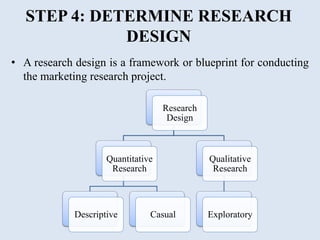
• A research design is a framework or blueprint for conducting
the marketing research project.
Research
Design
Quantitative
Research
Descriptive Casual
Qualitative
Research
Exploratory
 Exploratory Research Design: It is defined as collecting information
in an unstructured and informal manner.
• Examples: Reading periodicals, visiting competitors premises, examine
company sales and profits vs. industry sales and profit, clipping service.
 Descriptive Research Design: It refers to a set of methods and
procedure that describe marketing variables.
• Portray these variables by answering who, what, why and how
questions.
• Example: consumer attitude survey to your companies services.
 Casual Research Design: It allows us to isolate causes and their
effects.
• Casual research is conducted by controlling various factors to
determine which factor is causing the problem.
• By changing one factor, say price, we can monitor its effect on a key
consequence, such as sales.
• In other words, casual design allows us to determine causality, or which
variable is causing another variable to change.
STEP 5: IDENTIFY INFORMATION
TYPES AND SOURCES
• There are two types of market research that can be performed:
 Primary Research: It involves collecting information from sources
directly by conducting interviews and surveys, and by talking to
customers and established businesses
• It refers to information that has been gathered specifically to serve
the research objectives at hand
 Secondary Research: It involves collecting information from
sources where the primary research has already been conducted.
Such information includes industry statistics, market research
reports, news paper articles, etc.
• As the name implies, it refers to information that has been collected
for some other purpose.
STEP 6: DETERMINE METHODS OF
ACCESSING DATA
• Once the researcher has determined which type or types of information
are needed, he or she must determine methods of accessing data.
• There are several different methods of collecting primary data including:
 Telephone surveys
 Mail surveys
 Door-to-door interviews
 Mall-intercept studies
 New data collection methods are emerging
• Different methods of collecting secondary data includes:
 Information processing technology.
 Easy and Quick retrieval.
 Internal data- company reports, salespersons, executives, MIS and other
information sources.
STEP 7: DESIGN DATA COLLECTION
FORMS
 Questionnaire:
• It is a set of questions presented to a respondent
• Records the information communicated by respondents or the
respondent’s behavior as observed by the researcher
• Structured Questionnaires: List questions that have pre-specified answer
choices.
• Unstructured questionnaires: Have open ended questions and/or questions
that are asked based on a response.
 Qualitative measures:
• Sometimes, consumer response does not match their answers. Thus,
unstructured techniques are used. For example, consumer journey is a
technique of keeping track of all the interactions of a consumer with a
product service or space.
 Mechanical devices:
• Electronic devices have replaced questionnaires and diary filling methods.
For example, galvanometer can measure the interest or emotion of a
person on watching a picture or an advertisement.
STEP 8: DETERMINE SAMPLE
PLAN AND SIZE
• Here, a researcher has to plan the sampling unit, procedure
and size.
• It is not possible to interview each and every person.
• Therefore, the researcher must define the target population
from which sample has to be drawn.
• The researcher has to choose between probability and non-
probability sampling.
• The choice is based on circumstances facing the company
and research work.
• A good sampling procedure can provide good reliability.
• A sample plan identifies who is to be sampled and how to
select them for study.
• A sample element refers to a unit of the entity being studied.
• A sample frame is a list from which the sample elements are
drawn for the sample.
• A sample plan specify how to draw the sample elements from
the sample plan.
• Methods are available to help the researcher determine the
sample size required for the research study.
STEP 9: COLLECT DATA
• The collection of data relates to the gathering of facts to be
used in solving the problem.
• Data can be primary, i.e., collected from the original base
through empirical research by means of various tools.
• Data can be secondary, i.e., collected from concerned reports,
magazines and other periodicals, especially written articles,
government publications, company publications, books, etc.
• There can be broadly two types of sources
a) Internal sources: existing within the firm itself, such as
accounting data, salesmen’s reports, etc.
b) External sources: existing outside the firm.
STEP 10: DATA PROCESSING AND
ANALYSIS
• Data processing begins with the editing of data and its coding.
• Editing involves inspecting the data-collection forms for
omission, legibility, and consistency in classification.
• Before tabulation, responses need to be classified into meaningful
categories.
• The rules for categorizing, recording and transferring the data to
‘data storage media’ are called codes. This coding process
facilitates the manual or computer tabulation.
• If computer analysis is being used, the data can be key punched
and verified.
• Analysis of data represents the application of logic to the
understanding of data collected about the subject.
STEP 11: FORMULATING CONCLUSION,
PREPARING AND PRESENTING THE REPORT
• The final report should addresses
 The specific research questions identified
 The research design
 Data collection
 Data analysis procedures adopted
 Present the results and the major findings
• The final report reflects the skills and quality of the researches.
• It can be a written or an oral presentation, or both. Visual aids
such as line chart, pie chart, bar chart, pictographs, etc. can be
used.
• A well-presented report indicates the confidence levels of the
researchers in presenting strategies that help in managerial
decision-making.
SUMMARY
• Virtually all market research projects are different.
• Some are limited to review of secondary data; others require
complex designs involving large scale collection of primary
data.
• Understand the eleven steps of the research process.
• Steps can give researchers an overview of the entire research
process.
• Gives researchers a procedure to follow and a framework.
• Many steps outlined are interactive and the researcher may
decide which ones to use.
THANK YOU 

Steps in marketing research process

  • 1.
    PRESENTATION ON “STEPS OF MARKETING RESEARCHPROCESS” ENTREPRENEURSHIP SUBMITTED BY: HIMANSHI GUPTA (140120119057)/ ME/A2 GUIDED BY: PROF. NILESH GUPTA (2181923) GANDHINAGAR INSTITUTE OF TECHNOLOGY
  • 2.
    MARKETING RESEARCH: DEFINITION • “Marketing research is the systematic design, collection, analysis and reporting of data and findings relevant to a specific marketing situation facing the company.” • Marketing research is the process of designing, gathering, analyzing, and reporting information that may be used to solve a specific marketing problem.
  • 3.
    NEED FOR MARKETING RESEARCH •To undertake marketing effectively • Changes in technology • Changes in consumer tastes • Market demand • Changes in the product ranges of competitors • Changes in economic conditions • Distribution channels
  • 4.
    PURPOSE OF MARKETING RESEARCH •Gain a more detailed understanding of consumers’ needs: Example: views on products prices, packaging, recent advertising campaigns • Reduce the risk of product/business failure: There is no guarantee that any new idea will be a commercial success - Can help to achieve commercial success • Forecast future trends: It can also be used to anticipate future customer needs
  • 5.
    USES • Identify marketingopportunities and problems • Generate, refine, and evaluate potential marketing actions • Monitor marketing performance • Improve marketing as a process • Reduces uncertainty • Reduces risk • Helps focus decision making
  • 6.
    OVERVIEW OF THEMARKETING RESEARCH PROCESS • Why should we do research? • What research should be done? • Is it worth doing the research? • How should the research be designed to achieve the research objectives? • What will we do with the research?
  • 7.
    STEPS IN THEMARKETING RESEARCH PROCESS 1. Establish the need for the marketing research 2. Define the problem 3. Establish research objectives 4. Determine the research design 5. Identify information types and sources 6. Determine the methods of accessing data 7. Design data collection forms 8. Determine sample plan and size 9. Collect data 10. Data processing and analysis 11. Formulating conclusion, preparing and presenting the report
  • 8.
    STEP 1: ESTABLISHTHE NEED FOR MARKETING RESEARCH • A good monitoring system will alert the marketing manager to a problem that can be attacked by marketing research. • Regardless of the monitoring system used a good monitoring system constantly searches for hints that the companies marketing mix may be out of “sync” in the market place. • Marketing research may not be needed if  Information is already available  There is insufficient time for marketing research  Resources are not available  Costs outweigh the value of the research
  • 9.
    STEP 2: DEFINETHE PROBLEM • “A problem well-defined is half solved” • Identifying and defining the problem or opportunity is a crucial first step in the marketing research process • When defining the problem, it is important to think broadly about the possible causes. • Defining the Problem Results in Clear Cut Research Objectives. • Problem definition involves:  Specifying the symptoms  Itemizing the possible causes of the symptoms  Listing the reasonable alternative courses of action that the marketing manager can undertake to solve the problem
  • 10.
    STEP 3: ESTABLISHTHE RESEARCH OBJECTIVES • What specific information should the project provide? • If more than one type of information will be developed from the study, which is the most important? • What are the priorities? • When specifying research objectives, development of hypotheses, might be very helpful. • When achieved, objectives provide the necessary information to solve the problem.
  • 11.
    STEP 4: DETERMINERESEARCH DESIGN • A research design is a framework or blueprint for conducting the marketing research project. Research Design Quantitative Research Descriptive Casual Qualitative Research Exploratory
  • 12.
     Exploratory ResearchDesign: It is defined as collecting information in an unstructured and informal manner. • Examples: Reading periodicals, visiting competitors premises, examine company sales and profits vs. industry sales and profit, clipping service.  Descriptive Research Design: It refers to a set of methods and procedure that describe marketing variables. • Portray these variables by answering who, what, why and how questions. • Example: consumer attitude survey to your companies services.  Casual Research Design: It allows us to isolate causes and their effects. • Casual research is conducted by controlling various factors to determine which factor is causing the problem. • By changing one factor, say price, we can monitor its effect on a key consequence, such as sales. • In other words, casual design allows us to determine causality, or which variable is causing another variable to change.
  • 13.
    STEP 5: IDENTIFYINFORMATION TYPES AND SOURCES • There are two types of market research that can be performed:  Primary Research: It involves collecting information from sources directly by conducting interviews and surveys, and by talking to customers and established businesses • It refers to information that has been gathered specifically to serve the research objectives at hand  Secondary Research: It involves collecting information from sources where the primary research has already been conducted. Such information includes industry statistics, market research reports, news paper articles, etc. • As the name implies, it refers to information that has been collected for some other purpose.
  • 14.
    STEP 6: DETERMINEMETHODS OF ACCESSING DATA • Once the researcher has determined which type or types of information are needed, he or she must determine methods of accessing data. • There are several different methods of collecting primary data including:  Telephone surveys  Mail surveys  Door-to-door interviews  Mall-intercept studies  New data collection methods are emerging • Different methods of collecting secondary data includes:  Information processing technology.  Easy and Quick retrieval.  Internal data- company reports, salespersons, executives, MIS and other information sources.
  • 15.
    STEP 7: DESIGNDATA COLLECTION FORMS  Questionnaire: • It is a set of questions presented to a respondent • Records the information communicated by respondents or the respondent’s behavior as observed by the researcher • Structured Questionnaires: List questions that have pre-specified answer choices. • Unstructured questionnaires: Have open ended questions and/or questions that are asked based on a response.  Qualitative measures: • Sometimes, consumer response does not match their answers. Thus, unstructured techniques are used. For example, consumer journey is a technique of keeping track of all the interactions of a consumer with a product service or space.  Mechanical devices: • Electronic devices have replaced questionnaires and diary filling methods. For example, galvanometer can measure the interest or emotion of a person on watching a picture or an advertisement.
  • 16.
    STEP 8: DETERMINESAMPLE PLAN AND SIZE • Here, a researcher has to plan the sampling unit, procedure and size. • It is not possible to interview each and every person. • Therefore, the researcher must define the target population from which sample has to be drawn. • The researcher has to choose between probability and non- probability sampling. • The choice is based on circumstances facing the company and research work. • A good sampling procedure can provide good reliability.
  • 17.
    • A sampleplan identifies who is to be sampled and how to select them for study. • A sample element refers to a unit of the entity being studied. • A sample frame is a list from which the sample elements are drawn for the sample. • A sample plan specify how to draw the sample elements from the sample plan. • Methods are available to help the researcher determine the sample size required for the research study.
  • 18.
    STEP 9: COLLECTDATA • The collection of data relates to the gathering of facts to be used in solving the problem. • Data can be primary, i.e., collected from the original base through empirical research by means of various tools. • Data can be secondary, i.e., collected from concerned reports, magazines and other periodicals, especially written articles, government publications, company publications, books, etc. • There can be broadly two types of sources a) Internal sources: existing within the firm itself, such as accounting data, salesmen’s reports, etc. b) External sources: existing outside the firm.
  • 19.
    STEP 10: DATAPROCESSING AND ANALYSIS • Data processing begins with the editing of data and its coding. • Editing involves inspecting the data-collection forms for omission, legibility, and consistency in classification. • Before tabulation, responses need to be classified into meaningful categories. • The rules for categorizing, recording and transferring the data to ‘data storage media’ are called codes. This coding process facilitates the manual or computer tabulation. • If computer analysis is being used, the data can be key punched and verified. • Analysis of data represents the application of logic to the understanding of data collected about the subject.
  • 20.
    STEP 11: FORMULATINGCONCLUSION, PREPARING AND PRESENTING THE REPORT • The final report should addresses  The specific research questions identified  The research design  Data collection  Data analysis procedures adopted  Present the results and the major findings • The final report reflects the skills and quality of the researches. • It can be a written or an oral presentation, or both. Visual aids such as line chart, pie chart, bar chart, pictographs, etc. can be used. • A well-presented report indicates the confidence levels of the researchers in presenting strategies that help in managerial decision-making.
  • 21.
    SUMMARY • Virtually allmarket research projects are different. • Some are limited to review of secondary data; others require complex designs involving large scale collection of primary data. • Understand the eleven steps of the research process. • Steps can give researchers an overview of the entire research process. • Gives researchers a procedure to follow and a framework. • Many steps outlined are interactive and the researcher may decide which ones to use.
  • 22.