NIKITA SHARMA
5TH SEM.
 Research is a systematic inquiry that investigates
hypothesis, suggests new interpretations of data or
texts, and poses new questions for future research
to explore.
 Research consists of:-
1. Asking a question that nobody has asked before
2. Doing the necessary work to find the answer
3. Communicating the knowledge you have acquired
to a larger audience.
 Variable is central idea in Research. Simply defined as,
variable is a concept that varies. It can be in Quantity,
Intensity, Amount and Types.
 It takes two or more values.
 Variable is a measurable characteristics that varies. It may
change from group to group, person to person or within
person over time.
 In research science, variable refer to factor or condition that
can change during the course of an experiment.
 Thus, variable is anything that may assume different
numerical and categorical values.
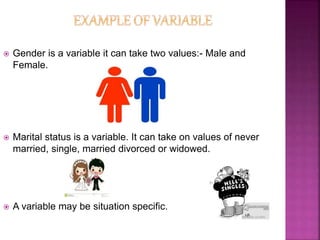
 Gender is a variable it can take two values:- Male and
Female.
 Marital status is a variable. It can take on values of never
married, single, married divorced or widowed.
 A variable may be situation specific.
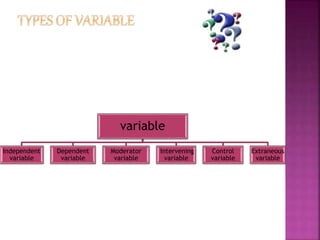
variable
Independent
variable
Dependent
variable
Moderator
variable
Intervening
variable
Control
variable
Extraneous
variable
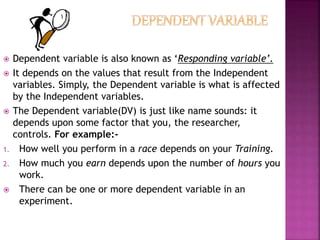
 Dependent variable is also known as ‘Responding variable’.
 It depends on the values that result from the Independent
variables. Simply, the Dependent variable is what is affected
by the Independent variables.
 The Dependent variable(DV) is just like name sounds: it
depends upon some factor that you, the researcher,
controls. For example:-
1. How well you perform in a race depends on your Training.
2. How much you earn depends upon the number of hours you
work.
 There can be one or more dependent variable in an
experiment.
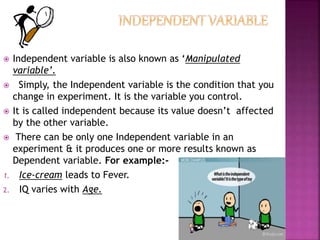
 Independent variable is also known as ‘Manipulated
variable’.
 Simply, the Independent variable is the condition that you
change in experiment. It is the variable you control.
 It is called independent because its value doesn’t affected
by the other variable.
 There can be only one Independent variable in an
experiment & it produces one or more results known as
Dependent variable. For example:-
1. Ice-cream leads to Fever.
2. IQ varies with Age.
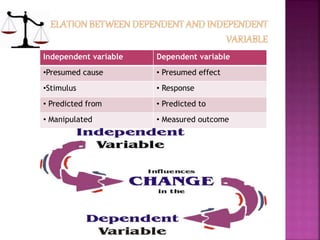
Independent variable Dependent variable
•Presumed cause • Presumed effect
•Stimulus • Response
• Predicted from • Predicted to
• Manipulated • Measured outcome
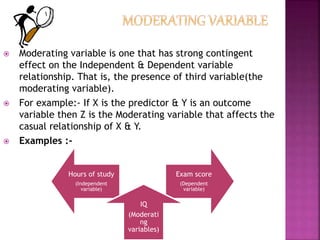
 Moderating variable is one that has strong contingent
effect on the Independent & Dependent variable
relationship. That is, the presence of third variable(the
moderating variable).
 For example:- If X is the predictor & Y is an outcome
variable then Z is the Moderating variable that affects the
casual relationship of X & Y.
 Examples :-
Hours of study
(Independent
variable)
Exam score
(Dependent
variable)
IQ
(Moderati
ng
variables)
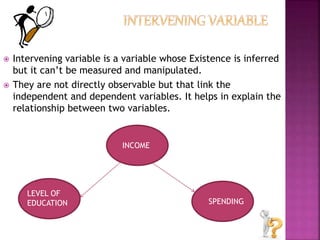
 Intervening variable is a variable whose Existence is inferred
but it can’t be measured and manipulated.
 They are not directly observable but that link the
independent and dependent variables. It helps in explain the
relationship between two variables.
INCOME
LEVEL OF
EDUCATION SPENDING
 Controlled variable is the factor that is kept constant
(unchanged) all throughout the experiment in order to test
the relative relationship of the Interdependent and
dependent variables.
 There are many controlled variables in an experiment. It
strongly influences experimental results. For example:-
Q. If we are testing to see how the amount of light received
affects plant growth:
1. In plant growth experiment, water and fertilizer levels are
constant.
 It is also called “Confounding variables”.
 Extraneous variable are factors in the research which may
have an effect on the Dependent variables but which are not
controlled.
 Extraneous variables are dangerous. They may damage a
study’s validity.
 In other words, these are all variable, which are not the
Independent variable, but could affect the result of the
experiment.
 They are things that influence our result, and are a source of
Error. For instance, if we are testing the influence of temp.
on plant growth, we want to make sure that soil type and
amount of water given are constant; otherwise, they are
extraneous variables.
Variables in research

Variables in research

  • 1.
  • 2.
     Research isa systematic inquiry that investigates hypothesis, suggests new interpretations of data or texts, and poses new questions for future research to explore.  Research consists of:- 1. Asking a question that nobody has asked before 2. Doing the necessary work to find the answer 3. Communicating the knowledge you have acquired to a larger audience.
  • 4.
     Variable iscentral idea in Research. Simply defined as, variable is a concept that varies. It can be in Quantity, Intensity, Amount and Types.  It takes two or more values.  Variable is a measurable characteristics that varies. It may change from group to group, person to person or within person over time.  In research science, variable refer to factor or condition that can change during the course of an experiment.  Thus, variable is anything that may assume different numerical and categorical values.
  • 5.
     Gender isa variable it can take two values:- Male and Female.  Marital status is a variable. It can take on values of never married, single, married divorced or widowed.  A variable may be situation specific.
  • 6.
  • 7.
     Dependent variableis also known as ‘Responding variable’.  It depends on the values that result from the Independent variables. Simply, the Dependent variable is what is affected by the Independent variables.  The Dependent variable(DV) is just like name sounds: it depends upon some factor that you, the researcher, controls. For example:- 1. How well you perform in a race depends on your Training. 2. How much you earn depends upon the number of hours you work.  There can be one or more dependent variable in an experiment.
  • 8.
     Independent variableis also known as ‘Manipulated variable’.  Simply, the Independent variable is the condition that you change in experiment. It is the variable you control.  It is called independent because its value doesn’t affected by the other variable.  There can be only one Independent variable in an experiment & it produces one or more results known as Dependent variable. For example:- 1. Ice-cream leads to Fever. 2. IQ varies with Age.
  • 9.
    Independent variable Dependentvariable •Presumed cause • Presumed effect •Stimulus • Response • Predicted from • Predicted to • Manipulated • Measured outcome
  • 10.
     Moderating variableis one that has strong contingent effect on the Independent & Dependent variable relationship. That is, the presence of third variable(the moderating variable).  For example:- If X is the predictor & Y is an outcome variable then Z is the Moderating variable that affects the casual relationship of X & Y.  Examples :- Hours of study (Independent variable) Exam score (Dependent variable) IQ (Moderati ng variables)
  • 11.
     Intervening variableis a variable whose Existence is inferred but it can’t be measured and manipulated.  They are not directly observable but that link the independent and dependent variables. It helps in explain the relationship between two variables. INCOME LEVEL OF EDUCATION SPENDING
  • 12.
     Controlled variableis the factor that is kept constant (unchanged) all throughout the experiment in order to test the relative relationship of the Interdependent and dependent variables.  There are many controlled variables in an experiment. It strongly influences experimental results. For example:- Q. If we are testing to see how the amount of light received affects plant growth: 1. In plant growth experiment, water and fertilizer levels are constant.
  • 13.
     It isalso called “Confounding variables”.  Extraneous variable are factors in the research which may have an effect on the Dependent variables but which are not controlled.  Extraneous variables are dangerous. They may damage a study’s validity.  In other words, these are all variable, which are not the Independent variable, but could affect the result of the experiment.  They are things that influence our result, and are a source of Error. For instance, if we are testing the influence of temp. on plant growth, we want to make sure that soil type and amount of water given are constant; otherwise, they are extraneous variables.