Classification
• Class 1: Cycadopsida
– It includes fossil and living forms
– Stem is large and stumpy
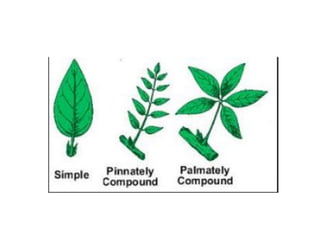
– Large and pinnately compound leaves
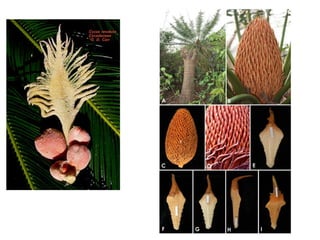
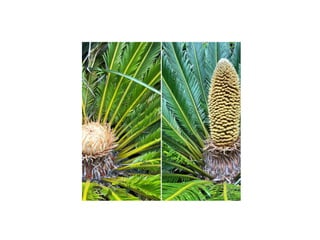
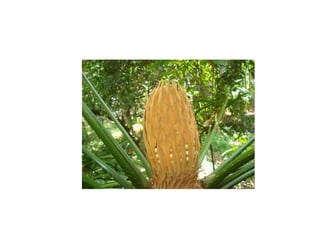
– Male cones are large and compact with simple
microsporophyll
– Female cones are loose or pinnate (leaf-like)
– Megasporophyll is simple and the ovules are large
– Anatomically the stem is with wide cortex
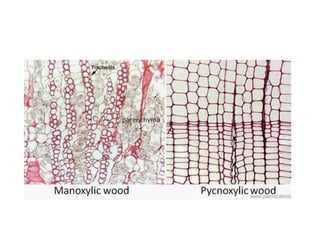
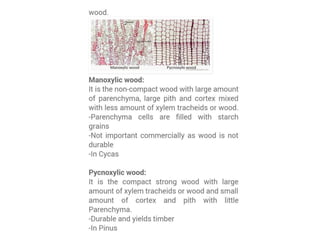
– The wood manoxylic type with large amount of
parenchyma
• It consists of four orders
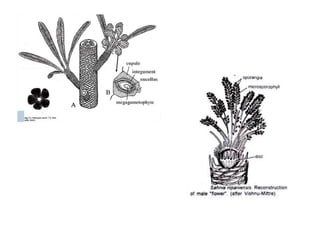
– Pteridospermales
– Bennettitales
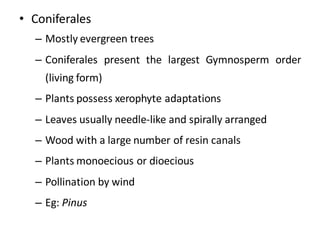
– Pentoxylales
– Cycadales
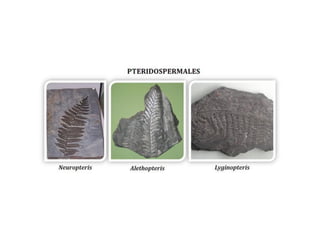
• Pteridospermales
– Are also called cycadofilicales
– They are cycad ferns
– All are extinct ferns
– They appeared in the Devonian period (The Devonian, part of
the Paleozoic era, is otherwise known as the Age of Fishes, as it
spawned a remarkable variety of fish) and abundant in the
carboniferous period
– The morphology and anatomy were similar to that of ferns and
gymnosperms
– Cones not produced
– Ovules are directly borne on the leaf margin
– Eg: Lyginopteris
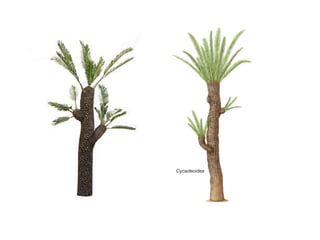
• Bennettitales
– Are also calledas Cycadeoidales
– It is an extinct group
– Appeared in the triassic period (The Mesozoic Era begins with the Triassic
Period. This era is popularly known as the “Age of Reptiles” and for good
reason: reptiles, and particularly dinosaurs, were the dominant land-dwelling
vertebrate animalsat the time)
– Completely extinct in the cretaceous period (The Cretaceous is defined as
the period between 145.5 and 65.5 million years ago,* the last period of the
Mesozoic Era, following the Jurassic and ending with the extinction of the
dinosaurs (except birds).
– Plant body resembles that of living cycads
– Have stout or slender stem
– Reproductiveparts were flower-like
– Cones bisporangiateor monosporangiate
– Eg: Cycadeoidea, Williamsonia
• Pentoxylales
– A completely extinct group
– Plants were shubby
– Stems with five vascular strands
– Each vascular strand with own cambial ring and undergo
secondary thickening
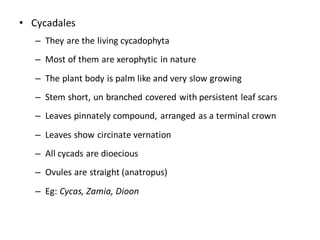
– This group was originally described by Prof. Birbal Sahni
– Female inflorescence with many cones
– Male structure are developed directly on dwarf shoots
– Eg: Pentoxylon, Sahania
• Cycadales
– They are the living cycadophyta
– Most of them are xerophytic in nature
– The plant body is palm like and very slow growing
– Stem short, un branched covered with persistent leaf scars
– Leaves pinnately compound, arranged as a terminal crown
– Leaves show circinate vernation
– All cycads are dioecious
– Ovules are straight (anatropus)
– Eg: Cycas, Zamia, Dioon
• Class II-Coniferopsida
– Members are large, profusely branched tree forms
– Plants with cone like appearance
– Leaves are simple
– Anatomically the pith is small
– Xylem is dense and massive
– The wood is pycnoxylic type
– Male and female strobili compact and contain complex sporophylls
– It consist of four orders
• Cordaitales
• Confierales
• Taxales
• Ginkgoales
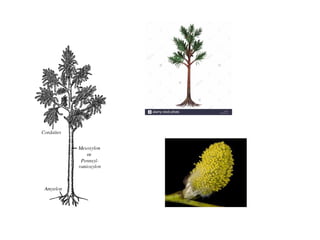
• Cordaitales
– They are the early conifers
– Appeared during the carboniferous period
– All are extinct, no living representatives
– The plants were small tress with star shaped leaves
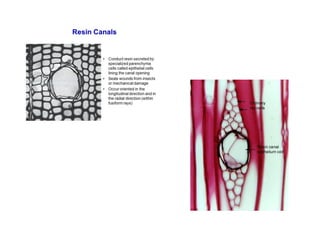
– The reproductive structures were catkin-like clusters
– Eg: Cordaites, Mesoxylon
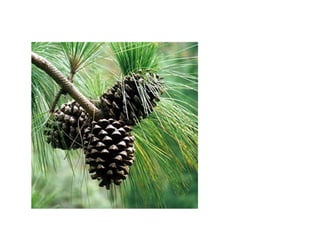
• Coniferales
– Mostly evergreen trees
– Coniferales present the largest Gymnosperm order
(living form)
– Plants possess xerophyte adaptations
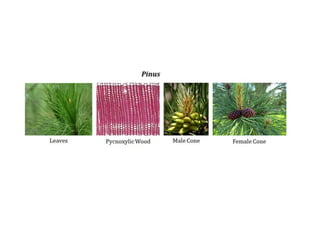
– Leaves usually needle-like and spirally arranged
– Wood with a large number of resin canals
– Plants monoecious or dioecious
– Pollination by wind
– Eg: Pinus
• Ginkgoales
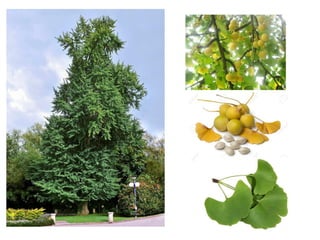
– Consist of only one extinct genus with one
species- Gingko biloba (maindenhair tree)
– Living fossil
– The plant is native to China
– Leaves are broad, bi-lobed with dichotomous
viening
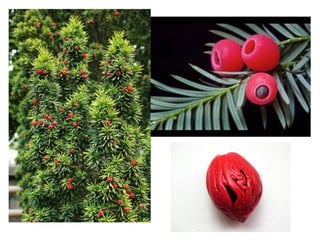
• Taxales
– Members of Taxales are evergreen small tress or
shrubs
– An extensively branched plant
– Leaves simple, solitary, flat and distichous
– Leaf arrangement is spiral
– Secondary wood is picnoxylic
– Ovules are surrounded by arils
– Eg: Taxus
• Gnetopsida
– Shrubs or woody climbers
– Morphologically similar to angiosperm
– Leaves are opposite
– Gnetales are only gymnosperm having wood with vessels
– Embryo dicotyledonous
– Resin canals are absent
– A connecting link between Gymnosperm and angiosperm
– Contain only one order: Gnetales
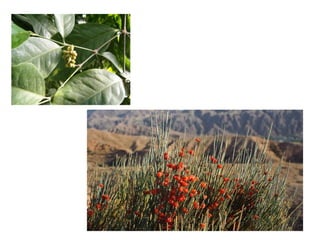
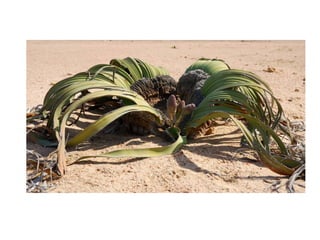
– Eg: Gnetum, Ephedra, Welwitschia
Classification gymnosperms.............pdf