Dr. Parag Moon 
Senior resident 
Dept. of Neurology
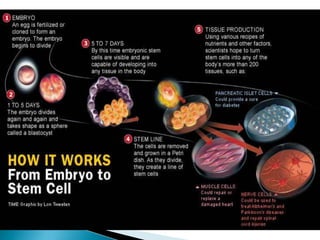
 Stem Cell- cell which can make exact 
copies of itself indefinitely, can 
differentiate, and produce specialized 
cells for various tissues of body 
 Self-renewal and multipotentiality
 Totipotent- can become any kind of cell 
Early Embryonic SC 
 Pluripotent- almost any kind of cell 
Blastocyst Embryonic SC 
 Multipotent- limited range of cell types 
Adult SC: nerve cells, blood cells, muscle 
cells, bone and skin cells.
1. EMBRYONIC STEM CELL 
- from embryos that develop eggs that 
have been fertilized in vitro. 
- not derived from eggs fertilized in a 
woman’s body. 
2. ADULT STEM CELL 
- undifferentiated cell types in a tissue or 
organ. 
- multipotent (limited range of cell type)
(a) capacity to proliferate in culture and large 
numbers of cells can be derived from a 
limited source; 
(b) potential to be harvested from the patients 
themselves; 
(c) ability to migrate and disseminate following 
implantation within the adult CNS;
(d) possible tropism for areas of pathology; 
(e) ease of manipulation using viral and non-viral 
gene transfer methods; 
(f) ability to better integrate into normal brain 
cytoarchitecture with the potential for 
physiologically regulated release of 
substances.
 Derived from the inner cell mass of the 
embryonic blastula 
 Pluripotent with great proliferative potential 
 Risk of teratomas. 
 Majority of research done on mouse derived 
embryonic stem cell 
 Showed promising results in animal studies.
 Human embryonic stem cells been isolated, 
grown in culture with enrichment for neuronal 
lineages with help of growth factors and 
mitogens. 
 When placed in the developing rat brain, can 
migrate widely and differentiate in a site specific 
fashion without the formation of teratomas. 
 The safety of these cells needs further 
investigation 
 Issue of therapeutic cloning is a major concern.
 Derived from the neuroepithelium of the 
developing embryo. 
 Respond in vitro to mitogens such as 
epidermal growth factor (EGF) and fibroblast 
growth factor (FGF2)
 Primarily found in the subependymal layer of 
the ventricular zone and the dentate gyrus of 
the hippocampus and other sites 
 Potential for autologous grafts is possible, 
assuming that the NPCs are not themselves 
involved in the disease process 
 Tried in one pt. with parkinsonism
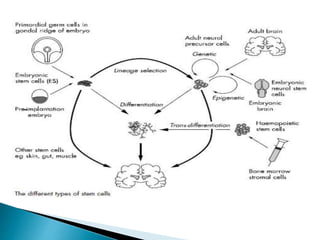
 It is theoretically possible that stem cells 
derived from non-neural system through a 
transdifferentiation process can be used for 
nerve cell therapy. 
 Haematopoietic stem cell transplanted into 
irradiated recipients can differentiate into 
microglia, astrocytes, and possibly neurons
 Some functional benefit in a rodent model of 
Parkinson’s disease when transfected with the 
dopamine synthetic enzyme tyrosine 
hydroxylase 
 Limitation-robustness and efficiency of this 
system to produce neural cells is still poor.
 Reversal of the terminally differentiated cells 
to totipotent or pluripotent cells 
 Achieved using nuclear transplantation, or 
nuclear transfer (NT), procedures (often called 
"cloning"). 
 Error-prone procedure with a very low 
success rate 
 Used to produce patient-specific ES cells 
carrying a genome identical to that of the 
patient
 The capacity to differentiate into cell types 
outside their lineage restrictions. 
 HS cells may be converted into neurons as 
well as germ cells 
 May provide a means to use tissue stem cells 
derived directly from a patient for therapeutic 
purposes
 Proliferation of ENPs in culture is not 
indefinite. 
 “Hayflick limit”-equivalent to approximately 
50 population doublings after which non-transformed 
cells enter replicative senescence 
and stop dividing. 
 Seems to be species dependent,and although 
greater for human than rodent ENPs
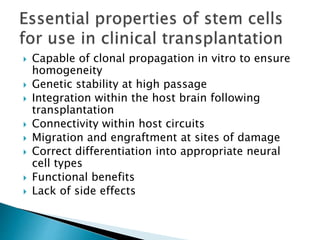
 Capable of clonal propagation in vitro to ensure 
homogeneity 
 Genetic stability at high passage 
 Integration within the host brain following 
transplantation 
 Connectivity within host circuits 
 Migration and engraftment at sites of damage 
 Correct differentiation into appropriate neural 
cell types 
 Functional benefits 
 Lack of side effects
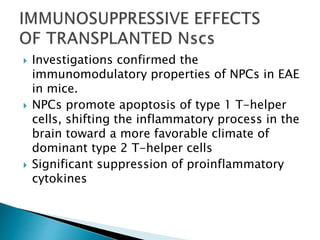
 Investigations confirmed the 
immunomodulatory properties of NPCs in EAE 
in mice. 
 NPCs promote apoptosis of type 1 T-helper 
cells, shifting the inflammatory process in the 
brain toward a more favorable climate of 
dominant type 2 T-helper cells 
 Significant suppression of proinflammatory 
cytokines
 The primary goal of NSC therapy is to replace 
missing cells and tissue. 
 Best targets for stem cell–based therapies-> 
those that would be improved by the 
transplant or induced replacement of a 
limited number of cell types.
 Aim to replace the lost motor neurons with 
those that express normal levels of SMN1. 
 Neural progenitors are not particularly 
migratory and would not be expected to 
spread much from the injection site 
 Multiple injection needed
 ALS- or SMA-specific ESC lines can be 
generated either 
1. engineering 
2. therapeutic cloning
 Dopaminergic fetal cells delivered to brains of 
Parkinson’s patients. 
 Transfer of fetal midbrain progenitors to the 
striatum 
 Two recent double-blind placebo-controlled 
clinical trials -limited efficacy for the 
procedure 
 Limitations- availability limited, the 
transplanted cells are heterogeneous
 Embryonic stem-derived dopaminergic neural 
progenitors 
 Can be produced in great abundance 
 Can be engineered to express additional 
proteins that might assist with survival, 
differentiation, or pathfinding of the new 
neural cells
 Limitation-In vitro, NPCs derived from the 
developing ventral mesencephalon lose the 
ability to spontaneously differentiate into 
dopaminergic cells after only a few divisions 
 Solution-employ ex vivo genetic techniques 
to modify cells prior to implantation to 
express tyrosine hydroxylase
 Transplanting neural stem cells to an injury 
site leads to increased behavioral 
improvement in rats 
 Side effects seen due to the addition of 
inappropriate circuitry 
 Difficulty of preventing scar tissue from 
forming at the site of the transplant which 
hinders growth of neural projection.
 Blindness-stem cells of a particular stage 
when placed into the subretinal space can 
incorporate into the adult retina and form 
functional circuits. 
 Hearing-stem cells with the ability to 
differentiate into new hair cells exist in the 
adult inner ear.
 Oligodendrocytes can develop from adult or 
fetal neural stem cells and from ESCs 
 Oligodendrocyte precursors delivered to the 
nervous system migrate readily and myelinate 
neuronal projections in several disease 
models. 
 Useful in demyelinating disorders. 
 Transplanting the cells intrathecally and 
intraventricularly is a promising approach for 
cell delivery
 Studies using NSCs limited but some evidence 
of appropriate neuronal differentiation with 
human NSCs. 
 Functional efficacy and connectivity of these 
cells in repairing the brain has not been 
demonstrated.
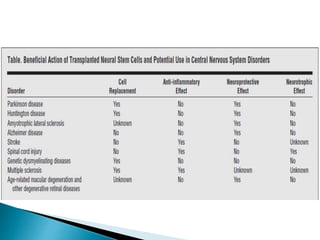
 Transplantation of the MHP36 line (ReNeuron 
holdings) has been reported to ameliorate 
cognitive deficits in rodent models of 
ischaemia. 
 hNT neurons derived from a human 
teratocarcinoma cell line 
 No evidence for tumorigenesis or other 
adverse effects in the 12 patients in the 
phase I study
 The associated neurodegeneration is too 
widespread and diffuse. 
 Therefore unlikely to be ameliorated by 
adding more cells to the system. 
 Disease-specific ESC lines could be used to 
study the degeneration of neurons in vitro.
 Role as efficient and flexible vectors for the 
sustained, local delivery of neuroactive 
compounds to the brain 
1. Neurotrophic factors for neuroprotection 
2. To replace proteins lost because of single 
gene defects
 Inherited neurological conditions attributed 
to the loss of function of a single gene that 
encodes for a metabolically or 
developmentally critical enzyme 
 Tried in mucopolysaccharidosis type VII (MPS 
VII, Morquio).
 NSC’s delivery strategy is attractive compared 
to a viral vector based delivery system 
because 
1. Host brain is not genetically manipulated, 
preventing insertional mutagenesis 
2. Preserving the function of neurons in the 
host. 
 Can be incorporated with “suicide cassette”, 
allowing elimination of cells
 Certain ENPs may show a tropism for areas of 
pathology and can be used for chemotherapy 
 C17.2 NSC line which is highly migratory in 
the adult brain when retrovirally transfected 
to express the anti-mitotic compound 
cytosine Deaminase. 
 Appeared to migrate preferentially towards 
the tumours, which decreased in size
 Stem cells are an attractive option in drug 
discovery process.
 Stem cells and neurological disease:R A 
Barker, M Jain, R J E Armstrong et al; J Neurol 
Neurosurg Psychiatry 2003 74: 553-557 
 The Changing Face of Neural Stem Cell 
Therapy in Neurologic Diseases:Ofira 
Einstein,Tamir Ben-Hur:Arch Neurol. 
2008;65(4):452-456 
 Cell replacement therapy in neurological 
disease:Philos Trans R Soc Lond B Biol Sci. 
2006, 361(1473):1463-1475. 
 Harrisons principle of internal medicine.
Stem cell therapy in neurological diseases

Stem cell therapy in neurological diseases

  • 1.
    Dr. Parag Moon Senior resident Dept. of Neurology
  • 2.
     Stem Cell-cell which can make exact copies of itself indefinitely, can differentiate, and produce specialized cells for various tissues of body  Self-renewal and multipotentiality
  • 3.
     Totipotent- canbecome any kind of cell Early Embryonic SC  Pluripotent- almost any kind of cell Blastocyst Embryonic SC  Multipotent- limited range of cell types Adult SC: nerve cells, blood cells, muscle cells, bone and skin cells.
  • 4.
    1. EMBRYONIC STEMCELL - from embryos that develop eggs that have been fertilized in vitro. - not derived from eggs fertilized in a woman’s body. 2. ADULT STEM CELL - undifferentiated cell types in a tissue or organ. - multipotent (limited range of cell type)
  • 6.
    (a) capacity toproliferate in culture and large numbers of cells can be derived from a limited source; (b) potential to be harvested from the patients themselves; (c) ability to migrate and disseminate following implantation within the adult CNS;
  • 7.
    (d) possible tropismfor areas of pathology; (e) ease of manipulation using viral and non-viral gene transfer methods; (f) ability to better integrate into normal brain cytoarchitecture with the potential for physiologically regulated release of substances.
  • 8.
     Derived fromthe inner cell mass of the embryonic blastula  Pluripotent with great proliferative potential  Risk of teratomas.  Majority of research done on mouse derived embryonic stem cell  Showed promising results in animal studies.
  • 9.
     Human embryonicstem cells been isolated, grown in culture with enrichment for neuronal lineages with help of growth factors and mitogens.  When placed in the developing rat brain, can migrate widely and differentiate in a site specific fashion without the formation of teratomas.  The safety of these cells needs further investigation  Issue of therapeutic cloning is a major concern.
  • 10.
     Derived fromthe neuroepithelium of the developing embryo.  Respond in vitro to mitogens such as epidermal growth factor (EGF) and fibroblast growth factor (FGF2)
  • 11.
     Primarily foundin the subependymal layer of the ventricular zone and the dentate gyrus of the hippocampus and other sites  Potential for autologous grafts is possible, assuming that the NPCs are not themselves involved in the disease process  Tried in one pt. with parkinsonism
  • 12.
     It istheoretically possible that stem cells derived from non-neural system through a transdifferentiation process can be used for nerve cell therapy.  Haematopoietic stem cell transplanted into irradiated recipients can differentiate into microglia, astrocytes, and possibly neurons
  • 13.
     Some functionalbenefit in a rodent model of Parkinson’s disease when transfected with the dopamine synthetic enzyme tyrosine hydroxylase  Limitation-robustness and efficiency of this system to produce neural cells is still poor.
  • 14.
     Reversal ofthe terminally differentiated cells to totipotent or pluripotent cells  Achieved using nuclear transplantation, or nuclear transfer (NT), procedures (often called "cloning").  Error-prone procedure with a very low success rate  Used to produce patient-specific ES cells carrying a genome identical to that of the patient
  • 15.
     The capacityto differentiate into cell types outside their lineage restrictions.  HS cells may be converted into neurons as well as germ cells  May provide a means to use tissue stem cells derived directly from a patient for therapeutic purposes
  • 16.
     Proliferation ofENPs in culture is not indefinite.  “Hayflick limit”-equivalent to approximately 50 population doublings after which non-transformed cells enter replicative senescence and stop dividing.  Seems to be species dependent,and although greater for human than rodent ENPs
  • 18.
     Capable ofclonal propagation in vitro to ensure homogeneity  Genetic stability at high passage  Integration within the host brain following transplantation  Connectivity within host circuits  Migration and engraftment at sites of damage  Correct differentiation into appropriate neural cell types  Functional benefits  Lack of side effects
  • 19.
     Investigations confirmedthe immunomodulatory properties of NPCs in EAE in mice.  NPCs promote apoptosis of type 1 T-helper cells, shifting the inflammatory process in the brain toward a more favorable climate of dominant type 2 T-helper cells  Significant suppression of proinflammatory cytokines
  • 20.
     The primarygoal of NSC therapy is to replace missing cells and tissue.  Best targets for stem cell–based therapies-> those that would be improved by the transplant or induced replacement of a limited number of cell types.
  • 21.
     Aim toreplace the lost motor neurons with those that express normal levels of SMN1.  Neural progenitors are not particularly migratory and would not be expected to spread much from the injection site  Multiple injection needed
  • 22.
     ALS- orSMA-specific ESC lines can be generated either 1. engineering 2. therapeutic cloning
  • 23.
     Dopaminergic fetalcells delivered to brains of Parkinson’s patients.  Transfer of fetal midbrain progenitors to the striatum  Two recent double-blind placebo-controlled clinical trials -limited efficacy for the procedure  Limitations- availability limited, the transplanted cells are heterogeneous
  • 24.
     Embryonic stem-deriveddopaminergic neural progenitors  Can be produced in great abundance  Can be engineered to express additional proteins that might assist with survival, differentiation, or pathfinding of the new neural cells
  • 25.
     Limitation-In vitro,NPCs derived from the developing ventral mesencephalon lose the ability to spontaneously differentiate into dopaminergic cells after only a few divisions  Solution-employ ex vivo genetic techniques to modify cells prior to implantation to express tyrosine hydroxylase
  • 26.
     Transplanting neuralstem cells to an injury site leads to increased behavioral improvement in rats  Side effects seen due to the addition of inappropriate circuitry  Difficulty of preventing scar tissue from forming at the site of the transplant which hinders growth of neural projection.
  • 27.
     Blindness-stem cellsof a particular stage when placed into the subretinal space can incorporate into the adult retina and form functional circuits.  Hearing-stem cells with the ability to differentiate into new hair cells exist in the adult inner ear.
  • 28.
     Oligodendrocytes candevelop from adult or fetal neural stem cells and from ESCs  Oligodendrocyte precursors delivered to the nervous system migrate readily and myelinate neuronal projections in several disease models.  Useful in demyelinating disorders.  Transplanting the cells intrathecally and intraventricularly is a promising approach for cell delivery
  • 29.
     Studies usingNSCs limited but some evidence of appropriate neuronal differentiation with human NSCs.  Functional efficacy and connectivity of these cells in repairing the brain has not been demonstrated.
  • 30.

     Transplantation ofthe MHP36 line (ReNeuron holdings) has been reported to ameliorate cognitive deficits in rodent models of ischaemia.  hNT neurons derived from a human teratocarcinoma cell line  No evidence for tumorigenesis or other adverse effects in the 12 patients in the phase I study
  • 31.
     The associatedneurodegeneration is too widespread and diffuse.  Therefore unlikely to be ameliorated by adding more cells to the system.  Disease-specific ESC lines could be used to study the degeneration of neurons in vitro.
  • 32.
     Role asefficient and flexible vectors for the sustained, local delivery of neuroactive compounds to the brain 1. Neurotrophic factors for neuroprotection 2. To replace proteins lost because of single gene defects
  • 33.
     Inherited neurologicalconditions attributed to the loss of function of a single gene that encodes for a metabolically or developmentally critical enzyme  Tried in mucopolysaccharidosis type VII (MPS VII, Morquio).
  • 34.
     NSC’s deliverystrategy is attractive compared to a viral vector based delivery system because 1. Host brain is not genetically manipulated, preventing insertional mutagenesis 2. Preserving the function of neurons in the host.  Can be incorporated with “suicide cassette”, allowing elimination of cells
  • 35.
     Certain ENPsmay show a tropism for areas of pathology and can be used for chemotherapy  C17.2 NSC line which is highly migratory in the adult brain when retrovirally transfected to express the anti-mitotic compound cytosine Deaminase.  Appeared to migrate preferentially towards the tumours, which decreased in size
  • 36.
     Stem cellsare an attractive option in drug discovery process.
  • 38.
     Stem cellsand neurological disease:R A Barker, M Jain, R J E Armstrong et al; J Neurol Neurosurg Psychiatry 2003 74: 553-557  The Changing Face of Neural Stem Cell Therapy in Neurologic Diseases:Ofira Einstein,Tamir Ben-Hur:Arch Neurol. 2008;65(4):452-456  Cell replacement therapy in neurological disease:Philos Trans R Soc Lond B Biol Sci. 2006, 361(1473):1463-1475.  Harrisons principle of internal medicine.