
PARKINSON DISEASE- SPECIFIC 
INDUCED PLURIPOTENT STEM 
CELLS 
By: Sara Camille Díaz Méndez 
Rise Program
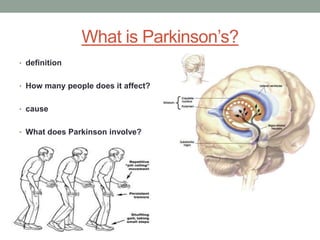
What is Parkinson’s? 
• definition 
• How many people does it affect? 
• cause 
• What does Parkinson involve?
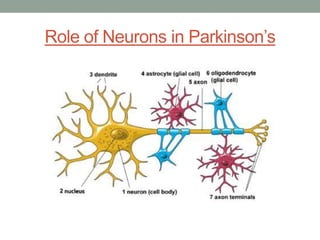
Role of Neurons in Parkinson’s
Parkinson’s Disease 
 neurological disorders (Wicks 2008) 
- slowness (bradykinesia) 
- stiffness 
- tremor 
 mean age onset: 60’s-70’s (Wicks 2008) 
- 10% of patients before 40 
- known as “young onset” PD (YOPD) 
 non-motor symptoms (Wicks 2008) 
- apathy, hallucinations 
- depression, anxiety 
- constipation, bladder urgency
The use of stem cells for Parkinson 
treatment 
• Stem cells are a renewable source of tissue that can be coaxed 
to become different cell types of the body. (Fox 2009) 
• How are they created?
Neurons derived from reprogrammed fibroblasts functionally integrate 
into the fetal brain and improve symptoms of rats with Parkinson's 
disease 
• Embryonic stem (ES) cells 
• What is the problem? 
• possible solution 
• article #1
Neurons derived from reprogrammed fibroblasts functionally integrate into the 
fetal brain and improve symptoms of rats with Parkinson's disease 
Keywords 
 embryonic stem cells 
 reprogramming 
 cell transplantation 
 Tyrosine hydroxylase (TH) 
• somatic cell nuclear transfer - embryonic stem cells (SCNT-ES) 
• therapeutic potential 
• “In vitro reprogramming of mouse fibroblasts into pluripotent stem cells (iPS) 
was achieved through retroviral transduction of the four transcription factors 
(Oct4, Sox2, c-Myc and Klf4) and selection for reactivation of the ES cell marker 
gene Fbx15.” (Werning et all 2008)
Neurons derived from reprogrammed fibroblasts functionally integrate into 
the fetal brain and improve symptoms of rats with Parkinson's disease 
• migratory capacity 
• “Our data shows that iPS cell-derived neurons synaptically integrate 
after transplantation into the fetal mouse brain and function after 
transplantation into the adult brain in a rat model of Parkinson’s 
disease.” (Werning et all 2008)
Results 
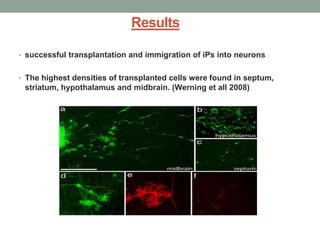
• successful transplantation and immigration of iPs into neurons 
• The highest densities of transplanted cells were found in septum, 
striatum, hypothalamus and midbrain. (Werning et all 2008)
Functional Recovery of Parkinsonian Rats After Transplantation 
of iPS Cell-Derived Midbrain Dopamine Neurons. 
• “Electrophysiological recordings from brain slices prepared 
from transplanted animals were used to examine functional 
neuronal properties in the engrafted cells.” (Werning et all 2008) 
• reprogrammed fibroblasts were differentiated into dopamine 
neurons 
• fourth week- no TH-positive elements present in the Substantia 
Nigra
Functional Recovery of Parkinsonian Rats After Transplantation 
of iPS Cell-Derived Midbrain Dopamine Neurons. 
• fourth week: Large number of TH-positive cells were 
found in the striatum 
• TH- immunoreactive fibers were present 
• four of five transplanted animals showed a marked 
recovery
Conclusion 
• Findings demonstrate that direct reprogramming is 
functionally equivalent to “therapeutic cloning” by nuclear 
transfer but future investigations need to be done in order 
eliminated complications before this technique can be 
safely applied in humans.
What is the future for stem cell research? 
• Long-term studies are awaited to determine whether 
the transplanted stem cells will eventually degenerate 
much like the natural dopamine cells affected by the 
ongoing Parkinson’s process.
Cited Literature: 
• 1. Lerou PH, Daley GQ. Therapeutic potential of embryonic stem cells. Blood Rev. 2005;19:321–331 
• 2. Hochedlinger K, Jaenisch R. Nuclear transplantation, embryonic stem cells, and the potential for cell therapy. N Engl J Med. 
2003;349:275–286. 
• 3. Jaenisch R. Human cloning: The science and ethics of nuclear transplantation. N Engl J Med. 2004;351:2787–2791. 
• 4. Werning IL. Medicine: Politic stem cells. Nature. 2006;439:145–147. 
• 5. Rideout WM, III, Hochedlinger K, Kyba M, Daley GQ, Jaenisch R. Correction of a genetic defect by nuclear transplantation and combined 
cell and gene therapy. Cell. 2002;109:17–27. 
• 6. Wakayama T, et al. Differentiation of embryonic stem cell lines generated from adult somatic cells by nuclear transfer. Science. 
2001;292:740–743. 
• 7. Wicks T, et al. Neural subtype specification of fertilization and nuclear transfer embryonic stem cells and application in parkinsonian mice. 
Nat Biotechnol. 2008;21:1200–1207. 
• 8. Takahashi K, Yamanaka S. Induction of pluripotent stem cells from mouse embryonic and adult fibroblast cultures by defined factors. Cell. 
2006;126:663–676. 
• 9. Maherali N, et al. Global epigenetic remodeling in directly reprogrammed fibroblasts Cell. Stem Cell. 2007;1:55–70. 
• 10. Okita K, Ichisaka T, Yamanaka S. Generation of germline-competent induced pluripotent stem cells. Nature. 2007;448:313–317. 11. 
Wernig M, et al. In vitro reprogramming of fibroblasts into a pluripotent ES-cell-like state. Nature. 2007;448:318–324. 
• 12. Meissner A, Wernig M, Jaenisch R. Direct reprogramming of genetically unmodified fibroblasts into pluripotent stem cells. Nat 
Biotechnol. 2007;25:1177–1181. 
• 13. Hanna J, et al. Treatment of sickle cell anemia mouse model with iPS cells generated from autologous skin. Science. 2007;318:1920– 
1923. 
• 14. Lindvall O, Kokaia Z. Stem cells for the treatment of neurological disorders. Nature. 2006;441:1094–1096. 
• 15. Winkler C, Kirik D, Bjorklund A. Cell transplantation in Parkinson's disease: How can we make it work? Trends Neurosci. 2005;28:86–92. 
• 16. Isacson O. The production and use of cells as therapeutic agents in neurodegenerative diseases. Lancet Neurol. 2003;2:417–424. 
• 17. Parish CL, et al. Wnt5a-treated midbrain neural stem cells improve dopamine cell replacement therapy in parkinsonian mice. J Clin 
Invest. 2008;118:149–160. 
• 18. Bjorklund LM, Isacson O. Regulation of dopamine cell type and transmitter function in fetal and stem cell transplantation for Parkinson's 
disease. Prog Brain Res. 2002;138:411–420
Review paper presentation

Review paper presentation

  • 1.
    PARKINSON DISEASE- SPECIFIC INDUCED PLURIPOTENT STEM CELLS By: Sara Camille Díaz Méndez Rise Program
  • 2.
    What is Parkinson’s? • definition • How many people does it affect? • cause • What does Parkinson involve?
  • 3.
    Role of Neuronsin Parkinson’s
  • 4.
    Parkinson’s Disease neurological disorders (Wicks 2008) - slowness (bradykinesia) - stiffness - tremor  mean age onset: 60’s-70’s (Wicks 2008) - 10% of patients before 40 - known as “young onset” PD (YOPD)  non-motor symptoms (Wicks 2008) - apathy, hallucinations - depression, anxiety - constipation, bladder urgency
  • 5.
    The use ofstem cells for Parkinson treatment • Stem cells are a renewable source of tissue that can be coaxed to become different cell types of the body. (Fox 2009) • How are they created?
  • 6.
    Neurons derived fromreprogrammed fibroblasts functionally integrate into the fetal brain and improve symptoms of rats with Parkinson's disease • Embryonic stem (ES) cells • What is the problem? • possible solution • article #1
  • 7.
    Neurons derived fromreprogrammed fibroblasts functionally integrate into the fetal brain and improve symptoms of rats with Parkinson's disease Keywords  embryonic stem cells  reprogramming  cell transplantation  Tyrosine hydroxylase (TH) • somatic cell nuclear transfer - embryonic stem cells (SCNT-ES) • therapeutic potential • “In vitro reprogramming of mouse fibroblasts into pluripotent stem cells (iPS) was achieved through retroviral transduction of the four transcription factors (Oct4, Sox2, c-Myc and Klf4) and selection for reactivation of the ES cell marker gene Fbx15.” (Werning et all 2008)
  • 8.
    Neurons derived fromreprogrammed fibroblasts functionally integrate into the fetal brain and improve symptoms of rats with Parkinson's disease • migratory capacity • “Our data shows that iPS cell-derived neurons synaptically integrate after transplantation into the fetal mouse brain and function after transplantation into the adult brain in a rat model of Parkinson’s disease.” (Werning et all 2008)
  • 9.
    Results • successfultransplantation and immigration of iPs into neurons • The highest densities of transplanted cells were found in septum, striatum, hypothalamus and midbrain. (Werning et all 2008)
  • 10.
    Functional Recovery ofParkinsonian Rats After Transplantation of iPS Cell-Derived Midbrain Dopamine Neurons. • “Electrophysiological recordings from brain slices prepared from transplanted animals were used to examine functional neuronal properties in the engrafted cells.” (Werning et all 2008) • reprogrammed fibroblasts were differentiated into dopamine neurons • fourth week- no TH-positive elements present in the Substantia Nigra
  • 11.
    Functional Recovery ofParkinsonian Rats After Transplantation of iPS Cell-Derived Midbrain Dopamine Neurons. • fourth week: Large number of TH-positive cells were found in the striatum • TH- immunoreactive fibers were present • four of five transplanted animals showed a marked recovery
  • 12.
    Conclusion • Findingsdemonstrate that direct reprogramming is functionally equivalent to “therapeutic cloning” by nuclear transfer but future investigations need to be done in order eliminated complications before this technique can be safely applied in humans.
  • 13.
    What is thefuture for stem cell research? • Long-term studies are awaited to determine whether the transplanted stem cells will eventually degenerate much like the natural dopamine cells affected by the ongoing Parkinson’s process.
  • 14.
    Cited Literature: •1. Lerou PH, Daley GQ. Therapeutic potential of embryonic stem cells. Blood Rev. 2005;19:321–331 • 2. Hochedlinger K, Jaenisch R. Nuclear transplantation, embryonic stem cells, and the potential for cell therapy. N Engl J Med. 2003;349:275–286. • 3. Jaenisch R. Human cloning: The science and ethics of nuclear transplantation. N Engl J Med. 2004;351:2787–2791. • 4. Werning IL. Medicine: Politic stem cells. Nature. 2006;439:145–147. • 5. Rideout WM, III, Hochedlinger K, Kyba M, Daley GQ, Jaenisch R. Correction of a genetic defect by nuclear transplantation and combined cell and gene therapy. Cell. 2002;109:17–27. • 6. Wakayama T, et al. Differentiation of embryonic stem cell lines generated from adult somatic cells by nuclear transfer. Science. 2001;292:740–743. • 7. Wicks T, et al. Neural subtype specification of fertilization and nuclear transfer embryonic stem cells and application in parkinsonian mice. Nat Biotechnol. 2008;21:1200–1207. • 8. Takahashi K, Yamanaka S. Induction of pluripotent stem cells from mouse embryonic and adult fibroblast cultures by defined factors. Cell. 2006;126:663–676. • 9. Maherali N, et al. Global epigenetic remodeling in directly reprogrammed fibroblasts Cell. Stem Cell. 2007;1:55–70. • 10. Okita K, Ichisaka T, Yamanaka S. Generation of germline-competent induced pluripotent stem cells. Nature. 2007;448:313–317. 11. Wernig M, et al. In vitro reprogramming of fibroblasts into a pluripotent ES-cell-like state. Nature. 2007;448:318–324. • 12. Meissner A, Wernig M, Jaenisch R. Direct reprogramming of genetically unmodified fibroblasts into pluripotent stem cells. Nat Biotechnol. 2007;25:1177–1181. • 13. Hanna J, et al. Treatment of sickle cell anemia mouse model with iPS cells generated from autologous skin. Science. 2007;318:1920– 1923. • 14. Lindvall O, Kokaia Z. Stem cells for the treatment of neurological disorders. Nature. 2006;441:1094–1096. • 15. Winkler C, Kirik D, Bjorklund A. Cell transplantation in Parkinson's disease: How can we make it work? Trends Neurosci. 2005;28:86–92. • 16. Isacson O. The production and use of cells as therapeutic agents in neurodegenerative diseases. Lancet Neurol. 2003;2:417–424. • 17. Parish CL, et al. Wnt5a-treated midbrain neural stem cells improve dopamine cell replacement therapy in parkinsonian mice. J Clin Invest. 2008;118:149–160. • 18. Bjorklund LM, Isacson O. Regulation of dopamine cell type and transmitter function in fetal and stem cell transplantation for Parkinson's disease. Prog Brain Res. 2002;138:411–420