BY
Marwa Mahmoud Khalifa
Amr Elfeky
Ahmed Elmoughazy
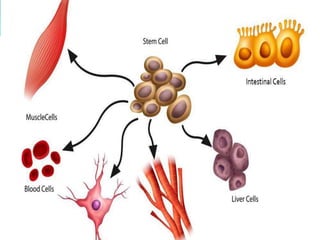
 Undifferentiated cells
 Able to develop into many different cell
types in the body during early life and
growth.
 Serve as a sort of internal repair system,
dividing essentially without limit to
replenish other cells
 Self renewal
 Unspecialized but can give rise to specialized
cells (differentiation)
 In some organs, such as the gut and bone
marrow, stem cells regularly divide. In other
organs, however, such as the pancreas and
the heart, stem cells only divide under
special conditions.
 Embryonic stem cells
 Non-embryonic "somatic" or "adult" stem cells.
 Induced pluripotent stem cells (ipscs)
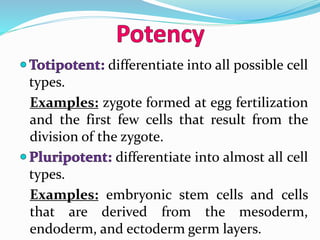
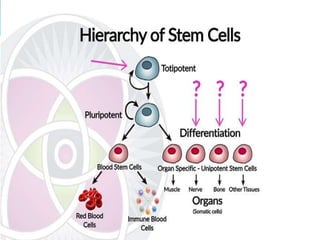
differentiate into all possible cell
types.
Examples: zygote formed at egg fertilization
and the first few cells that result from the
division of the zygote.
differentiate into almost all cell
types.
Examples: embryonic stem cells and cells
that are derived from the mesoderm,
endoderm, and ectoderm germ layers.
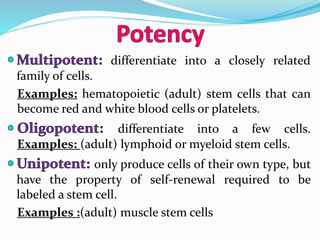
differentiate into a closely related
family of cells.
Examples: hematopoietic (adult) stem cells that can
become red and white blood cells or platelets.
differentiate into a few cells.
Examples: (adult) lymphoid or myeloid stem cells.
only produce cells of their own type, but
have the property of self-renewal required to be
labeled a stem cell.
Examples :(adult) muscle stem cells
 Embryonic stem cells are derived from a four- or
five-day-old human embryo that is in the
blastocyst phase of development, fertilized in
vitro then donated for research purposes with
informed consent of the donors.
 Human embryonic stem cells (hESCs)
are generated by transferring cells from
a preimplantation-stage embryo into a plastic
laboratory culture dish that contains a nutrient
broth known as culture medium.
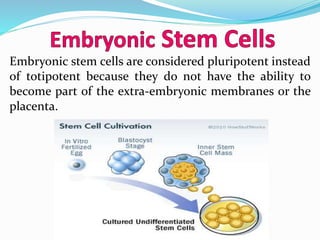
Embryonic stem cells are considered pluripotent instead
of totipotent because they do not have the ability to
become part of the extra-embryonic membranes or the
placenta.
 Adult stem cells supply new cells as an organism grows
and to replace cells that get damaged.
 Adult stem cells are said to be multipotent
Hematopoietic stem cells: give rise to all the types
of blood cells:.
Mesenchymal stem cells: Those from bone
marrow (bone marrow stromal stem cells, skeletal
stem cells) give rise to a variety of cell types: bone cells
(osteoblasts and osteocytes), cartilage cells
(chondrocytes), fat cells (adipocytes), and stromal
cells that support blood formation
 Adult stem cells supply new cells as an organism grows
and to replace cells that get damaged.
 Adult stem cells are said to be multipotent
Neural stem cells: in the brain give rise to its three
major cell types: nerve cells (neurons) and two
categories of non-neuronal cells—astrocytes and
oligodendrocytes.
Epithelial stem cells: in the lining of the digestive
tract in deep crypts and give rise to : absorptive cells,
goblet cells, Paneth cells, and enteroendocrine cells.
 Adult stem cells supply new cells as an organism grows
and to replace cells that get damaged.
 Adult stem cells are said to be multipotent
Skin stem cells: occur in the basal layer of the
epidermis and at the base of hair follicles. The
epidermal stem cells give rise to keratinocytes. The
follicular stem cells can give rise to both the hair
follicle and to the epidermis.
 Embryonic stem cells can become all cell types of the
body because they are pluripotent. Adult stem cells are
thought to be limited to differentiating into different
cell types of their tissue of origin.
 Embryonic stem cells can be grown relatively easily in
culture. Adult stem cells are rare in mature tissues, so
isolating these cells from an adult tissue is
challenging, and methods to expand their numbers
in cell culture have not yet been worked out.
 Adult cells that have been genetically reprogrammed
to an embryonic stem cell–like state by being forced to
express genes and factors important for maintaining
the defining properties of embryonic stem cells.
 Human iPSCs express stem cell markers and are
capable of generating cells characteristic of all
three germ layers.
 Viruses are currently used to introduce the
reprogramming factors into adult cells, and this
process must be carefully controlled and tested before
the technique can lead to useful treatment for
humans.
 Once stem cells have been allowed to divide
and propagate in a controlled culture, the
collection of healthy, dividing, and
undifferentiated cells is called a stem cell line.
 Once under control, the stem cells can be
stimulated to specialize as directed by a
researcher - a process known as directed
differentiation.
Studies of human embryonic stem cells will
yield information about the complex events
that occur during human development
Some of the most serious medical
conditions, such as cancer and birth defects,
are due to abnormal cell
division and differentiation
Human stem cells are currently being used
to test new drugs. Cancer cell lines, for
example, are used to screen potential anti-
tumor drugs.
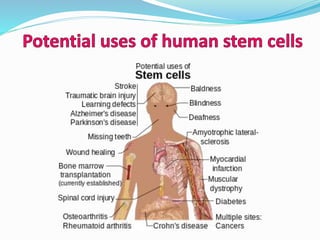
Generation of cells and tissues that could
be used for cell-based therapies.
Stem cells, directed to differentiate into
specific cell types, offer the possibility of a
renewable source of replacement cells and
tissues to treat diseases including
macular degeneration, spinal cord injury,
stroke, burns, heart disease, diabetes,
osteoarthritis, and rheumatoid arthritis.
Stem cells could be used to generate
new organs for use in transplants.
Currently, damaged organs can be
replaced by obtaining healthy organs
from a donor, however donated organs
may be 'rejected' by the body as the
immune system sees it as something
that is foreign.
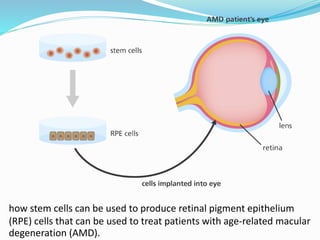
how stem cells can be used to produce retinal pigment epithelium
(RPE) cells that can be used to treat patients with age-related macular
degeneration (AMD).
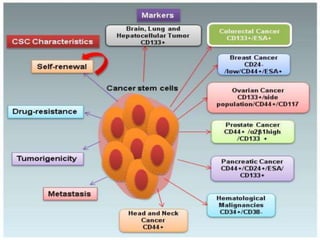
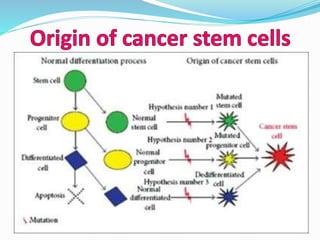
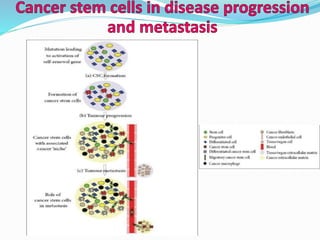
 immortal tumor-initiating cells that can self-
renew and have pluripotent capacity
 can generate tumor cells with different
phenotypes, which results in the growth of the
primary tumor and emergence of new tumors.
 Found in multiple malignancies, including
leukemia and various solid cancers (breast,
lung cancer, colon cancer, prostate cancer,
ovarian cancer, brain cancer, and melanoma).
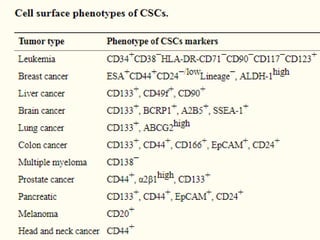
the most common method used to identify
CSCs is fluorescence-activated cell sorting
(FACS) based on cell surface markers or
intracellular molecules.
(1) Only a small fraction of the cancer cells within a
tumor have tumorigenic potential when transplanted
into immunodeficient mice.
(2) the CSC subpopulation can be separated from the
other cancer cells by distinctive surface markers;
(3) tumors resulting from the CSCs contain the mixed
tumorigenic and nontumorigenic cells of the original
tumor and
(4) the CSC subpopulation can be serially transplanted
through multiple generations, indicating that it is a
self-renewing population” .
Therefore, CSCs are capable of self-renewal and
differentiating into other distinctive cells that make up
the tumor mass.
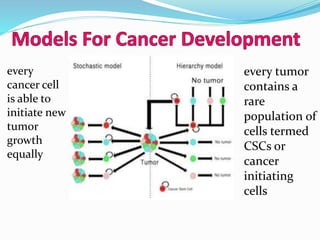
every
cancer cell
is able to
initiate new
tumor
growth
equally
every tumor
contains a
rare
population of
cells termed
CSCs or
cancer
initiating
cells
 Physiological stem cells and CSCs depend on their
immediate microenvironment or niche for their
survival and function.
 The cellular and noncellular components of the niche
provide signals that regulate proliferative and self-
renewal signals, thereby helping CSCs to maintain
their undifferentiated state.
 Nonepithelial stromal cells, inflammatory cells and
the vasculature have been proposed as key
components of the niche that support and sustain
CSCs.
 ATP-binding cassette (ABC) transporters are
membrane transporters that can pump various
distinct and structurally unrelated small molecules
(such as cytotoxic drugs and dyes) out of cells at the
expense of ATP hydrolysis
 Anti–tumor drugs can be pumped out, thereby
resulting in low intracellular drug concentrations.
Thus, the elevated levels of ABC transporters enable
cancer stem cells to resist current cancer therapies
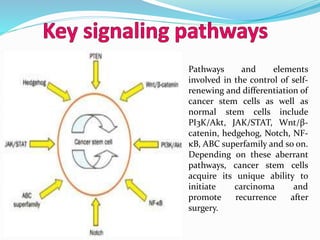
Pathways and elements
involved in the control of self-
renewing and differentiation of
cancer stem cells as well as
normal stem cells include
PI3K/Akt, JAK/STAT, Wnt/β-
catenin, hedgehog, Notch, NF-
κB, ABC superfamily and so on.
Depending on these aberrant
pathways, cancer stem cells
acquire its unique ability to
initiate carcinoma and
promote recurrence after
surgery.
JAK/STAT signaling pathway
 The JAK/STAT signaling pathway is activated through
the binding of diverse ligands, such as interleukins,
interferons, hormones, and growth factors, to their
respective receptors.
 JAK/STAT signaling in stem cells has been shown to be
involved in maintaining embryonic stem cell self-
renewal properties, hematopoiesis, and neurogenesis
 Evidence that this pathway is activated aberrantly in
CSCs has been found in stem-like cells isolated from
tumors of the breast, prostate, blood, and glia.
JAK/STAT signaling pathway
 Modulation of the JAK/STAT pathway in CSCs has
been shown to enhance or repress the expansion of
these cancer-forming cells in solid tumor model
systems.
 Tumor growth factor-beta (TGF-β) was shown to
regulate the self-renewal and differentiation properties
of glioma-initiating cells derived from patient samples
of glioblastoma multiforme.
Hedgehog pathway
 The Hedgehog pathway is essential for the
development and proper patterning of many organs
during embryogenesis, including the nervous system,
skeleton, limbs, lung, heart, and gut, by controlling
cellular proliferation, differentiation, and migration.
 the Hedgehog pathway is largely inactive in most
postnatal tissues except the adult central nervous
system, skin, hair, and teeth.
Hedgehog pathway
 The role for Hedgehog signaling in CSC function has been
documented in various cancers, including basal cell
carcinoma (BCC), multiple myeloma, glioblastoma, chronic
myeloid leukemia (CML), and colon cancer.
 Chemical inhibition of the Smoothened protein attenuated
proliferation, stemness maintenance, and self-renewal in
CSCs, suggesting strongly that Hedgehog signaling
promotes these CSC functions in multiple myeloma.
 Treatment of glioma CSCs with a Hedgehog signaling
inhibitor resulted in a decrease in proliferation, survival,
self-renewal, and clonogenicity.
Wnt pathway
 Mutations in genes encoding Wnt pathway mediators
are commonplace in many cancers including
medulloblastoma, lymphoma, and leukemia, as well as
breast, gastric, and colorectal cancer (CRC).
Notch pathway
 The Notch pathway has been demonstrated to regulate the
properties of tumor cells in many cancers, including
leukemia, glioblastoma, and those of the breast, colon,
pancreas, and lung
 the Notch pathway may be activated in nearly three-
quarters of primary esophageal adenocarcinoma samples as
compared with normal esophageal mucosa. In xenograft
models of tumorigenesis using esophageal
adenocarcinoma cells, inhibition of the Notch pathway via
treatment with a γ-secretase inhibitor greatly reduced
primary tumor growth.
 Notch may serve as a tumor suppressor in murine skin.
Deletion of Notch1 in the epidermis resulted in the
development of spontaneous BCC-like skin tumors.
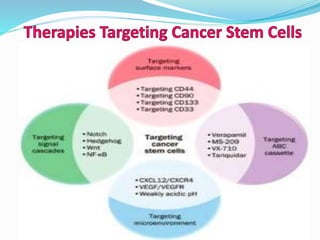
Targeting signal cascades
 The Notch ligand, DLL4, has been another popular
targeting strategy in cancer. Treatment with anti-DLL4
monoclonal antibody results in disorganized angiogenesis
due to its effect on endothelial cells and in clinical trial
inhibition of DLL4 has demonstrated good safety and
preliminary efficacy
 Targeting STAT3 was shown to reduce glioblastoma brain
Tumor stem cells in pre-clinical models. WP1066, a STAT3
inhibitor, is currently in Phase 1 clinical trial from patients
with recurrent malignant glioma and brain metastasis from
melanoma
 The most clinically advanced Hh targeting therapy is
vismodegib, which is approved by the FDA for the
treatment of metastatic basal cell carcinoma
Targeting surface markers
 CD44 is the most common CSC marker and plays a
major role in enhancing stemness and communication
with the microenvironment . However Anti CD 44 is in
phase 1 clinical trail.
 Imatinib is a tyrosine kinase inhibitor that selectively
inhibits c-kit, BCR/ABL and PDG F receptors and is
approved for the treatment of chronic myelogenous
leukemia(CML) and unresectable CD117+
gastrointestinal stromal tumors
 stem cells and cancer stem cells

stem cells and cancer stem cells

  • 1.
    BY Marwa Mahmoud Khalifa AmrElfeky Ahmed Elmoughazy
  • 2.
     Undifferentiated cells Able to develop into many different cell types in the body during early life and growth.  Serve as a sort of internal repair system, dividing essentially without limit to replenish other cells
  • 4.
     Self renewal Unspecialized but can give rise to specialized cells (differentiation)  In some organs, such as the gut and bone marrow, stem cells regularly divide. In other organs, however, such as the pancreas and the heart, stem cells only divide under special conditions.
  • 5.
     Embryonic stemcells  Non-embryonic "somatic" or "adult" stem cells.  Induced pluripotent stem cells (ipscs)
  • 6.
    differentiate into allpossible cell types. Examples: zygote formed at egg fertilization and the first few cells that result from the division of the zygote. differentiate into almost all cell types. Examples: embryonic stem cells and cells that are derived from the mesoderm, endoderm, and ectoderm germ layers.
  • 7.
    differentiate into aclosely related family of cells. Examples: hematopoietic (adult) stem cells that can become red and white blood cells or platelets. differentiate into a few cells. Examples: (adult) lymphoid or myeloid stem cells. only produce cells of their own type, but have the property of self-renewal required to be labeled a stem cell. Examples :(adult) muscle stem cells
  • 9.
     Embryonic stemcells are derived from a four- or five-day-old human embryo that is in the blastocyst phase of development, fertilized in vitro then donated for research purposes with informed consent of the donors.
  • 10.
     Human embryonicstem cells (hESCs) are generated by transferring cells from a preimplantation-stage embryo into a plastic laboratory culture dish that contains a nutrient broth known as culture medium.
  • 11.
    Embryonic stem cellsare considered pluripotent instead of totipotent because they do not have the ability to become part of the extra-embryonic membranes or the placenta.
  • 12.
     Adult stemcells supply new cells as an organism grows and to replace cells that get damaged.  Adult stem cells are said to be multipotent Hematopoietic stem cells: give rise to all the types of blood cells:. Mesenchymal stem cells: Those from bone marrow (bone marrow stromal stem cells, skeletal stem cells) give rise to a variety of cell types: bone cells (osteoblasts and osteocytes), cartilage cells (chondrocytes), fat cells (adipocytes), and stromal cells that support blood formation
  • 13.
     Adult stemcells supply new cells as an organism grows and to replace cells that get damaged.  Adult stem cells are said to be multipotent Neural stem cells: in the brain give rise to its three major cell types: nerve cells (neurons) and two categories of non-neuronal cells—astrocytes and oligodendrocytes. Epithelial stem cells: in the lining of the digestive tract in deep crypts and give rise to : absorptive cells, goblet cells, Paneth cells, and enteroendocrine cells.
  • 14.
     Adult stemcells supply new cells as an organism grows and to replace cells that get damaged.  Adult stem cells are said to be multipotent Skin stem cells: occur in the basal layer of the epidermis and at the base of hair follicles. The epidermal stem cells give rise to keratinocytes. The follicular stem cells can give rise to both the hair follicle and to the epidermis.
  • 15.
     Embryonic stemcells can become all cell types of the body because they are pluripotent. Adult stem cells are thought to be limited to differentiating into different cell types of their tissue of origin.  Embryonic stem cells can be grown relatively easily in culture. Adult stem cells are rare in mature tissues, so isolating these cells from an adult tissue is challenging, and methods to expand their numbers in cell culture have not yet been worked out.
  • 16.
     Adult cellsthat have been genetically reprogrammed to an embryonic stem cell–like state by being forced to express genes and factors important for maintaining the defining properties of embryonic stem cells.  Human iPSCs express stem cell markers and are capable of generating cells characteristic of all three germ layers.
  • 17.
     Viruses arecurrently used to introduce the reprogramming factors into adult cells, and this process must be carefully controlled and tested before the technique can lead to useful treatment for humans.
  • 18.
     Once stemcells have been allowed to divide and propagate in a controlled culture, the collection of healthy, dividing, and undifferentiated cells is called a stem cell line.  Once under control, the stem cells can be stimulated to specialize as directed by a researcher - a process known as directed differentiation.
  • 20.
    Studies of humanembryonic stem cells will yield information about the complex events that occur during human development Some of the most serious medical conditions, such as cancer and birth defects, are due to abnormal cell division and differentiation Human stem cells are currently being used to test new drugs. Cancer cell lines, for example, are used to screen potential anti- tumor drugs.
  • 21.
    Generation of cellsand tissues that could be used for cell-based therapies. Stem cells, directed to differentiate into specific cell types, offer the possibility of a renewable source of replacement cells and tissues to treat diseases including macular degeneration, spinal cord injury, stroke, burns, heart disease, diabetes, osteoarthritis, and rheumatoid arthritis.
  • 22.
    Stem cells couldbe used to generate new organs for use in transplants. Currently, damaged organs can be replaced by obtaining healthy organs from a donor, however donated organs may be 'rejected' by the body as the immune system sees it as something that is foreign.
  • 23.
    how stem cellscan be used to produce retinal pigment epithelium (RPE) cells that can be used to treat patients with age-related macular degeneration (AMD).
  • 25.
     immortal tumor-initiatingcells that can self- renew and have pluripotent capacity  can generate tumor cells with different phenotypes, which results in the growth of the primary tumor and emergence of new tumors.  Found in multiple malignancies, including leukemia and various solid cancers (breast, lung cancer, colon cancer, prostate cancer, ovarian cancer, brain cancer, and melanoma).
  • 26.
    the most commonmethod used to identify CSCs is fluorescence-activated cell sorting (FACS) based on cell surface markers or intracellular molecules.
  • 29.
    (1) Only asmall fraction of the cancer cells within a tumor have tumorigenic potential when transplanted into immunodeficient mice. (2) the CSC subpopulation can be separated from the other cancer cells by distinctive surface markers; (3) tumors resulting from the CSCs contain the mixed tumorigenic and nontumorigenic cells of the original tumor and
  • 30.
    (4) the CSCsubpopulation can be serially transplanted through multiple generations, indicating that it is a self-renewing population” . Therefore, CSCs are capable of self-renewal and differentiating into other distinctive cells that make up the tumor mass.
  • 32.
    every cancer cell is ableto initiate new tumor growth equally every tumor contains a rare population of cells termed CSCs or cancer initiating cells
  • 33.
     Physiological stemcells and CSCs depend on their immediate microenvironment or niche for their survival and function.  The cellular and noncellular components of the niche provide signals that regulate proliferative and self- renewal signals, thereby helping CSCs to maintain their undifferentiated state.  Nonepithelial stromal cells, inflammatory cells and the vasculature have been proposed as key components of the niche that support and sustain CSCs.
  • 35.
     ATP-binding cassette(ABC) transporters are membrane transporters that can pump various distinct and structurally unrelated small molecules (such as cytotoxic drugs and dyes) out of cells at the expense of ATP hydrolysis  Anti–tumor drugs can be pumped out, thereby resulting in low intracellular drug concentrations. Thus, the elevated levels of ABC transporters enable cancer stem cells to resist current cancer therapies
  • 36.
    Pathways and elements involvedin the control of self- renewing and differentiation of cancer stem cells as well as normal stem cells include PI3K/Akt, JAK/STAT, Wnt/β- catenin, hedgehog, Notch, NF- κB, ABC superfamily and so on. Depending on these aberrant pathways, cancer stem cells acquire its unique ability to initiate carcinoma and promote recurrence after surgery.
  • 37.
    JAK/STAT signaling pathway The JAK/STAT signaling pathway is activated through the binding of diverse ligands, such as interleukins, interferons, hormones, and growth factors, to their respective receptors.  JAK/STAT signaling in stem cells has been shown to be involved in maintaining embryonic stem cell self- renewal properties, hematopoiesis, and neurogenesis  Evidence that this pathway is activated aberrantly in CSCs has been found in stem-like cells isolated from tumors of the breast, prostate, blood, and glia.
  • 38.
    JAK/STAT signaling pathway Modulation of the JAK/STAT pathway in CSCs has been shown to enhance or repress the expansion of these cancer-forming cells in solid tumor model systems.  Tumor growth factor-beta (TGF-β) was shown to regulate the self-renewal and differentiation properties of glioma-initiating cells derived from patient samples of glioblastoma multiforme.
  • 39.
    Hedgehog pathway  TheHedgehog pathway is essential for the development and proper patterning of many organs during embryogenesis, including the nervous system, skeleton, limbs, lung, heart, and gut, by controlling cellular proliferation, differentiation, and migration.  the Hedgehog pathway is largely inactive in most postnatal tissues except the adult central nervous system, skin, hair, and teeth.
  • 40.
    Hedgehog pathway  Therole for Hedgehog signaling in CSC function has been documented in various cancers, including basal cell carcinoma (BCC), multiple myeloma, glioblastoma, chronic myeloid leukemia (CML), and colon cancer.  Chemical inhibition of the Smoothened protein attenuated proliferation, stemness maintenance, and self-renewal in CSCs, suggesting strongly that Hedgehog signaling promotes these CSC functions in multiple myeloma.  Treatment of glioma CSCs with a Hedgehog signaling inhibitor resulted in a decrease in proliferation, survival, self-renewal, and clonogenicity.
  • 41.
    Wnt pathway  Mutationsin genes encoding Wnt pathway mediators are commonplace in many cancers including medulloblastoma, lymphoma, and leukemia, as well as breast, gastric, and colorectal cancer (CRC).
  • 42.
    Notch pathway  TheNotch pathway has been demonstrated to regulate the properties of tumor cells in many cancers, including leukemia, glioblastoma, and those of the breast, colon, pancreas, and lung  the Notch pathway may be activated in nearly three- quarters of primary esophageal adenocarcinoma samples as compared with normal esophageal mucosa. In xenograft models of tumorigenesis using esophageal adenocarcinoma cells, inhibition of the Notch pathway via treatment with a γ-secretase inhibitor greatly reduced primary tumor growth.  Notch may serve as a tumor suppressor in murine skin. Deletion of Notch1 in the epidermis resulted in the development of spontaneous BCC-like skin tumors.
  • 44.
    Targeting signal cascades The Notch ligand, DLL4, has been another popular targeting strategy in cancer. Treatment with anti-DLL4 monoclonal antibody results in disorganized angiogenesis due to its effect on endothelial cells and in clinical trial inhibition of DLL4 has demonstrated good safety and preliminary efficacy  Targeting STAT3 was shown to reduce glioblastoma brain Tumor stem cells in pre-clinical models. WP1066, a STAT3 inhibitor, is currently in Phase 1 clinical trial from patients with recurrent malignant glioma and brain metastasis from melanoma  The most clinically advanced Hh targeting therapy is vismodegib, which is approved by the FDA for the treatment of metastatic basal cell carcinoma
  • 45.
    Targeting surface markers CD44 is the most common CSC marker and plays a major role in enhancing stemness and communication with the microenvironment . However Anti CD 44 is in phase 1 clinical trail.  Imatinib is a tyrosine kinase inhibitor that selectively inhibits c-kit, BCR/ABL and PDG F receptors and is approved for the treatment of chronic myelogenous leukemia(CML) and unresectable CD117+ gastrointestinal stromal tumors

Editor's Notes

  • #6 Under certain conditions that would allow some specialized adult cells to be "reprogrammed" genetically to assume a stem cell-like state