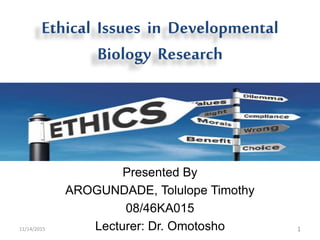
Ethical Issues in Developmental
Biology Research
Presented By
AROGUNDADE, Tolulope Timothy
08/46KA015
Lecturer: Dr. Omotosho11/14/2015 1
11/14/2015 2
•Introduction
•Definition of Terms
•Brief History on Ethics
•Key Tensions in Developmental biology Research
•Human Biological Material for Research
•Human Reproductive Technologies
•The Onset of Human Life
•Human-animal Hybrids
•Conclusion
•References
Introduction
11/14/2015 3
“…Nor shall any man's entreaty prevail upon me to administer poison to
anyone; neither will I counsel any man to do so. Moreover, I will get no sort
of medicine to any pregnant woman, with a view to destroy the child.
Further, I will comport myself and use my knowledge in a godly manner.
Whatsoever house I may enter, my visit shall be for the convenience and
advantage of the patient;...If I faithfully observe this oath, may I thrive and
prosper in my fortune and profession, and live in the estimation of posterity;
or on breach thereof, may the reverse be my fate!”
The Hippocratic Oath
DEFINITION OFTERMS
11/14/2015 4
Ethics: The principles of right and wrong that are
accepted by an individual of a social group/profession.
It governs appropriate conduct.
Bioethics: The branch of ethics that studies
moral values in biomedical research
Developmental Biology: This is the branch of biology
that studies the growth and development of organisms.
(Advanced English Dictionary)
KEY TENSIONS IN DEVELOPMENTAL
BIOLOGY RESEARCH
11/14/2015 5
•Use of Human Biological Material for Research
•Human Reproductive Technologies
•The Onset of Human Life
•Anti-ageing Research
•Human-animal Hybrids
•Genetic manipulation
(Berger, 2003)
BIOLOGICAL MATERIAL FOR RESEARCH
11/14/2015 6
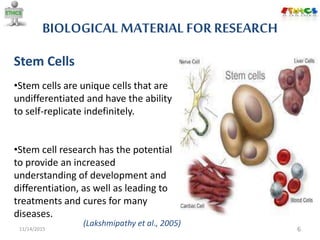
Stem Cells
•Stem cells are unique cells that are
undifferentiated and have the ability
to self-replicate indefinitely.
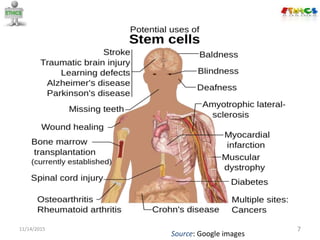
•Stem cell research has the potential
to provide an increased
understanding of development and
differentiation, as well as leading to
treatments and cures for many
diseases.
(Lakshmipathy et al., 2005)
11/14/2015 7
Source: Google images
Stem Cells (Cont’d)
11/14/2015 8
•Three types of stem cells:
•Embryonic stem cells (ESC)
•Fetal stem cells
•Adult stem cells
•Three main sources:
•Adult bone marrow
•Miscarried or aborted embryos/fetus; extra embryos
left over from IVF
•Embryos from therapeutic cloning
ESC is most promising for treatment, and therapeutic
cloning can avoid the problem of immunological
incompatibility.
(Bongso et al., 2004)
(Testa et al., 2005)
Ethical Issues on Stem Cells
11/14/2015 9
•Destroying an embryo to harvest ESC is equivalent
to killing a child to obtain his organs.
•Left-over from IVF are already there.
•How about the wellbeing of many patients who
may be cured by ESC research?
(Berger, 2003)
BIOLOGICAL MATERIAL FOR RESEARCH
11/14/2015 10
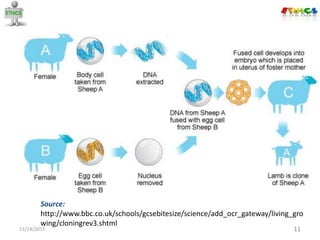
Cloning
•Two techniques:
•Embryo splitting
•Nuclear substitution
•cloning is the production of genetically identical
organisms.
(American Medical Association)
•Therapeutic and Reproductive cloning
(Kfoury, 2007)
11/14/2015 11
Source:
http://www.bbc.co.uk/schools/gcsebitesize/science/add_ocr_gateway/living_gro
wing/cloningrev3.shtml
11/14/2015 12
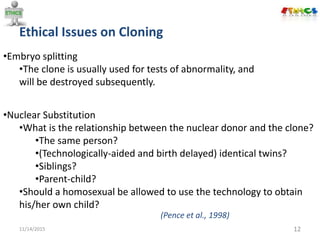
•Nuclear Substitution
•What is the relationship between the nuclear donor and the clone?
•The same person?
•(Technologically-aided and birth delayed) identical twins?
•Siblings?
•Parent-child?
•Should a homosexual be allowed to use the technology to obtain
his/her own child?
•Embryo splitting
•The clone is usually used for tests of abnormality, and
will be destroyed subsequently.
Ethical Issues on Cloning
(Pence et al., 1998)
Ethical Issues on Cloning
(Cont’d)
11/14/2015 13
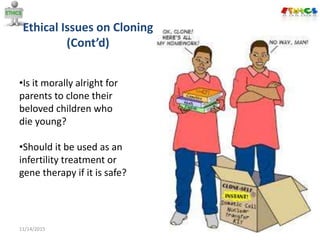
•Is it morally alright for
parents to clone their
beloved children who
die young?
•Should it be used as an
infertility treatment or
gene therapy if it is safe?
HUMAN REPRODUCTIVE TECHNOLOGIES
11/14/2015 14
•Artificial insemination by husband (AIH)
•Artificial insemination by donor (AID)
•In vitro fertilization (IVF)
•Egg donation
•Embryo donation
•Surrogacy
HUMAN REPRODUCTIVE TECHNOLOGIES
11/14/2015 15
Ethical Considerations
•Procreation rights of infertile couples
•It is unnatural
•Inequality and exploitation
•Selling babies?
•The moral status of extra embryos left over from
IVF
•Definition of parent-child relation
•Integrity of the family
•Best interests of the child
(Tao et al., 2006)
THE ONSET OF HUMANLIFE
11/14/2015 16
•The conflict concerning the definition of the onset of the human
being has two limits: it starts
either (i) after the birth of a viable child or
(ii) after the nuclear syngamy in the zygote.
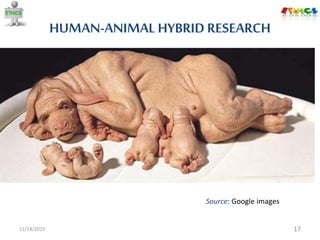
HUMAN-ANIMAL HYBRID RESEARCH
11/14/2015 17
Source: Google images
Ethical Issues on Chimeras
11/14/2015 18
• fundamental 'right to exist' possessed by each animal
species.
Mott et al., 2005
•an ethical 'crime against humanity.’
•Some transhumanists have seen possible human-modifying
technologies as one of many ways to overcome fundamental
human limitations that currently cause suffering, such as
disease and aging, and pointed out the many potential
commercial and medical benefits from fully realized para-
human experimentation.
CONCLUSION
11/14/2015 19
•The aim of ethics is to identify principles of right action
that can guide us in thinking about what we may do, what
we must do, and what we must refrain from doing.
•Ethical conflicts of interest in developmental biology
represent the greatest part of current bioethics.
• Both the ends and the means of science demand ethical
scrutiny and ultimately public oversight.
REFERENCES
11/14/2015 20
•Tao, Julia, “What’s wrong with creating designer babies?”, in Julia Tao
and Hektor H T Yan (eds), Meaning of life. Singapore: McGraw Hill
Education, 2006, pp. 317-335.
•Veatch, Robert M. The Basics of Bioethics 2nd ed., Upper Saddle River,
N.J.: Prentice Hall, 2003.
•Berger J.: Ethical conflicts of interest in modern biomedicine? J.
Appl. Biomed. 1: 181–182, 2003.
•Combes R.D.: The use of human cells in biomedical research and
testing. ATLA 32: Suppl 1A, 43–49, 2004.
•Bongso A., Richards M.: History and perspective of stem cell
research. Best Pract. Clin. Obst. Gynaecol. 18: 827–842, 2004.
•Testa G., Harris J.: Ethics and synthetic gametes. Bioethics
19: 146–166, 2005.
•Lakshmipathy U., Verfaillie C.: Stem cell plasticity. Blood
Rev. 19: 29–38, 2005.
THANK YOU FORLISTENING
11/14/2015 21

Ethical Issues in Developmental Biology Research

  • 1.
    Ethical Issues inDevelopmental Biology Research Presented By AROGUNDADE, Tolulope Timothy 08/46KA015 Lecturer: Dr. Omotosho11/14/2015 1
  • 2.
    11/14/2015 2 •Introduction •Definition ofTerms •Brief History on Ethics •Key Tensions in Developmental biology Research •Human Biological Material for Research •Human Reproductive Technologies •The Onset of Human Life •Human-animal Hybrids •Conclusion •References
  • 3.
    Introduction 11/14/2015 3 “…Nor shallany man's entreaty prevail upon me to administer poison to anyone; neither will I counsel any man to do so. Moreover, I will get no sort of medicine to any pregnant woman, with a view to destroy the child. Further, I will comport myself and use my knowledge in a godly manner. Whatsoever house I may enter, my visit shall be for the convenience and advantage of the patient;...If I faithfully observe this oath, may I thrive and prosper in my fortune and profession, and live in the estimation of posterity; or on breach thereof, may the reverse be my fate!” The Hippocratic Oath
  • 4.
    DEFINITION OFTERMS 11/14/2015 4 Ethics:The principles of right and wrong that are accepted by an individual of a social group/profession. It governs appropriate conduct. Bioethics: The branch of ethics that studies moral values in biomedical research Developmental Biology: This is the branch of biology that studies the growth and development of organisms. (Advanced English Dictionary)
  • 5.
    KEY TENSIONS INDEVELOPMENTAL BIOLOGY RESEARCH 11/14/2015 5 •Use of Human Biological Material for Research •Human Reproductive Technologies •The Onset of Human Life •Anti-ageing Research •Human-animal Hybrids •Genetic manipulation (Berger, 2003)
  • 6.
    BIOLOGICAL MATERIAL FORRESEARCH 11/14/2015 6 Stem Cells •Stem cells are unique cells that are undifferentiated and have the ability to self-replicate indefinitely. •Stem cell research has the potential to provide an increased understanding of development and differentiation, as well as leading to treatments and cures for many diseases. (Lakshmipathy et al., 2005)
  • 7.
  • 8.
    Stem Cells (Cont’d) 11/14/20158 •Three types of stem cells: •Embryonic stem cells (ESC) •Fetal stem cells •Adult stem cells •Three main sources: •Adult bone marrow •Miscarried or aborted embryos/fetus; extra embryos left over from IVF •Embryos from therapeutic cloning ESC is most promising for treatment, and therapeutic cloning can avoid the problem of immunological incompatibility. (Bongso et al., 2004) (Testa et al., 2005)
  • 9.
    Ethical Issues onStem Cells 11/14/2015 9 •Destroying an embryo to harvest ESC is equivalent to killing a child to obtain his organs. •Left-over from IVF are already there. •How about the wellbeing of many patients who may be cured by ESC research? (Berger, 2003)
  • 10.
    BIOLOGICAL MATERIAL FORRESEARCH 11/14/2015 10 Cloning •Two techniques: •Embryo splitting •Nuclear substitution •cloning is the production of genetically identical organisms. (American Medical Association) •Therapeutic and Reproductive cloning (Kfoury, 2007)
  • 11.
  • 12.
    11/14/2015 12 •Nuclear Substitution •Whatis the relationship between the nuclear donor and the clone? •The same person? •(Technologically-aided and birth delayed) identical twins? •Siblings? •Parent-child? •Should a homosexual be allowed to use the technology to obtain his/her own child? •Embryo splitting •The clone is usually used for tests of abnormality, and will be destroyed subsequently. Ethical Issues on Cloning (Pence et al., 1998)
  • 13.
    Ethical Issues onCloning (Cont’d) 11/14/2015 13 •Is it morally alright for parents to clone their beloved children who die young? •Should it be used as an infertility treatment or gene therapy if it is safe?
  • 14.
    HUMAN REPRODUCTIVE TECHNOLOGIES 11/14/201514 •Artificial insemination by husband (AIH) •Artificial insemination by donor (AID) •In vitro fertilization (IVF) •Egg donation •Embryo donation •Surrogacy
  • 15.
    HUMAN REPRODUCTIVE TECHNOLOGIES 11/14/201515 Ethical Considerations •Procreation rights of infertile couples •It is unnatural •Inequality and exploitation •Selling babies? •The moral status of extra embryos left over from IVF •Definition of parent-child relation •Integrity of the family •Best interests of the child (Tao et al., 2006)
  • 16.
    THE ONSET OFHUMANLIFE 11/14/2015 16 •The conflict concerning the definition of the onset of the human being has two limits: it starts either (i) after the birth of a viable child or (ii) after the nuclear syngamy in the zygote.
  • 17.
  • 18.
    Ethical Issues onChimeras 11/14/2015 18 • fundamental 'right to exist' possessed by each animal species. Mott et al., 2005 •an ethical 'crime against humanity.’ •Some transhumanists have seen possible human-modifying technologies as one of many ways to overcome fundamental human limitations that currently cause suffering, such as disease and aging, and pointed out the many potential commercial and medical benefits from fully realized para- human experimentation.
  • 19.
    CONCLUSION 11/14/2015 19 •The aimof ethics is to identify principles of right action that can guide us in thinking about what we may do, what we must do, and what we must refrain from doing. •Ethical conflicts of interest in developmental biology represent the greatest part of current bioethics. • Both the ends and the means of science demand ethical scrutiny and ultimately public oversight.
  • 20.
    REFERENCES 11/14/2015 20 •Tao, Julia,“What’s wrong with creating designer babies?”, in Julia Tao and Hektor H T Yan (eds), Meaning of life. Singapore: McGraw Hill Education, 2006, pp. 317-335. •Veatch, Robert M. The Basics of Bioethics 2nd ed., Upper Saddle River, N.J.: Prentice Hall, 2003. •Berger J.: Ethical conflicts of interest in modern biomedicine? J. Appl. Biomed. 1: 181–182, 2003. •Combes R.D.: The use of human cells in biomedical research and testing. ATLA 32: Suppl 1A, 43–49, 2004. •Bongso A., Richards M.: History and perspective of stem cell research. Best Pract. Clin. Obst. Gynaecol. 18: 827–842, 2004. •Testa G., Harris J.: Ethics and synthetic gametes. Bioethics 19: 146–166, 2005. •Lakshmipathy U., Verfaillie C.: Stem cell plasticity. Blood Rev. 19: 29–38, 2005.
  • 21.

Editor's Notes

  • #4 medical practitioner who is regarded as the father of medicine; author of the Hippocratic oath
  • #5 The term “bioethics” was introduced in the 70’s by Van Rensselaer Potter for a study aiming at ensuring the preservation of the biosphere. It was later used to refer a study of the ethical issues arising from health care, biological and medical sciences. The aim of ethics is to identify principles of right action that can guide us in thinking about what we may do, what we must do, and what we must refrain from doing.
  • #6 Great advances in cell biology have provoked a number of ethical studies. We can identify several areas within these topics:
  • #7 Stem cells are defined by two properties: first, the capacity for self-renewal, and second, the capacity to produce other cells that are more differentiated. There are two general categories of medical applications for stem cells: first, as an actual therapy, and second, as a way to model diseases to help researchers develop treatments.
  • #9 Many different kinds of stem cells have been discovered; the types most commonly used in research include embryonic, fetal and adult stem cells.
  • #10 Broadly speaking, there are three moral claims made concerning ES cells by participants in the debate over stem cell research. The first relates to the moral status of human embryos, the second relates to the potential medical therapies that could result from ES cell research, and the third relates to the contributions the research may make to our scientific knowledge. The question of the moral status of the embryo is the most contested and the most important of these three claims, since the different answers as to what moral status ought to be accorded to embryos each put different limits on what uses of embryos are morally permissible. Many proponents of embryonic stem cell research believe that the early embryo is merely a “clump of cells,” lacking the characteristics and properties that define human being and human personhood.[2] The early embryo does not have the appearance of a fully developed human being. It has no face for us to see — indeed, to see the embryo at all, we need a microscope. It has no limbs or organs. It cannot survive on its own. It lacks the integrated development of nerves, muscles, and bones that enable us to move and act in the world. It lacks a central nervous system — and so cannot think, cannot feel pain, and is not self-aware. If the possession of any of those capacities is the defining threshold for a being to merit moral standing, then the embryo can be treated the same way we might treat any other bit of tissue. Many opponents of embryo destruction argue that it is wrong, or even dangerous, to claim that human dignity and a right to life attach only to those human organisms who fulfill specific criteria. While a developing embryo does not have the manifest capacities of a fully developed human being, many persons who are young, sick, disabled, or developmentally challenged also lack some of these capacities. We may erode our respect for the human dignity and rights of these individuals if we consider it conditional on the possession of specific capacities — capacities we are all prone to lack or lose in the course of a human life. To counter the claim that the embryo is just a clump of cells deserving no respect, critics of embryonic stem cell research point to the standard position of both traditional and contemporary embryology, which is that a human life begins at fertilization.
  • #11 cloning is the production of genetically identical organisms.Identical twins are naturally occurring clones. Dolly the sheep was the first mammal cloned from an adult. She was produced by a process called nuclear transfer. Nuclear transfer involves placing the nucleus of a body cell into an egg cell. Embryo splitting involves bisecting the multicellular embryo at an early stage of development to generate "twins". It refers to artificial inducement of identical twinning.
  • #12 Identical twins are naturally occurring clones. Dolly the sheep was the first mammal cloned from an adult. She was produced by a process called nuclear transfer. Nuclear transfer involves placing the nucleus of a body cell into an egg cell.
  • #13 The various forms of cloning, particularly human cloning, are controversial.[1] There have been numerous demands for all progress in the human cloning field to be halted. Most scientific, governmental and religious organizations oppose reproductive cloning. Advocates of human therapeutic cloning believe the practice could provide genetically identical cells for regenerative medicine, and tissues and organs for transplantation.[4] Such cells, tissues, and organs would neither trigger an immune response nor require the use of immunosuppressive drugs. Both basic research and therapeutic development for serious diseases such as cancer, heart disease, and diabetes, as well as improvements in burn treatment and reconstructive and cosmetic surgery, are areas that might benefit from such new technology.
  • #18 A parahuman is a human-animal hybrid or chimera, an entity that incorporates genetic elements from both humans and non-human animals. Another technical definition given for a para-human is that of an entity formed from either a human egg fertilized by a nonhuman sperm or a nonhuman egg fertilized by a human sperm.  The creation of genetically modified organisms in general was a topic rooted in science fiction rather than practical research. This has changed significantly over the past few decades. There are several reasons for which parahumans or chimeras might be created. The current forms of chimera exist for medical and industrial purposes, e.g., production of drugs and of organs suitable for organ transplantation. Restrictions on cloning and stem cell research have made chimera research an attractive alternative.
  • #20 Ethical reflection focuses on both our doing and our being. In part it attends to “the good” — to what is good for human beings, the goods we seek to realize in our action, and what we must do to flourish and be fulfilled. In part it attends to “the right” — clarifying our duties and obligations. And in part it attends to “character” — to the sort of persons we should be, the virtues we seek to cultivate, and the vices we seek to discourage. The biomedical applications of stem cell research promise great benefits. But we cannot think about stem cell research simply in terms of the health benefits it might confer. We should also consider how those health benefits will contribute to our flourishing as human beings. We should think about what sorts of virtues and vices the pursuit of those benefits will encourage.