Scaffold for Tissue
Engineering
& Regenerative
Medicine
Mohamed Labadi
April 9, 2015
Overview
Regenerative Medicine
Tissue Engineering
Scaffolds for TE
Nanotechnology and
Microfluidics for Scaffold TE
R&D Trends & Pioneering
Future and Conclusion
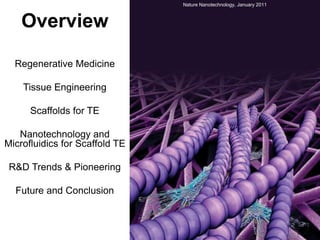
Nature Nanotechnology, January 2011
Characterizing Regenerative
Medicine
1. Regenerative medicine is a broad definition for innovative medical
therapies that will enable the body to repair, replace, restore and
regenerate damaged or diseased cells, tissues and organs. (Mayo
Clinic)
2. Tools and Procedures (Biofabrication or Additive Manufacturing) of
Regenerative Medicine
• Tissue Engineering: Tissue Repair/Replacement and Lab Grown
Organs
• Technologies
 Stem cells
 Natural and Synthetic Scaffolds
 3-D Printing and Chip Technologies
Areas of Regenerative Medicine
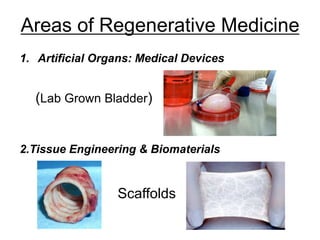
1. Artificial Organs: Medical Devices
(Lab Grown Bladder)
2.Tissue Engineering & Biomaterials
Scaffolds
Areas of Regenerative Medicine
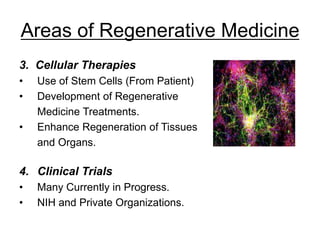
3. Cellular Therapies
• Use of Stem Cells (From Patient)
• Development of Regenerative
Medicine Treatments.
• Enhance Regeneration of Tissues
and Organs.
4. Clinical Trials
• Many Currently in Progress.
• NIH and Private Organizations.
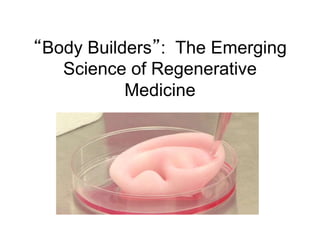
“Body Builders”: The Emerging
Science of Regenerative
Medicine
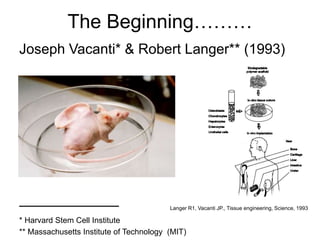
The Beginning………
Joseph Vacanti* & Robert Langer** (1993)
——————— Langer R1, Vacanti JP., Tissue engineering, Science, 1993
* Harvard Stem Cell Institute
** Massachusetts Institute of Technology (MIT)
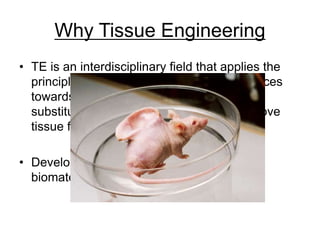
Why Tissue Engineering
• TE is an interdisciplinary field that applies the
principles of engineering and the life sciences
towards the development of biological
substitutes that restore, maintain, or improve
tissue function
• Developing living tissue using cells,
biomaterials, and signaling molecules
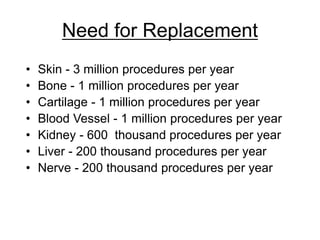
Need for Replacement
• Skin - 3 million procedures per year
• Bone - 1 million procedures per year
• Cartilage - 1 million procedures per year
• Blood Vessel - 1 million procedures per year
• Kidney - 600 thousand procedures per year
• Liver - 200 thousand procedures per year
• Nerve - 200 thousand procedures per year
Why Tissue Engineering
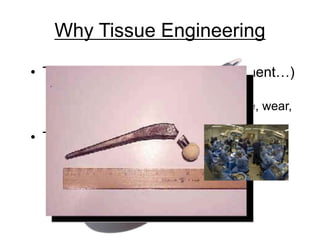
• Traditional Implants (hip replacement…)
– Poor biocompatibility
– Mechanical Failure (undergo fatigue, wear,
corrosion)
• Transplants
– Rejection
– Disease transmission
– Supply << Demand
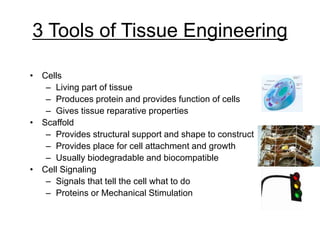
3 Tools of Tissue Engineering
• Cells
– Living part of tissue
– Produces protein and provides function of cells
– Gives tissue reparative properties
• Scaffold
– Provides structural support and shape to construct
– Provides place for cell attachment and growth
– Usually biodegradable and biocompatible
• Cell Signaling
– Signals that tell the cell what to do
– Proteins or Mechanical Stimulation
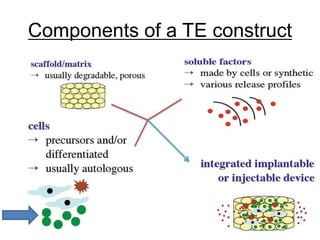
Components of a TE construct
• Isolated cells and cells substitues
 Allows for an infusion of specific cells into the patient
without the complication of surgery
• Tissue growth factor
 Massive quantities in targeted delivery
 Use of gene delivery system to upregulate the local
production
• Cell-matrix interaction with Scaffolds
 To grow and eventually replace a biodegradable
scaffold
Strategies of TE
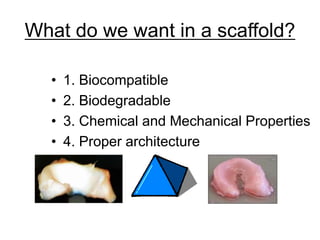
What do we want in a scaffold?
• 1. Biocompatible
• 2. Biodegradable
• 3. Chemical and Mechanical Properties
• 4. Proper architecture
Role of the Scaffold
• Present a surface/structure that closely
resembles the extracellular matrix (ECM)
• Surfaces that could maximize favorable
biological responses (cell-matrix interaction,
Protein-matrix interaction)
Synthetic Scaffolds
[Lecture: Sangeeta Bhatia – ‘Tiny Technologies’ and Regenerative Medicine:
stemcellassays.com/2011/04/lecture-sangeeta-bhatia-tiny-technologies-and-regenerative-medicine/]
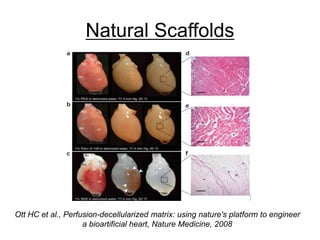
Natural Scaffolds
Ott HC et al., Perfusion-decellularized matrix: using nature's platform to engineer
a bioartificial heart, Nature Medicine, 2008
Nanotechnology and Microfluidics in
Tissue Engineering
• Advances in fabrication technologies have
brought a new dimension to the field of tissue
engineering.
• Fabricate tissue engineering scaffolds with
complex 3-D architectures and customized
chemistries that mimic the in vivo tissue
environment.
Microfluidic scaffold for tissue
engineering
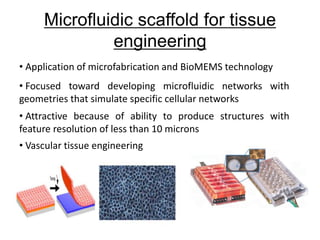
• Application of microfabrication and BioMEMS technology
• Focused toward developing microfluidic networks with
geometries that simulate specific cellular networks
• Attractive because of ability to produce structures with
feature resolution of less than 10 microns
• Vascular tissue engineering
• Problems of nutrient transport is critical in the design of tissue
engineering
• Scaffolds that are targeted for the growth of complex organs
such as the liver and kidney
• Approach to solving this problem involves the integration of an
intrinsic vascular network within these scaffolds.
• Drug delivery/ high throughput screening
Microfluidic scaffold for tissue
engineering
Regenerative Medicine Challenges
1. Design of Biomaterials that Function in the
Body
2. Getting Enough Cells and Cell Types for
Engineering Tissues and Organs
3. Vascularity: Engineering Blood Vessels that
Supply Nutrients, Oxygen and Signals to
Bioengineered Tissues and Organs
4. Cost of Tissue and Organ Development
Procedures
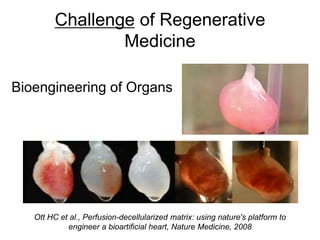
Challenge of Regenerative
Medicine
Bioengineering of Organs
Ott HC et al., Perfusion-decellularized matrix: using nature's platform to
engineer a bioartificial heart, Nature Medicine, 2008
Potential of Regenerative Medicine
Chip Technology
[Geraldine Hamilton, Body parts on a chip, TEDx Boston, June 2013:
https://youtu.be/CpkXmtJOH84]
• Reduces Need for Animal Testing
• 3-D Printed Organs on Chips Used to Test Vaccines
3-D Elastic Membrane Fits Heart’s
Epicardium
3-D Printer Creates Heart Membrane
[Prof. Igor Efimov, Washington University in St. Louish: ttps://news.wustl.edu/news/Pages/26554.aspx]
Lizhi Xu and al., Nature Communications, 2014, 3329, doi:10.1038/ncomms4329
Promise of Regenerative Medicine
R&D Trends, Innovation and
Pioneering
[Laboratory for Multiscale Regenerative Technologies: https://lmrt.mit.edu/research]
Regenerative Medicine Pioneers
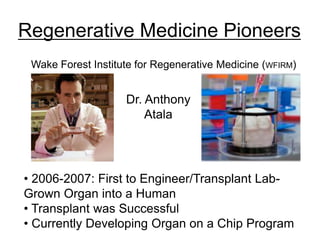
Wake Forest Institute for Regenerative Medicine (WFIRM)
Dr. Anthony
Atala
• 2006-2007: First to Engineer/Transplant Lab-
Grown Organ into a Human
• Transplant was Successful
• Currently Developing Organ on a Chip Program
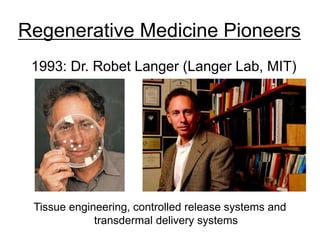
1993: Dr. Robet Langer (Langer Lab, MIT)
Tissue engineering, controlled release systems and
transdermal delivery systems
Regenerative Medicine Pioneers
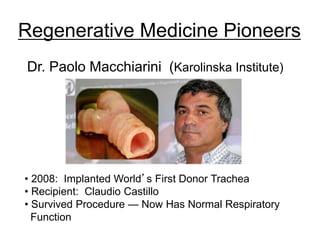
Dr. Paolo Macchiarini (Karolinska Institute)
• 2008: Implanted World’s First Donor Trachea
• Recipient: Claudio Castillo
• Survived Procedure — Now Has Normal Respiratory
Function
Regenerative Medicine Pioneers
Dr. Ali Khademhosseini (Wyss Institute at Harvard)
[MIT Technology Review: www2.technologyreview.com/tr35/profile.aspx?TRID=610]
• 2007: Creating living tissues
• Organs in the lab
Regenerative Medicine Pioneers
McGowan Institute of Regenerative Medicine
(University of Pittsburg)
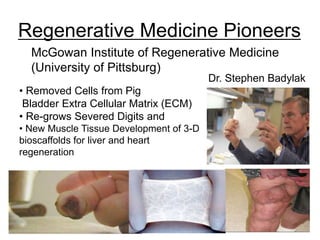
Dr. Stephen Badylak
• Removed Cells from Pig
Bladder Extra Cellular Matrix (ECM)
• Re-grows Severed Digits and
• New Muscle Tissue Development of 3-D
bioscaffolds for liver and heart
regeneration
Regenerative Medicine Pioneers
Regenerative Medicine Innovators
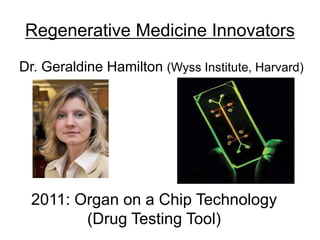
Dr. Geraldine Hamilton (Wyss Institute, Harvard)
2011: Organ on a Chip Technology
(Drug Testing Tool)
Regenerative Medicine Innovators
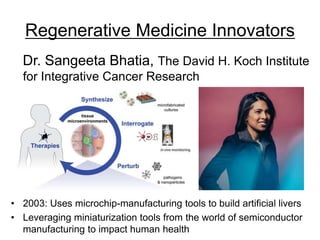
Dr. Sangeeta Bhatia, The David H. Koch Institute
for Integrative Cancer Research
• 2003: Uses microchip-manufacturing tools to build artificial livers
• Leveraging miniaturization tools from the world of semiconductor
manufacturing to impact human health
Regenerative Medicine Innovators
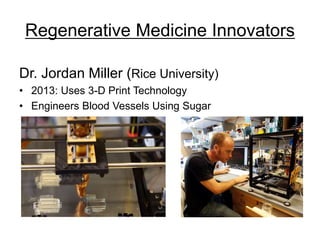
Dr. Jordan Miller (Rice University)
• 2013: Uses 3-D Print Technology
• Engineers Blood Vessels Using Sugar
Regenerative Medicine Innovators
Dr. Ramille N. Shah (Northwestern Univ.)
• 2011: Leader in Field of 3D-Printable Materials
• Engineers new 3D-Inks
• Creates Porous Scaffolds
• Technique: Additive Manufacturing
(Nanofiber Scaffold For
Cartilage Regeneration)
[Center for Regenerative Nanomedicine, Northwestern University:
rn.northwestern.edu/projects/peptide-amphiphile-polymer-hybrids-articular-cartilage-
regeneration]
Peptide amphiphile
nanofiber hybrid scaffolds
will be created using 3D
bioprinting technology
The Business of Regenerative
Medicine
Organovo
3-D Bioprinting Company
 Started A Collaboration with NIH (January 2014)
 Goal: Bioprinting of 3D Living Tissues
• Eliminate Challenges to New Therapy
Development
• Animal Models: Poor Predictors of Drug Efficacy
and Toxicity
The Business of Regenerative
Medicine
Tengion
A Biotechnology Company
 Company Platform for Engineering
Tissues/Organs
 Organ Regeneration Process
o Doctors send Tissue Sample from Diseased or
Failing Organ to Tengion
o Tengion Selects and Multiplies Healthy Cells
o Place Cells on an Organ-Shaped Scaffold
o Result: A Neo-Organ for Transplant
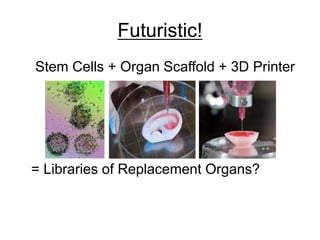
Futuristic!
Stem Cells + Organ Scaffold + 3D Printer
= Libraries of Replacement Organs?
Conclusion
• Engineered tissue replacements
combine celles & biomaterials to
replace a subset of tissue functions
• Biomaterials are natural or synthetic
• Convergence of cell biology,
medicine, and angineering is
advancing the field
• Langer R1, Vacanti JP., Tissue engineering, Science, May 1993
• K. Ren, Y. Chen, H. Wu, New materials for microfluidics in biology, Current Opinion in Biotechnology Volume
25, 2014
• Ott HC et al., Perfusion-decellularized matrix: using nature's platform to engineer a bioartificial
heart, Nature Medicine, 2008
• Sala et al., Current Applications of Tissue Engineering in Biomedicine, J Biochip Tissue chip 2012,
S2
• Sabu Thomas,Yves Grohens,Neethu Ninan, Nanotechnology Applications for Tissue Engineering,
1st Edition, William Andrew (Elsevier) (Google Books): http://bit.ly/1DPqoTZ
• Washington University in St. Louis, 3-D printer creates transformative device for heart
treatment: https://news.wustl.edu/news/Pages/26554.aspx
• Norbert Pallua, Christoph V. Suscheck, Tissue Engineering From Lab to Clinic, 2011, Springer
• Cato T. Laurencin, Lakshmi S. Nair, Nanotechnology and Regenerative Engineering: The Scaffold,
Second Edition, CRC Press, 2014
• I. Y. Wong, Bhatia, S. N., and Toner, M., “Nanotechnology: emerging tools for biology and
medicine.”, Genes Dev, vol. 27, no. 22, pp. 2397-408, 2013.
• Lizhi Xu and al. 3D multifunctional integumentary membranes for spatiotemporal cardiac
measurements and stimulation across the entire epicardium, Nature Communications, 2014
• R. Langer, D. A. Tirrell, Designing materials for biology and medicine, Nature 428, 2004
• S. Yang et al. The design of scaffolds for use in tissue engineering. Part I. Traditional factors.
Tissue Engineering, 7(6):679–689, 2001
References
S. Yang et al. The design of scaffolds for use in tissue engineering. Part II. Rapid prototyping
techniques. Tissue Engineering, 8:1–11, 2002
• Molly S. Shoichet, Polymer Scaffolds for Biomaterials Applications, Macromolecules, 2010
• I. E. Araci, P. Brisk, Recent developments in microfluidic large scale integration, Current Opinion
in Biotechnology Volume 25, 2014
•X-J J Li Y Zhou, Microfluidic Devices for Biomedical Applications, Woodhead Publishing Series in
Biomaterials: Number 61, 2013
References
Questions
The End
Thank you for your attention

Tissue Engineering & Regenerative Medicine

  • 1.
    Scaffold for Tissue Engineering &Regenerative Medicine Mohamed Labadi April 9, 2015
  • 2.
    Overview Regenerative Medicine Tissue Engineering Scaffoldsfor TE Nanotechnology and Microfluidics for Scaffold TE R&D Trends & Pioneering Future and Conclusion Nature Nanotechnology, January 2011
  • 3.
    Characterizing Regenerative Medicine 1. Regenerativemedicine is a broad definition for innovative medical therapies that will enable the body to repair, replace, restore and regenerate damaged or diseased cells, tissues and organs. (Mayo Clinic) 2. Tools and Procedures (Biofabrication or Additive Manufacturing) of Regenerative Medicine • Tissue Engineering: Tissue Repair/Replacement and Lab Grown Organs • Technologies  Stem cells  Natural and Synthetic Scaffolds  3-D Printing and Chip Technologies
  • 4.
    Areas of RegenerativeMedicine 1. Artificial Organs: Medical Devices (Lab Grown Bladder) 2.Tissue Engineering & Biomaterials Scaffolds
  • 5.
    Areas of RegenerativeMedicine 3. Cellular Therapies • Use of Stem Cells (From Patient) • Development of Regenerative Medicine Treatments. • Enhance Regeneration of Tissues and Organs. 4. Clinical Trials • Many Currently in Progress. • NIH and Private Organizations.
  • 6.
    “Body Builders”: TheEmerging Science of Regenerative Medicine
  • 7.
    The Beginning……… Joseph Vacanti*& Robert Langer** (1993) ——————— Langer R1, Vacanti JP., Tissue engineering, Science, 1993 * Harvard Stem Cell Institute ** Massachusetts Institute of Technology (MIT)
  • 8.
    Why Tissue Engineering •TE is an interdisciplinary field that applies the principles of engineering and the life sciences towards the development of biological substitutes that restore, maintain, or improve tissue function • Developing living tissue using cells, biomaterials, and signaling molecules
  • 9.
    Need for Replacement •Skin - 3 million procedures per year • Bone - 1 million procedures per year • Cartilage - 1 million procedures per year • Blood Vessel - 1 million procedures per year • Kidney - 600 thousand procedures per year • Liver - 200 thousand procedures per year • Nerve - 200 thousand procedures per year
  • 10.
    Why Tissue Engineering •Traditional Implants (hip replacement…) – Poor biocompatibility – Mechanical Failure (undergo fatigue, wear, corrosion) • Transplants – Rejection – Disease transmission – Supply << Demand
  • 11.
    3 Tools ofTissue Engineering • Cells – Living part of tissue – Produces protein and provides function of cells – Gives tissue reparative properties • Scaffold – Provides structural support and shape to construct – Provides place for cell attachment and growth – Usually biodegradable and biocompatible • Cell Signaling – Signals that tell the cell what to do – Proteins or Mechanical Stimulation
  • 12.
    Components of aTE construct
  • 13.
    • Isolated cellsand cells substitues  Allows for an infusion of specific cells into the patient without the complication of surgery • Tissue growth factor  Massive quantities in targeted delivery  Use of gene delivery system to upregulate the local production • Cell-matrix interaction with Scaffolds  To grow and eventually replace a biodegradable scaffold Strategies of TE
  • 14.
    What do wewant in a scaffold? • 1. Biocompatible • 2. Biodegradable • 3. Chemical and Mechanical Properties • 4. Proper architecture
  • 15.
    Role of theScaffold • Present a surface/structure that closely resembles the extracellular matrix (ECM) • Surfaces that could maximize favorable biological responses (cell-matrix interaction, Protein-matrix interaction)
  • 16.
    Synthetic Scaffolds [Lecture: SangeetaBhatia – ‘Tiny Technologies’ and Regenerative Medicine: stemcellassays.com/2011/04/lecture-sangeeta-bhatia-tiny-technologies-and-regenerative-medicine/]
  • 17.
    Natural Scaffolds Ott HCet al., Perfusion-decellularized matrix: using nature's platform to engineer a bioartificial heart, Nature Medicine, 2008
  • 18.
    Nanotechnology and Microfluidicsin Tissue Engineering • Advances in fabrication technologies have brought a new dimension to the field of tissue engineering. • Fabricate tissue engineering scaffolds with complex 3-D architectures and customized chemistries that mimic the in vivo tissue environment.
  • 19.
    Microfluidic scaffold fortissue engineering • Application of microfabrication and BioMEMS technology • Focused toward developing microfluidic networks with geometries that simulate specific cellular networks • Attractive because of ability to produce structures with feature resolution of less than 10 microns • Vascular tissue engineering
  • 20.
    • Problems ofnutrient transport is critical in the design of tissue engineering • Scaffolds that are targeted for the growth of complex organs such as the liver and kidney • Approach to solving this problem involves the integration of an intrinsic vascular network within these scaffolds. • Drug delivery/ high throughput screening Microfluidic scaffold for tissue engineering
  • 21.
    Regenerative Medicine Challenges 1.Design of Biomaterials that Function in the Body 2. Getting Enough Cells and Cell Types for Engineering Tissues and Organs 3. Vascularity: Engineering Blood Vessels that Supply Nutrients, Oxygen and Signals to Bioengineered Tissues and Organs 4. Cost of Tissue and Organ Development Procedures
  • 22.
    Challenge of Regenerative Medicine Bioengineeringof Organs Ott HC et al., Perfusion-decellularized matrix: using nature's platform to engineer a bioartificial heart, Nature Medicine, 2008
  • 23.
    Potential of RegenerativeMedicine Chip Technology [Geraldine Hamilton, Body parts on a chip, TEDx Boston, June 2013: https://youtu.be/CpkXmtJOH84] • Reduces Need for Animal Testing • 3-D Printed Organs on Chips Used to Test Vaccines
  • 24.
    3-D Elastic MembraneFits Heart’s Epicardium 3-D Printer Creates Heart Membrane [Prof. Igor Efimov, Washington University in St. Louish: ttps://news.wustl.edu/news/Pages/26554.aspx] Lizhi Xu and al., Nature Communications, 2014, 3329, doi:10.1038/ncomms4329 Promise of Regenerative Medicine
  • 25.
    R&D Trends, Innovationand Pioneering [Laboratory for Multiscale Regenerative Technologies: https://lmrt.mit.edu/research]
  • 26.
    Regenerative Medicine Pioneers WakeForest Institute for Regenerative Medicine (WFIRM) Dr. Anthony Atala • 2006-2007: First to Engineer/Transplant Lab- Grown Organ into a Human • Transplant was Successful • Currently Developing Organ on a Chip Program
  • 27.
    1993: Dr. RobetLanger (Langer Lab, MIT) Tissue engineering, controlled release systems and transdermal delivery systems Regenerative Medicine Pioneers
  • 28.
    Dr. Paolo Macchiarini(Karolinska Institute) • 2008: Implanted World’s First Donor Trachea • Recipient: Claudio Castillo • Survived Procedure — Now Has Normal Respiratory Function Regenerative Medicine Pioneers
  • 29.
    Dr. Ali Khademhosseini(Wyss Institute at Harvard) [MIT Technology Review: www2.technologyreview.com/tr35/profile.aspx?TRID=610] • 2007: Creating living tissues • Organs in the lab Regenerative Medicine Pioneers
  • 30.
    McGowan Institute ofRegenerative Medicine (University of Pittsburg) Dr. Stephen Badylak • Removed Cells from Pig Bladder Extra Cellular Matrix (ECM) • Re-grows Severed Digits and • New Muscle Tissue Development of 3-D bioscaffolds for liver and heart regeneration Regenerative Medicine Pioneers
  • 31.
    Regenerative Medicine Innovators Dr.Geraldine Hamilton (Wyss Institute, Harvard) 2011: Organ on a Chip Technology (Drug Testing Tool)
  • 32.
    Regenerative Medicine Innovators Dr.Sangeeta Bhatia, The David H. Koch Institute for Integrative Cancer Research • 2003: Uses microchip-manufacturing tools to build artificial livers • Leveraging miniaturization tools from the world of semiconductor manufacturing to impact human health
  • 33.
    Regenerative Medicine Innovators Dr.Jordan Miller (Rice University) • 2013: Uses 3-D Print Technology • Engineers Blood Vessels Using Sugar
  • 34.
    Regenerative Medicine Innovators Dr.Ramille N. Shah (Northwestern Univ.) • 2011: Leader in Field of 3D-Printable Materials • Engineers new 3D-Inks • Creates Porous Scaffolds • Technique: Additive Manufacturing (Nanofiber Scaffold For Cartilage Regeneration) [Center for Regenerative Nanomedicine, Northwestern University: rn.northwestern.edu/projects/peptide-amphiphile-polymer-hybrids-articular-cartilage- regeneration] Peptide amphiphile nanofiber hybrid scaffolds will be created using 3D bioprinting technology
  • 35.
    The Business ofRegenerative Medicine Organovo 3-D Bioprinting Company  Started A Collaboration with NIH (January 2014)  Goal: Bioprinting of 3D Living Tissues • Eliminate Challenges to New Therapy Development • Animal Models: Poor Predictors of Drug Efficacy and Toxicity
  • 36.
    The Business ofRegenerative Medicine Tengion A Biotechnology Company  Company Platform for Engineering Tissues/Organs  Organ Regeneration Process o Doctors send Tissue Sample from Diseased or Failing Organ to Tengion o Tengion Selects and Multiplies Healthy Cells o Place Cells on an Organ-Shaped Scaffold o Result: A Neo-Organ for Transplant
  • 37.
    Futuristic! Stem Cells +Organ Scaffold + 3D Printer = Libraries of Replacement Organs?
  • 38.
    Conclusion • Engineered tissuereplacements combine celles & biomaterials to replace a subset of tissue functions • Biomaterials are natural or synthetic • Convergence of cell biology, medicine, and angineering is advancing the field
  • 39.
    • Langer R1,Vacanti JP., Tissue engineering, Science, May 1993 • K. Ren, Y. Chen, H. Wu, New materials for microfluidics in biology, Current Opinion in Biotechnology Volume 25, 2014 • Ott HC et al., Perfusion-decellularized matrix: using nature's platform to engineer a bioartificial heart, Nature Medicine, 2008 • Sala et al., Current Applications of Tissue Engineering in Biomedicine, J Biochip Tissue chip 2012, S2 • Sabu Thomas,Yves Grohens,Neethu Ninan, Nanotechnology Applications for Tissue Engineering, 1st Edition, William Andrew (Elsevier) (Google Books): http://bit.ly/1DPqoTZ • Washington University in St. Louis, 3-D printer creates transformative device for heart treatment: https://news.wustl.edu/news/Pages/26554.aspx • Norbert Pallua, Christoph V. Suscheck, Tissue Engineering From Lab to Clinic, 2011, Springer • Cato T. Laurencin, Lakshmi S. Nair, Nanotechnology and Regenerative Engineering: The Scaffold, Second Edition, CRC Press, 2014 • I. Y. Wong, Bhatia, S. N., and Toner, M., “Nanotechnology: emerging tools for biology and medicine.”, Genes Dev, vol. 27, no. 22, pp. 2397-408, 2013. • Lizhi Xu and al. 3D multifunctional integumentary membranes for spatiotemporal cardiac measurements and stimulation across the entire epicardium, Nature Communications, 2014 • R. Langer, D. A. Tirrell, Designing materials for biology and medicine, Nature 428, 2004 • S. Yang et al. The design of scaffolds for use in tissue engineering. Part I. Traditional factors. Tissue Engineering, 7(6):679–689, 2001 References
  • 40.
    S. Yang etal. The design of scaffolds for use in tissue engineering. Part II. Rapid prototyping techniques. Tissue Engineering, 8:1–11, 2002 • Molly S. Shoichet, Polymer Scaffolds for Biomaterials Applications, Macromolecules, 2010 • I. E. Araci, P. Brisk, Recent developments in microfluidic large scale integration, Current Opinion in Biotechnology Volume 25, 2014 •X-J J Li Y Zhou, Microfluidic Devices for Biomedical Applications, Woodhead Publishing Series in Biomaterials: Number 61, 2013 References
  • 41.
    Questions The End Thank youfor your attention

Editor's Notes

  • #15 Architecture - a picture of a native meniscus. It has a very specific size and shape important to it’s function. Obviously you can’t replace it with something of any random shape like this pyramid. The final picture is tissue engineered meniscus made in the proper size and shape