The past present and
future prospects of stem
cell research
Presented By-
Kartikeya Singh
B.Sc BIOTECHNOLOGY
SEM-V
Roll No. 273001
Enrollnment No-ECC1808001
STEM CELL-DEFINITION
2
A stem cell is a cell
with the unique ability
to develop into
specialised cell types
in the body. In the
future they may be
used to replace cells
and tissues that have
been damaged or lost
due to disease.
What makes a cell a STEM CELL
Plasticity: A stem cell is plastic, meaning it can
develop into another type of cell.
Differentiation: The process where a stem cell specializes or
develops into another type of cell.
Unspecialized:They do not have any tissue specific structures.
Self renewal:A stem cell can divide(renew itself) indefinitely
and without always developing into another cell.
3
Classification of stem cells
Stem cells can be classified
according to their origin into
four broad types, from
embryos; from the fetus; from
the infants and from the adult.
Also, they can be classified
according to their potency.
4
HISTORY-
Past prospects and researches of stem cells
1
“What is stem cell research?
Stem-cell research is the area of research
that studies the properties of stem cells
and their potential use in medicine.
As stem cells are the source of all tissues,
understanding their properties helps in
our understanding of the healthy and
diseased body's development and
homeostasis
6
7
History of Human Stem Cell Research
• In 1968, the first bone marrow transplant was
successfully used in treatment of Severe
Combined Immunodeficiency.
• Since the 1970s, bone marrow transplants
have been used for treatment of
immunodeficiencies and leukemias .
• 1999 - First Successful human transplant of
insulinmaking cells from cadavers
• 2001- First cloned human embryos (only to six
cell stage) created by Advanced Cell
Technology (USA)
• 2004 - Harvard researchers grow stem cells
from embryos
History of human embryonic stem cell research
▸ In 1998, James Thomson (University of Wisconsin-
Madison) isolated cells from the inner cell mass of
the blastocyst, and developed the first human
embryonic stem cell line in culture.
▸ In 1998, John Gearhart derived human embryonic
germ cells from cells in fetal gonadal tissue
▸ Pluripotent stem cell ‘lines’ were developed from
both sources.
8
History of adult stem cell research
Since the 1970’s bone marrow transplants
Have been used for treatment of
immunodeficient and leukemia.
In fact, adult hematopoietic—or blood-
forming—stem cells from bone marrow
have been used in transplants for more
than 40 years.
9
1952 - Briggs and King cloned tadpoles
1996-Successful cloning of mammals-Dolly
the sheep, the first successfully cloned
mammal, was cloned in Scotland in 1996.
Dolly is shown with her first offspring,
Bonnie.
The process involves fusing a sheep egg
with an udder cell and implanting the
resulting hybrids into a surrogate mother
sheep.
History of Somatic Cell Nuclear Transfer
(Cloning)
10
PRESENT PROSPECTS
Umbilical cord stem cells
At the time of delivery, cord blood is collected, stored,
and frozen.
• UCB contains two classes of stem cells.
-Haematopoietic stem cells (HS ).
- Mesenchymal stem cells (MSC).
• Can be used to cure chronic blood-related disorders
such as sickle cell disease, Thalasemia, and leukaemia.
12
iPSC a turning point in stem cell therapy
▸ The turning point in stem cell therapy
appeared in 2006, when scientist
ShinyaYamanaka, discovered that it is
possible to reprogram multipotent adult
stem cells to the pluripotent state.
▸ can create stem cells directly from a patient
for research
▸ Advantage: no need for embryos! (ethical)
13
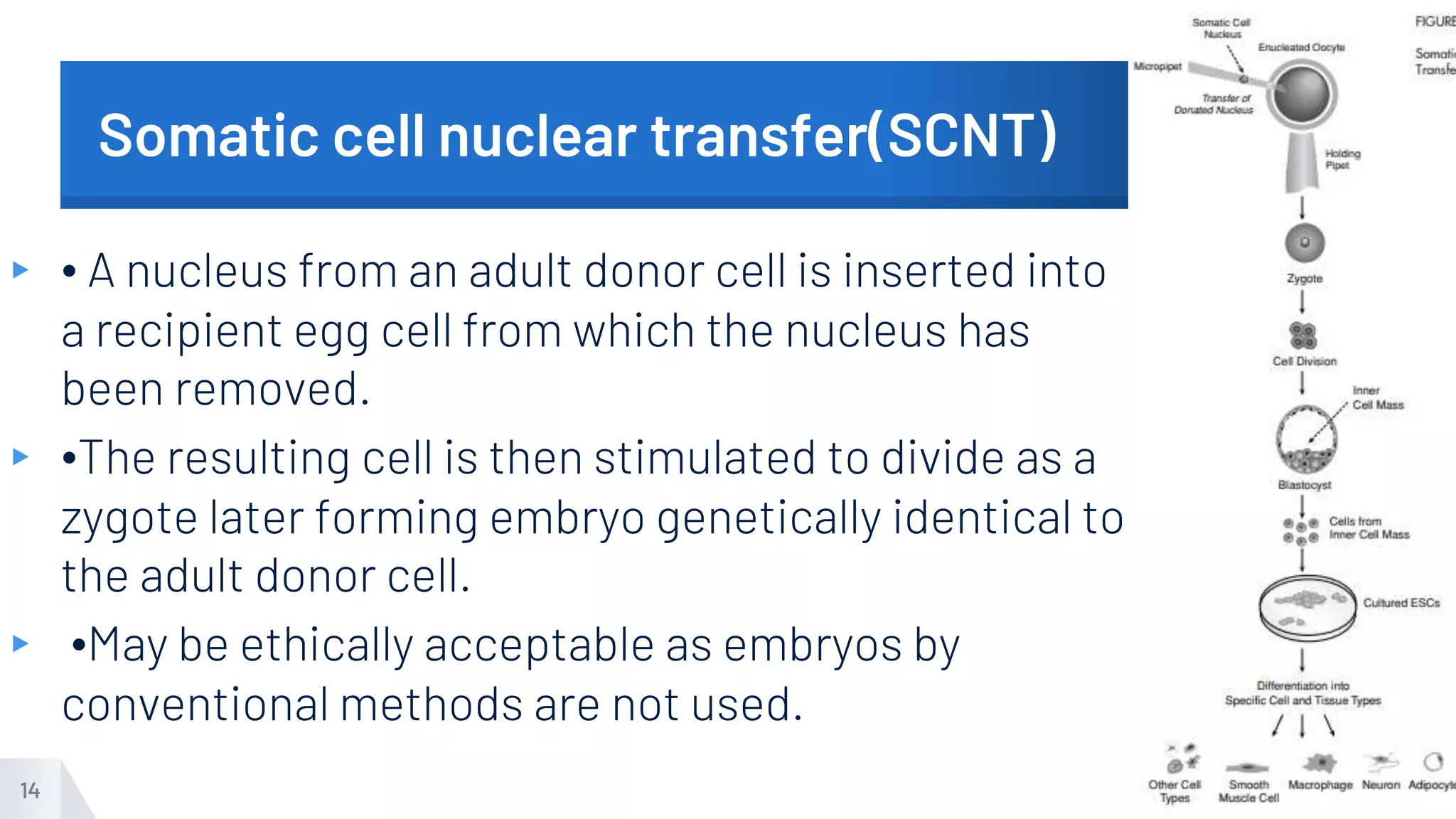
Somatic cell nuclear transfer(SCNT)
▸ • A nucleus from an adult donor cell is inserted into
a recipient egg cell from which the nucleus has
been removed.
▸ •The resulting cell is then stimulated to divide as a
zygote later forming embryo genetically identical to
the adult donor cell.
▸ •May be ethically acceptable as embryos by
conventional methods are not used.
14
DEVELOPMENT IN STEM
CELL RESEARCH
REGENERATIVE
MEDICINE
▸ For the first time researchers
reconstitute a complete organ.
New bladders were made by
growing bladder cells from the
patients on a biodegradable
scaffolding.
▸ - Reported in the Lancet (April,
2006)
16
Potential uses of stem cells
▸ Biotechnology(drug discovery & development)
▸ - stem cells can provide specific cell types to test new
drugs
• Cancer cell lines are already being used to screen
potential anti-tumor drugs.
• Availability of pluripotent stem cells would allow drug
testing in a wider range of cell types & to reduce animal
testing .
17
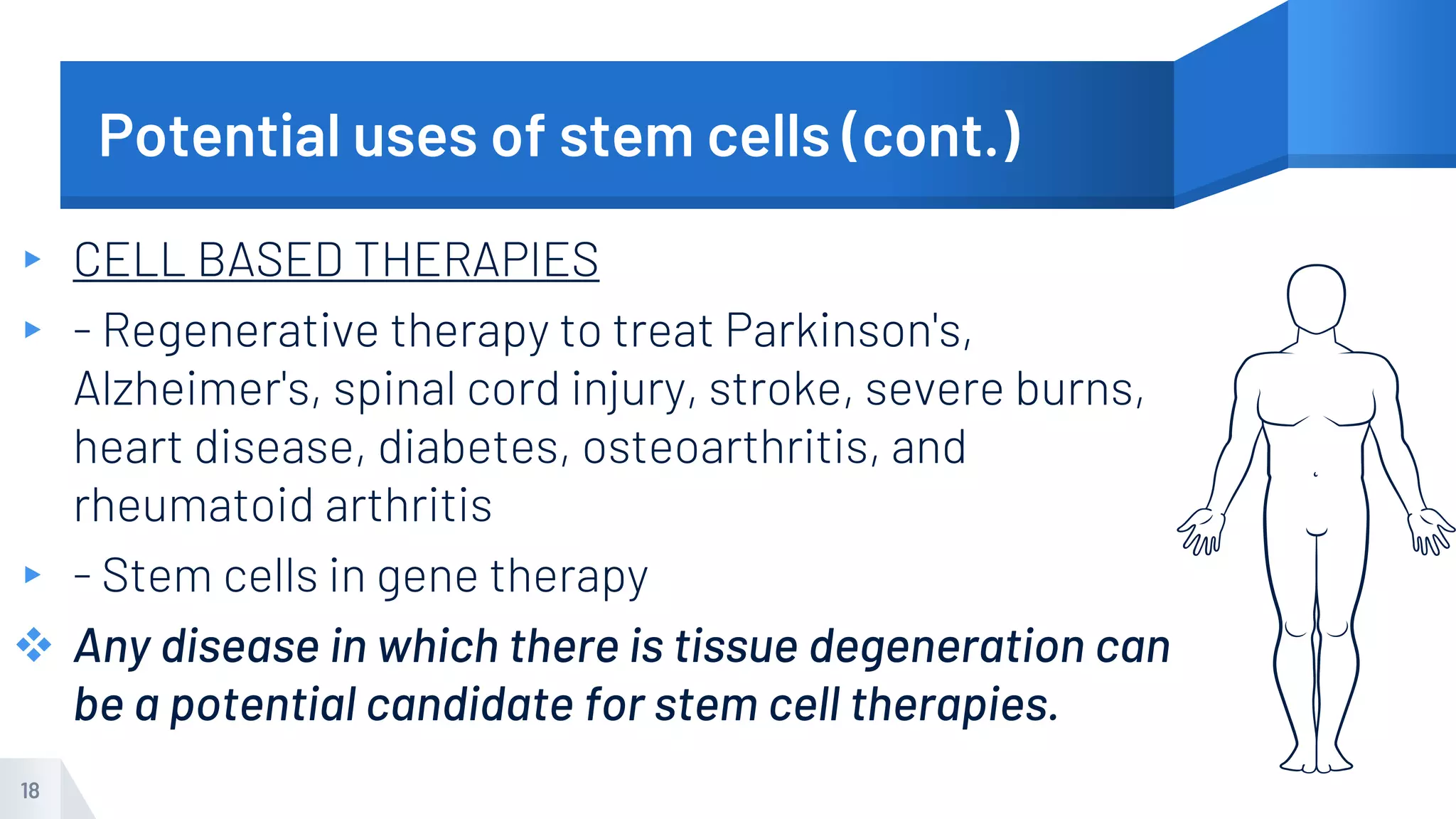
Potential uses of stem cells (cont.)
▸ CELL BASED THERAPIES
▸ - Regenerative therapy to treat Parkinson's,
Alzheimer's, spinal cord injury, stroke, severe burns,
heart disease, diabetes, osteoarthritis, and
rheumatoid arthritis
▸ - Stem cells in gene therapy
 Any disease in which there is tissue degeneration can
be a potential candidate for stem cell therapies.
18
Leukemia and Cancer
▸ Leukemia patients treated
with stem cells emerge
free of disease.
▸ Stem cells have also
reduces pancreatic
cancers in some patients.
19
Rheumatoid Arthritis
▸ Adult Stem Cells
may be helpful in
starting repair of
eroded cartilage.
20
Type I Diabetes
▸ Embryonic Stems
Cells might be
trained to become
pancreatic islets
cells needed to
secrete insulin.
21
CURRENT STATUS IN INDIA
22
Keeping in view of its potential therapeutic applications,
both basic and translational research are being
promoted in various institutions, hospitals and the
industry.
• Till date, more than 55 programmes have been
identified and supported on various aspects of stem cell
research.
National Guidelines for Stem Cell Research was
published by ICMR in 2013.
Challenges to stem cell research
▸ USE OF EMBRYOS FOR STEM CELL RESEARCH IS CONTROVERSIAL-No field
of biological science has been more controversial than that involving human
reproduction.ESC research on ethical, moral, or religious grounds,such
research deprives a human embryo of any further potential to develop into a
complete human being.
▸ Because stem cell research is relatively new, it is important to build a
scientific foundation that can support the research community,the
mechanisms are not fully understood,fear of the unknown is the greatest
challenge to overcome.
▸ Inability to obtain source material due to ethical concerns.
23
CONCLUSION
▸ After several decades of experiments, stem cell therapy is
becoming a magnificent game changer for regerative and
specific medicine.
▸ There is enormous potential in human stem cell research
Both adult and embryonic stem cells should be studied
▸ Much research needed before therapies are realized.
▸ Ethical concerns need to be taken into account.
24
Thanks!
25
Medical Icons
26
Diagrams and infographics
27

Stem cell research Project

  • 1.
    The past presentand future prospects of stem cell research Presented By- Kartikeya Singh B.Sc BIOTECHNOLOGY SEM-V Roll No. 273001 Enrollnment No-ECC1808001
  • 2.
    STEM CELL-DEFINITION 2 A stemcell is a cell with the unique ability to develop into specialised cell types in the body. In the future they may be used to replace cells and tissues that have been damaged or lost due to disease.
  • 3.
    What makes acell a STEM CELL Plasticity: A stem cell is plastic, meaning it can develop into another type of cell. Differentiation: The process where a stem cell specializes or develops into another type of cell. Unspecialized:They do not have any tissue specific structures. Self renewal:A stem cell can divide(renew itself) indefinitely and without always developing into another cell. 3
  • 4.
    Classification of stemcells Stem cells can be classified according to their origin into four broad types, from embryos; from the fetus; from the infants and from the adult. Also, they can be classified according to their potency. 4
  • 5.
    HISTORY- Past prospects andresearches of stem cells 1
  • 6.
    “What is stemcell research? Stem-cell research is the area of research that studies the properties of stem cells and their potential use in medicine. As stem cells are the source of all tissues, understanding their properties helps in our understanding of the healthy and diseased body's development and homeostasis 6
  • 7.
    7 History of HumanStem Cell Research • In 1968, the first bone marrow transplant was successfully used in treatment of Severe Combined Immunodeficiency. • Since the 1970s, bone marrow transplants have been used for treatment of immunodeficiencies and leukemias . • 1999 - First Successful human transplant of insulinmaking cells from cadavers • 2001- First cloned human embryos (only to six cell stage) created by Advanced Cell Technology (USA) • 2004 - Harvard researchers grow stem cells from embryos
  • 8.
    History of humanembryonic stem cell research ▸ In 1998, James Thomson (University of Wisconsin- Madison) isolated cells from the inner cell mass of the blastocyst, and developed the first human embryonic stem cell line in culture. ▸ In 1998, John Gearhart derived human embryonic germ cells from cells in fetal gonadal tissue ▸ Pluripotent stem cell ‘lines’ were developed from both sources. 8
  • 9.
    History of adultstem cell research Since the 1970’s bone marrow transplants Have been used for treatment of immunodeficient and leukemia. In fact, adult hematopoietic—or blood- forming—stem cells from bone marrow have been used in transplants for more than 40 years. 9
  • 10.
    1952 - Briggsand King cloned tadpoles 1996-Successful cloning of mammals-Dolly the sheep, the first successfully cloned mammal, was cloned in Scotland in 1996. Dolly is shown with her first offspring, Bonnie. The process involves fusing a sheep egg with an udder cell and implanting the resulting hybrids into a surrogate mother sheep. History of Somatic Cell Nuclear Transfer (Cloning) 10
  • 11.
  • 12.
    Umbilical cord stemcells At the time of delivery, cord blood is collected, stored, and frozen. • UCB contains two classes of stem cells. -Haematopoietic stem cells (HS ). - Mesenchymal stem cells (MSC). • Can be used to cure chronic blood-related disorders such as sickle cell disease, Thalasemia, and leukaemia. 12
  • 13.
    iPSC a turningpoint in stem cell therapy ▸ The turning point in stem cell therapy appeared in 2006, when scientist ShinyaYamanaka, discovered that it is possible to reprogram multipotent adult stem cells to the pluripotent state. ▸ can create stem cells directly from a patient for research ▸ Advantage: no need for embryos! (ethical) 13
  • 14.
    Somatic cell nucleartransfer(SCNT) ▸ • A nucleus from an adult donor cell is inserted into a recipient egg cell from which the nucleus has been removed. ▸ •The resulting cell is then stimulated to divide as a zygote later forming embryo genetically identical to the adult donor cell. ▸ •May be ethically acceptable as embryos by conventional methods are not used. 14
  • 15.
  • 16.
    REGENERATIVE MEDICINE ▸ For thefirst time researchers reconstitute a complete organ. New bladders were made by growing bladder cells from the patients on a biodegradable scaffolding. ▸ - Reported in the Lancet (April, 2006) 16
  • 17.
    Potential uses ofstem cells ▸ Biotechnology(drug discovery & development) ▸ - stem cells can provide specific cell types to test new drugs • Cancer cell lines are already being used to screen potential anti-tumor drugs. • Availability of pluripotent stem cells would allow drug testing in a wider range of cell types & to reduce animal testing . 17
  • 18.
    Potential uses ofstem cells (cont.) ▸ CELL BASED THERAPIES ▸ - Regenerative therapy to treat Parkinson's, Alzheimer's, spinal cord injury, stroke, severe burns, heart disease, diabetes, osteoarthritis, and rheumatoid arthritis ▸ - Stem cells in gene therapy  Any disease in which there is tissue degeneration can be a potential candidate for stem cell therapies. 18
  • 19.
    Leukemia and Cancer ▸Leukemia patients treated with stem cells emerge free of disease. ▸ Stem cells have also reduces pancreatic cancers in some patients. 19
  • 20.
    Rheumatoid Arthritis ▸ AdultStem Cells may be helpful in starting repair of eroded cartilage. 20
  • 21.
    Type I Diabetes ▸Embryonic Stems Cells might be trained to become pancreatic islets cells needed to secrete insulin. 21
  • 22.
    CURRENT STATUS ININDIA 22 Keeping in view of its potential therapeutic applications, both basic and translational research are being promoted in various institutions, hospitals and the industry. • Till date, more than 55 programmes have been identified and supported on various aspects of stem cell research. National Guidelines for Stem Cell Research was published by ICMR in 2013.
  • 23.
    Challenges to stemcell research ▸ USE OF EMBRYOS FOR STEM CELL RESEARCH IS CONTROVERSIAL-No field of biological science has been more controversial than that involving human reproduction.ESC research on ethical, moral, or religious grounds,such research deprives a human embryo of any further potential to develop into a complete human being. ▸ Because stem cell research is relatively new, it is important to build a scientific foundation that can support the research community,the mechanisms are not fully understood,fear of the unknown is the greatest challenge to overcome. ▸ Inability to obtain source material due to ethical concerns. 23
  • 24.
    CONCLUSION ▸ After severaldecades of experiments, stem cell therapy is becoming a magnificent game changer for regerative and specific medicine. ▸ There is enormous potential in human stem cell research Both adult and embryonic stem cells should be studied ▸ Much research needed before therapies are realized. ▸ Ethical concerns need to be taken into account. 24
  • 25.
  • 26.
  • 27.

Editor's Notes

  • #19 What diseases can be cured by stem cell therapies?