What is Ethics?
https://www.youtube.com/watch?v=u399XmkjeXo
5 Controversial psychology experiment
https://www.youtube.com/watch?v=zZ3l1jgmYrY
Research Ethics:
https://www.youtube.com/watch?v=mtLPd2u4DiA
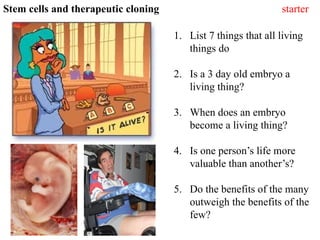
Stem cells and therapeutic cloning starter
1. List 7 things that all living
things do
2. Is a 3 day old embryo a
living thing?
3. When does an embryo
become a living thing?
4. Is one person’s life more
valuable than another’s?
5. Do the benefits of the many
outweigh the benefits of the
few?
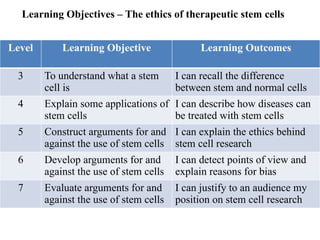
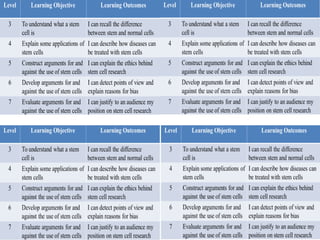
Level Learning Objective Learning Outcomes
3 To understand what a stem
cell is
I can recall the difference
between stem and normal cells
4 Explain some applications of
stem cells
I can describe how diseases can
be treated with stem cells
5 Construct arguments for and
against the use of stem cells
I can explain the ethics behind
stem cell research
6 Develop arguments for and
against the use of stem cells
I can detect points of view and
explain reasons for bias
7 Evaluate arguments for and
against the use of stem cells
I can justify to an audience my
position on stem cell research
Learning Objectives – The ethics of therapeutic stem cells
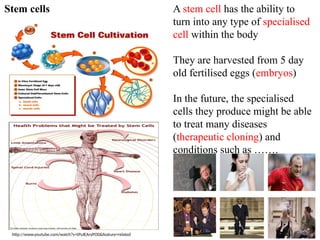
Stem cells A stem cell has the ability to
turn into any type of specialised
cell within the body
They are harvested from 5 day
old fertilised eggs (embryos)
In the future, the specialised
cells they produce might be able
to treat many diseases
(therapeutic cloning) and
conditions such as …….
http://www.youtube.com/watch?v=tPulEAryPO0&feature=related
On your whiteboard, write down the number of the statement that is
false
1. Stem cells have the potential to
make any other cell within the
body
2. Three to five day old embryos are
a good source of stem cells
3. In the future, stem cells might
allow humans to grow wings
4. Some people object to stem cell
research because they respect life
at all stages
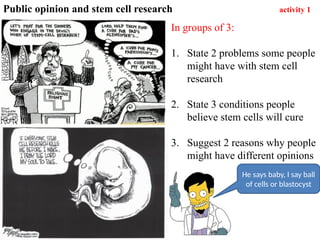
Public opinion and stem cell research activity 1
He says baby, I say ball
of cells or blastocyst
In groups of 3:
1. State 2 problems some people
might have with stem cell
research
2. State 3 conditions people
believe stem cells will cure
3. Suggest 2 reasons why people
might have different opinions
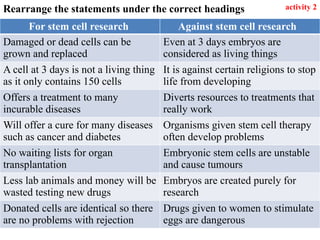
For stem cell research Against stem cell research
Organisms given stem cell therapy
often develop problems
Offers a treatment to many
incurable diseases
A cell at 3 days is not a living thing
as it only contains 150 cells
It is against certain religions to stop
life from developing
Even at 3 days embryos are
considered as living things
Diverts resources to treatments that
really work
Will offer a cure for many diseases
such as cancer and diabetes
Damaged or dead cells can be
grown and replaced
Embryonic stem cells are unstable
and cause tumours
No waiting lists for organ
transplantation
Less lab animals and money will be
wasted testing new drugs
Embryos are created purely for
research
Drugs given to women to stimulate
eggs are dangerous
Donated cells are identical so there
are no problems with rejection
activity 2
Rearrange the statements under the correct headings
For stem cell research Against stem cell research
Damaged or dead cells can be
grown and replaced
Even at 3 days embryos are
considered as living things
A cell at 3 days is not a living thing
as it only contains 150 cells
It is against certain religions to stop
life from developing
Offers a treatment to many
incurable diseases
Diverts resources to treatments that
really work
Will offer a cure for many diseases
such as cancer and diabetes
Organisms given stem cell therapy
often develop problems
No waiting lists for organ
transplantation
Embryonic stem cells are unstable
and cause tumours
Less lab animals and money will be
wasted testing new drugs
Embryos are created purely for
research
Donated cells are identical so there
are no problems with rejection
Drugs given to women to stimulate
eggs are dangerous
activity 2
Rearrange the statements under the correct headings
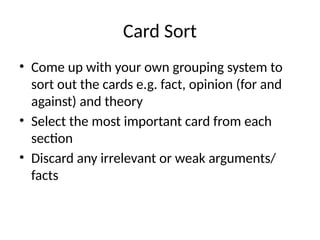
Card Sort
• Come up with your own grouping system to
sort out the cards e.g. fact, opinion (for and
against) and theory
• Select the most important card from each
section
• Discard any irrelevant or weak arguments/
facts
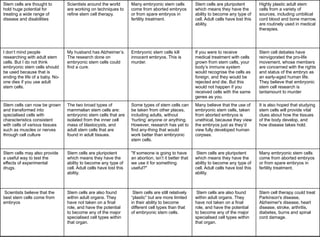
Stem cells are thought to
hold huge potential for
treating a wide range of
disease and disabilities
Scientists around the world
are working on techniques to
refine stem cell therapy.
Many embryonic stem cells
come from aborted embryos
or from spare embryos in
fertility treatment.
Stem cells are pluripotent
which means they have the
ability to become any type of
cell. Adult cells have lost this
ability.
Highly plastic adult stem
cells from a variety of
sources, including umbilical
cord blood and bone marrow,
are routinely used in medical
therapies.
I don’t mind people
researching with adult stem
cells. But I do not think
embryonic stem cells should
be used because that is
ending the life of a baby. No-
one dies if you use adult
stem cells.
My husband has Alzheimer’s.
The research done on
embryonic stem cells could
find a cure.
Embryonic stem cells kill
innocent embryos. This is
murder.
If you were to receive
medical treatment with cells
grown from stem cells, your
body’s immune system
would recognise the cells as
foreign, and they would be
rejected and die. But this
would not happen if you
received cells with the same
genes as you.
Stem cell debates have
reinvigorated the pro-life
movement, whose members
are concerned with the rights
and status of the embryo as
an early-aged human life.
They believe that embryonic
stem cell research is
tantamount to murder
Stem cells can now be grown
and transformed into
specialised cells with
characteristics consistent
with cells of various tissues
such as muscles or nerves
through cell culture
The two broad types of
mammalian stem cells are:
embryonic stem cells that are
isolated from the inner cell
mass of blastocysts, and
adult stem cells that are
found in adult tissues.
Some types of stem cells can
be taken from other places,
including adults, without
‘hurting’ anyone or anything.
However, research has yet to
find any-thing that would
work better than embryonic
stem cells.
Many believe that the use of
embryonic stem cells, taken
from aborted embryos is
unethical, because they view
the embryos just as they’d
view fully developed human
corpses.
It is also hoped that studying
stem cells will provide vital
clues about how the tissues
of the body develop, and
how disease takes hold.
Stem cells may also provide
a useful way to test the
effects of experimental
drugs.
Stem cells are pluripotent
which means they have the
ability to become any type of
cell. Adult cells have lost this
ability.
"If someone is going to have
an abortion, isn’t it better that
we use it for something
useful?"
Stem cells are pluripotent
which means they have the
ability to become any type of
cell. Adult cells have lost this
ability.
Many embryonic stem cells
come from aborted embryos
or from spare embryos in
fertility treatment.
Scientists believe that the
best stem cells come from
embryos
Stem cells are also found
within adult organs. They
have not taken on a final
role, and have the potential
to become any of the major
specialised cell types within
that organ.
Stem cells are still relatively
“plastic” but are more limited
in their ability to become
different cell types than that
of embryonic stem cells.
Stem cells are also found
within adult organs. They
have not taken on a final
role, and have the potential
to become any of the major
specialised cell types within
that organ.
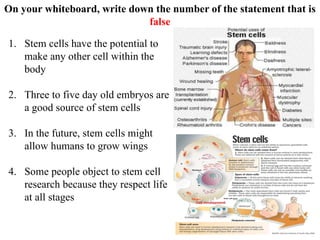
Stem cell therapy could treat
Parkinson's disease,
Alzheimer's disease, heart
disease, stroke, arthritis,
diabetes, burns and spinal
cord damage.
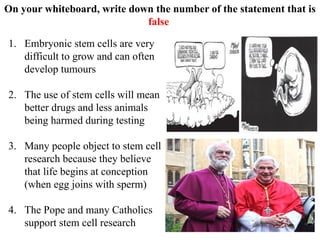
On your whiteboard, write down the number of the statement that is
false
1. Embryonic stem cells are very
difficult to grow and can often
develop tumours
2. The use of stem cells will mean
better drugs and less animals
being harmed during testing
3. Many people object to stem cell
research because they believe
that life begins at conception
(when egg joins with sperm)
4. The Pope and many Catholics
support stem cell research
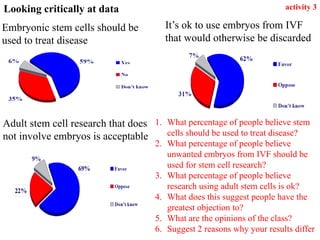
It’s ok to use embryos from IVF
that would otherwise be discarded
Looking critically at data
Adult stem cell research that does
not involve embryos is acceptable
Embryonic stem cells should be
used to treat disease
activity 3
1. What percentage of people believe stem
cells should be used to treat disease?
2. What percentage of people believe
unwanted embryos from IVF should be
used for stem cell research?
3. What percentage of people believe
research using adult stem cells is ok?
4. What does this suggest people have the
greatest objection to?
5. What are the opinions of the class?
6. Suggest 2 reasons why your results differ
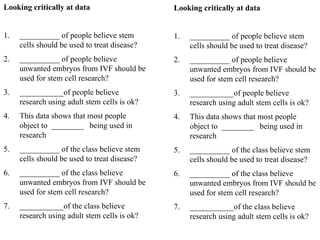
Looking critically at data
1. __________ of people believe stem
cells should be used to treat disease?
2. __________ of people believe
unwanted embryos from IVF should be
used for stem cell research?
3. ___________of people believe
research using adult stem cells is ok?
4. This data shows that most people
object to ________ being used in
research
5. __________ of the class believe stem
cells should be used to treat disease?
6. __________ of the class believe
unwanted embryos from IVF should be
used for stem cell research?
7. ___________of the class believe
research using adult stem cells is ok?
Looking critically at data
1. __________ of people believe stem
cells should be used to treat disease?
2. __________ of people believe
unwanted embryos from IVF should be
used for stem cell research?
3. ___________of people believe
research using adult stem cells is ok?
4. This data shows that most people
object to ________ being used in
research
5. __________ of the class believe stem
cells should be used to treat disease?
6. __________ of the class believe
unwanted embryos from IVF should be
used for stem cell research?
7. ___________of the class believe
research using adult stem cells is ok?
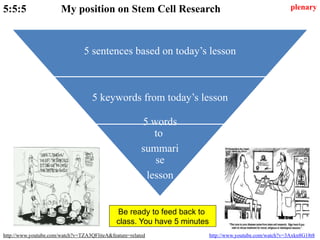
5:5:5 My position on Stem Cell Research
http://www.youtube.com/watch?v=TZA3QFliteA&feature=related http://www.youtube.com/watch?v=3Axkn8G18t8
5 sentences based on today’s lesson
5 keywords from today’s lesson
5 words
to
summari
se
lesson
plenary
Be ready to feed back to
class. You have 5 minutes
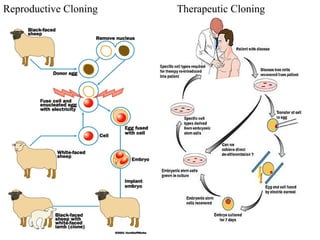
Reproductive Cloning Therapeutic Cloning
Extension activities
Stem cells
Cells that can change into
any type of specialist cell
Specialised
cells
Cells that perform specific
functions like, skin, heart
and liver cells
Totipotent
cells
Stem cells that can turn into
all types of specialised cell
(sometimes called
pluripotent)
Adult stem
cells
Stem cells taken from adult
tissue, many from bone
marrow – they are
multipotent
Embryonic
stem cells
Stem cells taken from
embryos – they are
totipotent
Multipotent
cells
Can change into a limited
number of specialised cells
Therapeutic
cloning
Stem cells used to treat
medical connditions
Blastocyst
A ball of cells formed shortly
after conception
Conception
When a sperm joins with a
female egg to form an
embryo
In-vitro
fertilisation
Conception that takes place
in a test tube
Ethical
right
Unethical
wrong
Embryo
The developing, immature
form that could form a
young adult
Cell
The biological building
blocks of all organisms
Characteristics
of life
All living things do these
(Mrs Gren)
Alzheimer’s
disease
Memory loss that could be
treated with stem cells
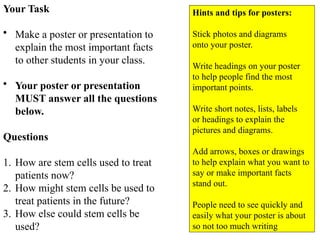
Your Task
• Make a poster or presentation to
explain the most important facts
to other students in your class.
• Your poster or presentation
MUST answer all the questions
below.
Questions
1. How are stem cells used to treat
patients now?
2. How might stem cells be used to
treat patients in the future?
3. How else could stem cells be
used?
Hints and tips for posters:
Stick photos and diagrams
onto your poster.
Write headings on your poster
to help people find the most
important points.
Write short notes, lists, labels
or headings to explain the
pictures and diagrams.
Add arrows, boxes or drawings
to help explain what you want to
say or make important facts
stand out.
People need to see quickly and
easily what your poster is about
so not too much writing

stem cell ethics powerpoint slide introduction

  • 1.
    What is Ethics? https://www.youtube.com/watch?v=u399XmkjeXo 5Controversial psychology experiment https://www.youtube.com/watch?v=zZ3l1jgmYrY Research Ethics: https://www.youtube.com/watch?v=mtLPd2u4DiA
  • 2.
    Stem cells andtherapeutic cloning starter 1. List 7 things that all living things do 2. Is a 3 day old embryo a living thing? 3. When does an embryo become a living thing? 4. Is one person’s life more valuable than another’s? 5. Do the benefits of the many outweigh the benefits of the few?
  • 3.
    Level Learning ObjectiveLearning Outcomes 3 To understand what a stem cell is I can recall the difference between stem and normal cells 4 Explain some applications of stem cells I can describe how diseases can be treated with stem cells 5 Construct arguments for and against the use of stem cells I can explain the ethics behind stem cell research 6 Develop arguments for and against the use of stem cells I can detect points of view and explain reasons for bias 7 Evaluate arguments for and against the use of stem cells I can justify to an audience my position on stem cell research Learning Objectives – The ethics of therapeutic stem cells
  • 5.
    Stem cells Astem cell has the ability to turn into any type of specialised cell within the body They are harvested from 5 day old fertilised eggs (embryos) In the future, the specialised cells they produce might be able to treat many diseases (therapeutic cloning) and conditions such as ……. http://www.youtube.com/watch?v=tPulEAryPO0&feature=related
  • 6.
    On your whiteboard,write down the number of the statement that is false 1. Stem cells have the potential to make any other cell within the body 2. Three to five day old embryos are a good source of stem cells 3. In the future, stem cells might allow humans to grow wings 4. Some people object to stem cell research because they respect life at all stages
  • 7.
    Public opinion andstem cell research activity 1 He says baby, I say ball of cells or blastocyst In groups of 3: 1. State 2 problems some people might have with stem cell research 2. State 3 conditions people believe stem cells will cure 3. Suggest 2 reasons why people might have different opinions
  • 8.
    For stem cellresearch Against stem cell research Organisms given stem cell therapy often develop problems Offers a treatment to many incurable diseases A cell at 3 days is not a living thing as it only contains 150 cells It is against certain religions to stop life from developing Even at 3 days embryos are considered as living things Diverts resources to treatments that really work Will offer a cure for many diseases such as cancer and diabetes Damaged or dead cells can be grown and replaced Embryonic stem cells are unstable and cause tumours No waiting lists for organ transplantation Less lab animals and money will be wasted testing new drugs Embryos are created purely for research Drugs given to women to stimulate eggs are dangerous Donated cells are identical so there are no problems with rejection activity 2 Rearrange the statements under the correct headings
  • 9.
    For stem cellresearch Against stem cell research Damaged or dead cells can be grown and replaced Even at 3 days embryos are considered as living things A cell at 3 days is not a living thing as it only contains 150 cells It is against certain religions to stop life from developing Offers a treatment to many incurable diseases Diverts resources to treatments that really work Will offer a cure for many diseases such as cancer and diabetes Organisms given stem cell therapy often develop problems No waiting lists for organ transplantation Embryonic stem cells are unstable and cause tumours Less lab animals and money will be wasted testing new drugs Embryos are created purely for research Donated cells are identical so there are no problems with rejection Drugs given to women to stimulate eggs are dangerous activity 2 Rearrange the statements under the correct headings
  • 11.
    Card Sort • Comeup with your own grouping system to sort out the cards e.g. fact, opinion (for and against) and theory • Select the most important card from each section • Discard any irrelevant or weak arguments/ facts
  • 12.
    Stem cells arethought to hold huge potential for treating a wide range of disease and disabilities Scientists around the world are working on techniques to refine stem cell therapy. Many embryonic stem cells come from aborted embryos or from spare embryos in fertility treatment. Stem cells are pluripotent which means they have the ability to become any type of cell. Adult cells have lost this ability. Highly plastic adult stem cells from a variety of sources, including umbilical cord blood and bone marrow, are routinely used in medical therapies. I don’t mind people researching with adult stem cells. But I do not think embryonic stem cells should be used because that is ending the life of a baby. No- one dies if you use adult stem cells. My husband has Alzheimer’s. The research done on embryonic stem cells could find a cure. Embryonic stem cells kill innocent embryos. This is murder. If you were to receive medical treatment with cells grown from stem cells, your body’s immune system would recognise the cells as foreign, and they would be rejected and die. But this would not happen if you received cells with the same genes as you. Stem cell debates have reinvigorated the pro-life movement, whose members are concerned with the rights and status of the embryo as an early-aged human life. They believe that embryonic stem cell research is tantamount to murder Stem cells can now be grown and transformed into specialised cells with characteristics consistent with cells of various tissues such as muscles or nerves through cell culture The two broad types of mammalian stem cells are: embryonic stem cells that are isolated from the inner cell mass of blastocysts, and adult stem cells that are found in adult tissues. Some types of stem cells can be taken from other places, including adults, without ‘hurting’ anyone or anything. However, research has yet to find any-thing that would work better than embryonic stem cells. Many believe that the use of embryonic stem cells, taken from aborted embryos is unethical, because they view the embryos just as they’d view fully developed human corpses. It is also hoped that studying stem cells will provide vital clues about how the tissues of the body develop, and how disease takes hold. Stem cells may also provide a useful way to test the effects of experimental drugs. Stem cells are pluripotent which means they have the ability to become any type of cell. Adult cells have lost this ability. "If someone is going to have an abortion, isn’t it better that we use it for something useful?" Stem cells are pluripotent which means they have the ability to become any type of cell. Adult cells have lost this ability. Many embryonic stem cells come from aborted embryos or from spare embryos in fertility treatment. Scientists believe that the best stem cells come from embryos Stem cells are also found within adult organs. They have not taken on a final role, and have the potential to become any of the major specialised cell types within that organ. Stem cells are still relatively “plastic” but are more limited in their ability to become different cell types than that of embryonic stem cells. Stem cells are also found within adult organs. They have not taken on a final role, and have the potential to become any of the major specialised cell types within that organ. Stem cell therapy could treat Parkinson's disease, Alzheimer's disease, heart disease, stroke, arthritis, diabetes, burns and spinal cord damage.
  • 13.
    On your whiteboard,write down the number of the statement that is false 1. Embryonic stem cells are very difficult to grow and can often develop tumours 2. The use of stem cells will mean better drugs and less animals being harmed during testing 3. Many people object to stem cell research because they believe that life begins at conception (when egg joins with sperm) 4. The Pope and many Catholics support stem cell research
  • 14.
    It’s ok touse embryos from IVF that would otherwise be discarded Looking critically at data Adult stem cell research that does not involve embryos is acceptable Embryonic stem cells should be used to treat disease activity 3 1. What percentage of people believe stem cells should be used to treat disease? 2. What percentage of people believe unwanted embryos from IVF should be used for stem cell research? 3. What percentage of people believe research using adult stem cells is ok? 4. What does this suggest people have the greatest objection to? 5. What are the opinions of the class? 6. Suggest 2 reasons why your results differ
  • 15.
    Looking critically atdata 1. __________ of people believe stem cells should be used to treat disease? 2. __________ of people believe unwanted embryos from IVF should be used for stem cell research? 3. ___________of people believe research using adult stem cells is ok? 4. This data shows that most people object to ________ being used in research 5. __________ of the class believe stem cells should be used to treat disease? 6. __________ of the class believe unwanted embryos from IVF should be used for stem cell research? 7. ___________of the class believe research using adult stem cells is ok? Looking critically at data 1. __________ of people believe stem cells should be used to treat disease? 2. __________ of people believe unwanted embryos from IVF should be used for stem cell research? 3. ___________of people believe research using adult stem cells is ok? 4. This data shows that most people object to ________ being used in research 5. __________ of the class believe stem cells should be used to treat disease? 6. __________ of the class believe unwanted embryos from IVF should be used for stem cell research? 7. ___________of the class believe research using adult stem cells is ok?
  • 16.
    5:5:5 My positionon Stem Cell Research http://www.youtube.com/watch?v=TZA3QFliteA&feature=related http://www.youtube.com/watch?v=3Axkn8G18t8 5 sentences based on today’s lesson 5 keywords from today’s lesson 5 words to summari se lesson plenary Be ready to feed back to class. You have 5 minutes
  • 17.
  • 18.
  • 19.
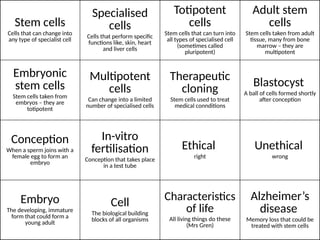
    Stem cells Cells thatcan change into any type of specialist cell Specialised cells Cells that perform specific functions like, skin, heart and liver cells Totipotent cells Stem cells that can turn into all types of specialised cell (sometimes called pluripotent) Adult stem cells Stem cells taken from adult tissue, many from bone marrow – they are multipotent Embryonic stem cells Stem cells taken from embryos – they are totipotent Multipotent cells Can change into a limited number of specialised cells Therapeutic cloning Stem cells used to treat medical connditions Blastocyst A ball of cells formed shortly after conception Conception When a sperm joins with a female egg to form an embryo In-vitro fertilisation Conception that takes place in a test tube Ethical right Unethical wrong Embryo The developing, immature form that could form a young adult Cell The biological building blocks of all organisms Characteristics of life All living things do these (Mrs Gren) Alzheimer’s disease Memory loss that could be treated with stem cells
  • 20.
    Your Task • Makea poster or presentation to explain the most important facts to other students in your class. • Your poster or presentation MUST answer all the questions below. Questions 1. How are stem cells used to treat patients now? 2. How might stem cells be used to treat patients in the future? 3. How else could stem cells be used? Hints and tips for posters: Stick photos and diagrams onto your poster. Write headings on your poster to help people find the most important points. Write short notes, lists, labels or headings to explain the pictures and diagrams. Add arrows, boxes or drawings to help explain what you want to say or make important facts stand out. People need to see quickly and easily what your poster is about so not too much writing

Editor's Notes

  • #2 Possible: Point evidence explain or Who said what? Match the statements to the author and explain your choices Tony Nickleson and locked in syndrome
  • #5 The only bit of copying in the lesson
  • #7 Could also do Point Evidence Explain or Who said what? Or Match the statements to the author and explain your choices
  • #11 More able Students can use the cards to help organise their ideas and a source of information. There is no correct way to sort the cards thus they can be used in many ways. Use the information to inform later work or form the basis of a debate/ presentation/ persuasive writing etc. Group cards by:- Fact, opinion and not relevant . For and against (embryonic) stem cell research. Extension Activities Get students to come up with their own grouping systems. Look for a key ideas or most important idea for each group. Ask students to add their own ideas or opinions to help balance the arguments. Get students to split the cards into fact, opinion, hearsay, theory and evidence. Get students to select 3 cards that give an overall picture of the topic. Or systematically get rid of weaker arguments/ least relevant until only a few left.
  • #14 What is the main concern this data reveals about the public’s attitude to stem cells
  • #15 Extra help sheet