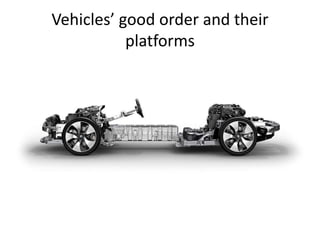
Vehicles’ good order and their
platforms
Introduction
Car platforms are more important for carmakers.
They sign periods and define strategies as production, flexibility and possibility to have
an electric motor.
From car platforms it is also possible see the vehicle’s good order and, consenquently,
how they move on the road before their tests.
In this way, if different vehicles adopt the same platform, the will have the same
behaviour.
But what is a car platform?
Introduction
It is a metal plate with the most important vehicle parts linked.
These are:
1) Engine
2) Suspension, springs and shock absorbers
3) Wheels
4) Supply sources (tank, batteries)
Introduction
The good order depends from two of the previous listed parts: wheels and
suspensions.
From wheels depend camber (for each wheel and axis) , toe and thrust angle (this
only for the rear axis). Togethter they influence the roll.
Caster and king pin depend from suspensions and they influence the pitch.
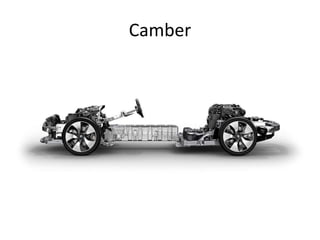
Camber
Camber
The camber is the inclination of a wheel seen by the front part of a vehicle platform.
The inclination can be of three types:
1) Positive: wheel’s inclination make an angle inside the track
2) Neutral : there is any inclination of the wheel
3) Negative : wheel’s inclination make an angle outside the track
Camber
Positive doesn’t mean better: in this case the handling get worse by cornering force.
This is made by the tyre slipping on the ground and tend to move the wheel to the
half of the vehicle track. In this way the contact surface between the tyre and the floor
modifies.
Cornering force depend directly from tyre slip angle: this angle marks the difference
between the wheel’s direction and the driver one.
Tyres can have an irregular and elevate consumption if this angle has an inclination
too much positive or negative, with risks for the stability.
In this way, the car will tend to follow the direction setted up by the wheel with the
major angle of camber.
Camber
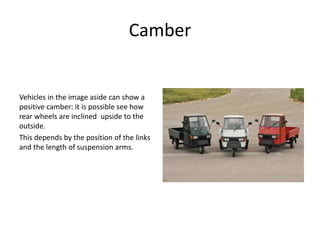
Vehicles in the image aside can show a
positive camber: it is possible see how
rear wheels are inclined upside to the
outside.
This depends by the position of the links
and the length of suspension arms.
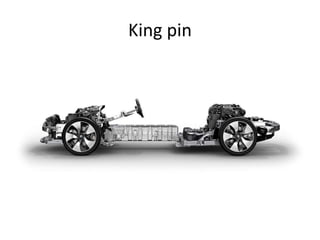
King pin
King pin
Another inclination can be seen viewing the platform from the front side: the king pin
angle.
This inclination is ever positive and, with the camber one, forms a sort of total angle,
useful to define the deformation of arms suspension and related coachbuild links .
King pin
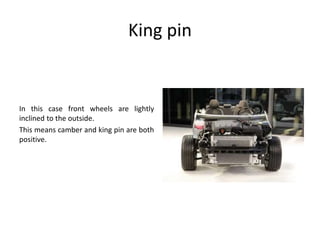
In this case front wheels are lightly
inclined to the outside.
This means camber and king pin are both
positive.
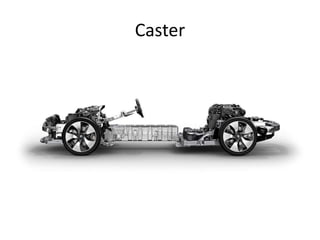
Caster
Caster
Caster is the longitudinal steer axis angle seen by the side view of the platfotm.
It can be of three different kinds:
1) Positive: the angle is addressed to the rear of the vehicle
2) Neutral : the angle is vertical
3) Negative : the angle is addressed to the front of the vehicle
Caster
A positive camber is beneficial for the camber: the internal and external wheel of the
front axis tend to the centre of the axis and vehicle can turn well.
A too much positive one can make troubles in steering.
There is less resistance to the wheel rolling with a neutral caster.
With a negative caster because it is easier to skid because minor force is necessary to
use for turnings.
Caster
Inclination passes through uppe and lower suspension junctions.
An offset will be present between tyre and asphalt if this doesnt’pass for the wheel
centre too: the greater is the distance, the more steering force will be applied.
Vehicle can have different problems if every wheel has its own caster: these can cause
rolling, load transfers proportional with angles and oversteering.
Toe
Toe
In a upside view of the platform tyres are not lined with that and not parallel among
them: this inclination is called toe.
The total axis toe is the sum of every toe of the wheel (named half-toes).
Toe can be of three kinds:
1) Positive (toe in):front part of the wheel is inclined to the inside of the vehicle
2) Neutral (toe): no inclination is present
3) Negative (toe out): front part of the wheel is inclined to the outside of the vehicle
Toe
The inner steering wheel whith toe in causes to the vehicle a delay when it’s going to
turn.
This happening is known as understeering and it is given by the great difference
among the steering wheel angles (called Ackermann angles too).
Understeering happens because the imaginary lines starting from the centre of
steering wheels meet themselves in a point before the centre of the rear axis (More
Ackermann condition).
In True Ackermann condition line meet themeselves exactly in centre of rear axis.
Toe
With a toe out wheel, vehicle turns in advance.
This is known as oversteering and it is given bythe small difference of steering wheels
angles.
The lines told in the slide before meet themselves after rear axis centre (Less
Ackermann condition).
Toe
In rear axis we can find the thrust angle. This is given by the not parallelism condition
of rear wheels.
Thrust angle is the inclination between thrust axis (accordind to the steering) and
platform’s symmetrical one.
Toe
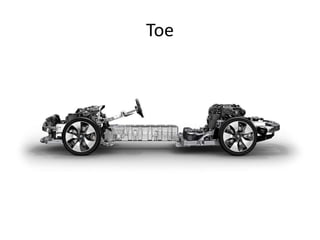
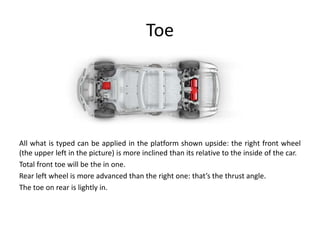
All what is typed can be applied in the platform shown upside: the right front wheel
(the upper left in the picture) is more inclined than its relative to the inside of the car.
Total front toe will be the in one.
Rear left wheel is more advanced than the right one: that’s the thrust angle.
The toe on rear is lightly in.
Barycentre
This is the place where three axes meets: the longitudinal, the transversal and the
vertical ones.
Vehicle’s behaviour depends from the position of barycentre.
The dependent moves are:
1) Roll
2) Yaw
3) Pitch
Roll
Roll
The roll is the swing that the vehicle has when it turns.
It moves along the longitudinal axis known as roll axis: when it happens, the car tends
to the opposite side of the curve (If it turns to the right it tends to the left, for
example) due to the load transfer, the concentration of the mass on one of vehicle’s
sides.
Roll centres are on the opposite sides of roll axis at the centre of the tracks.
The height of this two points depends by axis’ adopted schemes and weight: the
heavier is the axis, the higher is the point.
Roll
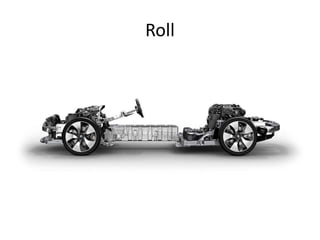
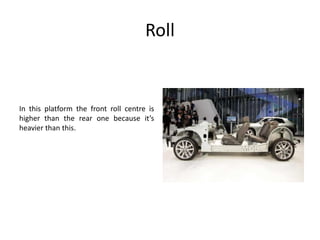
In this platform the front roll centre is
higher than the rear one because it’s
heavier than this.
Roll
If two lines were traced out from the links of one of the two suspension to the other
one, these are going to meet in a point called instant roll centre.
Once repeated this operation for the other suspension, trace lines to the centre of the
tyres (where they are in contact with the ground) responding to the start suspension.
The roll centre is the point where these another two lines meet themselves.
Roll
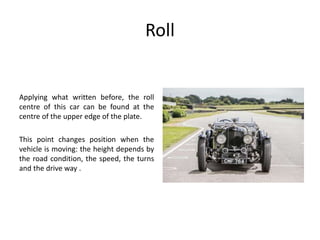
Applying what written before, the roll
centre of this car can be found at the
centre of the upper edge of the plate.
This point changes position when the
vehicle is moving: the height depends by
the road condition, the speed, the turns
and the drive way .
Roll
The swing can be clashed by … bar: this can be applied on front axis or the rear one.
This effect can be reduced whith this component, wide tracks, an accurate side
distribution of weights ( It carves on turn load tranfers) and the right springs.
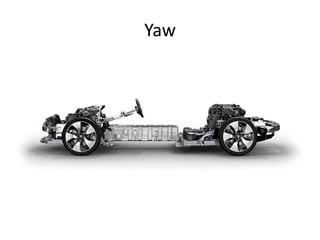
Yaw
Yaw
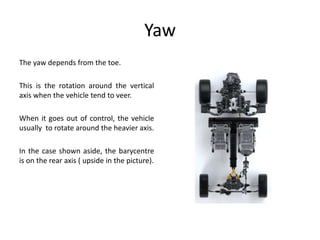
The yaw depends from the toe.
This is the rotation around the vertical
axis when the vehicle tend to veer.
When it goes out of control, the vehicle
usually to rotate around the heavier axis.
In the case shown aside, the barycentre
is on the rear axis ( upside in the picture).
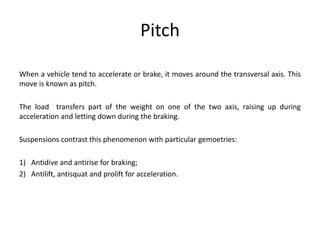
Pitch
When a vehicle tend to accelerate or brake, it moves around the transversal axis. This
move is known as pitch.
The load transfers part of the weight on one of the two axis, raising up during
acceleration and letting down during the braking.
Suspensions contrast this phenomenon with particular gemoetries:
1) Antidive and antirise for braking;
2) Antilift, antisquat and prolift for acceleration.
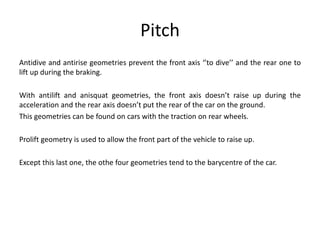
Pitch
Antidive and antirise geometries prevent the front axis ‘’to dive’’ and the rear one to
lift up during the braking.
With antilift and anisquat geometries, the front axis doesn’t raise up during the
acceleration and the rear axis doesn’t put the rear of the car on the ground.
This geometries can be found on cars with the traction on rear wheels.
Prolift geometry is used to allow the front part of the vehicle to raise up.
Except this last one, the othe four geometries tend to the barycentre of the car.
Pitch
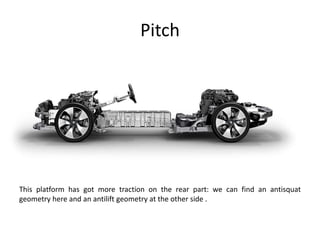
This platform has got more traction on the rear part: we can find an antisquat
geometry here and an antilift geometry at the other side .
Bibliography
1) L’assetto : teoria e pratica per la messa a punto dell’assetto, F.L. Facchinelli,
editrice Motor Books Tech
2) I segreti della guida - Il manuale che vi insegna a essere padroni del volante,
allegato a Quattroruote numero 675 - Gennaio 2012, EditorialeDomus
3) Pneumatici e assetto ruote: teoria, tecnica e pratica, Massimo Cassano, Hoepli
4) Assetto ruote: corso teorico e pratico, Massimo Cassano, Phasar Edizioni
Website sources
1) Wikipedia (it.wikipedia.org, en.wikipedia.org)
2) RC Tek (www.rctek.com)
3) PneusNews (pneusnews.it)
4) Super 7th Heaven (www.super7thheaven.co.uk)
5) Turnology (www.turnology.com)

Assetti e pianali - English version

  • 1.
    Vehicles’ good orderand their platforms
  • 2.
    Introduction Car platforms aremore important for carmakers. They sign periods and define strategies as production, flexibility and possibility to have an electric motor. From car platforms it is also possible see the vehicle’s good order and, consenquently, how they move on the road before their tests. In this way, if different vehicles adopt the same platform, the will have the same behaviour. But what is a car platform?
  • 3.
    Introduction It is ametal plate with the most important vehicle parts linked. These are: 1) Engine 2) Suspension, springs and shock absorbers 3) Wheels 4) Supply sources (tank, batteries)
  • 4.
    Introduction The good orderdepends from two of the previous listed parts: wheels and suspensions. From wheels depend camber (for each wheel and axis) , toe and thrust angle (this only for the rear axis). Togethter they influence the roll. Caster and king pin depend from suspensions and they influence the pitch.
  • 5.
  • 6.
    Camber The camber isthe inclination of a wheel seen by the front part of a vehicle platform. The inclination can be of three types: 1) Positive: wheel’s inclination make an angle inside the track 2) Neutral : there is any inclination of the wheel 3) Negative : wheel’s inclination make an angle outside the track
  • 7.
    Camber Positive doesn’t meanbetter: in this case the handling get worse by cornering force. This is made by the tyre slipping on the ground and tend to move the wheel to the half of the vehicle track. In this way the contact surface between the tyre and the floor modifies. Cornering force depend directly from tyre slip angle: this angle marks the difference between the wheel’s direction and the driver one. Tyres can have an irregular and elevate consumption if this angle has an inclination too much positive or negative, with risks for the stability. In this way, the car will tend to follow the direction setted up by the wheel with the major angle of camber.
  • 8.
    Camber Vehicles in theimage aside can show a positive camber: it is possible see how rear wheels are inclined upside to the outside. This depends by the position of the links and the length of suspension arms.
  • 9.
  • 10.
    King pin Another inclinationcan be seen viewing the platform from the front side: the king pin angle. This inclination is ever positive and, with the camber one, forms a sort of total angle, useful to define the deformation of arms suspension and related coachbuild links .
  • 11.
    King pin In thiscase front wheels are lightly inclined to the outside. This means camber and king pin are both positive.
  • 12.
  • 13.
    Caster Caster is thelongitudinal steer axis angle seen by the side view of the platfotm. It can be of three different kinds: 1) Positive: the angle is addressed to the rear of the vehicle 2) Neutral : the angle is vertical 3) Negative : the angle is addressed to the front of the vehicle
  • 14.
    Caster A positive camberis beneficial for the camber: the internal and external wheel of the front axis tend to the centre of the axis and vehicle can turn well. A too much positive one can make troubles in steering. There is less resistance to the wheel rolling with a neutral caster. With a negative caster because it is easier to skid because minor force is necessary to use for turnings.
  • 15.
    Caster Inclination passes throughuppe and lower suspension junctions. An offset will be present between tyre and asphalt if this doesnt’pass for the wheel centre too: the greater is the distance, the more steering force will be applied. Vehicle can have different problems if every wheel has its own caster: these can cause rolling, load transfers proportional with angles and oversteering.
  • 16.
  • 17.
    Toe In a upsideview of the platform tyres are not lined with that and not parallel among them: this inclination is called toe. The total axis toe is the sum of every toe of the wheel (named half-toes). Toe can be of three kinds: 1) Positive (toe in):front part of the wheel is inclined to the inside of the vehicle 2) Neutral (toe): no inclination is present 3) Negative (toe out): front part of the wheel is inclined to the outside of the vehicle
  • 18.
    Toe The inner steeringwheel whith toe in causes to the vehicle a delay when it’s going to turn. This happening is known as understeering and it is given by the great difference among the steering wheel angles (called Ackermann angles too). Understeering happens because the imaginary lines starting from the centre of steering wheels meet themselves in a point before the centre of the rear axis (More Ackermann condition). In True Ackermann condition line meet themeselves exactly in centre of rear axis.
  • 19.
    Toe With a toeout wheel, vehicle turns in advance. This is known as oversteering and it is given bythe small difference of steering wheels angles. The lines told in the slide before meet themselves after rear axis centre (Less Ackermann condition).
  • 20.
    Toe In rear axiswe can find the thrust angle. This is given by the not parallelism condition of rear wheels. Thrust angle is the inclination between thrust axis (accordind to the steering) and platform’s symmetrical one.
  • 21.
    Toe All what istyped can be applied in the platform shown upside: the right front wheel (the upper left in the picture) is more inclined than its relative to the inside of the car. Total front toe will be the in one. Rear left wheel is more advanced than the right one: that’s the thrust angle. The toe on rear is lightly in.
  • 22.
    Barycentre This is theplace where three axes meets: the longitudinal, the transversal and the vertical ones. Vehicle’s behaviour depends from the position of barycentre. The dependent moves are: 1) Roll 2) Yaw 3) Pitch
  • 23.
  • 24.
    Roll The roll isthe swing that the vehicle has when it turns. It moves along the longitudinal axis known as roll axis: when it happens, the car tends to the opposite side of the curve (If it turns to the right it tends to the left, for example) due to the load transfer, the concentration of the mass on one of vehicle’s sides. Roll centres are on the opposite sides of roll axis at the centre of the tracks. The height of this two points depends by axis’ adopted schemes and weight: the heavier is the axis, the higher is the point.
  • 25.
    Roll In this platformthe front roll centre is higher than the rear one because it’s heavier than this.
  • 26.
    Roll If two lineswere traced out from the links of one of the two suspension to the other one, these are going to meet in a point called instant roll centre. Once repeated this operation for the other suspension, trace lines to the centre of the tyres (where they are in contact with the ground) responding to the start suspension. The roll centre is the point where these another two lines meet themselves.
  • 27.
    Roll Applying what writtenbefore, the roll centre of this car can be found at the centre of the upper edge of the plate. This point changes position when the vehicle is moving: the height depends by the road condition, the speed, the turns and the drive way .
  • 28.
    Roll The swing canbe clashed by … bar: this can be applied on front axis or the rear one. This effect can be reduced whith this component, wide tracks, an accurate side distribution of weights ( It carves on turn load tranfers) and the right springs.
  • 29.
  • 30.
    Yaw The yaw dependsfrom the toe. This is the rotation around the vertical axis when the vehicle tend to veer. When it goes out of control, the vehicle usually to rotate around the heavier axis. In the case shown aside, the barycentre is on the rear axis ( upside in the picture).
  • 31.
    Pitch When a vehicletend to accelerate or brake, it moves around the transversal axis. This move is known as pitch. The load transfers part of the weight on one of the two axis, raising up during acceleration and letting down during the braking. Suspensions contrast this phenomenon with particular gemoetries: 1) Antidive and antirise for braking; 2) Antilift, antisquat and prolift for acceleration.
  • 32.
    Pitch Antidive and antirisegeometries prevent the front axis ‘’to dive’’ and the rear one to lift up during the braking. With antilift and anisquat geometries, the front axis doesn’t raise up during the acceleration and the rear axis doesn’t put the rear of the car on the ground. This geometries can be found on cars with the traction on rear wheels. Prolift geometry is used to allow the front part of the vehicle to raise up. Except this last one, the othe four geometries tend to the barycentre of the car.
  • 33.
    Pitch This platform hasgot more traction on the rear part: we can find an antisquat geometry here and an antilift geometry at the other side .
  • 34.
    Bibliography 1) L’assetto :teoria e pratica per la messa a punto dell’assetto, F.L. Facchinelli, editrice Motor Books Tech 2) I segreti della guida - Il manuale che vi insegna a essere padroni del volante, allegato a Quattroruote numero 675 - Gennaio 2012, EditorialeDomus 3) Pneumatici e assetto ruote: teoria, tecnica e pratica, Massimo Cassano, Hoepli 4) Assetto ruote: corso teorico e pratico, Massimo Cassano, Phasar Edizioni
  • 35.
    Website sources 1) Wikipedia(it.wikipedia.org, en.wikipedia.org) 2) RC Tek (www.rctek.com) 3) PneusNews (pneusnews.it) 4) Super 7th Heaven (www.super7thheaven.co.uk) 5) Turnology (www.turnology.com)