Steering systems

Parts and function


               copyright 2011 - eric jaromin
Steering system
components
  Steering wheel, column and shaft –
   driver inputs
  Steering gear – changes direction –
   rotating steering wheel into linear motion
  Steering linkage – connects steering
   gear to steering arms
  Ball joints – allows movement of steering
   components and suspension
                copyright 2011 - eric jaromin
Steering


           copyright 2011 - eric jaromin
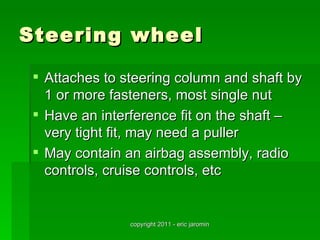
Steering wheel

  Attaches to steering column and shaft by
   1 or more fasteners, most single nut
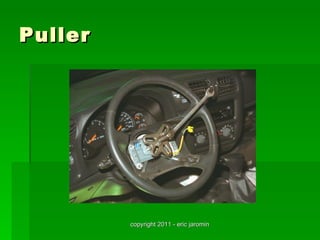
  Have an interference fit on the shaft –
   very tight fit, may need a puller
  May contain an airbag assembly, radio
   controls, cruise controls, etc


                copyright 2011 - eric jaromin
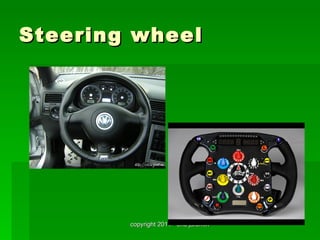
Steering wheel


        copyright 2011 - eric jaromin
Puller


         copyright 2011 - eric jaromin
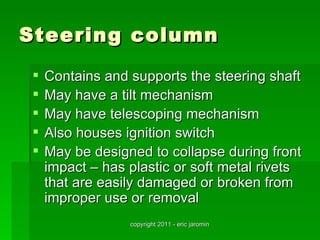
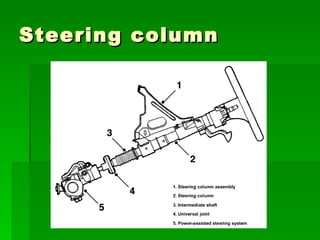
Steering column
    Contains and supports the steering shaft
    May have a tilt mechanism
    May have telescoping mechanism
    Also houses ignition switch
    May be designed to collapse during front
     impact – has plastic or soft metal rivets
     that are easily damaged or broken from
     improper use or removal
                  copyright 2011 - eric jaromin
Steering column


        copyright 2011 - eric jaromin
Steering column


        copyright 2011 - eric jaromin
Steering column
coupler
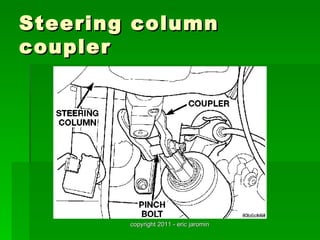
  Steering column couplers allow pivot
   points in the column
  Like a universal joint
  Loose or worn couplers will result in a
   loose steering feel, vibration, noise, or
   sticky steering feel


                 copyright 2011 - eric jaromin
Steering column
coupler


        copyright 2011 - eric jaromin
Impact
 If the vehicle is involved in a front impact,
  always inspect the steering column and
  wheel
 Squeaking, chirping or rubbing sounds
  indicate damage
 Catching, binding and play indicate
  damage
 Especially if the airbag deploys!
                copyright 2011 - eric jaromin
Steering ratio
  Steering ratio is a measurement of how many turns of
   the steering wheel it takes to go from a full lock to the
   other full lock
  Basically how many turns from all the way left to all the
   way right
  Also measured from the center (straight) to a full lock
   turn
  Fast ratio is 3 turns lock to lock
  Slow is about 4 or 5 times lock to lock
  15:1 ratio – wheels move 15deg for 1 deg of steering
   wheel movement
                      copyright 2011 - eric jaromin
Variable ratio steering


         copyright 2011 - eric jaromin
Steering gear systems

    Recirculating ball
    Rack and pinion
    Power assist
    Electronic assist


                   copyright 2011 - eric jaromin
Steering


           copyright 2011 - eric jaromin
Recirculating ball

  Recirculating ball is used on trucks in
   modern vehicles
  Used on most vehicles prior to 1980 and
   the use of front wheel drive
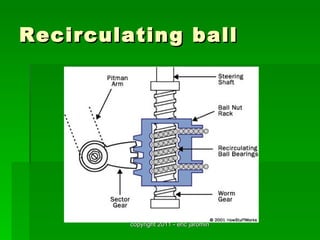
  Uses balls on a worm gear
  Has a pitman arm


               copyright 2011 - eric jaromin
Recirculating ball
  Balls inside the gear ride inside guide
   paths
  Move from one end of the ball nut
   through guides, back to the bottom of the
   housing
  Uses a Parallelogram Linkage steering
   arm system
  Pitman arm moves steering tie rods
                copyright 2011 - eric jaromin
Recirculating ball


         copyright 2011 - eric jaromin
Recirculating ball


         copyright 2011 - eric jaromin
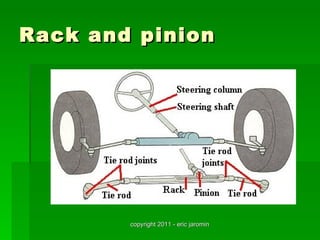
Rack and pinion
steering
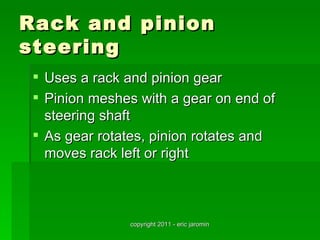
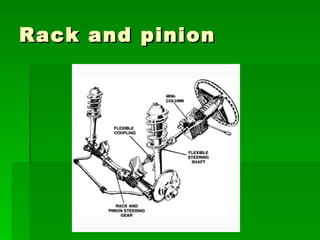
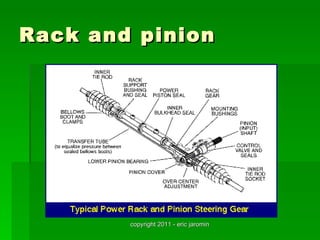
  Uses a rack and pinion gear
  Pinion meshes with a gear on end of
   steering shaft
  As gear rotates, pinion rotates and
   moves rack left or right


               copyright 2011 - eric jaromin
Rack and pinion


        copyright 2011 - eric jaromin
Rack and pinion


        copyright 2011 - eric jaromin
Steering linkage

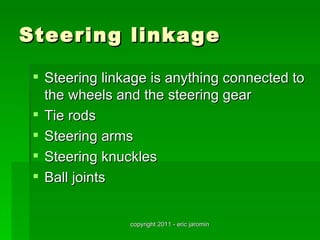
  Steering linkage is anything connected to
   the wheels and the steering gear
  Tie rods
  Steering arms
  Steering knuckles
  Ball joints


                copyright 2011 - eric jaromin
Steering linkage


        copyright 2011 - eric jaromin
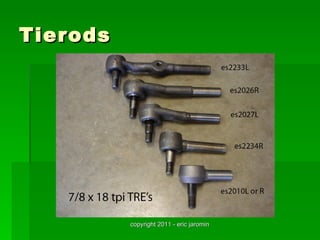
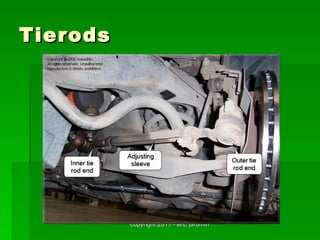
Tierods

  Tierods are attached to pivot points on
   each front wheel
  The other end is attached to the steering
   gear or rack
  Allows for suspension movement
  Used to adjust TOE of the car – tires face
   in /  or out  / when driving straight

                copyright 2011 - eric jaromin
Tierods


          copyright 2011 - eric jaromin
Tierods


          copyright 2011 - eric jaromin
Steering arms

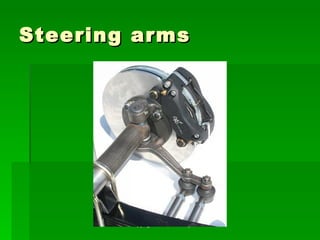
  Tierods attach to the front wheels at the
   steering arms
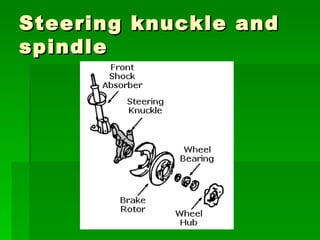
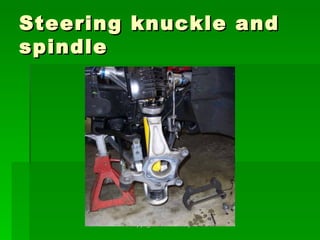
  The steering arm is attached to the
   steering knuckle, which includes the
   spindle
  Used to get proper steering angle during
   turns

                copyright 2011 - eric jaromin
Steering arms


        copyright 2011 - eric jaromin
Steering knuckle and
spindle


        copyright 2011 - eric jaromin
Steering knuckle and
spindle


        copyright 2011 - eric jaromin
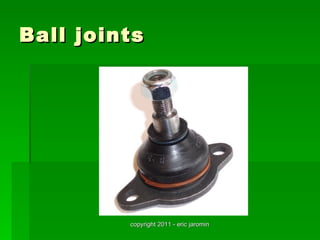
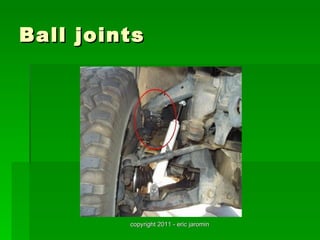
Ball joints

  Allow suspension movement up and
   down, as well as turning movement
  Located in control arms – in lower, as
   well as upper control arm if so equipped
  Wear items – need replacement
   periodically


                copyright 2011 - eric jaromin
Ball joints


         copyright 2011 - eric jaromin
Ball joints


         copyright 2011 - eric jaromin
Ball joints


         copyright 2011 - eric jaromin
Steering designs

  Parallelogram – used on cars with
   recirculating ball gear steering
  Rack and pinion – used on cars with a
   steering rack and pinion gear


                copyright 2011 - eric jaromin
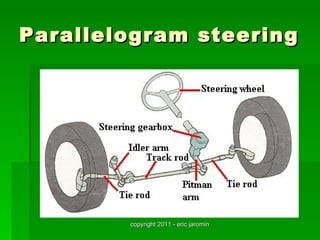
Parallelogram

  Uses tierods connected to a center link
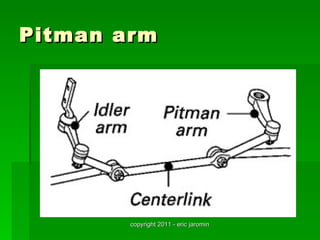
  Uses a pitman arm to move steering
   linkage
  Also uses an idler arm to support the
   linkage on the passenger side


                copyright 2011 - eric jaromin
Parallelogram steering


        copyright 2011 - eric jaromin
Pitman arm


        copyright 2011 - eric jaromin
Rack and pinion

  Fewer moving parts than the recirculating
   ball
  Smaller and more compact
  Can be a center link type as well


                copyright 2011 - eric jaromin
Rack and pinion


        copyright 2011 - eric jaromin
Rack and pinion


        copyright 2011 - eric jaromin
Rack and pinion


        copyright 2011 - eric jaromin
Power steering
  Used to aid in steering
  Can be hydraulic – uses a pump driven by the
   engine, or an electric motor, to pump fluid
   through the power steering rack/box to aid
   driver in turning the steering wheel
  Can be electric – uses electric motor mounted
   on rack/box to help driver turn the steering
   wheel

                  copyright 2011 - eric jaromin
Power steering


        copyright 2011 - eric jaromin
Power steering


        copyright 2011 - eric jaromin
Electronic power
steering


        copyright 2011 - eric jaromin
4 wheel steering

  Used by some manufacturers to aid
   handling
  Front wheels do most of the steering
  At low speeds, rear wheels steer
   opposite front to tighten turning radius
  At high speeds, rear wheels turn with
   front to improve handling and cornering

                copyright 2011 - eric jaromin
4 wheel steering

  Can be hydraulic or electric
  Front steering is usually “normal” power
   steering
  Rear wheel steering can be driven
   hydraulically or by electric motor


                copyright 2011 - eric jaromin
4 wheel steering

  3000GT VR4 All Wheel Steering demo – Yo


              copyright 2011 - eric jaromin

Steering systems

  • 1.
    Steering systems Parts andfunction copyright 2011 - eric jaromin
  • 2.
    Steering system components Steering wheel, column and shaft – driver inputs  Steering gear – changes direction – rotating steering wheel into linear motion  Steering linkage – connects steering gear to steering arms  Ball joints – allows movement of steering components and suspension copyright 2011 - eric jaromin
  • 3.
    Steering copyright 2011 - eric jaromin
  • 4.
    Steering wheel Attaches to steering column and shaft by 1 or more fasteners, most single nut  Have an interference fit on the shaft – very tight fit, may need a puller  May contain an airbag assembly, radio controls, cruise controls, etc copyright 2011 - eric jaromin
  • 5.
    Steering wheel copyright 2011 - eric jaromin
  • 6.
    Puller copyright 2011 - eric jaromin
  • 7.
    Steering column  Contains and supports the steering shaft  May have a tilt mechanism  May have telescoping mechanism  Also houses ignition switch  May be designed to collapse during front impact – has plastic or soft metal rivets that are easily damaged or broken from improper use or removal copyright 2011 - eric jaromin
  • 8.
    Steering column copyright 2011 - eric jaromin
  • 9.
    Steering column copyright 2011 - eric jaromin
  • 10.
    Steering column coupler Steering column couplers allow pivot points in the column  Like a universal joint  Loose or worn couplers will result in a loose steering feel, vibration, noise, or sticky steering feel copyright 2011 - eric jaromin
  • 11.
    Steering column coupler copyright 2011 - eric jaromin
  • 12.
    Impact  If thevehicle is involved in a front impact, always inspect the steering column and wheel  Squeaking, chirping or rubbing sounds indicate damage  Catching, binding and play indicate damage  Especially if the airbag deploys! copyright 2011 - eric jaromin
  • 13.
    Steering ratio Steering ratio is a measurement of how many turns of the steering wheel it takes to go from a full lock to the other full lock  Basically how many turns from all the way left to all the way right  Also measured from the center (straight) to a full lock turn  Fast ratio is 3 turns lock to lock  Slow is about 4 or 5 times lock to lock  15:1 ratio – wheels move 15deg for 1 deg of steering wheel movement copyright 2011 - eric jaromin
  • 14.
    Variable ratio steering copyright 2011 - eric jaromin
  • 15.
    Steering gear systems  Recirculating ball  Rack and pinion  Power assist  Electronic assist copyright 2011 - eric jaromin
  • 16.
    Steering copyright 2011 - eric jaromin
  • 17.
    Recirculating ball Recirculating ball is used on trucks in modern vehicles  Used on most vehicles prior to 1980 and the use of front wheel drive  Uses balls on a worm gear  Has a pitman arm copyright 2011 - eric jaromin
  • 18.
    Recirculating ball Balls inside the gear ride inside guide paths  Move from one end of the ball nut through guides, back to the bottom of the housing  Uses a Parallelogram Linkage steering arm system  Pitman arm moves steering tie rods copyright 2011 - eric jaromin
  • 19.
    Recirculating ball copyright 2011 - eric jaromin
  • 20.
    Recirculating ball copyright 2011 - eric jaromin
  • 21.
    Rack and pinion steering  Uses a rack and pinion gear  Pinion meshes with a gear on end of steering shaft  As gear rotates, pinion rotates and moves rack left or right copyright 2011 - eric jaromin
  • 22.
    Rack and pinion copyright 2011 - eric jaromin
  • 23.
    Rack and pinion copyright 2011 - eric jaromin
  • 24.
    Steering linkage Steering linkage is anything connected to the wheels and the steering gear  Tie rods  Steering arms  Steering knuckles  Ball joints copyright 2011 - eric jaromin
  • 25.
    Steering linkage copyright 2011 - eric jaromin
  • 26.
    Tierods  Tierodsare attached to pivot points on each front wheel  The other end is attached to the steering gear or rack  Allows for suspension movement  Used to adjust TOE of the car – tires face in / or out / when driving straight copyright 2011 - eric jaromin
  • 27.
    Tierods copyright 2011 - eric jaromin
  • 28.
    Tierods copyright 2011 - eric jaromin
  • 29.
    Steering arms Tierods attach to the front wheels at the steering arms  The steering arm is attached to the steering knuckle, which includes the spindle  Used to get proper steering angle during turns copyright 2011 - eric jaromin
  • 30.
    Steering arms copyright 2011 - eric jaromin
  • 31.
    Steering knuckle and spindle copyright 2011 - eric jaromin
  • 32.
    Steering knuckle and spindle copyright 2011 - eric jaromin
  • 33.
    Ball joints Allow suspension movement up and down, as well as turning movement  Located in control arms – in lower, as well as upper control arm if so equipped  Wear items – need replacement periodically copyright 2011 - eric jaromin
  • 34.
    Ball joints copyright 2011 - eric jaromin
  • 35.
    Ball joints copyright 2011 - eric jaromin
  • 36.
    Ball joints copyright 2011 - eric jaromin
  • 37.
    Steering designs Parallelogram – used on cars with recirculating ball gear steering  Rack and pinion – used on cars with a steering rack and pinion gear copyright 2011 - eric jaromin
  • 38.
    Parallelogram  Usestierods connected to a center link  Uses a pitman arm to move steering linkage  Also uses an idler arm to support the linkage on the passenger side copyright 2011 - eric jaromin
  • 39.
    Parallelogram steering copyright 2011 - eric jaromin
  • 40.
    Pitman arm copyright 2011 - eric jaromin
  • 41.
    Rack and pinion  Fewer moving parts than the recirculating ball  Smaller and more compact  Can be a center link type as well copyright 2011 - eric jaromin
  • 42.
    Rack and pinion copyright 2011 - eric jaromin
  • 43.
    Rack and pinion copyright 2011 - eric jaromin
  • 44.
    Rack and pinion copyright 2011 - eric jaromin
  • 45.
    Power steering Used to aid in steering  Can be hydraulic – uses a pump driven by the engine, or an electric motor, to pump fluid through the power steering rack/box to aid driver in turning the steering wheel  Can be electric – uses electric motor mounted on rack/box to help driver turn the steering wheel copyright 2011 - eric jaromin
  • 46.
    Power steering copyright 2011 - eric jaromin
  • 47.
    Power steering copyright 2011 - eric jaromin
  • 48.
    Electronic power steering copyright 2011 - eric jaromin
  • 49.
    4 wheel steering  Used by some manufacturers to aid handling  Front wheels do most of the steering  At low speeds, rear wheels steer opposite front to tighten turning radius  At high speeds, rear wheels turn with front to improve handling and cornering copyright 2011 - eric jaromin
  • 50.
    4 wheel steering  Can be hydraulic or electric  Front steering is usually “normal” power steering  Rear wheel steering can be driven hydraulically or by electric motor copyright 2011 - eric jaromin
  • 51.
    4 wheel steering  3000GT VR4 All Wheel Steering demo – Yo copyright 2011 - eric jaromin