British Standards and ASTM
  standard specification on
           iron/steel


                  11/8/2011
                              1
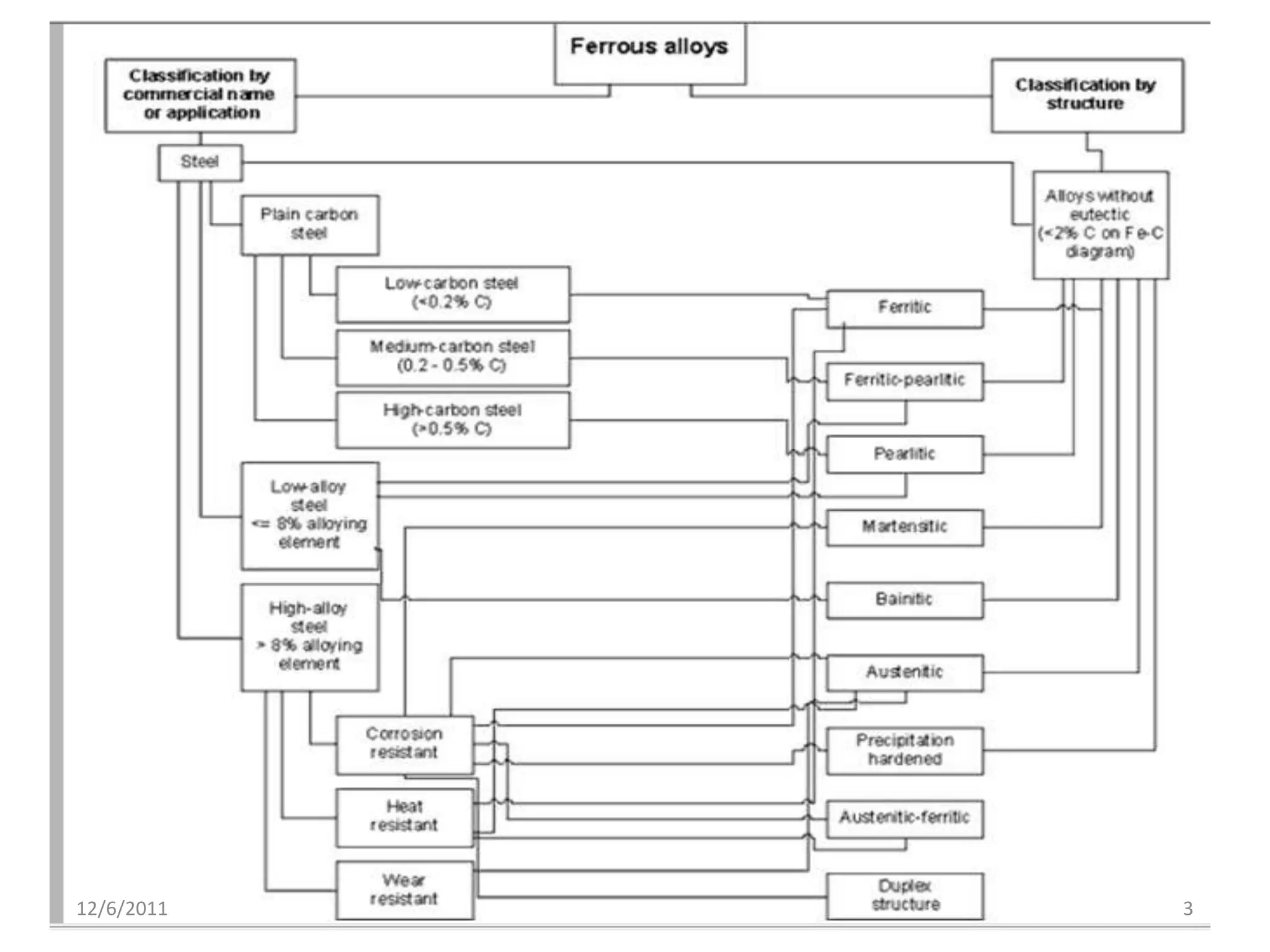
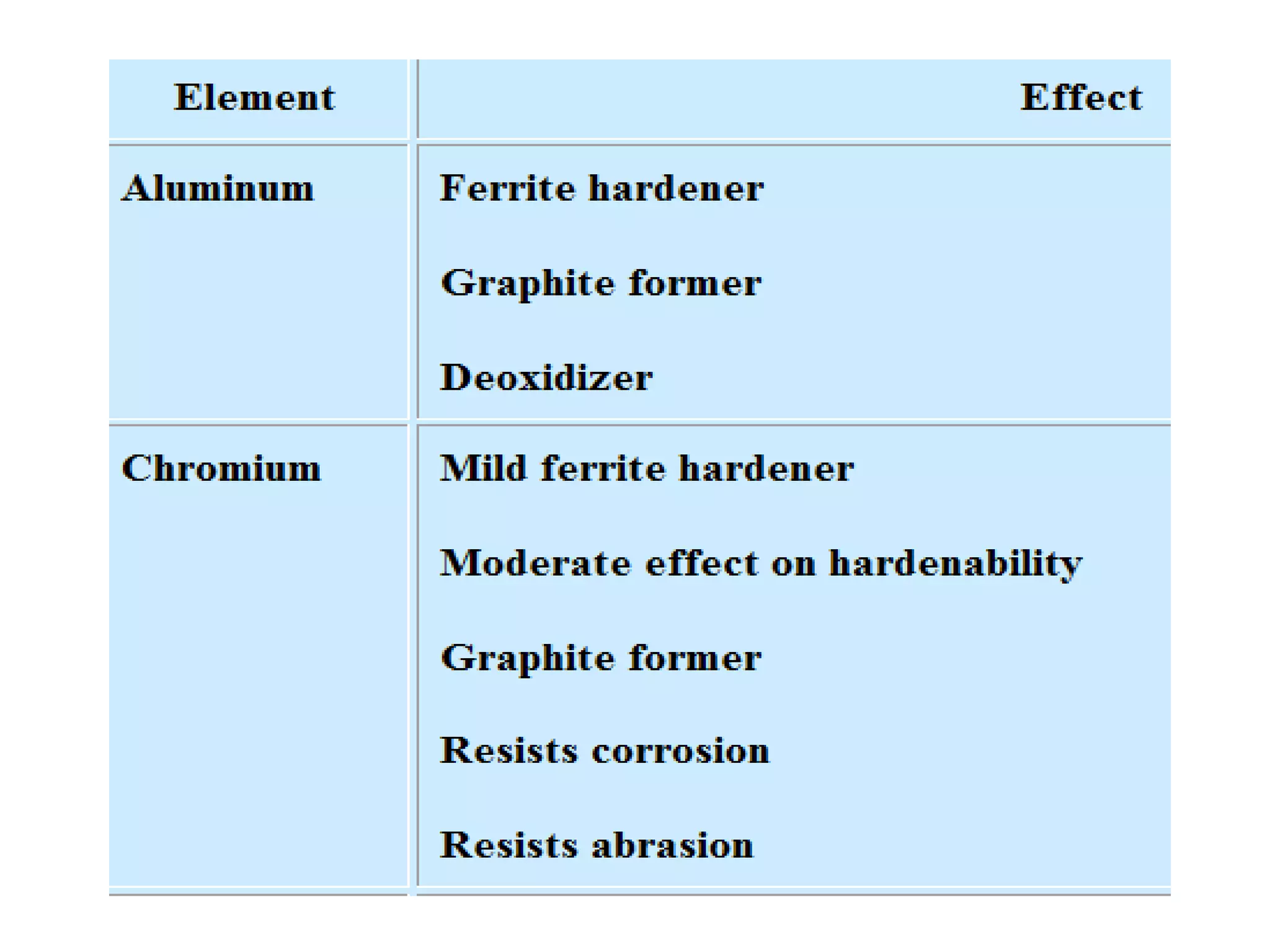
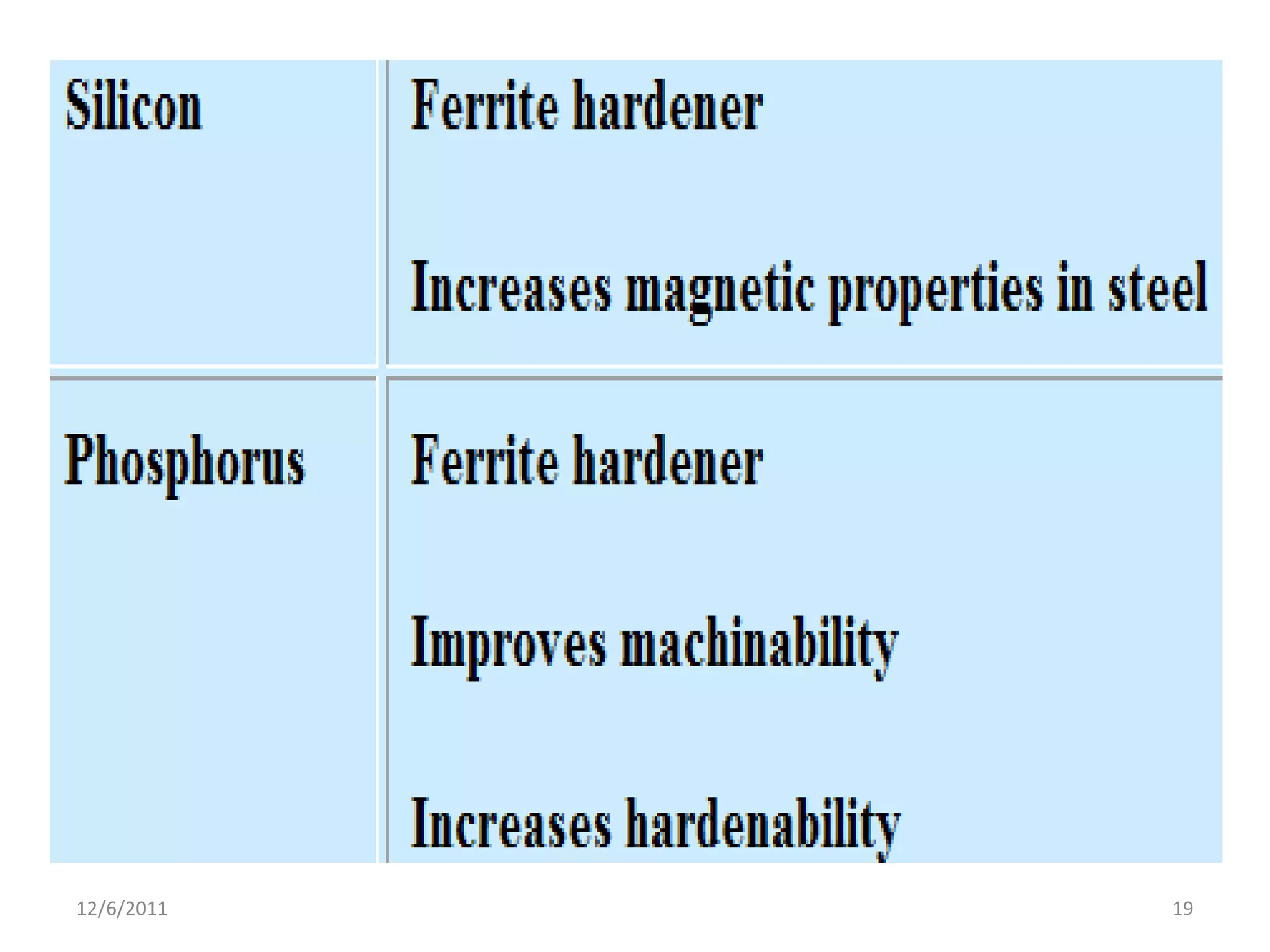
 Steels can be classified by a variety of different systems
  depending on: The composition, such as carbon, low-alloy
  or stainless steel.
 The manufacturing methods, such as open hearth, basic
  oxygen process, or electric furnace methods.
 The finishing method, such as hot rolling or cold rolling
 The product form, such as bar plate, sheet, strip, tubing or
  structural shape
 The deoxidation practice, such as killed, semi-
  killed, capped or rimmed steel
 The microstructure, such as ferritic, pearlitic and
  martensitic
 The required strength level, as specified in ASTM
  standards
 The heat treatment, such as annealing, quenching and
  tempering, and thermo mechanical processing
 Quality descriptors, such as forging quality and
  commercial quality.
                                       12/6/2011
                                                                 2
12/6/2011   3
Classifications
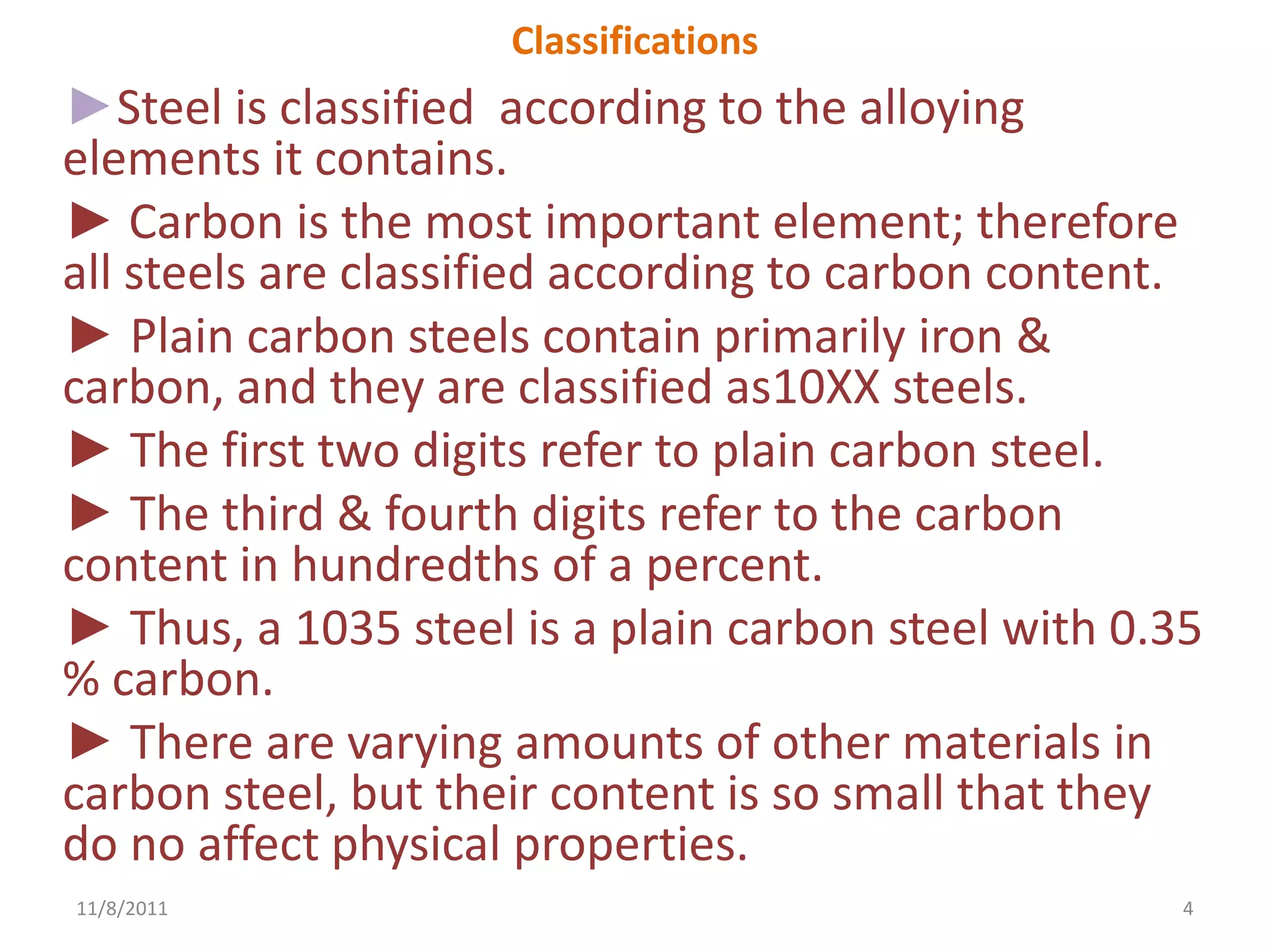
►Steel is classified according to the alloying
elements it contains.
► Carbon is the most important element; therefore
all steels are classified according to carbon content.
► Plain carbon steels contain primarily iron &
carbon, and they are classified as10XX steels.
► The first two digits refer to plain carbon steel.
► The third & fourth digits refer to the carbon
content in hundredths of a percent.
► Thus, a 1035 steel is a plain carbon steel with 0.35
% carbon.
► There are varying amounts of other materials in
carbon steel, but their content is so small that they
do no affect physical properties.
11/8/2011                                            4
Alloy steels
• Alloy steels are classified by the society of Automotive
  Engineers (SAE) & by the American Iron & Steel
  Institute (AISI).
• Some of the designations accepted by them as
  standard are shown in table 3.3.
• Often as many as 5 or more alloying elements may be
  present, & it is impractical to describe the alloy
  correctly by a simple numbering system.
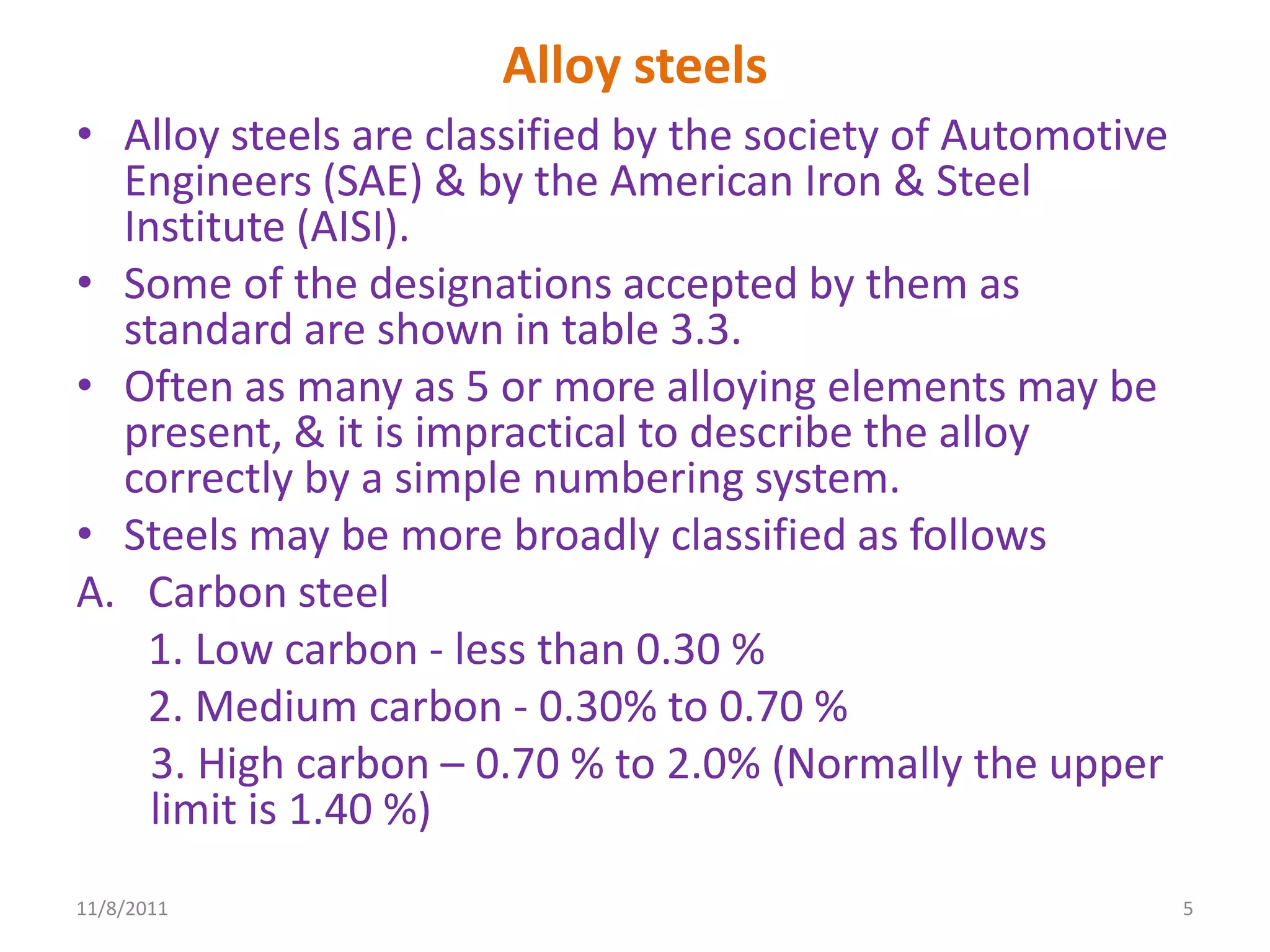
• Steels may be more broadly classified as follows
A. Carbon steel
   1. Low carbon - less than 0.30 %
   2. Medium carbon - 0.30% to 0.70 %
    3. High carbon – 0.70 % to 2.0% (Normally the upper
    limit is 1.40 %)
11/8/2011                                                    5
Table3.3 Classification of steel
                   Classification                   Number   Range of Number
 A. Carbon Steel
 Carbon steel SAE- AISI                               1XXX
 Plain carbon                                         10XX      1006-1095
 Free Machining (resulfurized)                        11XX      1108-1151
 Resulfurized, rephosphorized                         12XX      1211-1214
 B. Alloy Steels
 Manganese (1.5%to2.0%)                               13XX      1320-1340
 Molybdenum                                           4XXX
 C-Mo (0.25%Mo)                                       40XX      4024-4068
 Cr-Mo(0.70%Cr, 0.15%Mo)                              41XX      4130-4150
 Ni-Cr-Mo (1.8% Ni, 0.65 % Cr)                        43XX      4317-4340
 Ni-Mo (1.75 %)                                       46XX      4608-4640
 Ni-Cr (0.45 % Ni, 0.2 % Mo)                          47XX
 Ni-Mo (3.5 %Ni, 0.25 %Mo)                            48XX      4812-4820

11/8/2011                                                                      6
Table3.3 Classification of steel
                    Classification                  Number   Range of Number
 Chromium                                             5XXX
 0.5% Cr                                              50XX
 1.0% Cr                                              51XX      5120-5152
 1.5% Cr                                             52XXX    52095-52101
 Corrosion heat resistant                            514XX   (AISI 400 series)
 Chromium-Vanadium                                    6XXX
 1 % Cr, 0.12 %V                                      61XX      6120-6152
 Silicon Manganese
 0.85 % Mn, 2 %Si                                     92XX      9255-9262
 Tripple Alloy Steels
 0.55 % Ni, 0.50 % Cr, 0.020 % Mo                     85XX      8615-8660
 0.55 % Ni, 0.50 % Cr, 0.25 % Mo                      87XX      8720-8750
 3.25 % Ni, 1.20 % Cr, 0.12 % Mo                      93XX      9310-9317
 0.45 %Ni, 0.40 % Cr, 0.12 % Mo                       94XX      9437-9445

11/8/2011                                                                        7
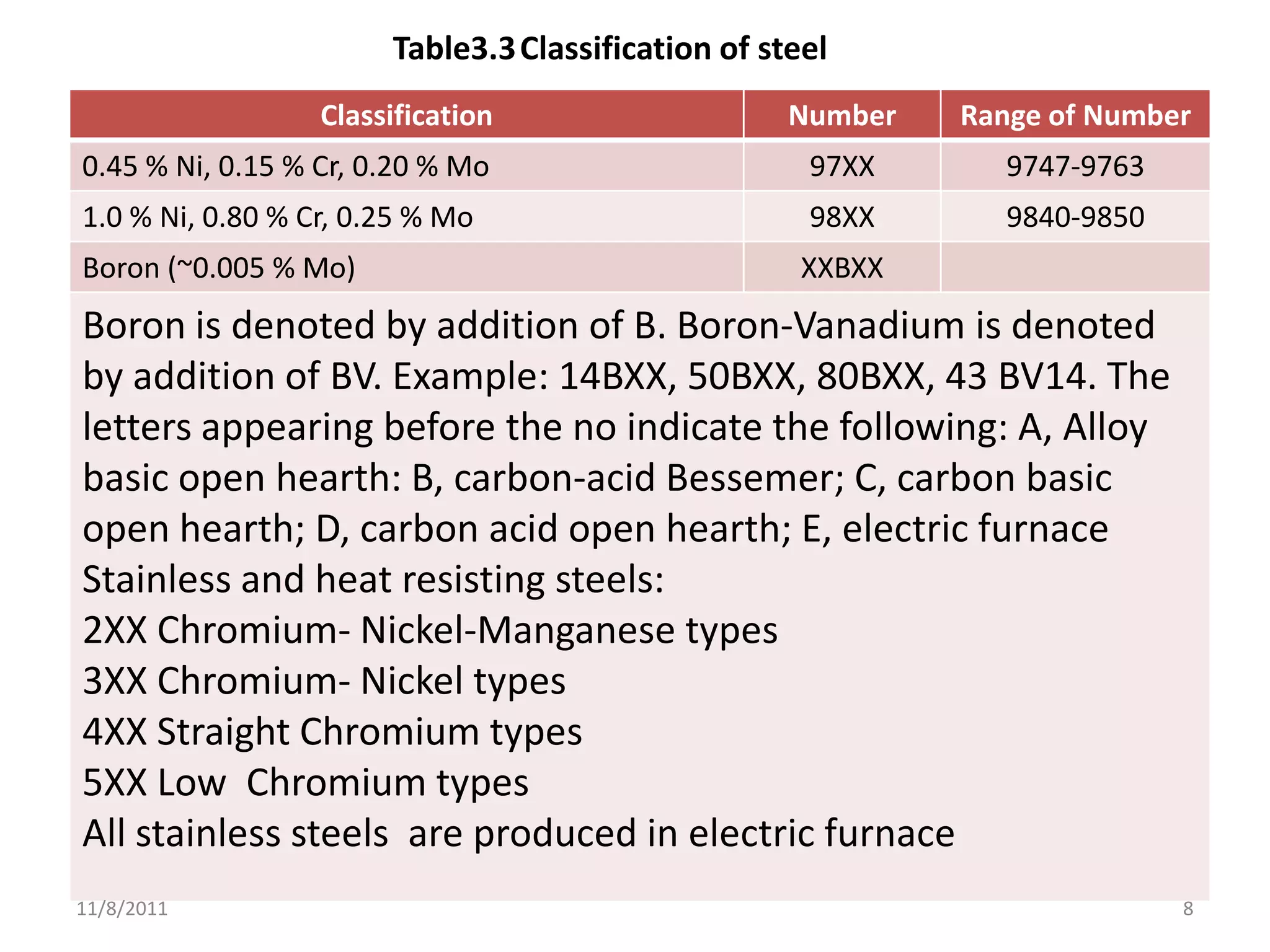
Table3.3 Classification of steel
                  Classification                    Number   Range of Number
0.45 % Ni, 0.15 % Cr, 0.20 % Mo                      97XX       9747-9763
1.0 % Ni, 0.80 % Cr, 0.25 % Mo                       98XX       9840-9850
Boron (~0.005 % Mo)                                  XXBXX
Boron is denoted by addition of B. Boron-Vanadium is denoted
by addition of BV. Example: 14BXX, 50BXX, 80BXX, 43 BV14. The
letters appearing before the no indicate the following: A, Alloy
basic open hearth: B, carbon-acid Bessemer; C, carbon basic
open hearth; D, carbon acid open hearth; E, electric furnace
Stainless and heat resisting steels:
2XX Chromium- Nickel-Manganese types
3XX Chromium- Nickel types
4XX Straight Chromium types
5XX Low Chromium types
All stainless steels are produced in electric furnace
11/8/2011                                                                   8
Classification Contd
B. Alloy Steel
    1.low alloys-special alloying elements totaling
    less than 8.0 %
    2. High alloys- special alloying elements totaling
    more than 8.0 %
 Low carbon steel is used for wire, structural shapes,
 and screw machine parts such as screws, & bolts.
 Medium carbon steels are used for rails, axles, gears,
 and parts requiring high strength & moderate to great
 hardness. High carbon steels find use in cutting tools
 such as knives, drills, taps, and for abrasion
     resisting properties.
11/8/2011                                                 9
Classification Contd
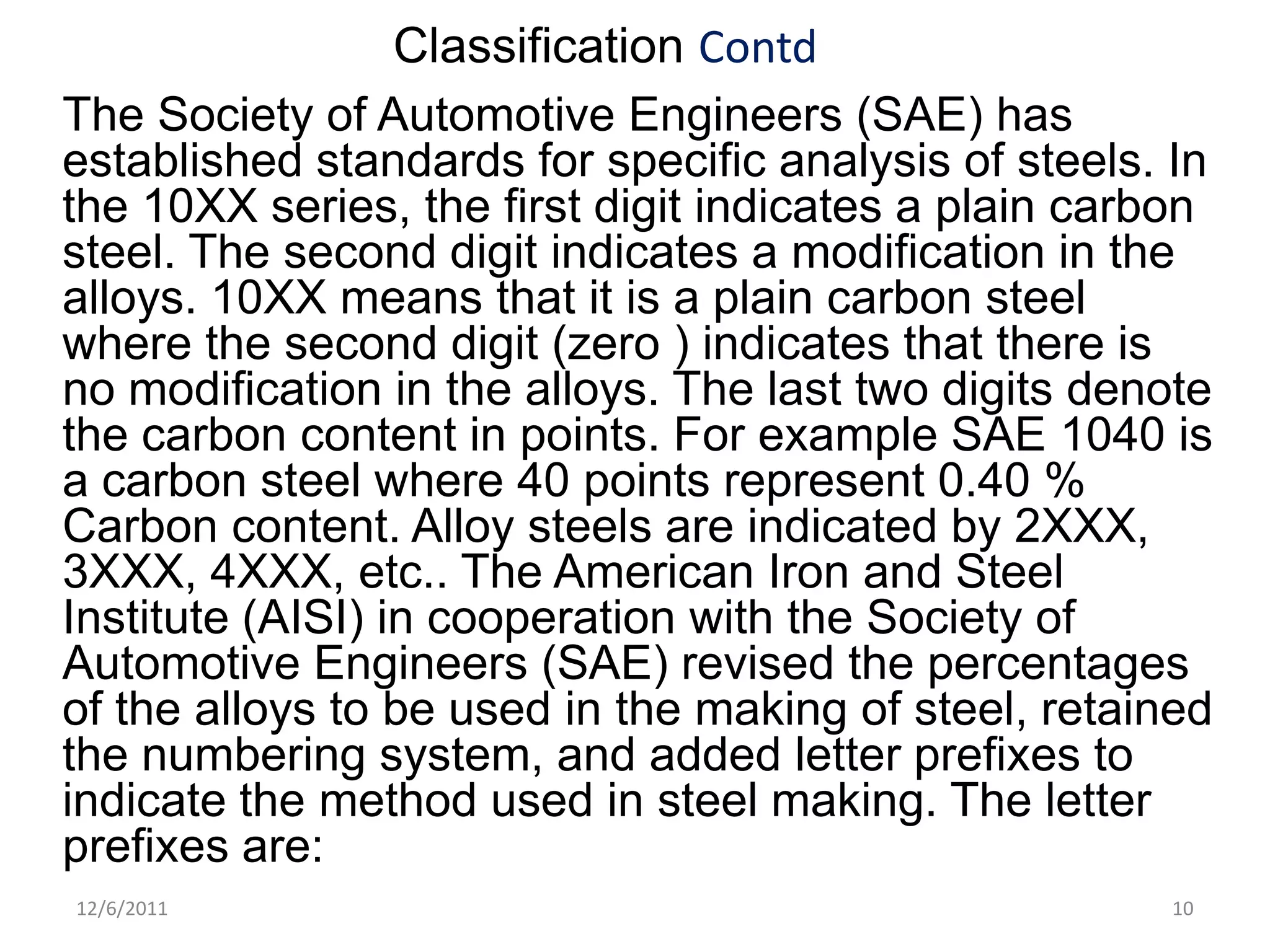
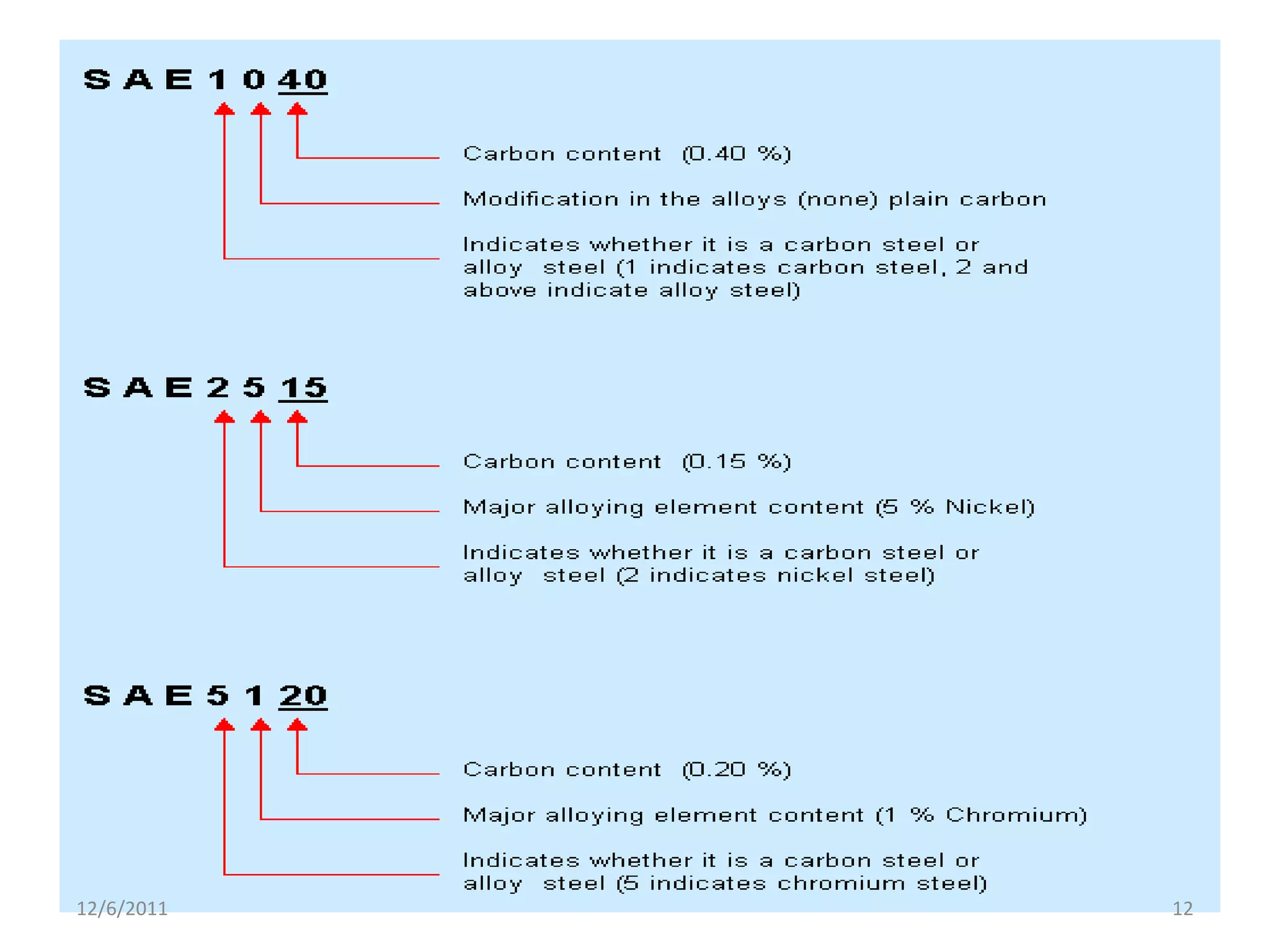
The Society of Automotive Engineers (SAE) has
established standards for specific analysis of steels. In
the 10XX series, the first digit indicates a plain carbon
steel. The second digit indicates a modification in the
alloys. 10XX means that it is a plain carbon steel
where the second digit (zero ) indicates that there is
no modification in the alloys. The last two digits denote
the carbon content in points. For example SAE 1040 is
a carbon steel where 40 points represent 0.40 %
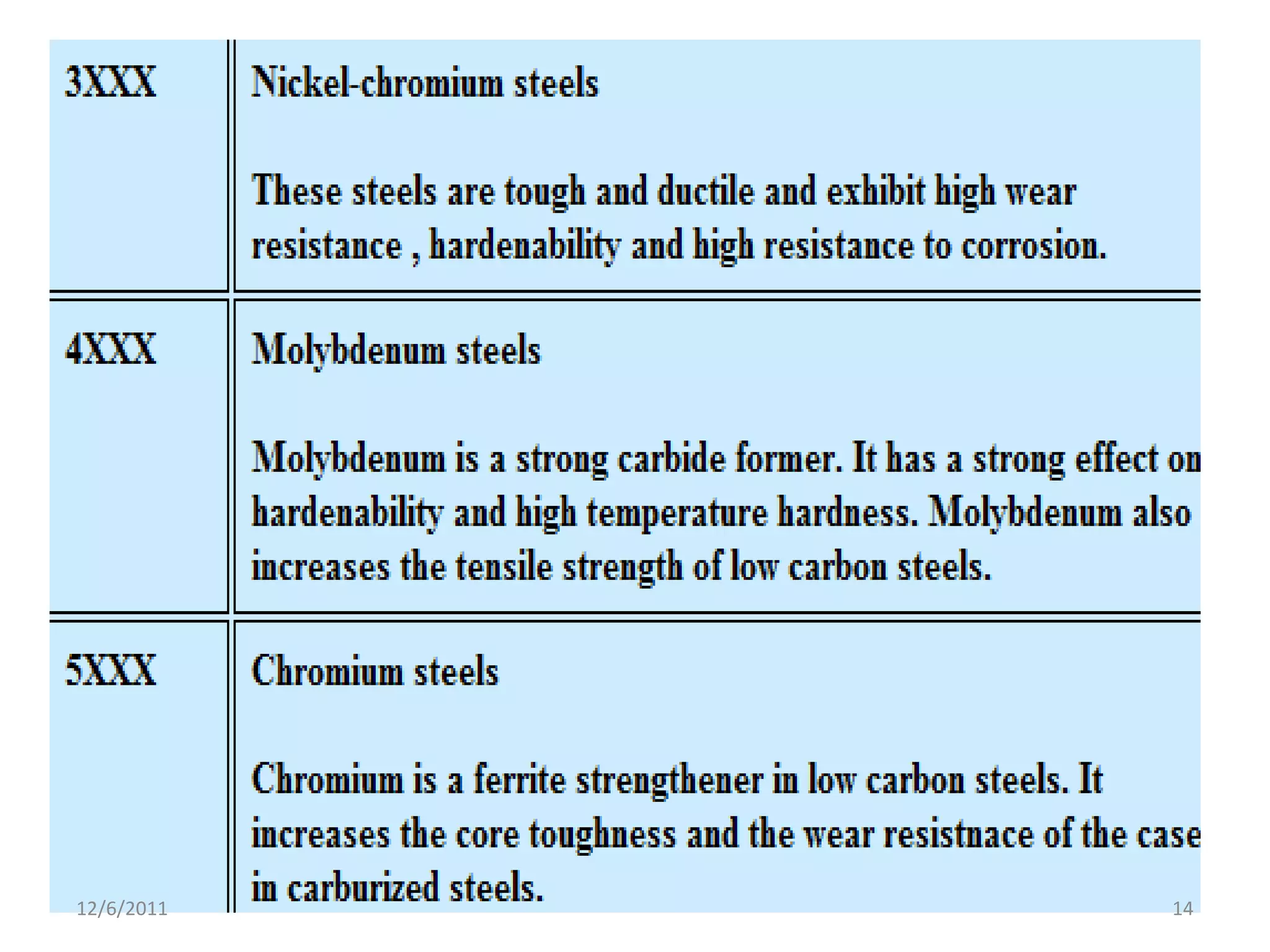
Carbon content. Alloy steels are indicated by 2XXX,
3XXX, 4XXX, etc.. The American Iron and Steel
Institute (AISI) in cooperation with the Society of
Automotive Engineers (SAE) revised the percentages
of the alloys to be used in the making of steel, retained
the numbering system, and added letter prefixes to
indicate the method used in steel making. The letter
prefixes are:
12/6/2011                                             10
Classification of Steels
A = alloy, basic open hearth
B = carbon, acid Bessemer
C = carbon, basic open hearth
D = carbon, acid open hearth
E = electric furnace
If the prefix is omitted, the steel is assumed
to be open hearth. Example: AISI C1050
indicates a plain carbon, basic-open hearth
steel that has 0.50 % Carbon content.
Another letter is the harden ability or H-
value. Example: 4340H
General representation of steels:
12/6/2011                                    11
12/6/2011   12
12/6/2011   13
12/6/2011   14
12/6/2011   15
12/6/2011   17
12/6/2011
12/6/2011   19
Classification Contd
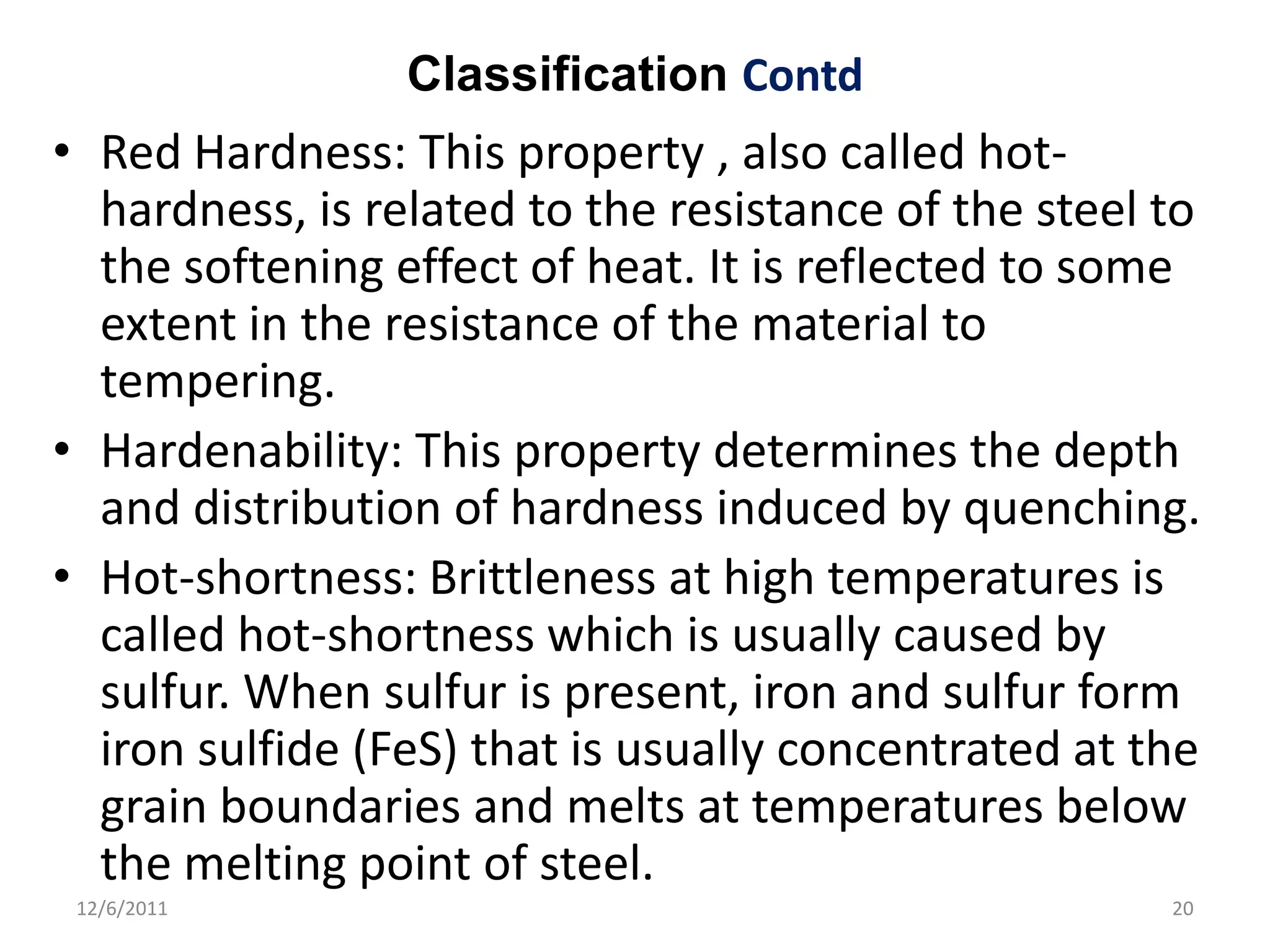
• Red Hardness: This property , also called hot-
  hardness, is related to the resistance of the steel to
  the softening effect of heat. It is reflected to some
  extent in the resistance of the material to
  tempering.
• Hardenability: This property determines the depth
  and distribution of hardness induced by quenching.
• Hot-shortness: Brittleness at high temperatures is
  called hot-shortness which is usually caused by
  sulfur. When sulfur is present, iron and sulfur form
  iron sulfide (FeS) that is usually concentrated at the
  grain boundaries and melts at temperatures below
  the melting point of steel.
 12/6/2011                                            20
Classification Contd
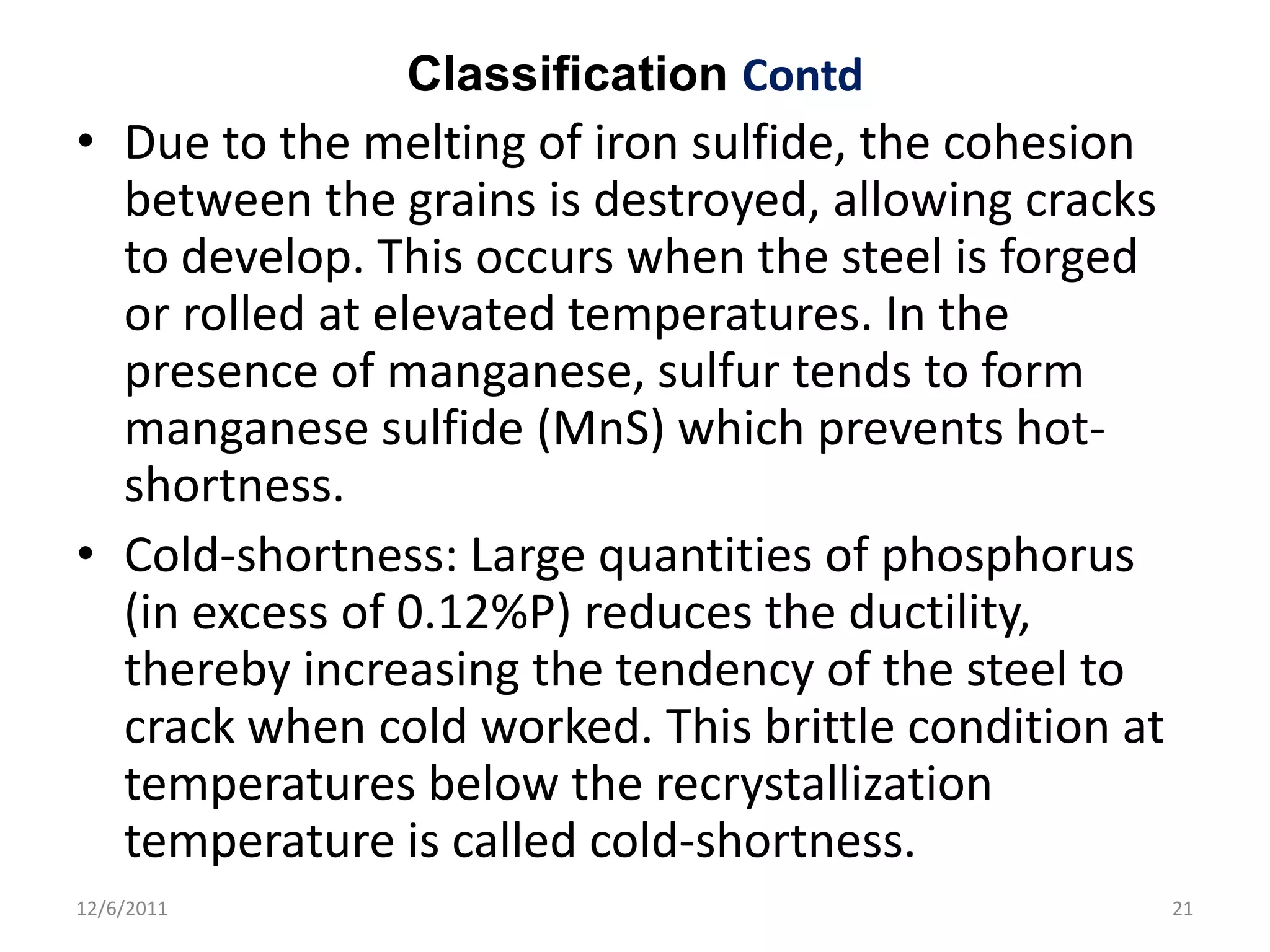
• Due to the melting of iron sulfide, the cohesion
  between the grains is destroyed, allowing cracks
  to develop. This occurs when the steel is forged
  or rolled at elevated temperatures. In the
  presence of manganese, sulfur tends to form
  manganese sulfide (MnS) which prevents hot-
  shortness.
• Cold-shortness: Large quantities of phosphorus
  (in excess of 0.12%P) reduces the ductility,
  thereby increasing the tendency of the steel to
  crack when cold worked. This brittle condition at
  temperatures below the recrystallization
  temperature is called cold-shortness.
12/6/2011                                             21

L 10

  • 1.
    British Standards andASTM standard specification on iron/steel 11/8/2011 1
  • 2.
     Steels canbe classified by a variety of different systems depending on: The composition, such as carbon, low-alloy or stainless steel.  The manufacturing methods, such as open hearth, basic oxygen process, or electric furnace methods.  The finishing method, such as hot rolling or cold rolling  The product form, such as bar plate, sheet, strip, tubing or structural shape  The deoxidation practice, such as killed, semi- killed, capped or rimmed steel  The microstructure, such as ferritic, pearlitic and martensitic  The required strength level, as specified in ASTM standards  The heat treatment, such as annealing, quenching and tempering, and thermo mechanical processing  Quality descriptors, such as forging quality and commercial quality. 12/6/2011 2
  • 3.
  • 4.
    Classifications ►Steel is classifiedaccording to the alloying elements it contains. ► Carbon is the most important element; therefore all steels are classified according to carbon content. ► Plain carbon steels contain primarily iron & carbon, and they are classified as10XX steels. ► The first two digits refer to plain carbon steel. ► The third & fourth digits refer to the carbon content in hundredths of a percent. ► Thus, a 1035 steel is a plain carbon steel with 0.35 % carbon. ► There are varying amounts of other materials in carbon steel, but their content is so small that they do no affect physical properties. 11/8/2011 4
  • 5.
    Alloy steels • Alloysteels are classified by the society of Automotive Engineers (SAE) & by the American Iron & Steel Institute (AISI). • Some of the designations accepted by them as standard are shown in table 3.3. • Often as many as 5 or more alloying elements may be present, & it is impractical to describe the alloy correctly by a simple numbering system. • Steels may be more broadly classified as follows A. Carbon steel 1. Low carbon - less than 0.30 % 2. Medium carbon - 0.30% to 0.70 % 3. High carbon – 0.70 % to 2.0% (Normally the upper limit is 1.40 %) 11/8/2011 5
  • 6.
    Table3.3 Classification ofsteel Classification Number Range of Number A. Carbon Steel Carbon steel SAE- AISI 1XXX Plain carbon 10XX 1006-1095 Free Machining (resulfurized) 11XX 1108-1151 Resulfurized, rephosphorized 12XX 1211-1214 B. Alloy Steels Manganese (1.5%to2.0%) 13XX 1320-1340 Molybdenum 4XXX C-Mo (0.25%Mo) 40XX 4024-4068 Cr-Mo(0.70%Cr, 0.15%Mo) 41XX 4130-4150 Ni-Cr-Mo (1.8% Ni, 0.65 % Cr) 43XX 4317-4340 Ni-Mo (1.75 %) 46XX 4608-4640 Ni-Cr (0.45 % Ni, 0.2 % Mo) 47XX Ni-Mo (3.5 %Ni, 0.25 %Mo) 48XX 4812-4820 11/8/2011 6
  • 7.
    Table3.3 Classification ofsteel Classification Number Range of Number Chromium 5XXX 0.5% Cr 50XX 1.0% Cr 51XX 5120-5152 1.5% Cr 52XXX 52095-52101 Corrosion heat resistant 514XX (AISI 400 series) Chromium-Vanadium 6XXX 1 % Cr, 0.12 %V 61XX 6120-6152 Silicon Manganese 0.85 % Mn, 2 %Si 92XX 9255-9262 Tripple Alloy Steels 0.55 % Ni, 0.50 % Cr, 0.020 % Mo 85XX 8615-8660 0.55 % Ni, 0.50 % Cr, 0.25 % Mo 87XX 8720-8750 3.25 % Ni, 1.20 % Cr, 0.12 % Mo 93XX 9310-9317 0.45 %Ni, 0.40 % Cr, 0.12 % Mo 94XX 9437-9445 11/8/2011 7
  • 8.
    Table3.3 Classification ofsteel Classification Number Range of Number 0.45 % Ni, 0.15 % Cr, 0.20 % Mo 97XX 9747-9763 1.0 % Ni, 0.80 % Cr, 0.25 % Mo 98XX 9840-9850 Boron (~0.005 % Mo) XXBXX Boron is denoted by addition of B. Boron-Vanadium is denoted by addition of BV. Example: 14BXX, 50BXX, 80BXX, 43 BV14. The letters appearing before the no indicate the following: A, Alloy basic open hearth: B, carbon-acid Bessemer; C, carbon basic open hearth; D, carbon acid open hearth; E, electric furnace Stainless and heat resisting steels: 2XX Chromium- Nickel-Manganese types 3XX Chromium- Nickel types 4XX Straight Chromium types 5XX Low Chromium types All stainless steels are produced in electric furnace 11/8/2011 8
  • 9.
    Classification Contd B. AlloySteel 1.low alloys-special alloying elements totaling less than 8.0 % 2. High alloys- special alloying elements totaling more than 8.0 % Low carbon steel is used for wire, structural shapes, and screw machine parts such as screws, & bolts. Medium carbon steels are used for rails, axles, gears, and parts requiring high strength & moderate to great hardness. High carbon steels find use in cutting tools such as knives, drills, taps, and for abrasion resisting properties. 11/8/2011 9
  • 10.
    Classification Contd The Societyof Automotive Engineers (SAE) has established standards for specific analysis of steels. In the 10XX series, the first digit indicates a plain carbon steel. The second digit indicates a modification in the alloys. 10XX means that it is a plain carbon steel where the second digit (zero ) indicates that there is no modification in the alloys. The last two digits denote the carbon content in points. For example SAE 1040 is a carbon steel where 40 points represent 0.40 % Carbon content. Alloy steels are indicated by 2XXX, 3XXX, 4XXX, etc.. The American Iron and Steel Institute (AISI) in cooperation with the Society of Automotive Engineers (SAE) revised the percentages of the alloys to be used in the making of steel, retained the numbering system, and added letter prefixes to indicate the method used in steel making. The letter prefixes are: 12/6/2011 10
  • 11.
    Classification of Steels A= alloy, basic open hearth B = carbon, acid Bessemer C = carbon, basic open hearth D = carbon, acid open hearth E = electric furnace If the prefix is omitted, the steel is assumed to be open hearth. Example: AISI C1050 indicates a plain carbon, basic-open hearth steel that has 0.50 % Carbon content. Another letter is the harden ability or H- value. Example: 4340H General representation of steels: 12/6/2011 11
  • 12.
  • 13.
  • 14.
  • 15.
  • 17.
  • 18.
  • 19.
  • 20.
    Classification Contd • RedHardness: This property , also called hot- hardness, is related to the resistance of the steel to the softening effect of heat. It is reflected to some extent in the resistance of the material to tempering. • Hardenability: This property determines the depth and distribution of hardness induced by quenching. • Hot-shortness: Brittleness at high temperatures is called hot-shortness which is usually caused by sulfur. When sulfur is present, iron and sulfur form iron sulfide (FeS) that is usually concentrated at the grain boundaries and melts at temperatures below the melting point of steel. 12/6/2011 20
  • 21.
    Classification Contd • Dueto the melting of iron sulfide, the cohesion between the grains is destroyed, allowing cracks to develop. This occurs when the steel is forged or rolled at elevated temperatures. In the presence of manganese, sulfur tends to form manganese sulfide (MnS) which prevents hot- shortness. • Cold-shortness: Large quantities of phosphorus (in excess of 0.12%P) reduces the ductility, thereby increasing the tendency of the steel to crack when cold worked. This brittle condition at temperatures below the recrystallization temperature is called cold-shortness. 12/6/2011 21