ELECTRODES & FLUX
- Can welding be done by bare electrodes ?
- Why do we require coating at all ?
- Reasons are instability of arc, lack of
  shielding, poor mechanical properties
- What are the different type of coating
TYPE OF COATING
Cellulose material - It is made by hard or soft wood,
pulp & similar substance. Washing, drying &
grading into different mesh sizes.

- High arc force, large volume of gas mostly
hydrogen
RUTILE
- It is a crystalline form of titanium dioxide.
  Available in beach sand. Concentration - 87% App.
- Arc Stabilizer.
- Good Slag remover.
BALL CLAY – It is a compound of silica &
  alumina commonly known as alumino silicate.
- Slag remover
- Gives plasticity in the wet paste.

 IRON POWDER – Sometimes added to flux
  coating to add strength to weld
- Gives good mechanical strength, arc stabilizer.
PURPOSE OF FLUX COATING

- Gas shielding of arc.
- Stabilizer of the arc (potassium silicate).
- Provides slag blanket.
- Alloying elements will improve mechanical
  properties (Iron oxide, Ferro manganese).
- Gives good penetration.
- Welding in all positions becomes easy.
- Compensate oxidation loss.
ELECTRODE CLASSIFICATION

BASED ON COVERING
- Rutile Electrode – Quite & smooth arc, Excellent
  slag removal, fine ripples, medium penetration, thick
  slag.
- Cellulose electrode – forceful & noisy arc, coarse
  slag, deep penetration, more gas shield, thin slag
  cover.
- Basic Electrode – Adequate penetration, slag
  removal is good, contains more iron powder, good
  mechanical properties.
BASED ON APPLICATIONS
- Stainless steel electrode
- Low alloy electrodes
- Copper & copper alloy electrode
- Aluminum & alloy electrodes
- Hard facing electrodes.

WHAT IT INDICATES
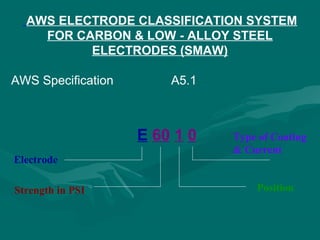
E6010
E – Electrode
60 – min tensile strength 60000 psi (410 mpa)
1- Welding position
0 – Coating current & condition.
AWS ELECTRODE CLASSIFICATION SYSTEM
    FOR CARBON & LOW - ALLOY STEEL
          ELECTRODES (SMAW)

AWS Specification       A5.1


                    E 60 1 0   Type of Coating
                               & Current
Electrode

Strength in PSI                    Position
E 80 1 8 - B1
Electrode

80 PSI Min.


      All Position


For AC or DCEP
                           Chemical Composition of
                           Weld Metal Deposit
POSITION


DIGIT   POSITION
1       Flat, Horizontal, Vertical, Overhead
2       Flat & Horizontal Only
3       Flat, Horizontal, Vertical down,
        Overhead
TYPE OF COATING & CURRENT

DIGIT   TYPE OF COATING            CURRENT
0       Cellulose Sodium           DCEP
1       Cellulose Potassium        AC or DCEP or DCEN

2       Titania Sodium             AC or DCEN
3       Titania Potassium          AC or DCEP
4       Iron Powder Titania        AC or DCEP or DCEN

5       Low Hydrogen Sodium        DCEP
6       Low Hydrogen Potassium     AC or DCEP
7       Iron Powder Iron Oxide     AC or DCEP or DCEN

8       Iron Powder Low Hydrogen   AC or DCEP
CHEMICAL COMPOSITION OF WELD DEPOSIT

Suffix   %Mn      %Ni     %Cr      %Mo         %V
A1                                 1/2
B1                        1/2      1/2
B2                        1-1/4    1/2
B3                        2-1/4    1
C1                2-1/2
C2                3-1/4
C3                1       0.15     0.35
D1&D2 1.25-2.00                    0.25-0.45

G                 0.50    0.3Min   0.20Min     0.10Min
AWS ELECTRODE CLASSIFICATION SYSTEM
   FOR CARBON STEEL ELECTRODES (GMAW)


                                  Chemical
                                  Composition
                  ER 70 S- X      & Shielding
Electrode
or rod


Strength in PSI                Solid Electrode Wire
SPECIFICATIONS FOR GMAW ELECTRODES


  BASE MATERIAL TYPE   AWS
                       SPECIFICATION
  Carbon Steel         A5.18
  Low Alloy Steel      A5.28
  Al Alloy             A5.10
  Cu Alloy             A5.7
  Magnesium            A5.19
  Nickel Alloys        A5.14
  Stainless Steel      A5.9
  Titanium             A5.16
AWS CLASSIFICATIONS FOR GTAW
             ELECTRODES


AWS      COMPOSITION                              COLOR
CLASS.                                            CODE
EWP      Pure Tungsten                            Green
EWCe-2   97.3% Tungsten, 2% Cerium Oxide          Orange
EWLa-1   98.3% Tungsten,1% lanthanum Oxide        Black
EWTh-1   98.3% Tungsten,1% lanthanum Oxide        Yellow
EWTh-2   97.3% Tungsten,2% lanthanum Oxide        Red
EWZr-1   99.1% Tungsten,0.25%Zirconium Oxide      Brown
EWG      94.5% Tungsten,remainder not specified   Gray
ALLOY STEELS

Steel is considered to be alloy - steel when the
maximum of the range given for the content of alloying
elements exceeds one or more of the following limits

Manganese          1.65%
Silicon            0.60%
Cu                 0.60% or

in which the limits of any of the following elements is
specified or required
Al, Boron, Cr             3.99%
Cobalt, Columbium, Mo, Ni, Ti, Tungsten, Vanadium or
any other element added to obtain the desired alloying
element.
ALLOY STEELS

AWS Filler Metal Specifications

     Suffix Letter designate the chemical composition
      of the deposited weld metal
     Suffix Letter indicate the following chemistry

Suffix Letter           Chemistry
     A                  C - Mo Steel
     B                  Cr - Mo Steel
     C or NI            Ni Steel
     D                  Mn - Mo Steel
     NM                 Ni - Mo Steel
     G, K, M and W      Other Low Alloy Steel
ALLOY STEELS

To Weld Alloy Steel successfully four factors
must be considered

1.   Always use a low - hydrogen welding procedure,
     process & filler metal

2.   Select a filler metal that matches the strength
     level of the alloy steel

3.   Select a filler metal that comes close to
     matching the composition of alloy steel

4.   Use proper welding procedure
CARBON STEELS & LOW - ALLOY STEELS

Wrought Iron          No Carbon ( < 0.08%)
Low Carbon Steels            0.15 % Carbon (Max)
                      0.25 - 1.5 % Manganese
Mild Steel            0.15 - 0.29 % Carbon
Medium Carbon Steel   0.25 - 0.50 % Carbon
                      0.60 - 1.65 % Manganese

High Carbon Steels    0.50 - 1.03 % Carbon
                      0.30 - 1.00% Manganese

Low Alloy Steels      0.29 % Carbon (Max.)
                      Total Metal Alloys <= 2.0 %

Cast Iron             2.1 % Carbon
CARBON STEELS & LOW - ALLOY STEELS

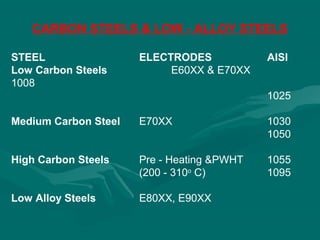
STEEL                 ELECTRODES            AISI
Low Carbon Steels          E60XX & E70XX
1008
                                            1025

Medium Carbon Steel   E70XX                 1030
                                            1050

High Carbon Steels    Pre - Heating &PWHT   1055
                      (200 - 310o C)        1095

Low Alloy Steels      E80XX, E90XX
LOW - ALLOY STEELS

Low Nickel Steel         AISI 2315, 2515, 2517
     Carbon              0.12 - 0.30%
     Mn                  0.40 - 0.60%
     Si                  0.20 - 0.45%
     Ni                  3.25 - 5.25 %

      Electrode          With the C-1, C - 2 Suffix

      if C < 0.15%       No preheat, except for heavy
                         section

      if C > 0.15%       Preheat up to 260o C

      Stress Relieving   Advisable
LOW - ALLOY STEELS

Low Ni - Cr Steel        AISI 3120, 3135, 3140, 3310, 3316
     Carbon              0.14 - 0.34%
     Mn                  0.40 - 0.90%
     Si                  0.20 - 0.35%
     Ni                  1.10 - 3.75 %
     Cr                  0.55 - 0.75%

      Electrode          E80XX & E90XX

      if C < 0.15%       No preheat, except for heavy
                         section

      if C > 0.20%       Preheat up to 316o C

      Stress Relieving   Advisable
LOW - ALLOY STEELS

Low Manganese Steel     AISI 1320, 1330, 1335, 1340, 1345

     Carbon             0.18 - 0.48%
     Mn                 1.60 - 1.90%
     Si                 0.20 - 0.35%

     Electrode          E80XX & E90XX With A-1, D-1 or
                        D-2 Suffix

Low Range of C & Mn     No preheat
if C >= 0.25%           Preheat desirable(121o C- 149o C)
High Range Mn           Mandatory
Thicker Section         (240o C- 290o C)

     Stress Relieving   Advisable
LOW - ALLOY STEELS

Low Alloy Cr Steel       AISI 5015 to 5160

      Carbon             0.12 - 1.10%
      Mn                 0.30 - 1.00%
      Si                 0.20 - 0.30%
      Cr                 0.20 - 1.60%

      Electrode          E80XX & E90XX With B Suffix

Low Range of C & Cr      No preheat
High Range C & Cr         399o C
Thicker Section          (240o C- 290o C)

      Stress Relieving   Advisable
LOW - ALLOY STEELS

Low Alloy Cr Steel         AISI 5015 to 5160

      C.E.   =       C% + Mn% + Ni% + Cr% + Mo% + Cu%
                           6     20      10        40

if C.E. < 0.40%      Material is readily weldable

 C.E. > 0.40%        Special Controls Required
                     Preheating
                     Low Hydrogen Processes

                     Procedure Should be Qualified
STAINLESS STEELS

   Also called Corrosion - Resistant Steels
   They do not rust
   Strongly resist attack by great many liquids, gases
    & chemicals
   Good low - temperature toughness & ductility
   Good Strength & Resistance to High Temp.
   Iron as main element
   Chromium - 11 to 30 %
STAINLESS STEELS

AISI Identification System
     Three Digit Number e.g. AISI 304
     First Digit indicates Group
     Last Two indicates specific alloy

Series      Metallurgical      Principle   Magnetic
Design.     Group              Elements

2XX         Austenitic         Cr-Ni-Mn    Non Magnetic
3XX         Austenitic         Cr-Ni       -do-
4XX         Martensitic        Cr          Magnetic
4XX         Ferritic           Cr          -do-
5XX         Martensitic        Cr-Mo       -do-
LOW HYDROGEN ELECTRODES
These electrodes are having covering that is
low in hydrogen bearing compound.

- Hydrogen has limited solubility in steel.
- Solubility is high in liquid state
- Beyond solubility limit, it retained in weld
  called traps.
- Localization of hydrogen takes place which

    creates under bead crack, Hydrogen
    induced crack.
SELECTION OF ELECTRODES

   - Composition & strength of BM
   - Penetration requirement
   - Position of welding.
   - Fit up condition
   - Skill of welding personnel
   - Cost of welding operation.
   - Service requirement of weld joint.
PREHEATING & POST HEATING

It is to elevate base metal temp before or after
welding operation.
Purpose - to reduce cooling rate
- To avoid cold cracks
- To avoid hydrogen entrapment
- To remove moisture

Carbon equivalent = C+Mn/6+(Cr+Mo+V)/5 +
(Ni+Cu)/15
0.40 Below – Preheating optional
0.40 - 0.60 – Preheating 150 to 200 deg c
0.60 & above – Preheating & Post heating –
              200 – 370 deg C

POST WELD HEAT TREATMENT

-   Rate of heating
-   Soaking & soaking time
-   Rate of cooling
WELDING DEFECTS
In the correct sense, a defect is a rejectable discontinuity
or a flaw of rejectable in nature. Certain flaws acceptable
in one type of product need not be accepted nature in
another product. A defect is definitely a discontinuity but
a discontinuity need not necessary be a defect.
ACCEPTANCE / REJECTION CRITERIA
- Stress to which the parts will be subjected.
- Type of material used.
- The temp & pressure to which the parts will be
  stressed & Its thickness
- Consequence of failure & cost &accessibility of
  repair.
DEFECT CHARACTERISTICS
- Size of defect
-   Sharpness or notch effect
-   Orientation of defect
-   Location of defect (surface, root, weld metal, HAZ,
    Parent metal.
BROAD CLASSIFICATIONS
Planer defect (two dimensional) - cracks, lack of fusion,
lack of penetration, lamination

Voluminar defect (three dimensional) – Slag inclusion,
Porosity, cavity, root concavity.
Geometric defects
Misalignment, undercut, concavity , convexity,
excessive reinforcement, improper reinforcement,
overlap, burn through, incomplete penetration, lack of
fusion, surface irregularity

Incomplete penetration – Lack of penetration &
excessive penetration.
- Excessive thick root face or insufficient root opening
  can be avoided by use proper joint geometry.
- Insufficient heat input.
- Slag flooding ahead of welding – Use small
   electrodes in root .
- Misalignment - id matching
- Bridging or root opening.
INCOMPLETE FUSION
- Insufficient heat input, wrong size of electrode,
  improper joint design – follow correct WPS
- Incorrect electrode position – maintain correct
  position.
- Weld metal running ahead of arc – lower the current
  & speed
SLAG INCLUSION
- Improper joint design-increase groove angle of joint.
- Oxide inclusions – proper gas shielding.
- Poor electrode manipulative techniques.
- Change electrode or flux to improve slag control.
- Failure by welder to remove slag
POROSITY

- Improper arc length, welding current, electrode
  manipulation – change welding condition &
  techniques.
- Excessive moisture in electrode-use correct baking
  & holding temp.
- Excessive Hydrogen & nitrogen in weld atmosphere

  by use low hydrogen electrodes.
- High solidification rate – use preheat
- Dirty metal or filler metal.
LACK OF FUSION
WELD DEFECTS
                                EL P MOCN
                                        I
WELD DEFECTS


INCOMPLETE PENETRATION
WELD DEFECTS


CONTINUOUS INCOMPLETE PENETRATION
ROOT CONCAVITY
WELD DEFECTS
                                RHT NRUB
CRACK ADJACENT TO THE ROOT
WELD DEFECTS
                                            REVS NART
WELD DEFECTS
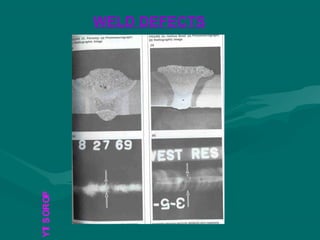
YT S OR OP
 I
WELD DEFECTS


                            CRACK
HCT A MS M
       I
TUNGUSTEN INCLUSION
WELD DEFECTS
                                     L CN GAL S
                                        I
WELD DEFECTS
EXCESSIVE PENETRATION
WELD DEFECTS
                                       UC RE DNU
WELD DEFECTS


WELDING EXAMPLES RELATED TO BAD PRACTICES
EFFECT OR VARIATION OF PARAMETERS
CURRENT TOO LOW
•   Poor penetration
•   Slag inclusion
•   Irregular ripples
•   Uneven bead height
CURRENT TOO HIGH
•   Excessive penetration
•   More spatter
•   Poor ripple appearance
•   Porosity
•   Undercut
ARC TOO SHORT
• Irregular ripples
• Electrode freezing the job
ARC TOO LONG
• Wide ripples
• More spatters, blow holes
TRAVEL TOO FAST
• Narrow width of bead
• Porosity
TRAVEL TOO LOW
• More width & height of bead
• Slag inclusion
DISTORATION & RESIDUAL STRESS
• Distortion or residual shape change occur during
  welding.
• These imperfections adversely affect further assembly.
• Designers are often constrained to design structure free
  from distortion
• Distortion control is often tackled by shop floor
  engineers.
• This is a after effect of welding that remains permanent
  in the component till the equilibrium is disturbed.
PROCESS – Localized application of heat causes
    plastic deformation. As a result thermal shrinkage occur
    near that zone & the metal or weldment changes its
    shape during cooling.
METHOD TO PREVENT
• Minimizing weld joints.
•   Minimizing weld sizes.
•   Minimizing unsupported length
•   Selection of appropriate edge preparation
•   Use of intermittent welding.
•   Using proper jigs & fixtures
•   Using welding sequence
•   Minimizing heat input rate

Electrode & welding defects

  • 1.
    ELECTRODES & FLUX -Can welding be done by bare electrodes ? - Why do we require coating at all ? - Reasons are instability of arc, lack of shielding, poor mechanical properties - What are the different type of coating TYPE OF COATING Cellulose material - It is made by hard or soft wood, pulp & similar substance. Washing, drying & grading into different mesh sizes. - High arc force, large volume of gas mostly hydrogen
  • 2.
    RUTILE - It isa crystalline form of titanium dioxide. Available in beach sand. Concentration - 87% App. - Arc Stabilizer. - Good Slag remover. BALL CLAY – It is a compound of silica & alumina commonly known as alumino silicate. - Slag remover - Gives plasticity in the wet paste. IRON POWDER – Sometimes added to flux coating to add strength to weld - Gives good mechanical strength, arc stabilizer.
  • 3.
    PURPOSE OF FLUXCOATING - Gas shielding of arc. - Stabilizer of the arc (potassium silicate). - Provides slag blanket. - Alloying elements will improve mechanical properties (Iron oxide, Ferro manganese). - Gives good penetration. - Welding in all positions becomes easy. - Compensate oxidation loss.
  • 4.
    ELECTRODE CLASSIFICATION BASED ONCOVERING - Rutile Electrode – Quite & smooth arc, Excellent slag removal, fine ripples, medium penetration, thick slag. - Cellulose electrode – forceful & noisy arc, coarse slag, deep penetration, more gas shield, thin slag cover. - Basic Electrode – Adequate penetration, slag removal is good, contains more iron powder, good mechanical properties.
  • 5.
    BASED ON APPLICATIONS -Stainless steel electrode - Low alloy electrodes - Copper & copper alloy electrode - Aluminum & alloy electrodes - Hard facing electrodes. WHAT IT INDICATES E6010 E – Electrode 60 – min tensile strength 60000 psi (410 mpa) 1- Welding position 0 – Coating current & condition.
  • 6.
    AWS ELECTRODE CLASSIFICATIONSYSTEM FOR CARBON & LOW - ALLOY STEEL ELECTRODES (SMAW) AWS Specification A5.1 E 60 1 0 Type of Coating & Current Electrode Strength in PSI Position
  • 7.
    E 80 18 - B1 Electrode 80 PSI Min. All Position For AC or DCEP Chemical Composition of Weld Metal Deposit
  • 8.
    POSITION DIGIT POSITION 1 Flat, Horizontal, Vertical, Overhead 2 Flat & Horizontal Only 3 Flat, Horizontal, Vertical down, Overhead
  • 9.
    TYPE OF COATING& CURRENT DIGIT TYPE OF COATING CURRENT 0 Cellulose Sodium DCEP 1 Cellulose Potassium AC or DCEP or DCEN 2 Titania Sodium AC or DCEN 3 Titania Potassium AC or DCEP 4 Iron Powder Titania AC or DCEP or DCEN 5 Low Hydrogen Sodium DCEP 6 Low Hydrogen Potassium AC or DCEP 7 Iron Powder Iron Oxide AC or DCEP or DCEN 8 Iron Powder Low Hydrogen AC or DCEP
  • 10.
    CHEMICAL COMPOSITION OFWELD DEPOSIT Suffix %Mn %Ni %Cr %Mo %V A1 1/2 B1 1/2 1/2 B2 1-1/4 1/2 B3 2-1/4 1 C1 2-1/2 C2 3-1/4 C3 1 0.15 0.35 D1&D2 1.25-2.00 0.25-0.45 G 0.50 0.3Min 0.20Min 0.10Min
  • 11.
    AWS ELECTRODE CLASSIFICATIONSYSTEM FOR CARBON STEEL ELECTRODES (GMAW) Chemical Composition ER 70 S- X & Shielding Electrode or rod Strength in PSI Solid Electrode Wire
  • 12.
    SPECIFICATIONS FOR GMAWELECTRODES BASE MATERIAL TYPE AWS SPECIFICATION Carbon Steel A5.18 Low Alloy Steel A5.28 Al Alloy A5.10 Cu Alloy A5.7 Magnesium A5.19 Nickel Alloys A5.14 Stainless Steel A5.9 Titanium A5.16
  • 13.
    AWS CLASSIFICATIONS FORGTAW ELECTRODES AWS COMPOSITION COLOR CLASS. CODE EWP Pure Tungsten Green EWCe-2 97.3% Tungsten, 2% Cerium Oxide Orange EWLa-1 98.3% Tungsten,1% lanthanum Oxide Black EWTh-1 98.3% Tungsten,1% lanthanum Oxide Yellow EWTh-2 97.3% Tungsten,2% lanthanum Oxide Red EWZr-1 99.1% Tungsten,0.25%Zirconium Oxide Brown EWG 94.5% Tungsten,remainder not specified Gray
  • 14.
    ALLOY STEELS Steel isconsidered to be alloy - steel when the maximum of the range given for the content of alloying elements exceeds one or more of the following limits Manganese 1.65% Silicon 0.60% Cu 0.60% or in which the limits of any of the following elements is specified or required Al, Boron, Cr 3.99% Cobalt, Columbium, Mo, Ni, Ti, Tungsten, Vanadium or any other element added to obtain the desired alloying element.
  • 15.
    ALLOY STEELS AWS FillerMetal Specifications  Suffix Letter designate the chemical composition of the deposited weld metal  Suffix Letter indicate the following chemistry Suffix Letter Chemistry A C - Mo Steel B Cr - Mo Steel C or NI Ni Steel D Mn - Mo Steel NM Ni - Mo Steel G, K, M and W Other Low Alloy Steel
  • 16.
    ALLOY STEELS To WeldAlloy Steel successfully four factors must be considered 1. Always use a low - hydrogen welding procedure, process & filler metal 2. Select a filler metal that matches the strength level of the alloy steel 3. Select a filler metal that comes close to matching the composition of alloy steel 4. Use proper welding procedure
  • 17.
    CARBON STEELS &LOW - ALLOY STEELS Wrought Iron No Carbon ( < 0.08%) Low Carbon Steels 0.15 % Carbon (Max) 0.25 - 1.5 % Manganese Mild Steel 0.15 - 0.29 % Carbon Medium Carbon Steel 0.25 - 0.50 % Carbon 0.60 - 1.65 % Manganese High Carbon Steels 0.50 - 1.03 % Carbon 0.30 - 1.00% Manganese Low Alloy Steels 0.29 % Carbon (Max.) Total Metal Alloys <= 2.0 % Cast Iron 2.1 % Carbon
  • 18.
    CARBON STEELS &LOW - ALLOY STEELS STEEL ELECTRODES AISI Low Carbon Steels E60XX & E70XX 1008 1025 Medium Carbon Steel E70XX 1030 1050 High Carbon Steels Pre - Heating &PWHT 1055 (200 - 310o C) 1095 Low Alloy Steels E80XX, E90XX
  • 19.
    LOW - ALLOYSTEELS Low Nickel Steel AISI 2315, 2515, 2517 Carbon 0.12 - 0.30% Mn 0.40 - 0.60% Si 0.20 - 0.45% Ni 3.25 - 5.25 % Electrode With the C-1, C - 2 Suffix if C < 0.15% No preheat, except for heavy section if C > 0.15% Preheat up to 260o C Stress Relieving Advisable
  • 20.
    LOW - ALLOYSTEELS Low Ni - Cr Steel AISI 3120, 3135, 3140, 3310, 3316 Carbon 0.14 - 0.34% Mn 0.40 - 0.90% Si 0.20 - 0.35% Ni 1.10 - 3.75 % Cr 0.55 - 0.75% Electrode E80XX & E90XX if C < 0.15% No preheat, except for heavy section if C > 0.20% Preheat up to 316o C Stress Relieving Advisable
  • 21.
    LOW - ALLOYSTEELS Low Manganese Steel AISI 1320, 1330, 1335, 1340, 1345 Carbon 0.18 - 0.48% Mn 1.60 - 1.90% Si 0.20 - 0.35% Electrode E80XX & E90XX With A-1, D-1 or D-2 Suffix Low Range of C & Mn No preheat if C >= 0.25% Preheat desirable(121o C- 149o C) High Range Mn Mandatory Thicker Section (240o C- 290o C) Stress Relieving Advisable
  • 22.
    LOW - ALLOYSTEELS Low Alloy Cr Steel AISI 5015 to 5160 Carbon 0.12 - 1.10% Mn 0.30 - 1.00% Si 0.20 - 0.30% Cr 0.20 - 1.60% Electrode E80XX & E90XX With B Suffix Low Range of C & Cr No preheat High Range C & Cr 399o C Thicker Section (240o C- 290o C) Stress Relieving Advisable
  • 23.
    LOW - ALLOYSTEELS Low Alloy Cr Steel AISI 5015 to 5160 C.E. = C% + Mn% + Ni% + Cr% + Mo% + Cu% 6 20 10 40 if C.E. < 0.40% Material is readily weldable C.E. > 0.40% Special Controls Required Preheating Low Hydrogen Processes Procedure Should be Qualified
  • 24.
    STAINLESS STEELS  Also called Corrosion - Resistant Steels  They do not rust  Strongly resist attack by great many liquids, gases & chemicals  Good low - temperature toughness & ductility  Good Strength & Resistance to High Temp.  Iron as main element  Chromium - 11 to 30 %
  • 25.
    STAINLESS STEELS AISI IdentificationSystem  Three Digit Number e.g. AISI 304  First Digit indicates Group  Last Two indicates specific alloy Series Metallurgical Principle Magnetic Design. Group Elements 2XX Austenitic Cr-Ni-Mn Non Magnetic 3XX Austenitic Cr-Ni -do- 4XX Martensitic Cr Magnetic 4XX Ferritic Cr -do- 5XX Martensitic Cr-Mo -do-
  • 26.
    LOW HYDROGEN ELECTRODES Theseelectrodes are having covering that is low in hydrogen bearing compound. - Hydrogen has limited solubility in steel. - Solubility is high in liquid state - Beyond solubility limit, it retained in weld called traps. - Localization of hydrogen takes place which creates under bead crack, Hydrogen induced crack.
  • 27.
    SELECTION OF ELECTRODES - Composition & strength of BM - Penetration requirement - Position of welding. - Fit up condition - Skill of welding personnel - Cost of welding operation. - Service requirement of weld joint.
  • 28.
    PREHEATING & POSTHEATING It is to elevate base metal temp before or after welding operation. Purpose - to reduce cooling rate - To avoid cold cracks - To avoid hydrogen entrapment - To remove moisture Carbon equivalent = C+Mn/6+(Cr+Mo+V)/5 + (Ni+Cu)/15
  • 29.
    0.40 Below –Preheating optional 0.40 - 0.60 – Preheating 150 to 200 deg c 0.60 & above – Preheating & Post heating – 200 – 370 deg C POST WELD HEAT TREATMENT - Rate of heating - Soaking & soaking time - Rate of cooling
  • 30.
    WELDING DEFECTS In thecorrect sense, a defect is a rejectable discontinuity or a flaw of rejectable in nature. Certain flaws acceptable in one type of product need not be accepted nature in another product. A defect is definitely a discontinuity but a discontinuity need not necessary be a defect. ACCEPTANCE / REJECTION CRITERIA - Stress to which the parts will be subjected. - Type of material used. - The temp & pressure to which the parts will be stressed & Its thickness - Consequence of failure & cost &accessibility of repair.
  • 31.
    DEFECT CHARACTERISTICS - Sizeof defect - Sharpness or notch effect - Orientation of defect - Location of defect (surface, root, weld metal, HAZ, Parent metal. BROAD CLASSIFICATIONS Planer defect (two dimensional) - cracks, lack of fusion, lack of penetration, lamination Voluminar defect (three dimensional) – Slag inclusion, Porosity, cavity, root concavity.
  • 32.
    Geometric defects Misalignment, undercut,concavity , convexity, excessive reinforcement, improper reinforcement, overlap, burn through, incomplete penetration, lack of fusion, surface irregularity Incomplete penetration – Lack of penetration & excessive penetration. - Excessive thick root face or insufficient root opening can be avoided by use proper joint geometry. - Insufficient heat input. - Slag flooding ahead of welding – Use small electrodes in root .
  • 33.
    - Misalignment -id matching - Bridging or root opening. INCOMPLETE FUSION - Insufficient heat input, wrong size of electrode, improper joint design – follow correct WPS - Incorrect electrode position – maintain correct position. - Weld metal running ahead of arc – lower the current & speed SLAG INCLUSION - Improper joint design-increase groove angle of joint. - Oxide inclusions – proper gas shielding. - Poor electrode manipulative techniques. - Change electrode or flux to improve slag control. - Failure by welder to remove slag
  • 34.
    POROSITY - Improper arclength, welding current, electrode manipulation – change welding condition & techniques. - Excessive moisture in electrode-use correct baking & holding temp. - Excessive Hydrogen & nitrogen in weld atmosphere by use low hydrogen electrodes. - High solidification rate – use preheat - Dirty metal or filler metal.
  • 35.
    LACK OF FUSION WELDDEFECTS EL P MOCN I
  • 36.
  • 37.
  • 38.
  • 39.
    CRACK ADJACENT TOTHE ROOT WELD DEFECTS REVS NART
  • 40.
  • 41.
    WELD DEFECTS CRACK HCT A MS M I
  • 42.
  • 43.
  • 44.
  • 45.
    WELD DEFECTS WELDING EXAMPLESRELATED TO BAD PRACTICES
  • 46.
    EFFECT OR VARIATIONOF PARAMETERS CURRENT TOO LOW • Poor penetration • Slag inclusion • Irregular ripples • Uneven bead height CURRENT TOO HIGH • Excessive penetration • More spatter • Poor ripple appearance • Porosity • Undercut
  • 47.
    ARC TOO SHORT •Irregular ripples • Electrode freezing the job ARC TOO LONG • Wide ripples • More spatters, blow holes TRAVEL TOO FAST • Narrow width of bead • Porosity TRAVEL TOO LOW • More width & height of bead • Slag inclusion
  • 48.
    DISTORATION & RESIDUALSTRESS • Distortion or residual shape change occur during welding. • These imperfections adversely affect further assembly. • Designers are often constrained to design structure free from distortion • Distortion control is often tackled by shop floor engineers. • This is a after effect of welding that remains permanent in the component till the equilibrium is disturbed.
  • 49.
    PROCESS – Localizedapplication of heat causes plastic deformation. As a result thermal shrinkage occur near that zone & the metal or weldment changes its shape during cooling. METHOD TO PREVENT • Minimizing weld joints. • Minimizing weld sizes. • Minimizing unsupported length • Selection of appropriate edge preparation • Use of intermittent welding. • Using proper jigs & fixtures • Using welding sequence • Minimizing heat input rate