Maraging Steel
1. Introduction and General Characteristics:
 Maraging steels are characterized with superior strength
combined with excellent toughness properties and
weldability. without loss of malleability. OR
 Maraging steels are carbon free iron-nickel alloys with
additions of cobalt, molybdenum, titanium and aluminium.
 The term maraging is derived from the strengthening
mechanism, which is transforming the alloy to martensite
with subsequent age hardening. (Martensite + Ageing)
• special class of steel contain No-carbon but provides “ultra-
high-strength”
• Their strength comes from precipitation of intermetallic
compounds like (Mo, Ti & Al)Ni3 “NOT FROM CARBON”.
• High strength is maintained up to 350 oC. …? How?
cont…
• Since ductile Fe-Ni martensites are formed upon cooling,
cracks are non-existent or negligible.
• These steels can be nitrided to improve case hardness.
• C is considered as an impurity element in these steel and it
should be kept below 0.03%.
2. Application:
• Considered as Military grade … crankshafts, gears, and the
firing pins of automatic weapons that cycle from hot to cool
repeatedly under substantial load.
• Missile Nose. aerospace, e.g. undercarriage parts and wing
fittings, tooling & machinery , e.g. extrusion press rams and
mandrels in tube production, gears
• Ordnance components and fasteners.
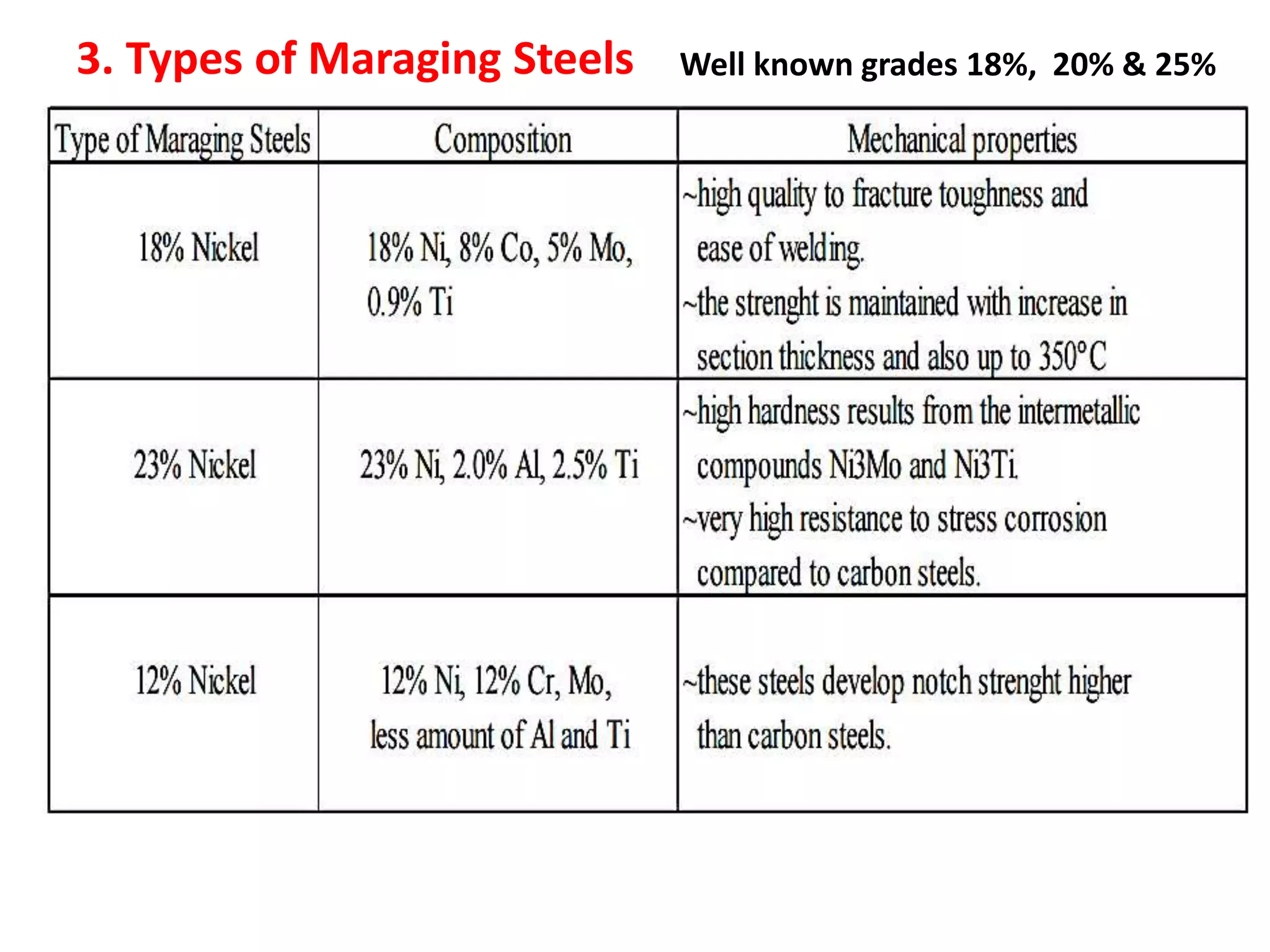
3. Types of Maraging Steels Well known grades 18%, 20% & 25%
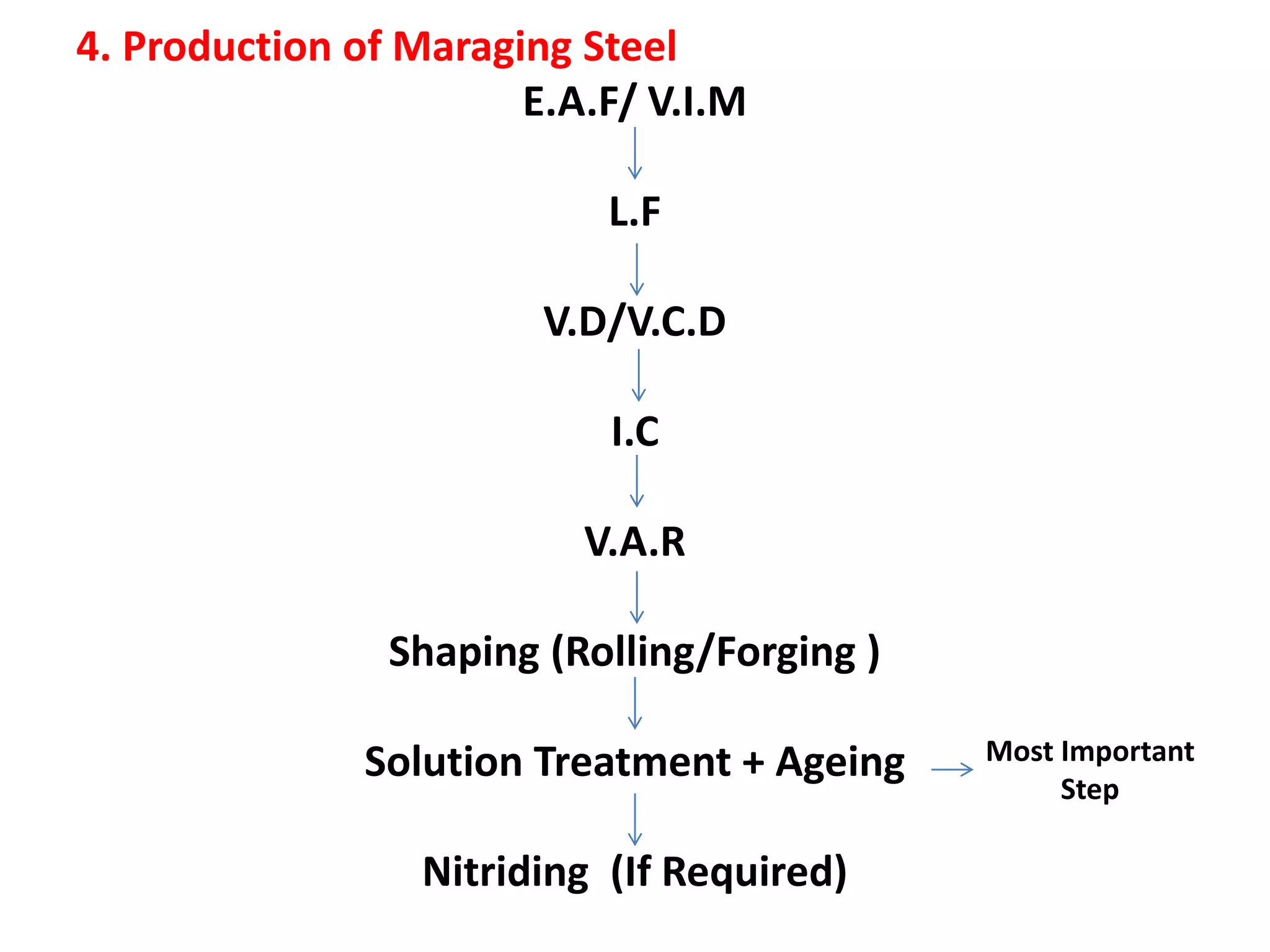
4. Production of Maraging Steel
E.A.F/ V.I.M
L.F
V.D/V.C.D
I.C
V.A.R
Shaping (Rolling/Forging )
Solution Treatment + Ageing
Nitriding (If Required)
Most Important
Step
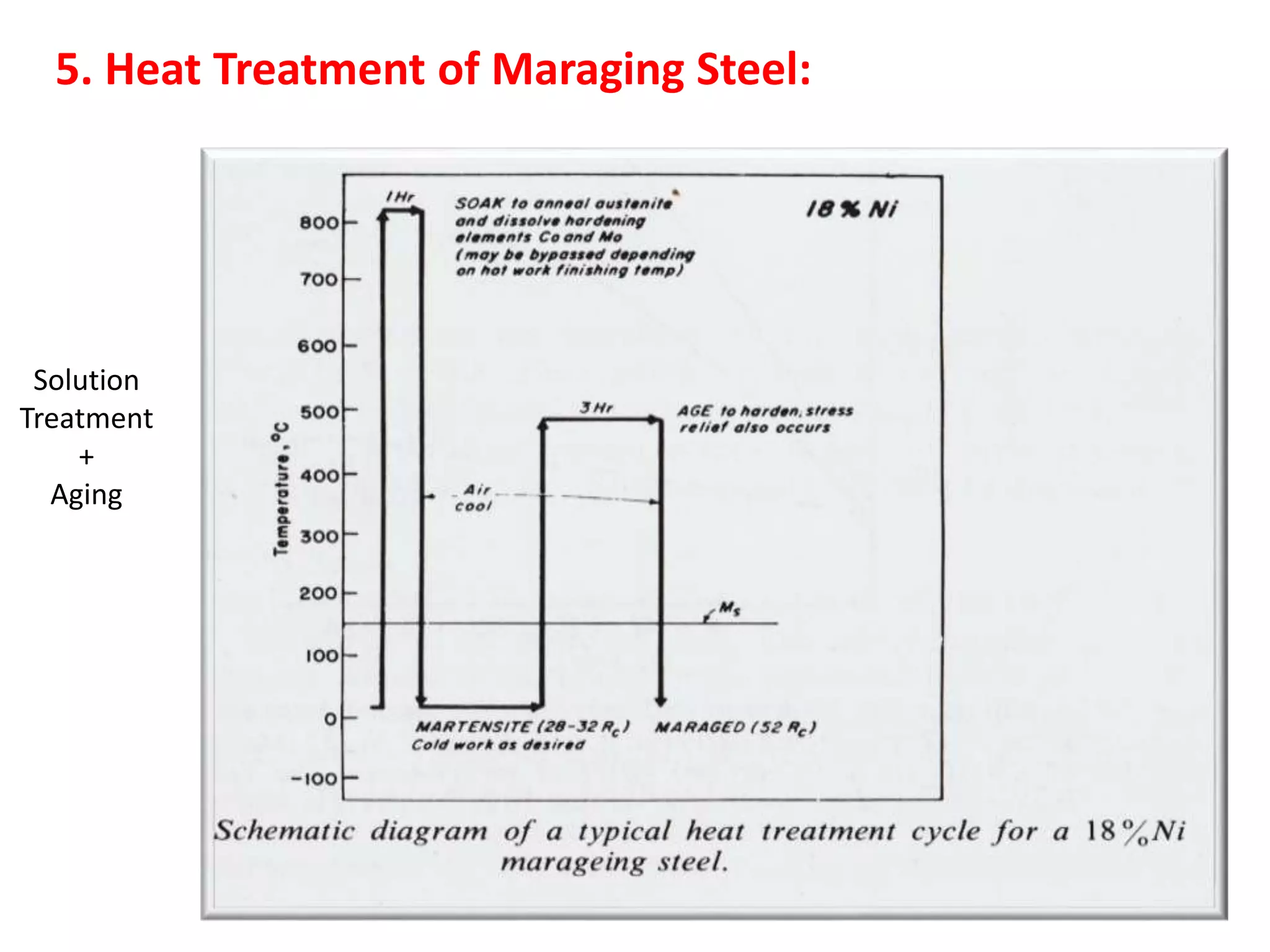
5. Heat Treatment of Maraging Steel:
Solution
Treatment
+
Aging
6. Physical Metallurgy of Maraging Steel /
• Effects
a) Ni = Austenitic Stabilizing Element, Increases hardenability, resistant to fatigue &
corrosion
b) Co/Mo = Retain hardness at high temperature, good wear resistant.
c) Ti = Stabilize Ferrite, Refine Grain structure, raises creep strength.
d) Al = stabilize ferrite, form nitride, refine grain size.
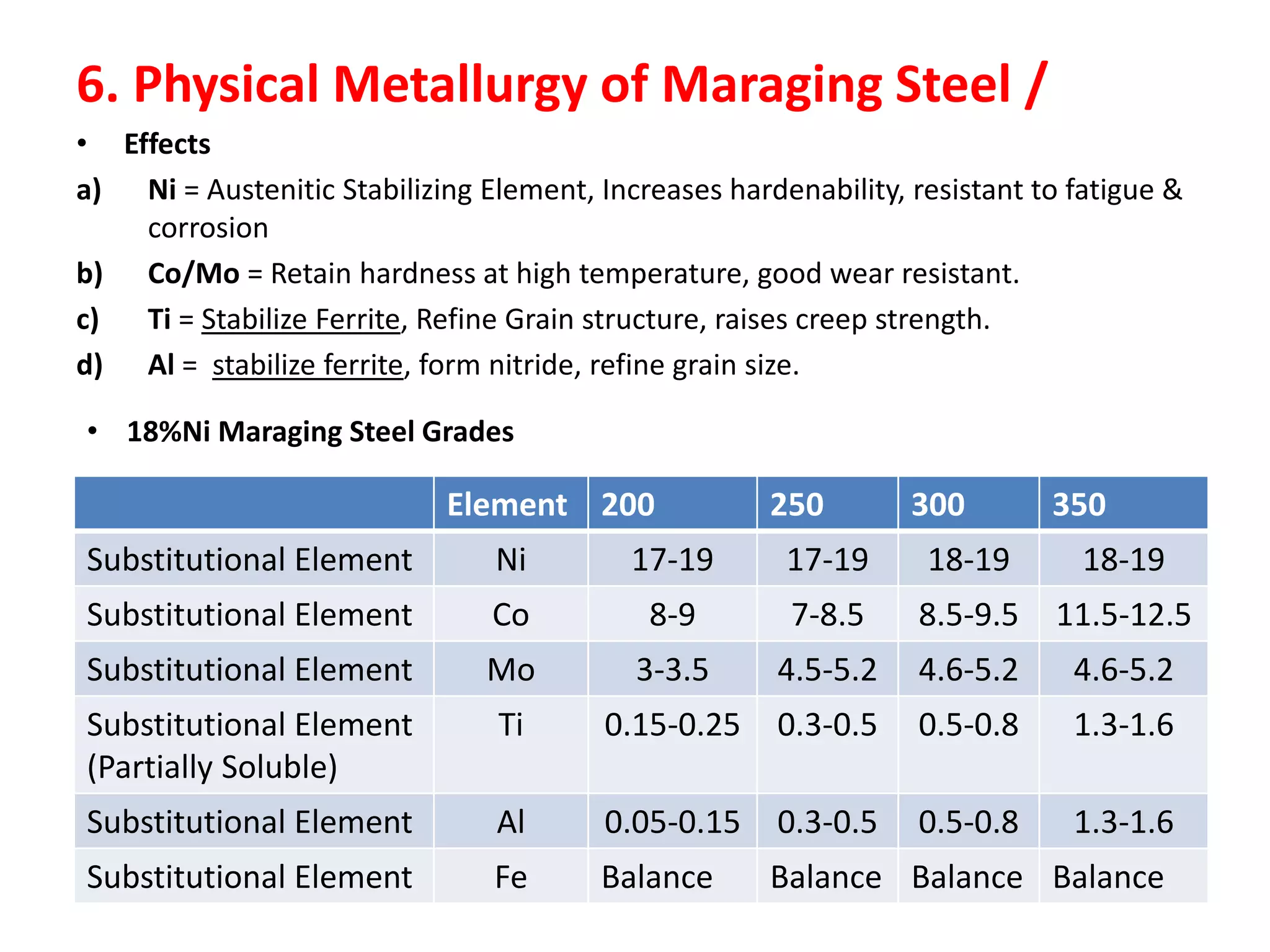
Element 200 250 300 350
Substitutional Element Ni 17-19 17-19 18-19 18-19
Substitutional Element Co 8-9 7-8.5 8.5-9.5 11.5-12.5
Substitutional Element Mo 3-3.5 4.5-5.2 4.6-5.2 4.6-5.2
Substitutional Element
(Partially Soluble)
Ti 0.15-0.25 0.3-0.5 0.5-0.8 1.3-1.6
Substitutional Element Al 0.05-0.15 0.3-0.5 0.5-0.8 1.3-1.6
Substitutional Element Fe Balance Balance Balance Balance
• 18%Ni Maraging Steel Grades
6.1 Fe-Ni Phase Diagram
• steels are solution treated at 820 oC , to absorb all
precipitates or alloying elements & produce uniform
austenitic structure.
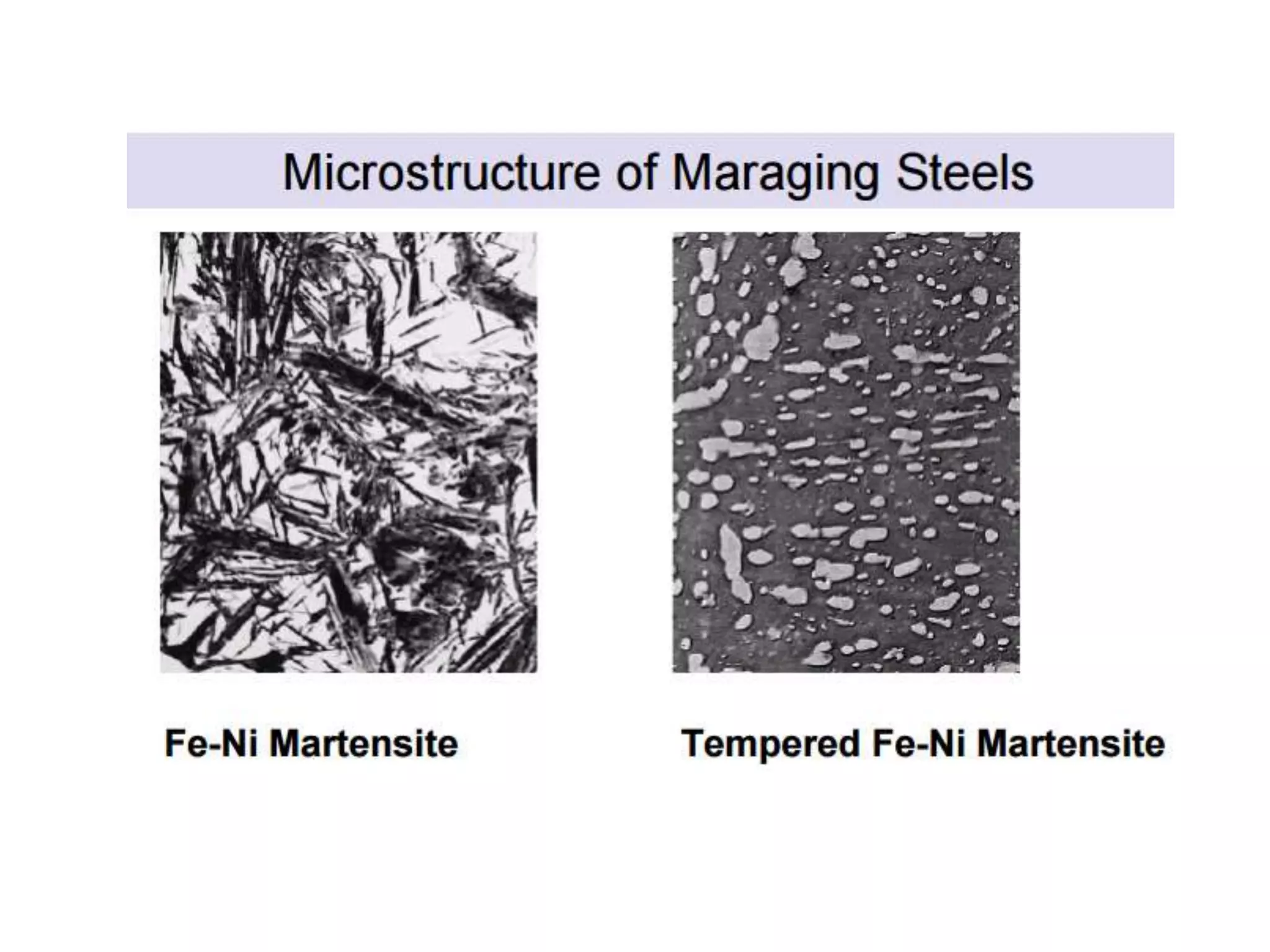
• upon cooling in air/quenching, an Fe-Ni BCC Martensite is
formed instead of ordinary Tetragonal Martensite (Fe-C).
• This is of lath-like BCC form, softer & tougher than ordinary
martensite but heavily dislocated martensite.
(means high dislocation density = high energy = means
favorable site for precipitation)
• Upon ageing at 480oC for 3 or more hours, coherent
precipitates of intermetallic compound (Mo, Ti & Al)Ni3 are
formed.
• The main function of “Co” seems to produce more sites for
the nucleation of (Mo, Ti & Al)Ni3 precipitates. Or Co reduces
the solubility of Ti, Mo & Al in the matrix as a result theses
increases the volume fraction of rich precipitate.
• If the precipitation hardening temperaure exceeds 500oC, over-aging
results the strength begin to fall due to reversion of the austenite.
• similarly increases the time for aging the same effect will be
produce.
Why Ni is selected for Maraging steels ?
How it can with stand high strength at high temperature?
• High-nickel steels introduces considerable thermal hysteresis
in the polymorphic transformation.
• steel containing 15% nickel will not begin to transform on
cooling until a temperature of about 250oC has been reached,
when martensite begins to form.
• On re-heating the structure, however, martensite does not
begin to change to austenite until a temperature approaching
600oC.
• This hysteresis, or lag, in transformation is fundamental to the
use of nickel in maraging steels.
Advances in Special Steel: Maraging steel updated 2016

Advances in Special Steel: Maraging steel updated 2016

  • 1.
    Maraging Steel 1. Introductionand General Characteristics:  Maraging steels are characterized with superior strength combined with excellent toughness properties and weldability. without loss of malleability. OR  Maraging steels are carbon free iron-nickel alloys with additions of cobalt, molybdenum, titanium and aluminium.  The term maraging is derived from the strengthening mechanism, which is transforming the alloy to martensite with subsequent age hardening. (Martensite + Ageing) • special class of steel contain No-carbon but provides “ultra- high-strength” • Their strength comes from precipitation of intermetallic compounds like (Mo, Ti & Al)Ni3 “NOT FROM CARBON”. • High strength is maintained up to 350 oC. …? How?
  • 2.
    cont… • Since ductileFe-Ni martensites are formed upon cooling, cracks are non-existent or negligible. • These steels can be nitrided to improve case hardness. • C is considered as an impurity element in these steel and it should be kept below 0.03%. 2. Application: • Considered as Military grade … crankshafts, gears, and the firing pins of automatic weapons that cycle from hot to cool repeatedly under substantial load. • Missile Nose. aerospace, e.g. undercarriage parts and wing fittings, tooling & machinery , e.g. extrusion press rams and mandrels in tube production, gears • Ordnance components and fasteners.
  • 3.
    3. Types ofMaraging Steels Well known grades 18%, 20% & 25%
  • 4.
    4. Production ofMaraging Steel E.A.F/ V.I.M L.F V.D/V.C.D I.C V.A.R Shaping (Rolling/Forging ) Solution Treatment + Ageing Nitriding (If Required) Most Important Step
  • 5.
    5. Heat Treatmentof Maraging Steel: Solution Treatment + Aging
  • 6.
    6. Physical Metallurgyof Maraging Steel / • Effects a) Ni = Austenitic Stabilizing Element, Increases hardenability, resistant to fatigue & corrosion b) Co/Mo = Retain hardness at high temperature, good wear resistant. c) Ti = Stabilize Ferrite, Refine Grain structure, raises creep strength. d) Al = stabilize ferrite, form nitride, refine grain size. Element 200 250 300 350 Substitutional Element Ni 17-19 17-19 18-19 18-19 Substitutional Element Co 8-9 7-8.5 8.5-9.5 11.5-12.5 Substitutional Element Mo 3-3.5 4.5-5.2 4.6-5.2 4.6-5.2 Substitutional Element (Partially Soluble) Ti 0.15-0.25 0.3-0.5 0.5-0.8 1.3-1.6 Substitutional Element Al 0.05-0.15 0.3-0.5 0.5-0.8 1.3-1.6 Substitutional Element Fe Balance Balance Balance Balance • 18%Ni Maraging Steel Grades
  • 7.
  • 8.
    • steels aresolution treated at 820 oC , to absorb all precipitates or alloying elements & produce uniform austenitic structure. • upon cooling in air/quenching, an Fe-Ni BCC Martensite is formed instead of ordinary Tetragonal Martensite (Fe-C). • This is of lath-like BCC form, softer & tougher than ordinary martensite but heavily dislocated martensite. (means high dislocation density = high energy = means favorable site for precipitation) • Upon ageing at 480oC for 3 or more hours, coherent precipitates of intermetallic compound (Mo, Ti & Al)Ni3 are formed. • The main function of “Co” seems to produce more sites for the nucleation of (Mo, Ti & Al)Ni3 precipitates. Or Co reduces the solubility of Ti, Mo & Al in the matrix as a result theses increases the volume fraction of rich precipitate.
  • 10.
    • If theprecipitation hardening temperaure exceeds 500oC, over-aging results the strength begin to fall due to reversion of the austenite. • similarly increases the time for aging the same effect will be produce.
  • 11.
    Why Ni isselected for Maraging steels ? How it can with stand high strength at high temperature? • High-nickel steels introduces considerable thermal hysteresis in the polymorphic transformation. • steel containing 15% nickel will not begin to transform on cooling until a temperature of about 250oC has been reached, when martensite begins to form. • On re-heating the structure, however, martensite does not begin to change to austenite until a temperature approaching 600oC. • This hysteresis, or lag, in transformation is fundamental to the use of nickel in maraging steels.