HIGH STRENGTH LOW ALLOY STEELS
C R E AT E D B Y: -
V I V E K S D AV E - 3 7 6
The Maharaja Sayajirao University
Baroda
Guided By:-
Prof. B.J. Chauhan
Metallurgical and Materials
Engineering Department
M.E. – Materials Technology (Part-2)
Subject-Metallic Materials
HISTORY
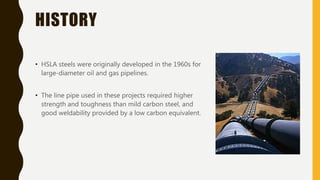
• HSLA steels were originally developed in the 1960s for
large-diameter oil and gas pipelines.
• The line pipe used in these projects required higher
strength and toughness than mild carbon steel, and
good weldability provided by a low carbon equivalent.
INTRODUCTION
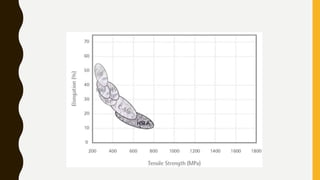
• High-strength low-alloy (HSLA) steels, or micro alloyed steels, are designed to provide
better mechanical properties and greater resistance to atmospheric corrosion than
conventional carbon steels.
• They are not considered to be alloy steels in the normal sense because they are
designed to meet specific mechanical properties rather than a chemical composition.
• HSLA steels are Low carbon, formable steels possessing high strength than
conventional steels.
INTRODUCTION
• The HSLA steels in sheet or plate form have low carbon content of 0.05 to 0.25% in
order to produce adequate formability and weldability.
• And they have Manganese content up to 2.0%.
• Small quantities of chromium, nickel, molybdenum, copper, nitrogen, vanadium,
niobium, titanium, and zirconium are used in various combinations for improving
properties.
PROPERTIES
High-strength low-alloy (HSLA) steels possess,
• High strength to weight ratio
• Improved low temperature toughness
• Fatigue resistance
• High temperature creep resistance
• Atmospheric corrosion resistance
• Improved notch toughness
• Weldability
• Formability
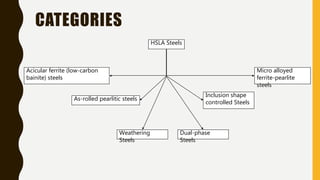
CATEGORIES
HSLA Steels
Weathering
Steels
As-rolled pearlitic steels
Inclusion shape
controlled Steels
Acicular ferrite (low-carbon
bainite) steels
Micro alloyed
ferrite-pearlite
steels
Dual-phase
Steels
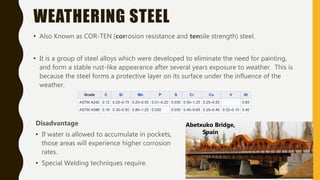
WEATHERING STEEL
• Also Known as COR-TEN (corrosion resistance and tensile strength) steel.
• It is a group of steel alloys which were developed to eliminate the need for painting,
and form a stable rust-like appearance after several years exposure to weather. This is
because the steel forms a protective layer on its surface under the influence of the
weather.
Abetxuko Bridge,
Spain
Disadvantage
• If water is allowed to accumulate in pockets,
those areas will experience higher corrosion
rates.
• Special Welding techniques require.
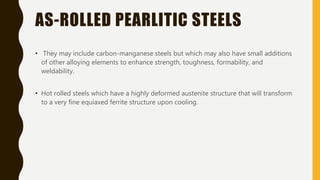
AS-ROLLED PEARLITIC STEELS
• They may include carbon-manganese steels but which may also have small additions
of other alloying elements to enhance strength, toughness, formability, and
weldability.
• Hot rolled steels which have a highly deformed austenite structure that will transform
to a very fine equiaxed ferrite structure upon cooling.
DUAL PHASE STEELS
• Dual-phase steel is a high-strength steel that has a ferritic – martensitic microstructure.
• Dual-phase steels consist of ferrite and a dispersed hard martensitic second phase in
the form of islands.
• As they combine high strength and good formability at low production costs they are
widely used for automotive applications.
ACICULAR FERRITE STEEL
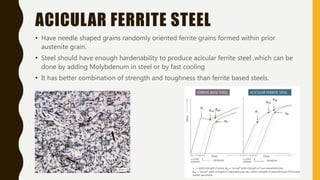
• Have needle shaped grains randomly oriented ferrite grains formed within prior
austenite grain.
• Steel should have enough hardenability to produce acicular ferrite steel ,which can be
done by adding Molybdenum in steel or by fast cooling
• It has better combination of strength and toughness than ferrite based steels.
MICRO ALLOYED FERRITE-PEARLITE
STEELS
• These steels use additions of very small amounts of alloying elements such as niobium and
vanadium (<0.10% each) to increase strength (and thereby increase load-carrying ability) of
hot-rolled steel without increasing carbon and/or manganese contents.
• Minor alloying elements refine the grain microstructure and facilitate precipitation
hardening.
• Application : oil and gas pipelines, bridges and off-shore structure, construction and
storage tanks.
• Along with microalloying elements, the mechanical properties of microalloyed HSLA steels
depend upon austenite conditioning. Austenite conditioning depends on the complex
effects of alloy design and rolling techniques.
MICRO ALLOYED FERRITE-PEARLITE
STEELS
The various types of microalloyed ferrite-pearlite steels include:
• Vanadium-microalloyed steels
• Niobium-microalloyed steels
• Niobium-molybdenum steels
• Vanadium-niobium microalloyed steels
• Vanadium-nitrogen microalloyed steels
• Titanium-microalloyed steels
• Niobium-titanium microalloyed steels
• Vanadium-titanium microalloyed steels
Composition limit for various HSLA
Composition limit for various HSLA(continued)
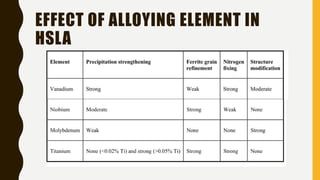
EFFECT OF ALLOYING ELEMENT IN
HSLA
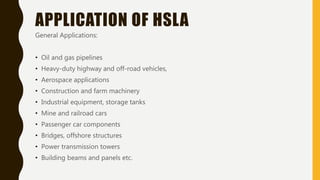
APPLICATION OF HSLA
General Applications:
• Oil and gas pipelines
• Heavy-duty highway and off-road vehicles,
• Aerospace applications
• Construction and farm machinery
• Industrial equipment, storage tanks
• Mine and railroad cars
• Passenger car components
• Bridges, offshore structures
• Power transmission towers
• Building beams and panels etc.
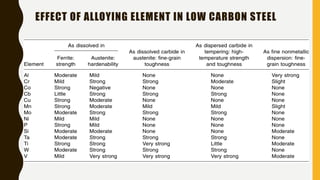
EFFECT OF ALLOYING ELEMENT IN LOW CARBON STEEL
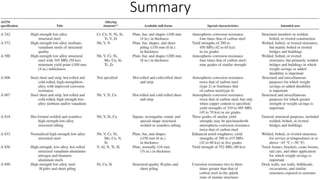
Summary
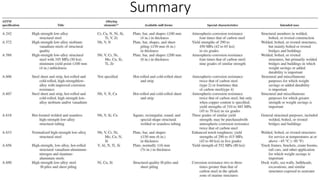
Summary
DOUBTS?
REFERENCES
• Wikipedia.org
• http://www.imoa.info
• http://www.baileymetalprocessing.com
• ASM Handbook volume no. 1
• Metallic Materials by Philiip A. Schweitzer, P.E.
THANK
YOU