By:- Siddharth Kumar Sahu
• Distillation
• Difference between Distillation & Evaporation & Drying
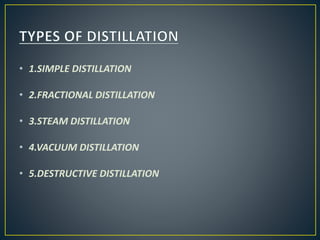
• Types Of Distillation
1.Simple Distillation
2.Fractional Distillation
3.Steam Distillation
• Water For Injection
• Preparation of Purified Water I.P. & Water For Injection I.P.
• Distillation is the process of separating the constituents of
a liquid by vaporizing the liquid and passing the vapours
through a cold surface thereby converting the vapours
again to a liquid.
• It is a separation technique that can be used to either
increase the concentration of a particular component in
the mixture or to obtain (almost) pure components from
the mixture.
• in pharmacy it is either used to extract volatile active
constituents from vegetable drugs OR to separate volatile
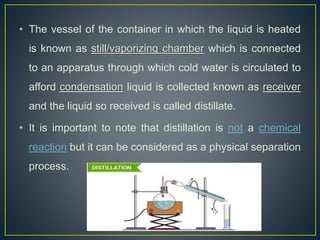
• The vessel of the container in which the liquid is heated
is known as still/vaporizing chamber which is connected
to an apparatus through which cold water is circulated to
afford condensation liquid is collected known as receiver
and the liquid so received is called distillate.
• It is important to note that distillation is not a chemical
reaction but it can be considered as a physical separation
process.
• 1.SIMPLE DISTILLATION
• 2.FRACTIONAL DISTILLATION
• 3.STEAM DISTILLATION
• 4.VACUUM DISTILLATION
• 5.DESTRUCTIVE DISTILLATION
• Simple distillation is the process of converting a
liquid into its vapours which are passes through a
cooling surface to condense the vapours.
• Simple distillation may be used when the boiling points of
two liquids are significantly different from each other or to
separate liquids from solids or non-volatile
components. OR
• Simple distillation is the process of converting a liquid into
its vapour, transferring the vapours to another place, and
recovering the liquid by condensing the vapours
• Consequently, the distillate is not pure but rather its
composition is identical to the composition of the vapours
at the given temperature & pressure. That concentration
follows Raoult's law.
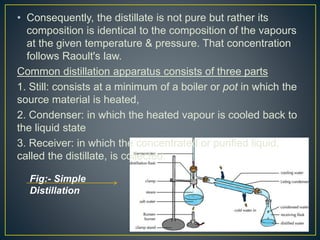
Common distillation apparatus consists of three parts
1. Still: consists at a minimum of a boiler or pot in which the
source material is heated,
2. Condenser: in which the heated vapour is cooled back to
the liquid state
3. Receiver: in which the concentrated or purified liquid,
called the distillate, is collected.
Fig:- Simple
Distillation
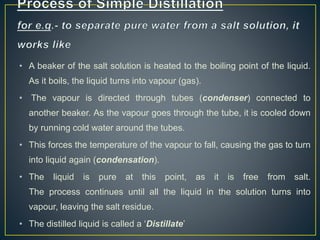
• A beaker of the salt solution is heated to the boiling point of the liquid.
As it boils, the liquid turns into vapour (gas).
• The vapour is directed through tubes (condenser) connected to
another beaker. As the vapour goes through the tube, it is cooled down
by running cold water around the tubes.
• This forces the temperature of the vapour to fall, causing the gas to turn
into liquid again (condensation).
• The liquid is pure at this point, as it is free from salt.
The process continues until all the liquid in the solution turns into
vapour, leaving the salt residue.
• The distilled liquid is called a ‘Distillate’
1. Simple distillation is mainly used for the purification of organic
liquids.
2. Used for the preparation of distilled water and water for injection.
3. Used to separate temperature-sensitive organic compounds such as
aromatic substances.
4. It can be used to extract oils from natural products, such as
eucalyptus oil, citrus oils, or other natural substances.
5. Volatile and aromatic water are prepared.
6. Organic solvent are prepared.
7. Spirit of nitrous ether and aromatic spirit of ammonia are prepared.
8. Non volatile are separate from volatile liquid.
• Fractional distillation process is used to separate miscible
volatile liquids having different boiling points.
Ex-a mixture of alcohol and water.
• In fractional distillation vapour pass through fractioning
column where partial condensation of vapours occurs
and part of condensing vapours goes to the still.
• Construction:- the apparatus consist of
Still in which liquid is boiled.
Fractioning column – it is inserted between still and
condenser.
Condenser – it is used to condense vapours. Some part
of condensate goes back to column which called as
reflux and rest is obtain as product.
Fig:- Fractional Distillation
Fractional
Column
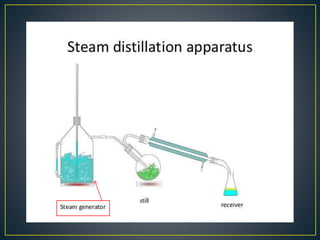
• In Steam distillation impure compound are distilled with
the help of steam. This method is applicable to solid as
well as liquid.
• Steam distillation is a special type of distillation used for
temperature sensitive materials like natural aromatic
compounds.
• Steam is used to reduce the boiling point of a liquid to be
distilled.
• steam distillation is used to obtain essential oils and
• When a mixture of two immiscible liquids (e.g., water and
organics) is heated and when the sum of their vapour
pressure is equal to atmospheric pressure.
• let P1 represent the vapour pressure of water,
P2 represent the vapour pressure of organic liquid.
𝑃1 + 𝑃2 = 𝐴𝑡𝑚𝑜𝑠𝑝ℎ𝑒𝑟𝑖𝑐 𝑃𝑟𝑒𝑠𝑠𝑢𝑟𝑒
• The temperature must be lower than the normal boiling
point of water or the organic liquid.
fig:- Plant Extraction by Steam Distillation
Construction of Steam Distillation
• Used to separation of immiscible liquid.
• Used to extraction of volatile oil such as clove,
eucalyptus.
• Used for the preparation of some aromatic water e.g.
concent. Rose water.
• Steam distillation is also widely used in petroleum
refineries and petrochemical plants.
• Purified Water I.P. –
Water which is free from volatile and non-volatile impurities is called
purified water.
• Water For Injection I.P.
Water which is free from volatile and non-volatile impurities, micro-
organism and pyrogens is called “water for injection”.
• Sterile Water For Injection I.P.
o It is water for injection which is sterilised and suitably packed. It
contain no anti-microbial agent or other added substances. It has
pH between 4.5 and 7.5.
o It must comply with the test for sterility, pyrogens and requirement
of the test for 𝐶𝑂2 Cl, 𝑆𝑂4, NO3-, NO2−, NH₄⁺, Ca and heavy
metals.
• Purified water is typically prepared by -
i. Ion Exchange
ii. Reverse Osmosis or
iii. A Combination of the two treatment processes
• For producing Water for Injection (WFI) There are
several methods. Some are:
i. Vapour Compression Distillation
ii. Multiple Effect Distillation
iii. Reverse Osmosis Filtration
• Preparation methods are very similar to a particular
point, however some process are:
1. De-chlorination 2. Ion removal
3. Bacterial control 4. Removal of Specific impurities.
• R. M. Mehta, A textbook of “Pharmaceutics-
1”, Sixth Edition Reprint 2018, Vallabh
Prakashan, Page No. 196-207.
• www.google.com
• www.slideshare.net Dr. Nasir Abbas,
Distillation.
• www.byjus.com
Distillation

Distillation

  • 1.
  • 2.
    • Distillation • Differencebetween Distillation & Evaporation & Drying • Types Of Distillation 1.Simple Distillation 2.Fractional Distillation 3.Steam Distillation • Water For Injection • Preparation of Purified Water I.P. & Water For Injection I.P.
  • 3.
    • Distillation isthe process of separating the constituents of a liquid by vaporizing the liquid and passing the vapours through a cold surface thereby converting the vapours again to a liquid. • It is a separation technique that can be used to either increase the concentration of a particular component in the mixture or to obtain (almost) pure components from the mixture. • in pharmacy it is either used to extract volatile active constituents from vegetable drugs OR to separate volatile
  • 4.
    • The vesselof the container in which the liquid is heated is known as still/vaporizing chamber which is connected to an apparatus through which cold water is circulated to afford condensation liquid is collected known as receiver and the liquid so received is called distillate. • It is important to note that distillation is not a chemical reaction but it can be considered as a physical separation process.
  • 6.
    • 1.SIMPLE DISTILLATION •2.FRACTIONAL DISTILLATION • 3.STEAM DISTILLATION • 4.VACUUM DISTILLATION • 5.DESTRUCTIVE DISTILLATION
  • 7.
    • Simple distillationis the process of converting a liquid into its vapours which are passes through a cooling surface to condense the vapours. • Simple distillation may be used when the boiling points of two liquids are significantly different from each other or to separate liquids from solids or non-volatile components. OR • Simple distillation is the process of converting a liquid into its vapour, transferring the vapours to another place, and recovering the liquid by condensing the vapours
  • 8.
    • Consequently, thedistillate is not pure but rather its composition is identical to the composition of the vapours at the given temperature & pressure. That concentration follows Raoult's law. Common distillation apparatus consists of three parts 1. Still: consists at a minimum of a boiler or pot in which the source material is heated, 2. Condenser: in which the heated vapour is cooled back to the liquid state 3. Receiver: in which the concentrated or purified liquid, called the distillate, is collected. Fig:- Simple Distillation
  • 9.
    • A beakerof the salt solution is heated to the boiling point of the liquid. As it boils, the liquid turns into vapour (gas). • The vapour is directed through tubes (condenser) connected to another beaker. As the vapour goes through the tube, it is cooled down by running cold water around the tubes. • This forces the temperature of the vapour to fall, causing the gas to turn into liquid again (condensation). • The liquid is pure at this point, as it is free from salt. The process continues until all the liquid in the solution turns into vapour, leaving the salt residue. • The distilled liquid is called a ‘Distillate’
  • 10.
    1. Simple distillationis mainly used for the purification of organic liquids. 2. Used for the preparation of distilled water and water for injection. 3. Used to separate temperature-sensitive organic compounds such as aromatic substances. 4. It can be used to extract oils from natural products, such as eucalyptus oil, citrus oils, or other natural substances. 5. Volatile and aromatic water are prepared. 6. Organic solvent are prepared. 7. Spirit of nitrous ether and aromatic spirit of ammonia are prepared. 8. Non volatile are separate from volatile liquid.
  • 11.
    • Fractional distillationprocess is used to separate miscible volatile liquids having different boiling points. Ex-a mixture of alcohol and water. • In fractional distillation vapour pass through fractioning column where partial condensation of vapours occurs and part of condensing vapours goes to the still. • Construction:- the apparatus consist of Still in which liquid is boiled. Fractioning column – it is inserted between still and condenser. Condenser – it is used to condense vapours. Some part of condensate goes back to column which called as reflux and rest is obtain as product.
  • 12.
  • 13.
    • In Steamdistillation impure compound are distilled with the help of steam. This method is applicable to solid as well as liquid. • Steam distillation is a special type of distillation used for temperature sensitive materials like natural aromatic compounds. • Steam is used to reduce the boiling point of a liquid to be distilled. • steam distillation is used to obtain essential oils and
  • 14.
    • When amixture of two immiscible liquids (e.g., water and organics) is heated and when the sum of their vapour pressure is equal to atmospheric pressure. • let P1 represent the vapour pressure of water, P2 represent the vapour pressure of organic liquid. 𝑃1 + 𝑃2 = 𝐴𝑡𝑚𝑜𝑠𝑝ℎ𝑒𝑟𝑖𝑐 𝑃𝑟𝑒𝑠𝑠𝑢𝑟𝑒 • The temperature must be lower than the normal boiling point of water or the organic liquid.
  • 16.
    fig:- Plant Extractionby Steam Distillation
  • 17.
  • 18.
    • Used toseparation of immiscible liquid. • Used to extraction of volatile oil such as clove, eucalyptus. • Used for the preparation of some aromatic water e.g. concent. Rose water. • Steam distillation is also widely used in petroleum refineries and petrochemical plants.
  • 19.
    • Purified WaterI.P. – Water which is free from volatile and non-volatile impurities is called purified water. • Water For Injection I.P. Water which is free from volatile and non-volatile impurities, micro- organism and pyrogens is called “water for injection”. • Sterile Water For Injection I.P. o It is water for injection which is sterilised and suitably packed. It contain no anti-microbial agent or other added substances. It has pH between 4.5 and 7.5. o It must comply with the test for sterility, pyrogens and requirement of the test for 𝐶𝑂2 Cl, 𝑆𝑂4, NO3-, NO2−, NH₄⁺, Ca and heavy metals.
  • 20.
    • Purified wateris typically prepared by - i. Ion Exchange ii. Reverse Osmosis or iii. A Combination of the two treatment processes • For producing Water for Injection (WFI) There are several methods. Some are: i. Vapour Compression Distillation ii. Multiple Effect Distillation iii. Reverse Osmosis Filtration • Preparation methods are very similar to a particular point, however some process are: 1. De-chlorination 2. Ion removal 3. Bacterial control 4. Removal of Specific impurities.
  • 21.
    • R. M.Mehta, A textbook of “Pharmaceutics- 1”, Sixth Edition Reprint 2018, Vallabh Prakashan, Page No. 196-207. • www.google.com • www.slideshare.net Dr. Nasir Abbas, Distillation. • www.byjus.com