Vacuum Distillation
Vacuum Distillation:
Principle:
 Vacuum distillation is a special method of separating
compounds at pressure lower than the standard
atmospheric pressure.
 Under this condition, the compounds boil below their
normal boiling temperature.
 Hence, vacuum distillation is best suited for
separation of compounds with higher boiling points
(more than 200°C), which tend to decompose at their
boiling temperature.
 Vacuum distillation is a method of distillation
performed under reduced pressure.
 As with distillation, this technique separates compounds
based on differences in boiling points.
 This technique is used when the boiling point of the
desired compound is difficult to achieve or will cause the
compound to decompose.
 For examples The boiling point of ethanol is 79°C
and under vacuum (28 inHg) it drops to around
34°C.
Construction and working:
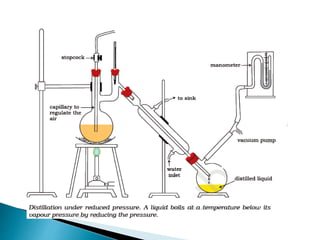
 The crude liquid is heated in distillation flask fitted with
a water condenser, receiver and vacuum pump.
 As the pressure is reduced, the liquid begins to boil at a
much lower temperature than its normal boiling point.
The vapor is condensed by water condenser and the pure
liquid collects in the receiver.
 Vacuum distillation can be conducted without heating
the mixture, as is usually followed in other distillation
types.
 For the separation of some aromatic compounds,
vacuum distillation is used along with steam distillation.
 When vacuum distillation is combined with fractional
distillation method, components of a mixture get
separated very easily.
Applications:
This method is used for the purification of high
boiling liquids and liquids which decompose at or
below their boiling points.

Vacuum distillation

  • 1.
  • 2.
    Vacuum Distillation: Principle:  Vacuumdistillation is a special method of separating compounds at pressure lower than the standard atmospheric pressure.  Under this condition, the compounds boil below their normal boiling temperature.  Hence, vacuum distillation is best suited for separation of compounds with higher boiling points (more than 200°C), which tend to decompose at their boiling temperature.
  • 3.
     Vacuum distillationis a method of distillation performed under reduced pressure.  As with distillation, this technique separates compounds based on differences in boiling points.  This technique is used when the boiling point of the desired compound is difficult to achieve or will cause the compound to decompose.  For examples The boiling point of ethanol is 79°C and under vacuum (28 inHg) it drops to around 34°C.
  • 5.
    Construction and working: The crude liquid is heated in distillation flask fitted with a water condenser, receiver and vacuum pump.  As the pressure is reduced, the liquid begins to boil at a much lower temperature than its normal boiling point. The vapor is condensed by water condenser and the pure liquid collects in the receiver.
  • 6.
     Vacuum distillationcan be conducted without heating the mixture, as is usually followed in other distillation types.  For the separation of some aromatic compounds, vacuum distillation is used along with steam distillation.  When vacuum distillation is combined with fractional distillation method, components of a mixture get separated very easily.
  • 7.
    Applications: This method isused for the purification of high boiling liquids and liquids which decompose at or below their boiling points.