
MOLECULAR DISTILLATION
Evaporative distillation
 short path distillation
MOLECULAR DISTILLATION
• Molecular distillation is defined as a
distillation process in which each molecule in
the vapor phase travels mean free path and get
condensed individually without intermolecular
collisions on application of vacuum
PRINCIPLE
• Mean free path of a molecule is defined as
the average distance through which a
molecule can move without coming in to
collision with another
• Mean free path
PRINCIPLE
P vapor pressure ,Kpa
density
viscosity
mean path length
MOLECULAR DISTILLATION
It is necessary to design the equipment based on
the requirement of the molecular distillation
• The evaporating surface must be close to the
condensing surface
This ensure the molecule come in contact with the
condenser as soon as they leave the evaporating
surface – so it is known as short path distillation
MOLECULAR DISTILLATION
• High vacuum is applied (0.1-1.0 Pascal) so
intermolecular distance increases and thus
molecular collisions minimized
• The liquid surface area must be as large as
possible .so that vapor evolved from the
surface without boiling
• So it is called evaporative distillation
MOLECULAR DISTILLATION
• Based on the method of formation of liquid
film, apparatus is divided in to two types
 falling film molecular still or wiped film
molecular still
Centrifugal molecular still
FALLING FILM MOLECULAR STILL
PRINCIPLE
• WIPED FILM MOLECULAR STILL
• Vaporization occurs from a film of liquid
flowing down a heated surface under high
vacuum
• The vapor travels a short distance and strikes
the condenser nearby
FALLING FILM MOLECULAR STILL
PRINCIPLE
• Each molecule is condensed individually
• The distillate is collected
CONSTRUCTION
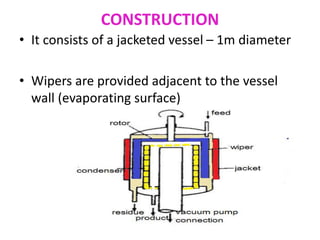
• It consists of a jacketed vessel – 1m diameter
• Wipers are provided adjacent to the vessel
wall (evaporating surface)
CONSTRUCTION
• Vacuum pump is connected to a large pipe at
the centre of the vessel
• Provisions for collecting distillate and un-
distilled liquid residue at the bottom
WORKING
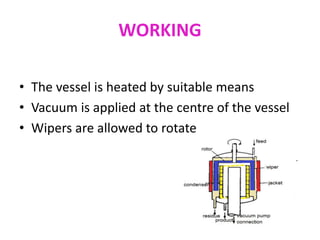
• The vessel is heated by suitable means
• Vacuum is applied at the centre of the vessel
• Wipers are allowed to rotate
WORKING
• Feed is entered through the inlet of the vessel
• As liquid flows down the walls, it spread to
form a film by PTFE wipers(moving a rate of
3m/s)
WORKING
• The velocity of the film is 1.5m/s
• Since the surface is heated liquid film
evaporates directly
• The vapor travels its mean free path and strike
the condenser
WORKING
• The condensate is collected in to a vessel
• The residue is collected from the bottom of
the vessel and recirculated through the feed
port for further distillation
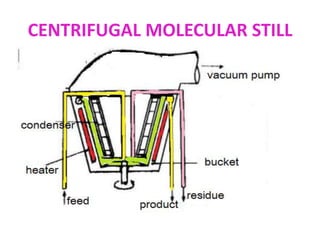
CENTRIFUGAL MOLECULAR STILL
PRINCIPLE
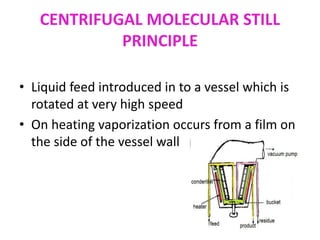
• Liquid feed introduced in to a vessel which is
rotated at very high speed
• On heating vaporization occurs from a film on
the side of the vessel wall
PRINCIPLE
• The vapor travels a short distance and get
condensed on the adjacent condenser
• Each molecule condensed individually
• Distillate is subsequently collected
CONSTRUCTION
• A bucket shaped vessel – 1 to 1.5 m diameter
• Rotated at high speed using a motor
• Radiant heaters are provided externally to
heat the fluid in the bucket
• Condenser arranged very close to the
evaporating surface
CONSTRUCTION
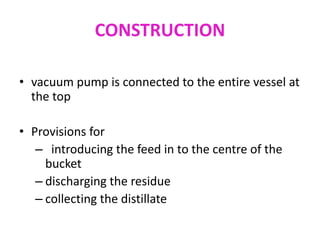
• vacuum pump is connected to the entire vessel at
the top
• Provisions for
– introducing the feed in to the centre of the
bucket
– discharging the residue
– collecting the distillate
CONSTRUCTION
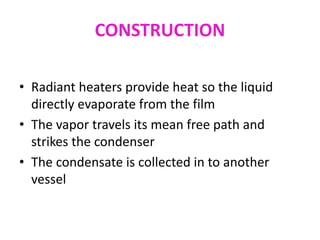
• Radiant heaters provide heat so the liquid
directly evaporate from the film
• The vapor travels its mean free path and
strikes the condenser
• The condensate is collected in to another
vessel
CONSTRUCTION
• The residue collected from the bottom of the
vessel and is recirculated through the feed
port for further distillation
DISADVANTAGE
• Construction and operation are more
complicated compared to falling film still
THANK YOU

MOLECULAR DISTILLATION.pptx

  • 1.
  • 2.
  • 3.
    MOLECULAR DISTILLATION • Moleculardistillation is defined as a distillation process in which each molecule in the vapor phase travels mean free path and get condensed individually without intermolecular collisions on application of vacuum
  • 4.
    PRINCIPLE • Mean freepath of a molecule is defined as the average distance through which a molecule can move without coming in to collision with another • Mean free path
  • 5.
    PRINCIPLE P vapor pressure,Kpa density viscosity mean path length
  • 6.
    MOLECULAR DISTILLATION It isnecessary to design the equipment based on the requirement of the molecular distillation • The evaporating surface must be close to the condensing surface This ensure the molecule come in contact with the condenser as soon as they leave the evaporating surface – so it is known as short path distillation
  • 7.
    MOLECULAR DISTILLATION • Highvacuum is applied (0.1-1.0 Pascal) so intermolecular distance increases and thus molecular collisions minimized • The liquid surface area must be as large as possible .so that vapor evolved from the surface without boiling • So it is called evaporative distillation
  • 8.
    MOLECULAR DISTILLATION • Basedon the method of formation of liquid film, apparatus is divided in to two types  falling film molecular still or wiped film molecular still Centrifugal molecular still
  • 9.
  • 10.
    FALLING FILM MOLECULARSTILL PRINCIPLE • WIPED FILM MOLECULAR STILL • Vaporization occurs from a film of liquid flowing down a heated surface under high vacuum • The vapor travels a short distance and strikes the condenser nearby
  • 11.
    FALLING FILM MOLECULARSTILL PRINCIPLE • Each molecule is condensed individually • The distillate is collected
  • 12.
    CONSTRUCTION • It consistsof a jacketed vessel – 1m diameter • Wipers are provided adjacent to the vessel wall (evaporating surface)
  • 13.
    CONSTRUCTION • Vacuum pumpis connected to a large pipe at the centre of the vessel • Provisions for collecting distillate and un- distilled liquid residue at the bottom
  • 14.
    WORKING • The vesselis heated by suitable means • Vacuum is applied at the centre of the vessel • Wipers are allowed to rotate
  • 15.
    WORKING • Feed isentered through the inlet of the vessel • As liquid flows down the walls, it spread to form a film by PTFE wipers(moving a rate of 3m/s)
  • 16.
    WORKING • The velocityof the film is 1.5m/s • Since the surface is heated liquid film evaporates directly • The vapor travels its mean free path and strike the condenser
  • 17.
    WORKING • The condensateis collected in to a vessel • The residue is collected from the bottom of the vessel and recirculated through the feed port for further distillation
  • 18.
  • 19.
    CENTRIFUGAL MOLECULAR STILL PRINCIPLE •Liquid feed introduced in to a vessel which is rotated at very high speed • On heating vaporization occurs from a film on the side of the vessel wall
  • 20.
    PRINCIPLE • The vaportravels a short distance and get condensed on the adjacent condenser • Each molecule condensed individually • Distillate is subsequently collected
  • 21.
    CONSTRUCTION • A bucketshaped vessel – 1 to 1.5 m diameter • Rotated at high speed using a motor • Radiant heaters are provided externally to heat the fluid in the bucket • Condenser arranged very close to the evaporating surface
  • 22.
    CONSTRUCTION • vacuum pumpis connected to the entire vessel at the top • Provisions for – introducing the feed in to the centre of the bucket – discharging the residue – collecting the distillate
  • 23.
    CONSTRUCTION • Radiant heatersprovide heat so the liquid directly evaporate from the film • The vapor travels its mean free path and strikes the condenser • The condensate is collected in to another vessel
  • 24.
    CONSTRUCTION • The residuecollected from the bottom of the vessel and is recirculated through the feed port for further distillation
  • 25.
    DISADVANTAGE • Construction andoperation are more complicated compared to falling film still
  • 26.