PRESENTATION ON BOILERS
Presented By:-
ABHAY RAJ
ANIMESH NAGRARE
Introduction
What is a Boiler?
 Vessel that heats water to become
hot water or steam
 At atmospheric pressure water
volume increases 1,600 times
 Hot water or steam used to transfer
heat to a process
PRINCIPLE OF OPERATION
 The boiler is essentially a closed vessel inside which
water is stored. Fuel (generally coal) is bunt in a
furnace and hot gasses are produced.
 These hot gasses come in contact with water vessel
where the heat of these hot gases transfer to the water
and consequently steam is produced in the boiler.
 This steam is piped to the turbine of thermal power
plant.
TYPES OF BOILERS
Horizontal, vertical or inclined
Fire tube and Water tube
Externally fired and internally fired
Forced circulation and natural circulation
High pressure and low pressure boilers
Stationary and portable
Single tube and multi-tube boilers
Fluidized bed boiler
Pulverized fuel boiler
Horizontal, vertical or inclined boilers:-
If the axis of the boiler is horizontal, the boiler is
called horizontal, if the axis is vertical it is called
vertical boiler and if the axis is inclined it is
called inclined boiler.
Part of the horizontal boiler can be inspected and
repair easily but it occupies more space.
The vertical boiler occupies less floor area.
FIRE TUBE AND WATER TUBE
In the fire tube boilers, the hot gases are inside
the tube and water surrounds the tubes. for ex-
cochran, lancashire and locomotive boilers.
In the water tube boilers, the water is inside the
tubes and hot gases surrounds them. For ex-
Babcock and Wilcox, Stirling, Yarrow boiler
etc.
FIRE TUBE BOILER
 Relatively small steam
capacities (12,000
kg/hour).
 Low to medium steam
pressures (18 kg/cm2).
 Operates with oil, gas
or solid fuels.
 The advantage of fire tube boiler:-
1) It is quite compact in construction.
2) Fluctuation of steam demand can be met easily.
3) It is also quite cheap.
 The disadvantage of fire tube boiler:-
1) As the water required for operation of the boiler is quite
large, it requires long time for rising steam at desired
pressure.
2) As the water and steam are in same vessel the very high
pressure of steam is not possible
3) The steam received from fire tube boiler is not very dry.
WATER TUBE BOILER
 Used for high steam
demand and pressure
requirements.
 Capacity range of 4,500
– 120,000 kg/hour.
 Combustion efficiency
enhanced by induced
draft provisions.
 Advantages of water tube boiler:-
1) Larger heating surface can be achieved by using more
numbers of water tubes.
2) Due to convectional flow, movement of water is much faster
than that of fire tube boiler; hence rate of heat transfer is high
which results into higher efficiency.
3) Very high pressure in order of 140 kg/cm2 can be obtained
smoothly.
Disadvantage of water tube boiler
1) The main disadvantage of water tube boiler is that it is not
compact in construction.
2) Its cost is not cheap.
3) Size is a difficulty for transportation and construction.
COMPARISON BETWEEN FIRE
AND WATER TUBE BOILER
FIRE TUBE BOILER
 Hot gases inside the tube and
water outside the tubes.
 Generally internally fired .
 Operating pressure limited to 16
bar.
 Rate of steam production is
lower.
 Not suitable for large power
plant.
 It occupies more floor area.
 Water treatment is not so
necessary.
WATER TUBE BOILER
 Water inside the tubes and hot
gases outside the tubes.
 Externally fired.
 Can work under as high pressure
as 100 bar.
 Rate of steam production is
higher.
 It is suitable for large power
plant.
 It occupies less floor area.
 Water treatment is more
necessary.
EXTERNALLY AND INTERNALLY
FIRED
The boiler is known as externally fired if the
fired is outside the shell. For ex-Babcock and
Wilcox boiler, Stirling boiler.
In case of internally fired boilers, the furnace
is located inside the boiler shell. For ex-
cochran, lancashire boiler etc.
FORCED AND NATURAL
CIRCULATION
In forced circulation type of boiler, circulation
of water is done by a forced pump. For ex-
Velox, Lamont, Benson boiler etc.
In natural circulation type of boiler, circulation
of water in the boiler takes place due to natural
convention currents produce by application of
heat. For ex- Lancashire, Babcock and Wilcox
boiler etc.
HIGH AND LOW PRESSURE
BOILERS
The boilers which produce steam at pressure of
80 bar and above are called high pressure
boilers. For ex- Babcock and Wilcox, Velox,
Lamount, Benson boilers etc.
The boiler which produce steam at pressure
below 80 bar are called low pressure boiler. for
ex- Cochran, Cornish, Lancashire and
locomotive boilers etc.
STATIONARY AND PORTABLE
Stationary boilers are used for power plant
steam, for central station utility power plant,
for plant process steam etc.
Portable boiler include locomotive type, and
other small units for temporary use at sites.
SINGLE AND MULTI – TUBE
BOILER
These are basically types of fire tube boilers.
If single tube is used to pass hot gases then it is
called single tube boiler. For ex- Cornish
boiler.
If many tubes are used to pass hot gases then it
is called multi-tube boiler. For ex- Lancashire,
Babcock and Wilcox etc.
FLUIDIZED BED BOILER
Particles (e.g. sand) are suspended in
high velocity air stream: bubbling
fluidized bed.
Combustion at 840° – 950° C.
Capacity range 0.5 T/hr to 100 T/hr.
Fuels: coal, washery rejects, rice husk,
bagasse and agricultural wastes.
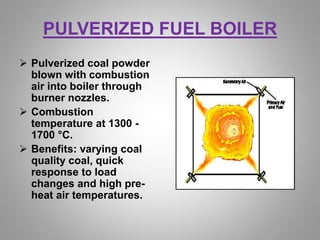
PULVERIZED FUEL BOILER
 Pulverized coal powder
blown with combustion
air into boiler through
burner nozzles.
 Combustion
temperature at 1300 -
1700 °C.
 Benefits: varying coal
quality coal, quick
response to load
changes and high pre-
heat air temperatures.
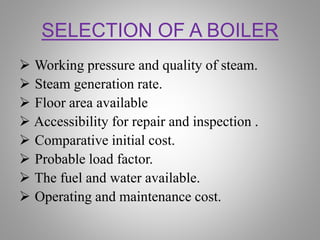
SELECTION OF A BOILER
 Working pressure and quality of steam.
 Steam generation rate.
 Floor area available
 Accessibility for repair and inspection .
 Comparative initial cost.
 Probable load factor.
 The fuel and water available.
 Operating and maintenance cost.
THANK YOU

Ppt on boilers

  • 1.
    PRESENTATION ON BOILERS PresentedBy:- ABHAY RAJ ANIMESH NAGRARE
  • 2.
    Introduction What is aBoiler?  Vessel that heats water to become hot water or steam  At atmospheric pressure water volume increases 1,600 times  Hot water or steam used to transfer heat to a process
  • 3.
    PRINCIPLE OF OPERATION The boiler is essentially a closed vessel inside which water is stored. Fuel (generally coal) is bunt in a furnace and hot gasses are produced.  These hot gasses come in contact with water vessel where the heat of these hot gases transfer to the water and consequently steam is produced in the boiler.  This steam is piped to the turbine of thermal power plant.
  • 4.
    TYPES OF BOILERS Horizontal,vertical or inclined Fire tube and Water tube Externally fired and internally fired Forced circulation and natural circulation High pressure and low pressure boilers Stationary and portable Single tube and multi-tube boilers Fluidized bed boiler Pulverized fuel boiler
  • 5.
    Horizontal, vertical orinclined boilers:- If the axis of the boiler is horizontal, the boiler is called horizontal, if the axis is vertical it is called vertical boiler and if the axis is inclined it is called inclined boiler. Part of the horizontal boiler can be inspected and repair easily but it occupies more space. The vertical boiler occupies less floor area.
  • 6.
    FIRE TUBE ANDWATER TUBE In the fire tube boilers, the hot gases are inside the tube and water surrounds the tubes. for ex- cochran, lancashire and locomotive boilers. In the water tube boilers, the water is inside the tubes and hot gases surrounds them. For ex- Babcock and Wilcox, Stirling, Yarrow boiler etc.
  • 7.
    FIRE TUBE BOILER Relatively small steam capacities (12,000 kg/hour).  Low to medium steam pressures (18 kg/cm2).  Operates with oil, gas or solid fuels.
  • 8.
     The advantageof fire tube boiler:- 1) It is quite compact in construction. 2) Fluctuation of steam demand can be met easily. 3) It is also quite cheap.  The disadvantage of fire tube boiler:- 1) As the water required for operation of the boiler is quite large, it requires long time for rising steam at desired pressure. 2) As the water and steam are in same vessel the very high pressure of steam is not possible 3) The steam received from fire tube boiler is not very dry.
  • 9.
    WATER TUBE BOILER Used for high steam demand and pressure requirements.  Capacity range of 4,500 – 120,000 kg/hour.  Combustion efficiency enhanced by induced draft provisions.
  • 10.
     Advantages ofwater tube boiler:- 1) Larger heating surface can be achieved by using more numbers of water tubes. 2) Due to convectional flow, movement of water is much faster than that of fire tube boiler; hence rate of heat transfer is high which results into higher efficiency. 3) Very high pressure in order of 140 kg/cm2 can be obtained smoothly. Disadvantage of water tube boiler 1) The main disadvantage of water tube boiler is that it is not compact in construction. 2) Its cost is not cheap. 3) Size is a difficulty for transportation and construction.
  • 11.
    COMPARISON BETWEEN FIRE ANDWATER TUBE BOILER FIRE TUBE BOILER  Hot gases inside the tube and water outside the tubes.  Generally internally fired .  Operating pressure limited to 16 bar.  Rate of steam production is lower.  Not suitable for large power plant.  It occupies more floor area.  Water treatment is not so necessary. WATER TUBE BOILER  Water inside the tubes and hot gases outside the tubes.  Externally fired.  Can work under as high pressure as 100 bar.  Rate of steam production is higher.  It is suitable for large power plant.  It occupies less floor area.  Water treatment is more necessary.
  • 12.
    EXTERNALLY AND INTERNALLY FIRED Theboiler is known as externally fired if the fired is outside the shell. For ex-Babcock and Wilcox boiler, Stirling boiler. In case of internally fired boilers, the furnace is located inside the boiler shell. For ex- cochran, lancashire boiler etc.
  • 13.
    FORCED AND NATURAL CIRCULATION Inforced circulation type of boiler, circulation of water is done by a forced pump. For ex- Velox, Lamont, Benson boiler etc. In natural circulation type of boiler, circulation of water in the boiler takes place due to natural convention currents produce by application of heat. For ex- Lancashire, Babcock and Wilcox boiler etc.
  • 14.
    HIGH AND LOWPRESSURE BOILERS The boilers which produce steam at pressure of 80 bar and above are called high pressure boilers. For ex- Babcock and Wilcox, Velox, Lamount, Benson boilers etc. The boiler which produce steam at pressure below 80 bar are called low pressure boiler. for ex- Cochran, Cornish, Lancashire and locomotive boilers etc.
  • 15.
    STATIONARY AND PORTABLE Stationaryboilers are used for power plant steam, for central station utility power plant, for plant process steam etc. Portable boiler include locomotive type, and other small units for temporary use at sites.
  • 16.
    SINGLE AND MULTI– TUBE BOILER These are basically types of fire tube boilers. If single tube is used to pass hot gases then it is called single tube boiler. For ex- Cornish boiler. If many tubes are used to pass hot gases then it is called multi-tube boiler. For ex- Lancashire, Babcock and Wilcox etc.
  • 17.
    FLUIDIZED BED BOILER Particles(e.g. sand) are suspended in high velocity air stream: bubbling fluidized bed. Combustion at 840° – 950° C. Capacity range 0.5 T/hr to 100 T/hr. Fuels: coal, washery rejects, rice husk, bagasse and agricultural wastes.
  • 18.
    PULVERIZED FUEL BOILER Pulverized coal powder blown with combustion air into boiler through burner nozzles.  Combustion temperature at 1300 - 1700 °C.  Benefits: varying coal quality coal, quick response to load changes and high pre- heat air temperatures.
  • 19.
    SELECTION OF ABOILER  Working pressure and quality of steam.  Steam generation rate.  Floor area available  Accessibility for repair and inspection .  Comparative initial cost.  Probable load factor.  The fuel and water available.  Operating and maintenance cost.
  • 20.