Sexual Transmitted Disease
By- Joshua(Chairmen)
Joel
Jyoti
Keshav Kumar
STDs are diseases and infections which are capable

of being spread from person to person through :
• Sexual intercourse
• oral-genital contact or in non-sexual ways.
• Intra venous drug
How can someone get an STD?
• Vaginal sex
• Anal sex
• Oral sex
• Transmission from mother to baby during childbirth
• Skin to Skin contact
• Sharing equipment
• Exchange of bodily fluids
Symptoms
How would I know if I have been infected?
• Sores (either painful or painless)
• Blood in urine
• Burning sensation when urinating
• Rashes
• Itching
• Bumps
• Warts
• Unusual discharge
There are 3 types of STDs
 Bacterial
 Parasitic
 Viral
Bacterial STDs
 Chlamydia
 Gonorrhea
 Syphilis
Chlamydia
• Among the most common bacterial STIs in the world
• Passed by having unprotected oral, anal or vaginal sex
• Condoms can help prevent the spread of chlamydia
during vaginal/anal sex
• Condoms or dental dams can be used for protection
during oral sex
Chlamydia
• Most people have no symptoms
• The infection can be cured with a single dose of antibiotics
• A person can get the infection again, so their partners should also be
tested
Remember chlamydia is CURABLE!
Gonorrhea
• Sexually transmitted bacterial infection
• Passed along by having unprotected oral, anal or vaginal sex
• Condoms can help prevent the spread of gonorrhea during
vaginal or anal sex
• Condoms or dental dams can be used for protection during oral
sex
Gonorrhea
• Most people have no symptoms
• The infection can be cured with antibiotics
• A person can get the infection again, so their
partners should also be tested
Remember gonorrhea is CURABLE!
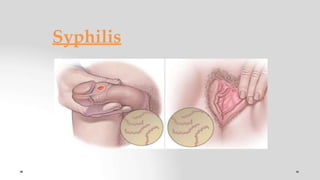
Syphilis
• Rare sexually transmitted bacterial infection
• Can cause serious damage to the body if not cured, including death
• Passed along by having unprotected oral, anal or vaginal sex
• Condoms can help prevent the spread of syphilis during vaginal or
anal sex
• Condoms or dental dams can be used for protection during oral sex
Syphilis
• Syphilis produces a wide range of symptoms that are
often confused with other illnesses
• Some people have no symptoms at all
• The infection can be cured antibiotics
• A person can get the infection again, so their partners
should also be tested
Remember syphilis is CURABLE!
Syphilis
Parasitic STDs
 Pubic lice
 Scabies
 Trichomoniasis
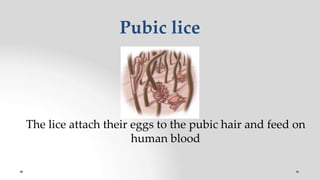
Pubic lice
The lice attach their eggs to the pubic hair and feed on
human blood
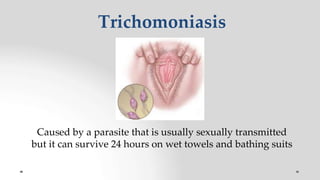
Trichomoniasis
Caused by a parasite that is usually sexually transmitted
but it can survive 24 hours on wet towels and bathing suits
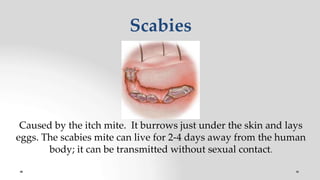
Scabies
Caused by the itch mite. It burrows just under the skin and lays
eggs. The scabies mite can live for 2-4 days away from the human
body; it can be transmitted without sexual contact.
Signs and symptoms of a parasitic STD
• Intense itchiness
• Reddish rash
• Pain during sex or urination
• Vaginal discharge
How are parasitic STIs treated?
• Shampoo – special shampoo to kill lice or scabies
• Lotion - special shampoo to kill lice or scabies
• Ointment- special shampoo to kill lice or scabies
• Antibiotic – used to treat trich
Viral STDs
Human Papilloma Virus (HPV)
Herpes
Hepatitis
HIV / AIDS
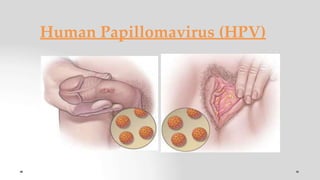
Human Papillomavirus (HPV)
• Very contagious virus
• Some people never get symptoms
• HPV is spread through skin to skin contact,oral,anal and
vaginal sex with an infected partner
• Some types cause genital warts and other types can cause
cancer of the cervix
Human Papillomavirus (HPV)
Genital Herpes
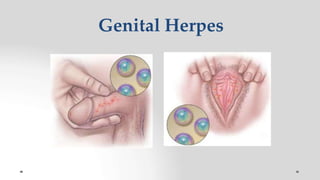
• Caused by the Herpes Simplex Virus (HSV)
• Spread through skin to skin contact and oral, anal and vaginal sex
• Some people with herpes never develop sores, but are still contagious
and may spread it to others without knowing
• People who have an initial outbreak can have more outbreaks
throughout the rest of their life
Remember herpes is not CURABLE. It is TREATABLE!
Genital Herpes
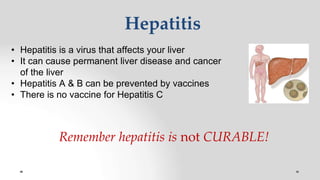
Hepatitis
• Hepatitis is a virus that affects your liver
• It can cause permanent liver disease and cancer
of the liver
• Hepatitis A & B can be prevented by vaccines
• There is no vaccine for Hepatitis C
Remember hepatitis is not CURABLE!
How is Hepatitis transmitted
• Hepatitis A is transmitted through fecal oral route
• Hep B is transmitted through blood and bodily fluids
• Hep C is transmitted mostly through blood but also
through bodily fluids
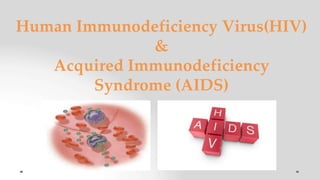
Human Immunodeficiency Virus(HIV)
&
Acquired Immunodeficiency
Syndrome (AIDS)
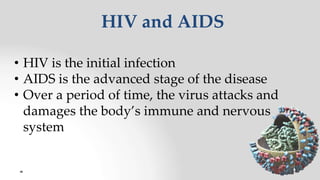
HIV and AIDS
• HIV is the initial infection
• AIDS is the advanced stage of the disease
• Over a period of time, the virus attacks and
damages the body’s immune and nervous
system
How is HIV/AIDS spread?
The virus is spread through bodily fluids
Decrease risk with condom use
There is no cure for HIV infection
Once infected, you have HIV for life
What is the only 100 % effective way
of preventing STIs and pregnancy?
What does abstinence mean?
• Abstinence means to not do something
• Sexual abstinence means to abstain from different levels of
sexual activity
• Possible choices for sexual abstinence between two people
could be:
• Avoiding vaginal and anal intercourse
• Avoiding oral-genital contact
• Avoiding genital contact
Preventing STDs and pregnancy
• Delay sexual activity until you are older
• If you choose to be sexually active, use protective
barriers (condoms, dental dams) and birth
control
STD Testing
Chlamydia and Gonorrhea
•Urine test for males and females
•If symptoms present, swabs may be done
Trichomoniasis
•Diagnosed by taking a sample of vaginal discharge
Genital warts (HPV)
•Diagnosed by visual examination
Herpes
•Usually diagnosed by sight, and by history
•A swab of the lesion can be taken to confirm virus
Hepatitis B, C, Syphilis and HIV
•Diagnosed by blood tests
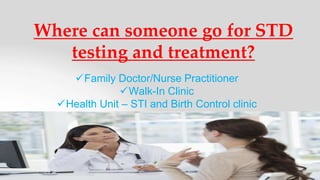
Where can someone go for STD
testing and treatment?
Family Doctor/Nurse Practitioner
Walk-In Clinic
Health Unit – STI and Birth Control clinic
Prevention
 Abstinence
 Know your partner
 Limit your partners
 Visit your doctor
 Always look
 Keep clean!
Summary
Keep informed about STIs and how to protect yourself
Talk to a parent, teacher, or a trusted adult
Remember
 People who engage in premarital sex are nearly 50
percent more likely to divorce.
 3 million teens contract an STD each year – some of
which have no cure, are a leading cause of cervical
cancer or can even lead to infertility.
QUESTIONS
Sexual Transmitted Disease

Sexual Transmitted Disease

  • 1.
    Sexual Transmitted Disease By-Joshua(Chairmen) Joel Jyoti Keshav Kumar
  • 2.
    STDs are diseasesand infections which are capable of being spread from person to person through : • Sexual intercourse • oral-genital contact or in non-sexual ways. • Intra venous drug
  • 3.
    How can someoneget an STD? • Vaginal sex • Anal sex • Oral sex • Transmission from mother to baby during childbirth • Skin to Skin contact • Sharing equipment • Exchange of bodily fluids
  • 4.
    Symptoms How would Iknow if I have been infected? • Sores (either painful or painless) • Blood in urine • Burning sensation when urinating • Rashes • Itching • Bumps • Warts • Unusual discharge
  • 5.
    There are 3types of STDs  Bacterial  Parasitic  Viral
  • 6.
    Bacterial STDs  Chlamydia Gonorrhea  Syphilis
  • 7.
    Chlamydia • Among themost common bacterial STIs in the world • Passed by having unprotected oral, anal or vaginal sex • Condoms can help prevent the spread of chlamydia during vaginal/anal sex • Condoms or dental dams can be used for protection during oral sex
  • 8.
    Chlamydia • Most peoplehave no symptoms • The infection can be cured with a single dose of antibiotics • A person can get the infection again, so their partners should also be tested Remember chlamydia is CURABLE!
  • 9.
    Gonorrhea • Sexually transmittedbacterial infection • Passed along by having unprotected oral, anal or vaginal sex • Condoms can help prevent the spread of gonorrhea during vaginal or anal sex • Condoms or dental dams can be used for protection during oral sex
  • 10.
    Gonorrhea • Most peoplehave no symptoms • The infection can be cured with antibiotics • A person can get the infection again, so their partners should also be tested Remember gonorrhea is CURABLE!
  • 11.
    Syphilis • Rare sexuallytransmitted bacterial infection • Can cause serious damage to the body if not cured, including death • Passed along by having unprotected oral, anal or vaginal sex • Condoms can help prevent the spread of syphilis during vaginal or anal sex • Condoms or dental dams can be used for protection during oral sex
  • 12.
    Syphilis • Syphilis producesa wide range of symptoms that are often confused with other illnesses • Some people have no symptoms at all • The infection can be cured antibiotics • A person can get the infection again, so their partners should also be tested Remember syphilis is CURABLE!
  • 13.
  • 14.
    Parasitic STDs  Pubiclice  Scabies  Trichomoniasis
  • 15.
    Pubic lice The liceattach their eggs to the pubic hair and feed on human blood
  • 16.
    Trichomoniasis Caused by aparasite that is usually sexually transmitted but it can survive 24 hours on wet towels and bathing suits
  • 17.
    Scabies Caused by theitch mite. It burrows just under the skin and lays eggs. The scabies mite can live for 2-4 days away from the human body; it can be transmitted without sexual contact.
  • 18.
    Signs and symptomsof a parasitic STD • Intense itchiness • Reddish rash • Pain during sex or urination • Vaginal discharge How are parasitic STIs treated? • Shampoo – special shampoo to kill lice or scabies • Lotion - special shampoo to kill lice or scabies • Ointment- special shampoo to kill lice or scabies • Antibiotic – used to treat trich
  • 19.
    Viral STDs Human PapillomaVirus (HPV) Herpes Hepatitis HIV / AIDS
  • 20.
    Human Papillomavirus (HPV) •Very contagious virus • Some people never get symptoms • HPV is spread through skin to skin contact,oral,anal and vaginal sex with an infected partner • Some types cause genital warts and other types can cause cancer of the cervix
  • 21.
  • 22.
    Genital Herpes • Causedby the Herpes Simplex Virus (HSV) • Spread through skin to skin contact and oral, anal and vaginal sex • Some people with herpes never develop sores, but are still contagious and may spread it to others without knowing • People who have an initial outbreak can have more outbreaks throughout the rest of their life Remember herpes is not CURABLE. It is TREATABLE!
  • 23.
  • 24.
    Hepatitis • Hepatitis isa virus that affects your liver • It can cause permanent liver disease and cancer of the liver • Hepatitis A & B can be prevented by vaccines • There is no vaccine for Hepatitis C Remember hepatitis is not CURABLE!
  • 25.
    How is Hepatitistransmitted • Hepatitis A is transmitted through fecal oral route • Hep B is transmitted through blood and bodily fluids • Hep C is transmitted mostly through blood but also through bodily fluids
  • 26.
    Human Immunodeficiency Virus(HIV) & AcquiredImmunodeficiency Syndrome (AIDS)
  • 27.
    HIV and AIDS •HIV is the initial infection • AIDS is the advanced stage of the disease • Over a period of time, the virus attacks and damages the body’s immune and nervous system
  • 28.
    How is HIV/AIDSspread? The virus is spread through bodily fluids Decrease risk with condom use There is no cure for HIV infection Once infected, you have HIV for life
  • 29.
    What is theonly 100 % effective way of preventing STIs and pregnancy?
  • 30.
    What does abstinencemean? • Abstinence means to not do something • Sexual abstinence means to abstain from different levels of sexual activity • Possible choices for sexual abstinence between two people could be: • Avoiding vaginal and anal intercourse • Avoiding oral-genital contact • Avoiding genital contact
  • 31.
    Preventing STDs andpregnancy • Delay sexual activity until you are older • If you choose to be sexually active, use protective barriers (condoms, dental dams) and birth control
  • 32.
    STD Testing Chlamydia andGonorrhea •Urine test for males and females •If symptoms present, swabs may be done Trichomoniasis •Diagnosed by taking a sample of vaginal discharge
  • 33.
    Genital warts (HPV) •Diagnosedby visual examination Herpes •Usually diagnosed by sight, and by history •A swab of the lesion can be taken to confirm virus Hepatitis B, C, Syphilis and HIV •Diagnosed by blood tests
  • 34.
    Where can someonego for STD testing and treatment? Family Doctor/Nurse Practitioner Walk-In Clinic Health Unit – STI and Birth Control clinic
  • 35.
    Prevention  Abstinence  Knowyour partner  Limit your partners  Visit your doctor  Always look  Keep clean!
  • 36.
    Summary Keep informed aboutSTIs and how to protect yourself Talk to a parent, teacher, or a trusted adult
  • 37.
    Remember  People whoengage in premarital sex are nearly 50 percent more likely to divorce.  3 million teens contract an STD each year – some of which have no cure, are a leading cause of cervical cancer or can even lead to infertility.
  • 38.