https://www.youtube.com/watch?v=XcPCY83FIvk
Introduction
Sexually transmitted diseases (STD), also referred to
as sexually transmitted infections (STI) and venereal
diseases (VD), are illnesses that have a significant
probability of transmission between humans by means of
sexual behaviour, including vaginal intercourse, anal sex
and oral sex.
Some STIs can also be contracted by using drug needles
after their use by an infected person, as well as through
any incident involving the contact of a wound with
contaminated blood or through childbirth or
breastfeeding.
Sexually Transmitted Diseases
(STDs)
 Sexually Transmitted Disease (STD) are diseases
passed from one person to another during sexual
activity.
 STDs can be serious, painful and may have long
term effects, especially if left undetected and
untreated.
 They infect your sexual and reproductive organs.
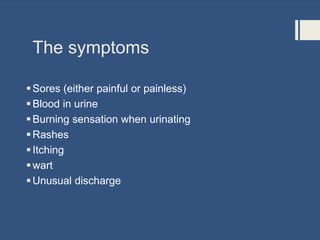
The symptoms
Sores (either painful or painless)
Blood in urine
Burning sensation when urinating
Rashes
Itching
wart
Unusual discharge
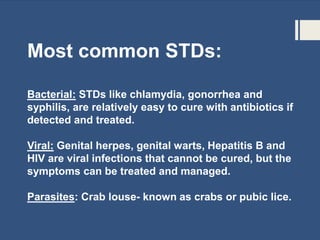
Most common STDs:
Bacterial: STDs like chlamydia, gonorrhea and
syphilis, are relatively easy to cure with antibiotics if
detected and treated.
Viral: Genital herpes, genital warts, Hepatitis B and
HIV are viral infections that cannot be cured, but the
symptoms can be treated and managed.
Parasites: Crab louse- known as crabs or pubic lice.
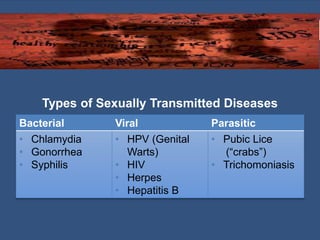
Bacterial Viral Parasitic
• Chlamydia
• Gonorrhea
• Syphilis
• HPV (Genital
Warts)
• HIV
• Herpes
• Hepatitis B
• Pubic Lice
(“crabs”)
• Trichomoniasis
Types of Sexually Transmitted Diseases
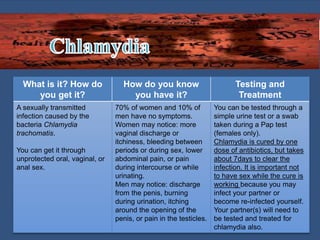
What is it? How do
you get it?
How do you know
you have it?
Testing and
Treatment
A sexually transmitted
infection caused by the
bacteria Chlamydia
trachomatis.
You can get it through
unprotected oral, vaginal, or
anal sex.
70% of women and 10% of
men have no symptoms.
Women may notice: more
vaginal discharge or
itchiness, bleeding between
periods or during sex, lower
abdominal pain, or pain
during intercourse or while
urinating.
Men may notice: discharge
from the penis, burning
during urination, itching
around the opening of the
penis, or pain in the testicles.
You can be tested through a
simple urine test or a swab
taken during a Pap test
(females only).
Chlamydia is cured by one
dose of antibiotics, but takes
about 7days to clear the
infection. It is important not
to have sex while the cure is
working because you may
infect your partner or
become re-infected yourself.
Your partner(s) will need to
be tested and treated for
chlamydia also.
What is it? How do
you get it?
How do you know
you have it?
Testing and
Treatment
A sexually transmitted
infection caused by the
bacteria Neisseria
gonorrhoeae.
You can get it through
unprotected oral, vaginal or
anal sex. It can infect the
penis, rectum, throat, eyes,
and cervix.
You may have this infection
and not even know it.
Women may notice an
increase in vaginal
discharge, bleeding between
periods, bleeding or pain
during sex, pain in the
abdomen or pain while
urinating.
Men may notice burning
while urinating, thick
greenish-yellow discharge
from the penis or pain in the
testicles.
You can be tested through a
simple urine test or a swab
taken during a Pap test
(females only).
It is cured by one dose of
antibiotics, but takes about
7days to clear the infection.
It is important not to have
sex while the cure is working
because you may infect your
partner or become re-
infected yourself. Your
partner(s) will need to be
tested and treated for
chlamydia also.
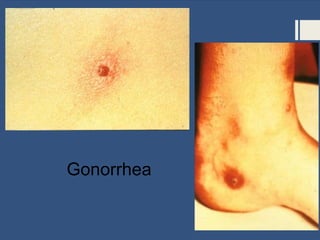
Gonorrhea
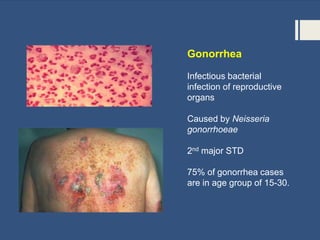
Gonorrhea
Infectious bacterial
infection of reproductive
organs
Caused by Neisseria
gonorrhoeae
2nd major STD
75% of gonorrhea cases
are in age group of 15-30.
What is it? How do
you get it?
How do you know
you have it?
Testing and
Treatment
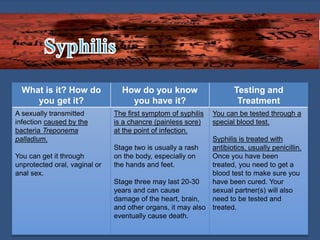
A sexually transmitted
infection caused by the
bacteria Treponema
palladium.
You can get it through
unprotected oral, vaginal or
anal sex.
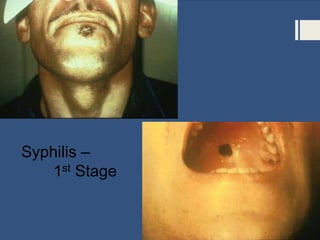
The first symptom of syphilis
is a chancre (painless sore)
at the point of infection.
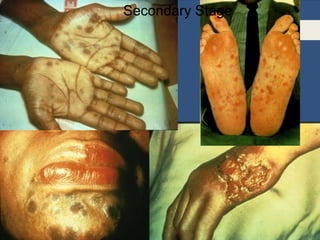
Stage two is usually a rash
on the body, especially on
the hands and feet.
Stage three may last 20-30
years and can cause
damage of the heart, brain,
and other organs, it may also
eventually cause death.
You can be tested through a
special blood test.
Syphilis is treated with
antibiotics, usually penicillin.
Once you have been
treated, you need to get a
blood test to make sure you
have been cured. Your
sexual partner(s) will also
need to be tested and
treated.
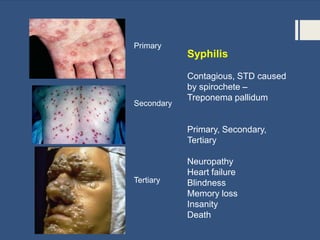
Syphilis
Contagious, STD caused
by spirochete –
Treponema pallidum
Primary, Secondary,
Tertiary
Neuropathy
Heart failure
Blindness
Memory loss
Insanity
Death
Primary
Secondary
Tertiary
Syphilis –
1st Stage
Secondary Stage
What is it? How do
you get it?
How do you know
you have it?
Testing and
Treatment
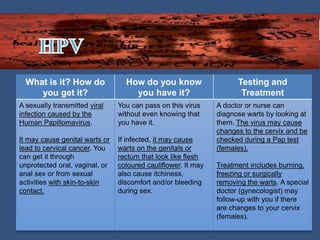
A sexually transmitted viral
infection caused by the
Human Papillomavirus.
It may cause genital warts or
lead to cervical cancer. You
can get it through
unprotected oral, vaginal, or
anal sex or from sexual
activities with skin-to-skin
contact.
You can pass on this virus
without even knowing that
you have it.
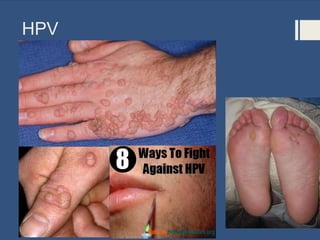
If infected, it may cause
warts on the genitals or
rectum that look like flesh
coloured cauliflower. It may
also cause itchiness,
discomfort and/or bleeding
during sex.
A doctor or nurse can
diagnose warts by looking at
them. The virus may cause
changes to the cervix and be
checked during a Pap test
(females).
Treatment includes burning,
freezing or surgically
removing the warts. A special
doctor (gynecologist) may
follow-up with you if there
are changes to your cervix
(females).
HPV
What is it? How do
you get it?
How do you know
you have it?
Testing and
Treatment
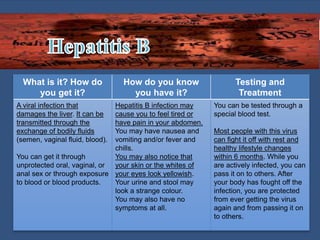
A viral infection that
damages the liver. It can be
transmitted through the
exchange of bodily fluids
(semen, vaginal fluid, blood).
You can get it through
unprotected oral, vaginal, or
anal sex or through exposure
to blood or blood products.
Hepatitis B infection may
cause you to feel tired or
have pain in your abdomen.
You may have nausea and
vomiting and/or fever and
chills.
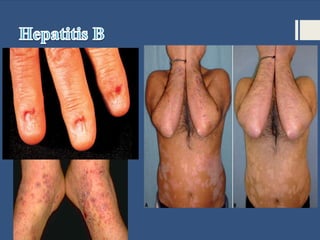
You may also notice that
your skin or the whites of
your eyes look yellowish.
Your urine and stool may
look a strange colour.
You may also have no
symptoms at all.
You can be tested through a
special blood test.
Most people with this virus
can fight it off with rest and
healthy lifestyle changes
within 6 months. While you
are actively infected, you can
pass it on to others. After
your body has fought off the
infection, you are protected
from ever getting the virus
again and from passing it on
to others.
What is it? How do
you get it?
How do you know
you have it?
Testing and
Treatment
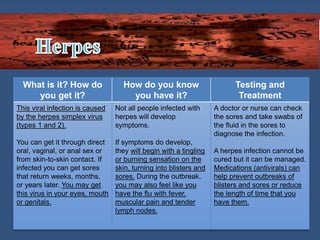
This viral infection is caused
by the herpes simplex virus
(types 1 and 2).
You can get it through direct
oral, vaginal, or anal sex or
from skin-to-skin contact. If
infected you can get sores
that return weeks, months,
or years later. You may get
this virus in your eyes, mouth
or genitals.
Not all people infected with
herpes will develop
symptoms.
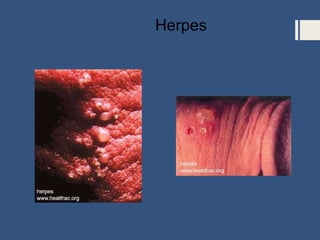
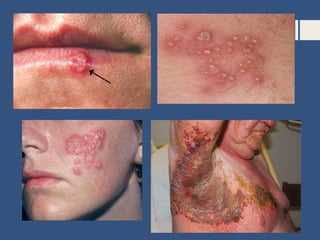
If symptoms do develop,
they will begin with a tingling
or burning sensation on the
skin, turning into blisters and
sores. During the outbreak,
you may also feel like you
have the flu with fever,
muscular pain and tender
lymph nodes.
A doctor or nurse can check
the sores and take swabs of
the fluid in the sores to
diagnose the infection.
A herpes infection cannot be
cured but it can be managed.
Medications (antivirals) can
help prevent outbreaks of
blisters and sores or reduce
the length of time that you
have them.
Herpes
What is it? How do
you get it?
How do you know
you have it?
Testing and
Treatment
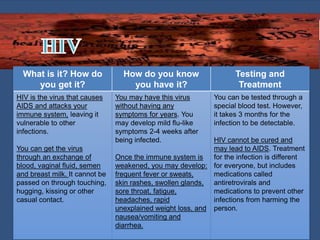
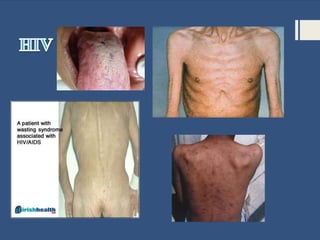
HIV is the virus that causes
AIDS and attacks your
immune system, leaving it
vulnerable to other
infections.
You can get the virus
through an exchange of
blood, vaginal fluid, semen
and breast milk. It cannot be
passed on through touching,
hugging, kissing or other
casual contact.
You may have this virus
without having any
symptoms for years. You
may develop mild flu-like
symptoms 2-4 weeks after
being infected.
Once the immune system is
weakened, you may develop:
frequent fever or sweats,
skin rashes, swollen glands,
sore throat, fatigue,
headaches, rapid
unexplained weight loss, and
nausea/vomiting and
diarrhea.
You can be tested through a
special blood test. However,
it takes 3 months for the
infection to be detectable.
HIV cannot be cured and
may lead to AIDS. Treatment
for the infection is different
for everyone, but includes
medications called
antiretrovirals and
medications to prevent other
infections from harming the
person.
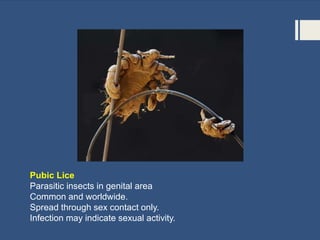
Pubic Lice
Parasitic insects in genital area
Common and worldwide.
Spread through sex contact only.
Infection may indicate sexual activity.
Prevention Of STD’s And STI’s
1. Counseling and behavioral interventions offer primary
prevention against STIs (including HIV), as well as against
unintended pregnancies.
2. Comprehensive sexuality education, STI and HIV pre- and
post-test counseling.
3. Safer sex/risk-reduction counseling, condom promotion.
4. Think about your alcohol and drug use.
Prevention
Abstinence
Know your partner
Limit your partners
Visit your doctor
Always look
Keep clean!
If an infection is detected, it is recommended that
the infected individual and their partner(s) abstain
from sexual activity until treatment is complete,
symptoms have subsided, and the infection is cured
(when applicable).
Remember:
3 million teens contract an STD each year
– some of which have no cure, are a
leading cause of cervical cancer or can
even lead to infertility.
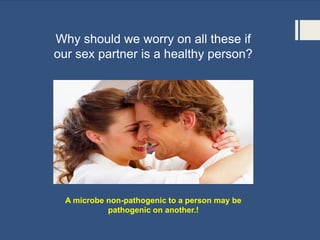
Why should we worry on all these if
our sex partner is a healthy person?
A microbe non-pathogenic to a person may be
pathogenic on another.!
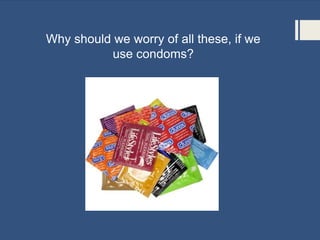
Why should we worry of all these, if we
use condoms?
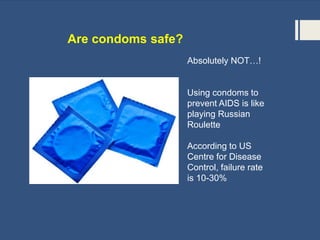
Are condoms safe?
Absolutely NOT…!
Using condoms to
prevent AIDS is like
playing Russian
Roulette
According to US
Centre for Disease
Control, failure rate
is 10-30%
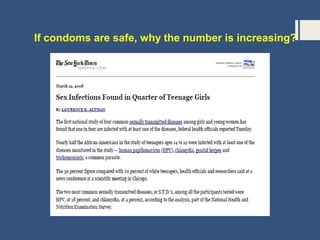
If condoms are safe, why the number is increasing?
If sperms can escape, how much easier for
STDs and Viruses?
“The HIV virus is 50 times smaller than the
sperm and 50 times smaller than the voids in
rubber. Virus can easily pass through condom.”
- Dr. C.M. Ronanld, Editor, Rubber Chemistry and Technology
If we know that if we start the car and it has a
50% chance of exploding and killing whoever is
inside, Will we start the engine?
What about 10% chance?
Teen Years
•A time to study and learn.
•Think about what I will do in the future.
•To develop friendship.
•To grow into the kind of person you want to
be in the future.
Exciting time to discover
the opposite sex.
Dating can be a lot of fun without sex!
Exploring friendship
Right and Wrong
Sextually transmitted diseases

Sextually transmitted diseases

  • 1.
  • 2.
    Introduction Sexually transmitted diseases(STD), also referred to as sexually transmitted infections (STI) and venereal diseases (VD), are illnesses that have a significant probability of transmission between humans by means of sexual behaviour, including vaginal intercourse, anal sex and oral sex. Some STIs can also be contracted by using drug needles after their use by an infected person, as well as through any incident involving the contact of a wound with contaminated blood or through childbirth or breastfeeding.
  • 3.
    Sexually Transmitted Diseases (STDs) Sexually Transmitted Disease (STD) are diseases passed from one person to another during sexual activity.  STDs can be serious, painful and may have long term effects, especially if left undetected and untreated.  They infect your sexual and reproductive organs.
  • 4.
    The symptoms Sores (eitherpainful or painless) Blood in urine Burning sensation when urinating Rashes Itching wart Unusual discharge
  • 5.
    Most common STDs: Bacterial:STDs like chlamydia, gonorrhea and syphilis, are relatively easy to cure with antibiotics if detected and treated. Viral: Genital herpes, genital warts, Hepatitis B and HIV are viral infections that cannot be cured, but the symptoms can be treated and managed. Parasites: Crab louse- known as crabs or pubic lice.
  • 6.
    Bacterial Viral Parasitic •Chlamydia • Gonorrhea • Syphilis • HPV (Genital Warts) • HIV • Herpes • Hepatitis B • Pubic Lice (“crabs”) • Trichomoniasis Types of Sexually Transmitted Diseases
  • 7.
    What is it?How do you get it? How do you know you have it? Testing and Treatment A sexually transmitted infection caused by the bacteria Chlamydia trachomatis. You can get it through unprotected oral, vaginal, or anal sex. 70% of women and 10% of men have no symptoms. Women may notice: more vaginal discharge or itchiness, bleeding between periods or during sex, lower abdominal pain, or pain during intercourse or while urinating. Men may notice: discharge from the penis, burning during urination, itching around the opening of the penis, or pain in the testicles. You can be tested through a simple urine test or a swab taken during a Pap test (females only). Chlamydia is cured by one dose of antibiotics, but takes about 7days to clear the infection. It is important not to have sex while the cure is working because you may infect your partner or become re-infected yourself. Your partner(s) will need to be tested and treated for chlamydia also.
  • 9.
    What is it?How do you get it? How do you know you have it? Testing and Treatment A sexually transmitted infection caused by the bacteria Neisseria gonorrhoeae. You can get it through unprotected oral, vaginal or anal sex. It can infect the penis, rectum, throat, eyes, and cervix. You may have this infection and not even know it. Women may notice an increase in vaginal discharge, bleeding between periods, bleeding or pain during sex, pain in the abdomen or pain while urinating. Men may notice burning while urinating, thick greenish-yellow discharge from the penis or pain in the testicles. You can be tested through a simple urine test or a swab taken during a Pap test (females only). It is cured by one dose of antibiotics, but takes about 7days to clear the infection. It is important not to have sex while the cure is working because you may infect your partner or become re- infected yourself. Your partner(s) will need to be tested and treated for chlamydia also.
  • 10.
  • 11.
    Gonorrhea Infectious bacterial infection ofreproductive organs Caused by Neisseria gonorrhoeae 2nd major STD 75% of gonorrhea cases are in age group of 15-30.
  • 12.
    What is it?How do you get it? How do you know you have it? Testing and Treatment A sexually transmitted infection caused by the bacteria Treponema palladium. You can get it through unprotected oral, vaginal or anal sex. The first symptom of syphilis is a chancre (painless sore) at the point of infection. Stage two is usually a rash on the body, especially on the hands and feet. Stage three may last 20-30 years and can cause damage of the heart, brain, and other organs, it may also eventually cause death. You can be tested through a special blood test. Syphilis is treated with antibiotics, usually penicillin. Once you have been treated, you need to get a blood test to make sure you have been cured. Your sexual partner(s) will also need to be tested and treated.
  • 13.
    Syphilis Contagious, STD caused byspirochete – Treponema pallidum Primary, Secondary, Tertiary Neuropathy Heart failure Blindness Memory loss Insanity Death Primary Secondary Tertiary
  • 14.
  • 15.
  • 16.
    What is it?How do you get it? How do you know you have it? Testing and Treatment A sexually transmitted viral infection caused by the Human Papillomavirus. It may cause genital warts or lead to cervical cancer. You can get it through unprotected oral, vaginal, or anal sex or from sexual activities with skin-to-skin contact. You can pass on this virus without even knowing that you have it. If infected, it may cause warts on the genitals or rectum that look like flesh coloured cauliflower. It may also cause itchiness, discomfort and/or bleeding during sex. A doctor or nurse can diagnose warts by looking at them. The virus may cause changes to the cervix and be checked during a Pap test (females). Treatment includes burning, freezing or surgically removing the warts. A special doctor (gynecologist) may follow-up with you if there are changes to your cervix (females).
  • 17.
  • 18.
    What is it?How do you get it? How do you know you have it? Testing and Treatment A viral infection that damages the liver. It can be transmitted through the exchange of bodily fluids (semen, vaginal fluid, blood). You can get it through unprotected oral, vaginal, or anal sex or through exposure to blood or blood products. Hepatitis B infection may cause you to feel tired or have pain in your abdomen. You may have nausea and vomiting and/or fever and chills. You may also notice that your skin or the whites of your eyes look yellowish. Your urine and stool may look a strange colour. You may also have no symptoms at all. You can be tested through a special blood test. Most people with this virus can fight it off with rest and healthy lifestyle changes within 6 months. While you are actively infected, you can pass it on to others. After your body has fought off the infection, you are protected from ever getting the virus again and from passing it on to others.
  • 20.
    What is it?How do you get it? How do you know you have it? Testing and Treatment This viral infection is caused by the herpes simplex virus (types 1 and 2). You can get it through direct oral, vaginal, or anal sex or from skin-to-skin contact. If infected you can get sores that return weeks, months, or years later. You may get this virus in your eyes, mouth or genitals. Not all people infected with herpes will develop symptoms. If symptoms do develop, they will begin with a tingling or burning sensation on the skin, turning into blisters and sores. During the outbreak, you may also feel like you have the flu with fever, muscular pain and tender lymph nodes. A doctor or nurse can check the sores and take swabs of the fluid in the sores to diagnose the infection. A herpes infection cannot be cured but it can be managed. Medications (antivirals) can help prevent outbreaks of blisters and sores or reduce the length of time that you have them.
  • 21.
  • 23.
    What is it?How do you get it? How do you know you have it? Testing and Treatment HIV is the virus that causes AIDS and attacks your immune system, leaving it vulnerable to other infections. You can get the virus through an exchange of blood, vaginal fluid, semen and breast milk. It cannot be passed on through touching, hugging, kissing or other casual contact. You may have this virus without having any symptoms for years. You may develop mild flu-like symptoms 2-4 weeks after being infected. Once the immune system is weakened, you may develop: frequent fever or sweats, skin rashes, swollen glands, sore throat, fatigue, headaches, rapid unexplained weight loss, and nausea/vomiting and diarrhea. You can be tested through a special blood test. However, it takes 3 months for the infection to be detectable. HIV cannot be cured and may lead to AIDS. Treatment for the infection is different for everyone, but includes medications called antiretrovirals and medications to prevent other infections from harming the person.
  • 26.
    Pubic Lice Parasitic insectsin genital area Common and worldwide. Spread through sex contact only. Infection may indicate sexual activity.
  • 27.
    Prevention Of STD’sAnd STI’s 1. Counseling and behavioral interventions offer primary prevention against STIs (including HIV), as well as against unintended pregnancies. 2. Comprehensive sexuality education, STI and HIV pre- and post-test counseling. 3. Safer sex/risk-reduction counseling, condom promotion. 4. Think about your alcohol and drug use.
  • 28.
    Prevention Abstinence Know your partner Limityour partners Visit your doctor Always look Keep clean!
  • 29.
    If an infectionis detected, it is recommended that the infected individual and their partner(s) abstain from sexual activity until treatment is complete, symptoms have subsided, and the infection is cured (when applicable).
  • 30.
    Remember: 3 million teenscontract an STD each year – some of which have no cure, are a leading cause of cervical cancer or can even lead to infertility.
  • 31.
    Why should weworry on all these if our sex partner is a healthy person? A microbe non-pathogenic to a person may be pathogenic on another.!
  • 32.
    Why should weworry of all these, if we use condoms?
  • 33.
    Are condoms safe? AbsolutelyNOT…! Using condoms to prevent AIDS is like playing Russian Roulette According to US Centre for Disease Control, failure rate is 10-30%
  • 34.
    If condoms aresafe, why the number is increasing?
  • 35.
    If sperms canescape, how much easier for STDs and Viruses? “The HIV virus is 50 times smaller than the sperm and 50 times smaller than the voids in rubber. Virus can easily pass through condom.” - Dr. C.M. Ronanld, Editor, Rubber Chemistry and Technology

  • 37.
    If we knowthat if we start the car and it has a 50% chance of exploding and killing whoever is inside, Will we start the engine? What about 10% chance?
  • 38.
    Teen Years •A timeto study and learn. •Think about what I will do in the future. •To develop friendship. •To grow into the kind of person you want to be in the future.
  • 39.
    Exciting time todiscover the opposite sex.
  • 40.
    Dating can bea lot of fun without sex!
  • 41.
  • 42.