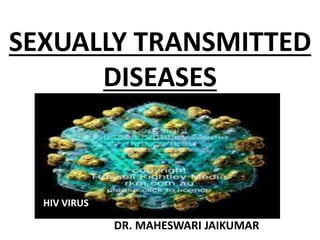
SEXUALLY TRANSMITTED
DISEASES
DR. MAHESWARI JAIKUMAR
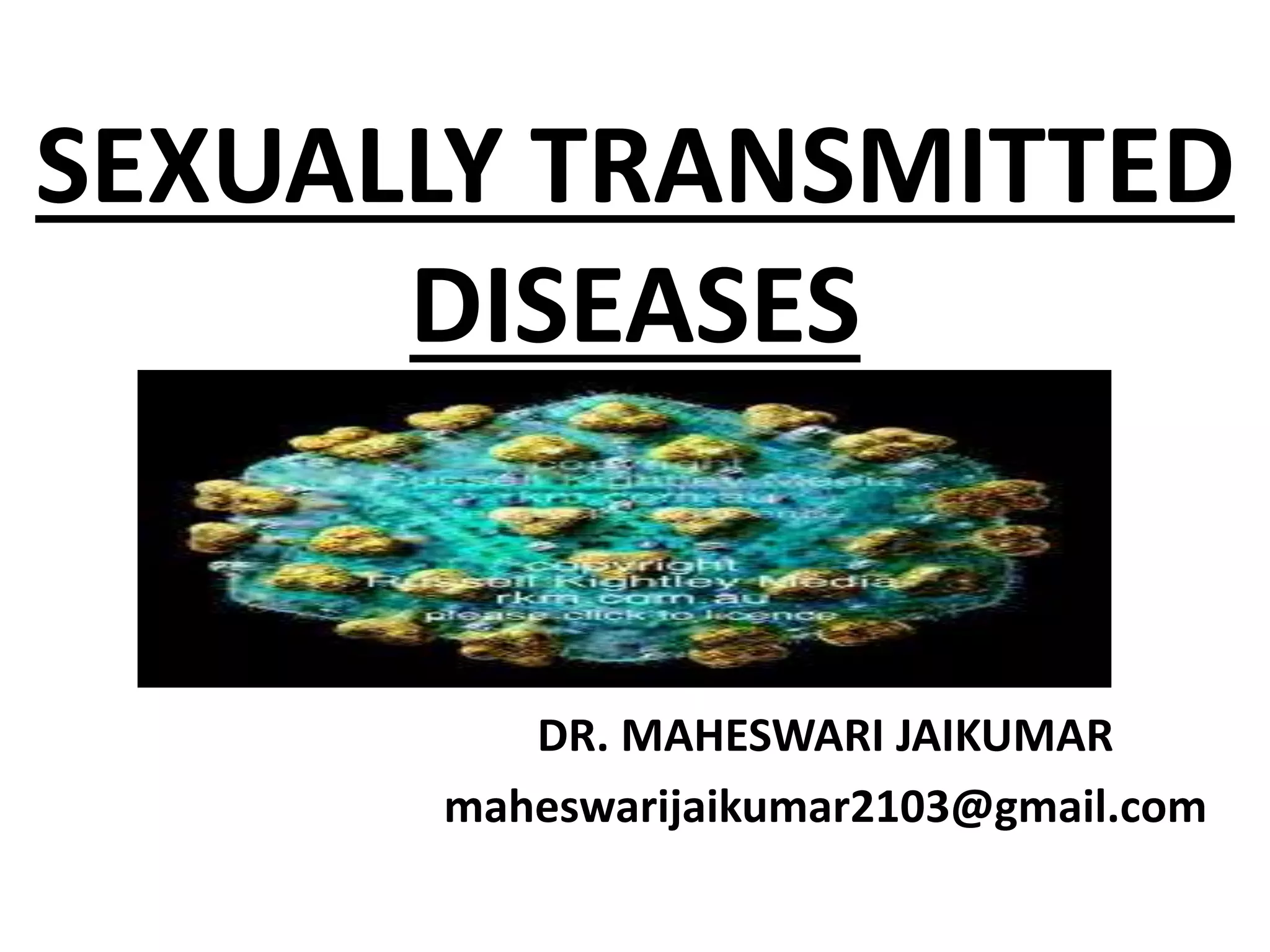
maheswarijaikumar2103@gmail.comHIV VIRUS
DEFINITION
• STD (Sexually Transmitted Disease)
are a group of communicable
diseases that are transmitted
predominantly by sexual contact
and caused by a wide range of
bacterial, viral, protozoal & fungal
agents & ecto parasites
SEXUALLY TRANSMITTED
DISEASES (STDS)
• STDs or STIs (sexually transmitted
infections) are infections/diseases that
can be transferred from one person to
another through sexual contact. In
India, the prevalence of sexually
transmitted diseases is quite high.
Among the sexually transmitted
diseases, AIDS is a serious concern.
• STDs or STIs (sexually transmitted
infections) are infections/diseases that
can be transferred from one person to
another through sexual contact.
• Some of the Sexually Transmitted
Infections are also transmitted through
birth, intravenous needles or
breastfeeding.
• Adolescents and young adults (15-24)
are the age groups at the greatest risk
for acquiring a Sexually Transmitted
Disease (STD). STDs can have severe
consequences if not treated, especially
in women.
• It is important to go for STD testing
whenever you suspect that you have
contracted a sexually transmitted
disease.
CLASSIFICATION OF STD AGENTS
A. BACTERIAL AGENTS.
B. VIRAL AGENTS.
C. PROTOZOAL AGENTS.
D. FUNGAL AGENTS.
E. ECTOPARASITES.
A. BACTERIAL AGENTS:
Nesseria gonorrhoea.
Chlamydia trachomatis.
Haemophilus ducreyi.
Mycoplasma hominis.
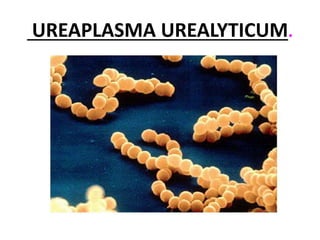
Ureaplasma urealyticum.
Callymmatobacterium granulomatis.
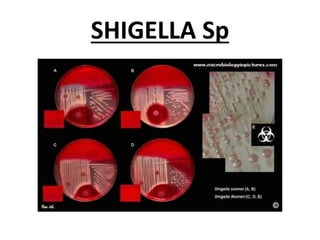
Shigella spp.
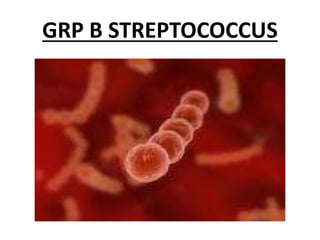
Grp B steptococcus.
Bacteial vaginitis associated organisms.
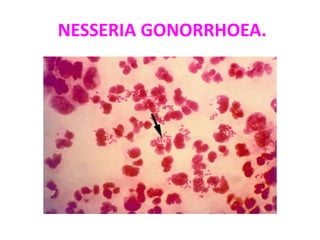
NESSERIA GONORRHOEA.
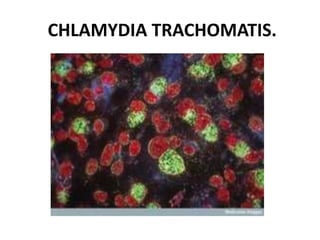
CHLAMYDIA TRACHOMATIS.
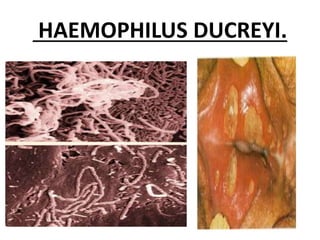
HAEMOPHILUS DUCREYI.
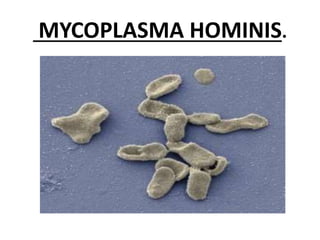
MYCOPLASMA HOMINIS.
UREAPLASMA UREALYTICUM.
SHIGELLA Sp
GRP B STREPTOCOCCUS
VIRAL AGENTS.
• Human (alpha) Herpes virus.
• Human (beta) Herpes virus.
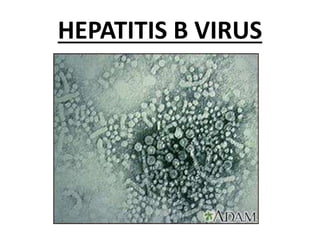
• Hepatitis B virus.
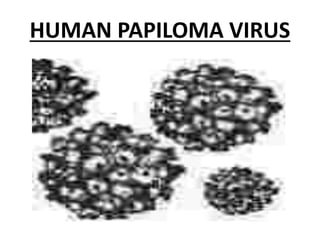
• Human Papilloma Virus.
• Molluscum contagiosum virus.
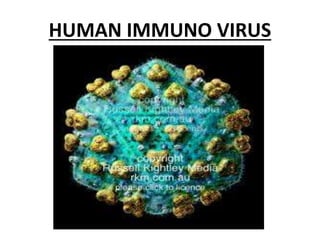
• Human Immunodeficiency virus.
HEPATITIS B VIRUS
HUMAN PAPILOMA VIRUS
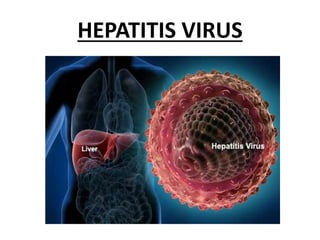
HEPATITIS VIRUS
HUMAN IMMUNO VIRUS
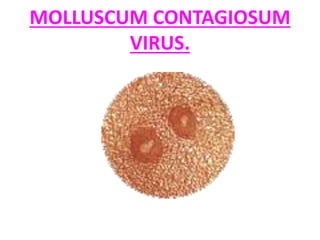
MOLLUSCUM CONTAGIOSUM
VIRUS.
PROTOZOAL AGENTS.
• Entamoeba histolytica.
• Giardia lamblia.
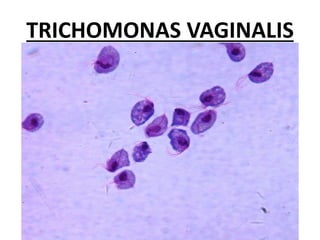
• Trichomonas vaginalis
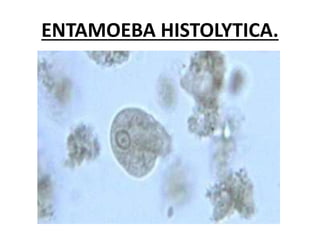
ENTAMOEBA HISTOLYTICA.
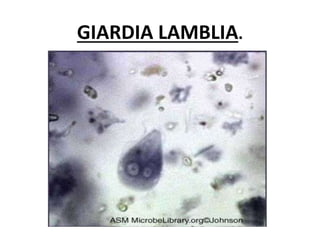
GIARDIA LAMBLIA.
TRICHOMONAS VAGINALIS
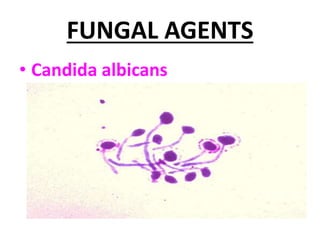
FUNGAL AGENTS
• Candida albicans
ECTOPARASITES.
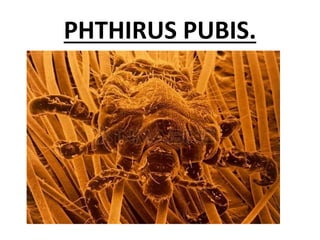
• Phthirus pubis.
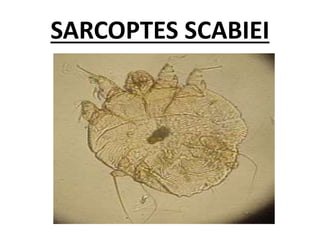
• Sarcoptes scabiei
PHTHIRUS PUBIS.
SARCOPTES SCABIEI
EXTENT OF THE PROBLEM
WORLD:
• True incidence will never be known
not only due to inadequate
reporting but also because of the
secrecy that surrounds them.
• Most of them are not even
notifiable.
INDIA
STD is becoming a major public
health problem in India.
SYPHILIS
2011 – About 37,243 cases
(19,032 males/18,211 females)
were reported in the country
with two deaths.
GONORRHOEA
Information is notoriously lacking as
most cases are not reported.
Generally gonorrhoea is widely
prevalent than syphilis.
2011- About 2,50,155 cases (56,386
males/93,769 female) were
reported with 3 deaths.
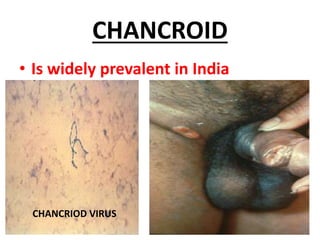
CHANCROID
• Is widely prevalent in India
CHANCRIOD VIRUS
LGV
• Is more prevalent in southern
states of Tamil Nadu, Andra
Pradesh, Maharastra &
Karnataka
DONOVANOSIS
• Is endemic in Tamil Nadu, Andra
Pradesh, Odisha, Karnataka &
Maharashtra.
• A greater prevalence along coastal
areas has been reported.
OTHER STDs
Information is not available, as
there is no reporting system for
these diseases.
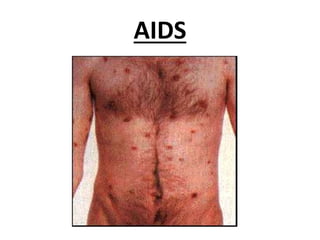
AIDS
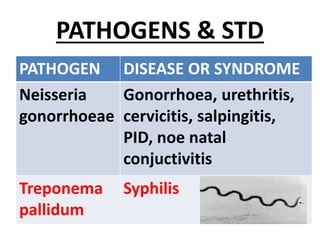
PATHOGENS & STD
PATHOGEN DISEASE OR SYNDROME
Neisseria
gonorrhoeae
Gonorrhoea, urethritis,
cervicitis, salpingitis,
PID, noe natal
conjuctivitis
Treponema
pallidum
Syphilis
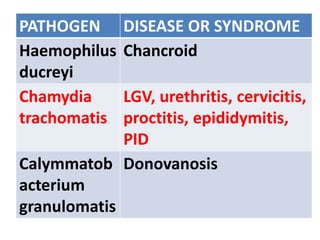
PATHOGEN DISEASE OR SYNDROME
Haemophilus
ducreyi
Chancroid
Chamydia
trachomatis
LGV, urethritis, cervicitis,
proctitis, epididymitis,
PID
Calymmatob
acterium
granulomatis
Donovanosis
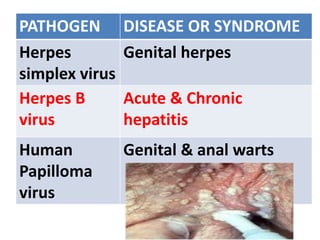
PATHOGEN DISEASE OR SYNDROME
Herpes
simplex virus
Genital herpes
Herpes B
virus
Acute & Chronic
hepatitis
Human
Papilloma
virus
Genital & anal warts
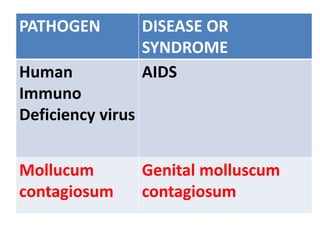
PATHOGEN DISEASE OR
SYNDROME
Human
Immuno
Deficiency virus
AIDS
Mollucum
contagiosum
Genital molluscum
contagiosum
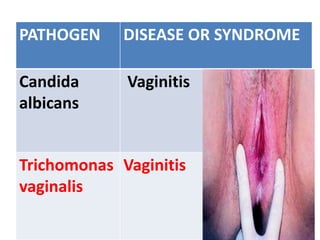
PATHOGEN DISEASE OR SYNDROME
Candida
albicans
Vaginitis
Trichomonas
vaginalis
Vaginitis
HOST FACTORS
• AGE: Highest rate are prevalent in 20-24
yers old & followed by 25-29 & 15-19
years age groups.
• GENDER: Morbidity is higher in men.
• MARITAL STATUS : Higher among single,
divorced and separated persons than
among married couples
• SOCIO ECONOMIC STATUS:
Individuals from the lowest socio
economic groups have the highest
morbidity rates
DEMOGRAPHIC FACTORS
Certain demographic factors contribute
to a higher prevalence rates. They are;
1. Population explosion.
2. Rural to Urban migration.
3. Increasing educational opportunities
for women.
4. Delayed marriage due to the afore said.
SOCIAL FACTORS
1. Prostitution (good time girl).
2. Broken homes.
3. Sexual disharmony.
4. Easy money.
5. Emotional immaturity.
6. Urbanization.
7. International travel.
8. Changing behavioural patterns.
10. Alcoholism.
CLINICAL
SPRECTRUM
GONOCOCCAL INFECTION
• Causes inflammation of the
genital tract involving urethra in
men & women and rectum
among homosexuals.
• Other sites are throat & eyes.
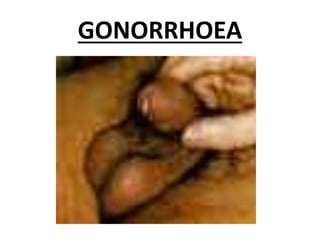
GONORRHOEA
• Complications in women include PID
(infertility).
• In men it may lead to epididymitis
(urethral strictures).
• The antibiotics of choice are
CIPROFLAXIN, CEFTRIAXONE,
CEFIXIME or SEPTINOMYCIN.
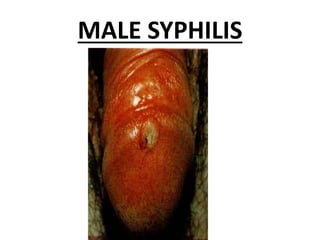
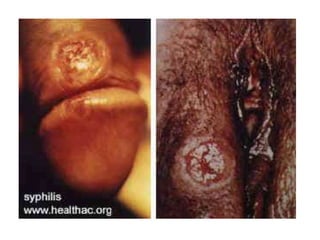
SYPHILIS
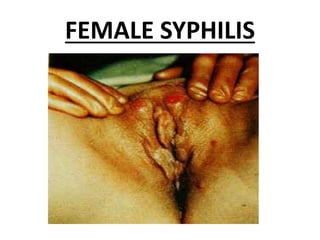
• Causes ulceration of the uro genital
tract, mouth or rectum.
• Later skin eruptions may be seen.
• Final stage is marked with
complications of CVS, Nervous
system.
• Congenital syphilis is an
important cause for still birth.
• Penicillin, doxycycline and
eryhtromycin are drug of choice.
FEMALE SYPHILIS
MALE SYPHILIS
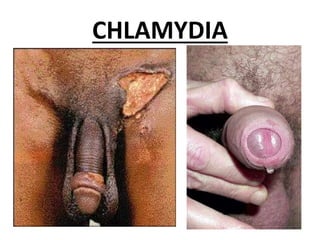
CHLAMYDIAL INFECTION
• Individuals may not exhibit clinical
manifestations.
• The symptoms mimic like
gonorrhoea.
• It can result in vertical transmission
to the foetus.
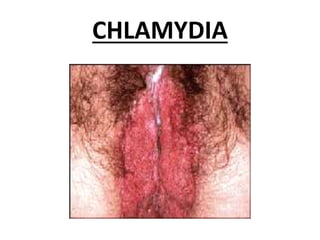
CHLAMYDIA
CHLAMYDIA
• The drug of choice include
doxycycline, azithromycin /
amoxycillin, ofloxacin, erythromycin
or tetracycline.
TRICHOMONIASIS
• The parasitic infection leads to
vaginitis & vaginal discharge in
women.
• Usually there are no symptoms. In
men it may cause urethritis.
• The treatment option is metronidazole
/ tinidazole.
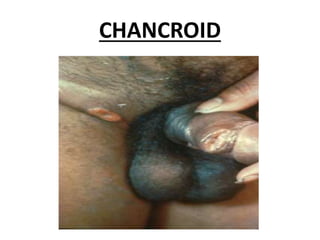
CHANCRIOD
• After infection a small papule
develops at the site of inoculation
within 2-3 days.
• The lesion then erodes into a deep
ulcer that is extremely painful.
• This is followed by painful swelling of
the inguinal lymph node (BUBO).
CHANCROID
• The antibiotics used are
ciprofloxacin, erythromycin,
ciftriaxone and azithromycin.
LGV
• It commonly presents with swelling
of lymph nodes in the groin.
• Initially there is a small painless
ulcer of the genitalia 3-30 days after
exposure.
• It may pass unrecognized and
resolve spontaneously.
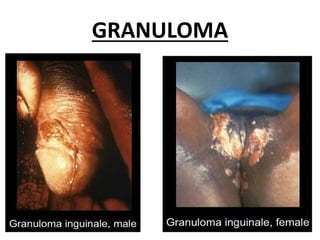
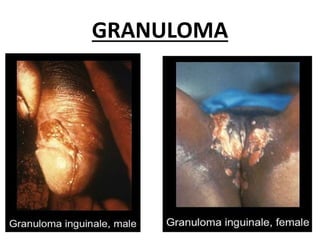
GRANULOMA
• If left untreated the disease may cause
extensive lymphatic damage resulting in
elephantiasis of the genitalia.
• The antibiotics used are doxycycline,
erythromycin & tetracycline.
• Later it may cause rectal strictures
(surgery required)
DONOVANOSIS
• Symptoms are similar togranuloma
venereum.
• The first manifestation appears after a
3-40 days incubation period.
• Usually it is a small papule which
ruptures to form a granulomatous lesion
that is characteristically pain free &
bleeds readily on contact.
GRANULOMA
• The drug used are azithromycin
& doxy or alternatively
erythromycin, tetracycline,
trimethoprim-sulfamthoxazole.
GENITAL HERPES
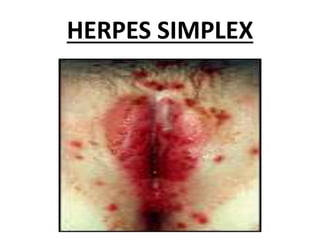
• HSV type 2 is the primary cause of
genital herpes.
• It can be recognized by presence of
typical papular lesions that progress to
multiple blisters & ulcers.
• The first manifestations are frequently
associated with a prolonged course of
ulceration lasting to 3-4 wks
HERPES SIMPLEX
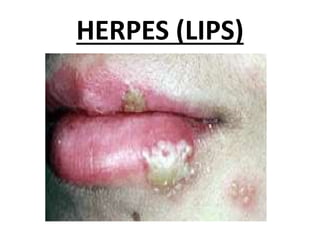
HERPES (LIPS)
• Anti virals such as acyclovir
valaciclovir and famiclovir are
effective.
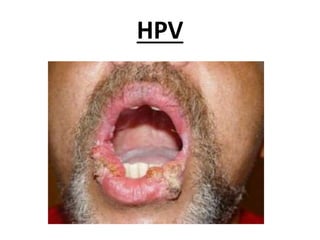
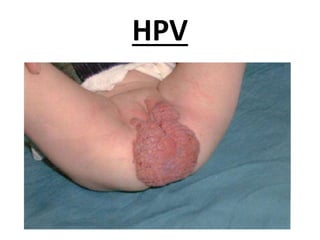
HPV
• Causes genital warts, which vary from
the common soft, flesh coloured
protuberances which may become
exuberant (cauliflower like) to papular
flat warts on drier areas (shaft of the
penis).
• Can cause cervical cancer in women.
HPV
HPV
• Prevention is the drug of choice.
(sexually active individuals)
STD CONTROL PROGRAMME
• National STD Control Programme in
India was started in 1946. With the
arrival spread of HIV infection in the
country it was brought under the
purview of National AIDS
Organization in the year 1992.
OBJECTIVES OF STD CONTROL
PROGRAMME (INDIA)
1.Reduce STD cases and thereby
control HIV transmission by
minimizing the risk factor
2. Prevent the short term as well as
long term morbidity and mortality
due to STD
STRATEGIES
• The broad strategies for
controlling STD, as outlined in
the strategic plan for the
prevention and control of AIDS
in India are the following:
• Adequate and effective programme
management
• Prevention of the transmission of
STD/HIV infection through IEC and
promotion of safer sexual behaviour
by the use of condoms.
• Adequate and comprehensive case
management including diagnosis,
treatment, individual counseling,
partner notification and screening for
other diseases.
• Increasing access to health care for STD
by strengthening existing facilities and
structures and creating new facilities
wherever necessary.
• Early diagnosis and treatment of
mostly asymptomatic infections
through case finding and screening.
ACTIONS
• Training of health care workers in
both public and private sectors in
comprehensive STD case
management.
• Development of appropriate
laboratory services for the diagnosis
of STD
• Conduct of Microbiological,
Socio-behavioural and Operation
research.
• Surveillance to assess the
epidemiological situation, and
monitor and� evaluate the on
going STD control programme.
• One of the major actions taken
along the lines suggested in the
strategies was strengthening the
existing facilities and structure of
STD clinics.
• This year following drugs are supplied to
the STD clinics other than the usual.
• Erythromycin 500 mg Tabs.
• Doxycycline caps 100 mg
• Norfloxacin 400 mg Tabs
• Fluconazole 150 mg tabs
• Clotrimzole Vag Tab 500 mg
• Acyclovir cream 5 mg tubes
AIDS
REFER AIDS CONTROL
PROGRAMME IN INDIA
CONTROL OF STDs
INVOLVES FOUR STEPS:
1. Initial planning.
2. Intervention strategies.
3. Support components.
4. Monitoring and evaluation.
INITIAL PLANNING
COMPRISES OF THE FOLLOWING STEPS:
1. Problem definition.
2. Establishing priorities.
3. Setting objectives.
4. Considering strategies.
INTERVENTION STRATEGIES
INCLUDES:
1. Case detection (Screening, contract
tracing, cluster testing).
2. Case holding and treatment.
3. Epidemiological treatment(contact
treatment)
4. Personal prophylaxis.
5. Health education
SUPPORT COMPONENTS
INCLUDE:
1. Establishing of STD clinics.
2. Laboratory services.
3. Primary Health Care.
4. Information System.
5. Legislation.
6. Social Welfare Measures. (Socio
therapy)
SOCIAL WELFARE MEASURES
1.Rehabilitation of Commercial Sex
Workers.
2. Provision of recreation facilities.
3. Marriage counselling.
4. Prohibiting Sexually stimulating
literature.
5. Prohibition of pornography
(Advertisements & Photographs).
MONITORING & EVALUATION
THIS CRITICAL ASPECT INCLUDES:
1. Monitoring of disease trends.
2. Evaluation of programme activities.
3. On going evaluation of the disease.
4. Determining the appropriateness of
intervention strategies.
SEXUALLY TRANSMITTED
DISEASES
DR. MAHESWARI JAIKUMAR
HIV VIRUS

SEXUALLY TRANSMITTED DISEASES

  • 1.
    SEXUALLY TRANSMITTED DISEASES DR. MAHESWARIJAIKUMAR maheswarijaikumar2103@gmail.comHIV VIRUS
  • 2.
    DEFINITION • STD (SexuallyTransmitted Disease) are a group of communicable diseases that are transmitted predominantly by sexual contact and caused by a wide range of bacterial, viral, protozoal & fungal agents & ecto parasites
  • 3.
    SEXUALLY TRANSMITTED DISEASES (STDS) •STDs or STIs (sexually transmitted infections) are infections/diseases that can be transferred from one person to another through sexual contact. In India, the prevalence of sexually transmitted diseases is quite high. Among the sexually transmitted diseases, AIDS is a serious concern.
  • 4.
    • STDs orSTIs (sexually transmitted infections) are infections/diseases that can be transferred from one person to another through sexual contact. • Some of the Sexually Transmitted Infections are also transmitted through birth, intravenous needles or breastfeeding.
  • 5.
    • Adolescents andyoung adults (15-24) are the age groups at the greatest risk for acquiring a Sexually Transmitted Disease (STD). STDs can have severe consequences if not treated, especially in women. • It is important to go for STD testing whenever you suspect that you have contracted a sexually transmitted disease.
  • 6.
    CLASSIFICATION OF STDAGENTS A. BACTERIAL AGENTS. B. VIRAL AGENTS. C. PROTOZOAL AGENTS. D. FUNGAL AGENTS. E. ECTOPARASITES.
  • 7.
    A. BACTERIAL AGENTS: Nesseriagonorrhoea. Chlamydia trachomatis. Haemophilus ducreyi. Mycoplasma hominis. Ureaplasma urealyticum. Callymmatobacterium granulomatis. Shigella spp. Grp B steptococcus. Bacteial vaginitis associated organisms.
  • 8.
  • 9.
  • 10.
  • 11.
  • 12.
  • 13.
  • 14.
  • 15.
    VIRAL AGENTS. • Human(alpha) Herpes virus. • Human (beta) Herpes virus. • Hepatitis B virus. • Human Papilloma Virus. • Molluscum contagiosum virus. • Human Immunodeficiency virus.
  • 16.
  • 17.
  • 18.
  • 19.
  • 20.
  • 21.
    PROTOZOAL AGENTS. • Entamoebahistolytica. • Giardia lamblia. • Trichomonas vaginalis
  • 22.
  • 23.
  • 24.
  • 25.
  • 26.
  • 27.
  • 28.
  • 29.
    EXTENT OF THEPROBLEM WORLD: • True incidence will never be known not only due to inadequate reporting but also because of the secrecy that surrounds them. • Most of them are not even notifiable.
  • 30.
    INDIA STD is becominga major public health problem in India.
  • 31.
    SYPHILIS 2011 – About37,243 cases (19,032 males/18,211 females) were reported in the country with two deaths.
  • 32.
    GONORRHOEA Information is notoriouslylacking as most cases are not reported. Generally gonorrhoea is widely prevalent than syphilis. 2011- About 2,50,155 cases (56,386 males/93,769 female) were reported with 3 deaths.
  • 33.
    CHANCROID • Is widelyprevalent in India CHANCRIOD VIRUS
  • 34.
    LGV • Is moreprevalent in southern states of Tamil Nadu, Andra Pradesh, Maharastra & Karnataka
  • 35.
    DONOVANOSIS • Is endemicin Tamil Nadu, Andra Pradesh, Odisha, Karnataka & Maharashtra. • A greater prevalence along coastal areas has been reported.
  • 36.
    OTHER STDs Information isnot available, as there is no reporting system for these diseases.
  • 37.
  • 38.
    PATHOGENS & STD PATHOGENDISEASE OR SYNDROME Neisseria gonorrhoeae Gonorrhoea, urethritis, cervicitis, salpingitis, PID, noe natal conjuctivitis Treponema pallidum Syphilis
  • 39.
    PATHOGEN DISEASE ORSYNDROME Haemophilus ducreyi Chancroid Chamydia trachomatis LGV, urethritis, cervicitis, proctitis, epididymitis, PID Calymmatob acterium granulomatis Donovanosis
  • 40.
    PATHOGEN DISEASE ORSYNDROME Herpes simplex virus Genital herpes Herpes B virus Acute & Chronic hepatitis Human Papilloma virus Genital & anal warts
  • 41.
    PATHOGEN DISEASE OR SYNDROME Human Immuno Deficiencyvirus AIDS Mollucum contagiosum Genital molluscum contagiosum
  • 42.
    PATHOGEN DISEASE ORSYNDROME Candida albicans Vaginitis Trichomonas vaginalis Vaginitis
  • 43.
    HOST FACTORS • AGE:Highest rate are prevalent in 20-24 yers old & followed by 25-29 & 15-19 years age groups. • GENDER: Morbidity is higher in men. • MARITAL STATUS : Higher among single, divorced and separated persons than among married couples
  • 44.
    • SOCIO ECONOMICSTATUS: Individuals from the lowest socio economic groups have the highest morbidity rates
  • 45.
    DEMOGRAPHIC FACTORS Certain demographicfactors contribute to a higher prevalence rates. They are; 1. Population explosion. 2. Rural to Urban migration. 3. Increasing educational opportunities for women. 4. Delayed marriage due to the afore said.
  • 46.
    SOCIAL FACTORS 1. Prostitution(good time girl). 2. Broken homes. 3. Sexual disharmony. 4. Easy money. 5. Emotional immaturity. 6. Urbanization. 7. International travel. 8. Changing behavioural patterns. 10. Alcoholism.
  • 47.
  • 48.
    GONOCOCCAL INFECTION • Causesinflammation of the genital tract involving urethra in men & women and rectum among homosexuals. • Other sites are throat & eyes.
  • 49.
  • 50.
    • Complications inwomen include PID (infertility). • In men it may lead to epididymitis (urethral strictures). • The antibiotics of choice are CIPROFLAXIN, CEFTRIAXONE, CEFIXIME or SEPTINOMYCIN.
  • 51.
    SYPHILIS • Causes ulcerationof the uro genital tract, mouth or rectum. • Later skin eruptions may be seen. • Final stage is marked with complications of CVS, Nervous system.
  • 52.
    • Congenital syphilisis an important cause for still birth. • Penicillin, doxycycline and eryhtromycin are drug of choice.
  • 53.
  • 54.
  • 56.
    CHLAMYDIAL INFECTION • Individualsmay not exhibit clinical manifestations. • The symptoms mimic like gonorrhoea. • It can result in vertical transmission to the foetus.
  • 57.
  • 58.
  • 59.
    • The drugof choice include doxycycline, azithromycin / amoxycillin, ofloxacin, erythromycin or tetracycline.
  • 60.
    TRICHOMONIASIS • The parasiticinfection leads to vaginitis & vaginal discharge in women. • Usually there are no symptoms. In men it may cause urethritis. • The treatment option is metronidazole / tinidazole.
  • 61.
    CHANCRIOD • After infectiona small papule develops at the site of inoculation within 2-3 days. • The lesion then erodes into a deep ulcer that is extremely painful. • This is followed by painful swelling of the inguinal lymph node (BUBO).
  • 62.
  • 63.
    • The antibioticsused are ciprofloxacin, erythromycin, ciftriaxone and azithromycin.
  • 64.
    LGV • It commonlypresents with swelling of lymph nodes in the groin. • Initially there is a small painless ulcer of the genitalia 3-30 days after exposure. • It may pass unrecognized and resolve spontaneously.
  • 65.
  • 66.
    • If leftuntreated the disease may cause extensive lymphatic damage resulting in elephantiasis of the genitalia. • The antibiotics used are doxycycline, erythromycin & tetracycline. • Later it may cause rectal strictures (surgery required)
  • 67.
    DONOVANOSIS • Symptoms aresimilar togranuloma venereum. • The first manifestation appears after a 3-40 days incubation period. • Usually it is a small papule which ruptures to form a granulomatous lesion that is characteristically pain free & bleeds readily on contact.
  • 68.
  • 69.
    • The drugused are azithromycin & doxy or alternatively erythromycin, tetracycline, trimethoprim-sulfamthoxazole.
  • 70.
    GENITAL HERPES • HSVtype 2 is the primary cause of genital herpes. • It can be recognized by presence of typical papular lesions that progress to multiple blisters & ulcers. • The first manifestations are frequently associated with a prolonged course of ulceration lasting to 3-4 wks
  • 71.
  • 72.
  • 73.
    • Anti viralssuch as acyclovir valaciclovir and famiclovir are effective.
  • 74.
    HPV • Causes genitalwarts, which vary from the common soft, flesh coloured protuberances which may become exuberant (cauliflower like) to papular flat warts on drier areas (shaft of the penis). • Can cause cervical cancer in women.
  • 75.
  • 76.
  • 77.
    • Prevention isthe drug of choice. (sexually active individuals)
  • 78.
    STD CONTROL PROGRAMME •National STD Control Programme in India was started in 1946. With the arrival spread of HIV infection in the country it was brought under the purview of National AIDS Organization in the year 1992.
  • 79.
    OBJECTIVES OF STDCONTROL PROGRAMME (INDIA) 1.Reduce STD cases and thereby control HIV transmission by minimizing the risk factor 2. Prevent the short term as well as long term morbidity and mortality due to STD
  • 80.
    STRATEGIES • The broadstrategies for controlling STD, as outlined in the strategic plan for the prevention and control of AIDS in India are the following:
  • 81.
    • Adequate andeffective programme management • Prevention of the transmission of STD/HIV infection through IEC and promotion of safer sexual behaviour by the use of condoms.
  • 82.
    • Adequate andcomprehensive case management including diagnosis, treatment, individual counseling, partner notification and screening for other diseases. • Increasing access to health care for STD by strengthening existing facilities and structures and creating new facilities wherever necessary.
  • 83.
    • Early diagnosisand treatment of mostly asymptomatic infections through case finding and screening.
  • 84.
    ACTIONS • Training ofhealth care workers in both public and private sectors in comprehensive STD case management. • Development of appropriate laboratory services for the diagnosis of STD
  • 85.
    • Conduct ofMicrobiological, Socio-behavioural and Operation research. • Surveillance to assess the epidemiological situation, and monitor and� evaluate the on going STD control programme.
  • 86.
    • One ofthe major actions taken along the lines suggested in the strategies was strengthening the existing facilities and structure of STD clinics.
  • 87.
    • This yearfollowing drugs are supplied to the STD clinics other than the usual. • Erythromycin 500 mg Tabs. • Doxycycline caps 100 mg • Norfloxacin 400 mg Tabs • Fluconazole 150 mg tabs • Clotrimzole Vag Tab 500 mg • Acyclovir cream 5 mg tubes
  • 88.
  • 89.
    CONTROL OF STDs INVOLVESFOUR STEPS: 1. Initial planning. 2. Intervention strategies. 3. Support components. 4. Monitoring and evaluation.
  • 90.
    INITIAL PLANNING COMPRISES OFTHE FOLLOWING STEPS: 1. Problem definition. 2. Establishing priorities. 3. Setting objectives. 4. Considering strategies.
  • 91.
    INTERVENTION STRATEGIES INCLUDES: 1. Casedetection (Screening, contract tracing, cluster testing). 2. Case holding and treatment. 3. Epidemiological treatment(contact treatment)
  • 92.
  • 93.
    SUPPORT COMPONENTS INCLUDE: 1. Establishingof STD clinics. 2. Laboratory services. 3. Primary Health Care. 4. Information System. 5. Legislation. 6. Social Welfare Measures. (Socio therapy)
  • 94.
    SOCIAL WELFARE MEASURES 1.Rehabilitationof Commercial Sex Workers. 2. Provision of recreation facilities. 3. Marriage counselling. 4. Prohibiting Sexually stimulating literature. 5. Prohibition of pornography (Advertisements & Photographs).
  • 95.
    MONITORING & EVALUATION THISCRITICAL ASPECT INCLUDES: 1. Monitoring of disease trends. 2. Evaluation of programme activities. 3. On going evaluation of the disease. 4. Determining the appropriateness of intervention strategies.
  • 96.