


By : Mahalatchmy Tamil Selvan
012012100321
MAHALATCHMY TAMIL SELVAN 012012100321
SYPHILIS
OUTLINES
o Introduction
o Causative Agent
o Identification
o Occurence
o Reservoir of infection
o Mode of transmission
o References
INTRODUCTION
o Syphilis is one type of sexually
transmitted disease.
o A chronic bacterial disease that is
contracted chiefly by infection
during sexual intercourse, but also
congenitally by infection of a
developing fetus.
CAUSATIVE AGENT
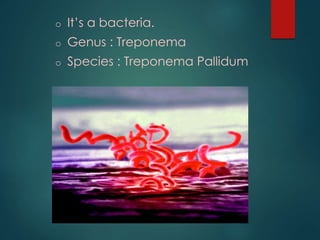
o Treponema pallidum is the causative
agent of syphilis.
o T. pallidum is a thin, elongated (0.10 to
0.18 um) bacterium that cannot be
readily visualized by light microscopy,
instead requiring visualization by darkfield
microscopy, which uses obliquely applied
light.
o It’s a bacteria.
o Genus : Treponema
o Species : Treponema Pallidum
IDENTIFICATION
.
OCCURENCE
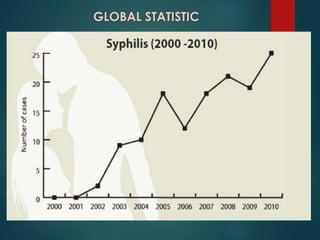
o The disease is worldwide in distribution.
o Globally an estimated 12 million new cases
of syphilis arise each year according to the
World Health Organization, most of which
occur in developing countries.
o Because of a lack of antibiotic treatment
and prenatal testing, congenital syphilis is
especially raising alarm in these developing
countries.
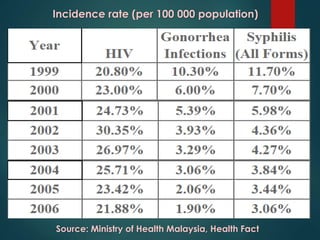
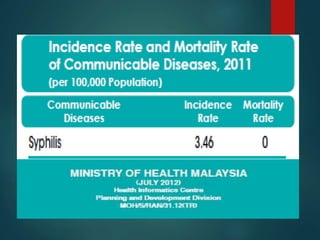
Incidence rate (per 100 000 population)
Source: Ministry of Health Malaysia, Health Fact
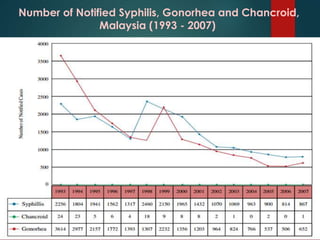
Number of Notified Syphilis, Gonorhea and Chancroid,
Malaysia (1993 - 2007)
GLOBAL STATISTIC
RESERVOIR OF INFECTION
o Humans are the only type of reservoir
for T. pallidum or syphilis.
o Syphilis cannot be spread by a non-
living reservoir, such as toilet seats,
swimming pools, or eating utensils.
MODE OF TRANSMISSION
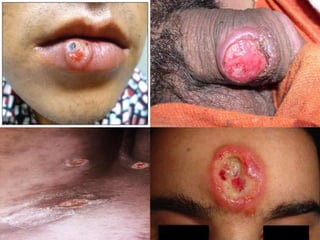
o Person to person by direct contact with a
syphilitic sore, known as a CHANCRE.
Chancres occur mainly on the external
genitals, vagina, anus, or in the rectum.
Chancres also can occur on the lips and in
the mouth.
o Transmission of syphilis occurs during vaginal,
anal, or oral sex.
o Pregnant women with disease can transmit
it to their unborn child.
o It is also transmissible by sexual contact with
infectious lesions, from mother to fetus in
uterus, via blood product transfusion, and
occasionally through breaks in the skin that
come into contact with infectious lesions.
o
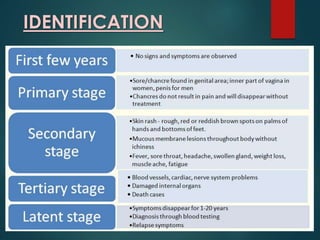
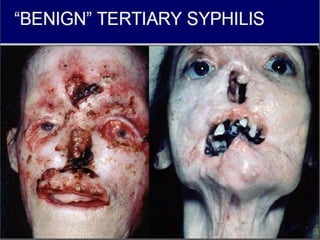
o If untreated, it progresses through 4 stages:
primary, secondary, latent, and tertiary.
REFERENCES
o http://apps.who.int/iris/bitstream/10665/75181/1/97
89241503839_eng.pdf (WHO)
o http://www.cdc.gov/std/stats07/syphilis.htm#a7
(CDC)
o http://www.slideshare.net/leorezzneri/syphilis-
disease?qid=79e2c361-a7f3-41ce-9d58-
e92745c098f8&v=default&b=&from_search=4
o http://www.austincc.edu/microbio/2421b/tp1.htm
o https://micpohling.wordpress.com/2008/04/02/mal
aysia-health-statistic-hiv-gonorrhea-syphilis/
Sexually transmitted disease by maha

Sexually transmitted disease by maha

  • 1.
    By : MahalatchmyTamil Selvan 012012100321
  • 2.
    MAHALATCHMY TAMIL SELVAN012012100321 SYPHILIS
  • 3.
    OUTLINES o Introduction o CausativeAgent o Identification o Occurence o Reservoir of infection o Mode of transmission o References
  • 4.
    INTRODUCTION o Syphilis isone type of sexually transmitted disease. o A chronic bacterial disease that is contracted chiefly by infection during sexual intercourse, but also congenitally by infection of a developing fetus.
  • 5.
    CAUSATIVE AGENT o Treponemapallidum is the causative agent of syphilis. o T. pallidum is a thin, elongated (0.10 to 0.18 um) bacterium that cannot be readily visualized by light microscopy, instead requiring visualization by darkfield microscopy, which uses obliquely applied light.
  • 6.
    o It’s abacteria. o Genus : Treponema o Species : Treponema Pallidum
  • 7.
  • 10.
  • 11.
    OCCURENCE o The diseaseis worldwide in distribution. o Globally an estimated 12 million new cases of syphilis arise each year according to the World Health Organization, most of which occur in developing countries. o Because of a lack of antibiotic treatment and prenatal testing, congenital syphilis is especially raising alarm in these developing countries.
  • 12.
    Incidence rate (per100 000 population) Source: Ministry of Health Malaysia, Health Fact
  • 13.
    Number of NotifiedSyphilis, Gonorhea and Chancroid, Malaysia (1993 - 2007)
  • 14.
  • 16.
    RESERVOIR OF INFECTION oHumans are the only type of reservoir for T. pallidum or syphilis. o Syphilis cannot be spread by a non- living reservoir, such as toilet seats, swimming pools, or eating utensils.
  • 17.
    MODE OF TRANSMISSION oPerson to person by direct contact with a syphilitic sore, known as a CHANCRE. Chancres occur mainly on the external genitals, vagina, anus, or in the rectum. Chancres also can occur on the lips and in the mouth. o Transmission of syphilis occurs during vaginal, anal, or oral sex.
  • 18.
    o Pregnant womenwith disease can transmit it to their unborn child. o It is also transmissible by sexual contact with infectious lesions, from mother to fetus in uterus, via blood product transfusion, and occasionally through breaks in the skin that come into contact with infectious lesions. o o If untreated, it progresses through 4 stages: primary, secondary, latent, and tertiary.
  • 19.
    REFERENCES o http://apps.who.int/iris/bitstream/10665/75181/1/97 89241503839_eng.pdf (WHO) ohttp://www.cdc.gov/std/stats07/syphilis.htm#a7 (CDC) o http://www.slideshare.net/leorezzneri/syphilis- disease?qid=79e2c361-a7f3-41ce-9d58- e92745c098f8&v=default&b=&from_search=4 o http://www.austincc.edu/microbio/2421b/tp1.htm o https://micpohling.wordpress.com/2008/04/02/mal aysia-health-statistic-hiv-gonorrhea-syphilis/