INFECTIOUS DISEASES I
Sexually Transmitted Infections (STIs)
Group names:
1. Abdikani Ibrahem Nour
2. Ayaanle Ahmed Muhumed
3. Hafsa Hassan H. Abdisalam
4. Kamal Abdirahman Ahmed
5. Khaled Abduaziz Hussein
6. Murad Mahamed Elmi
7. Suleiman Abdirahman Warsame
Sexually Transmitted Infections
 Sexually transmitted infections (STIs) are a group of
contagious conditions whose principal mode of
transmission is by intimate sexual activity involving
the moist mucous membranes of the penis, vulva,
vagina, cervix, anus, rectum, mouth and pharynx,
along with their adjacent skin surfaces.
 Most STIs affect both men and women, but in many
cases the health problems they cause can be more
severe for women. If a pregnant woman has an STI,
it can cause serious health problems for the baby.
 A wide range of infections may be sexually
transmitted, including syphilis, gonorrhoea, human
immunodeficiency virus (HIV), genital herpes, genital
warts, chlamydia and trichomoniasis.
 Also Chancroid, lymphogranuloma venereum (LGV)
and granuloma inguinale.
 The World Health Organization estimates that 448
million curable STIs (Trichomonas vaginalis,
Chlamydia trachomatis, gonorrhoea and syphilis)
occur world-wide each year.
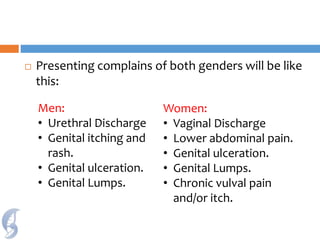
 Presenting complains of both genders will be like
this:
Men:
• Urethral Discharge
• Genital itching and
rash.
• Genital ulceration.
• Genital Lumps.
Women:
• Vaginal Discharge
• Lower abdominal pain.
• Genital ulceration.
• Genital Lumps.
• Chronic vulval pain
and/or itch.
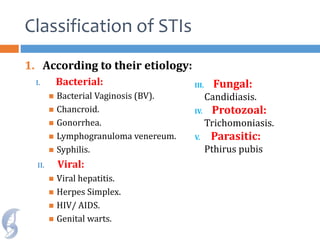
Classification of STIs
1. According to their etiology:
I. Bacterial:
 Bacterial Vaginosis (BV).
 Chancroid.
 Gonorrhea.
 Lymphogranuloma venereum.
 Syphilis.
II. Viral:
 Viral hepatitis.
 Herpes Simplex.
 HIV/ AIDS.
 Genital warts.
III. Fungal:
Candidiasis.
IV. Protozoal:
Trichomoniasis.
V. Parasitic:
Pthirus pubis
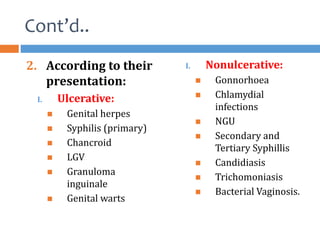
Cont’d..
2. According to their
presentation:
I. Ulcerative:
 Genital herpes
 Syphilis (primary)
 Chancroid
 LGV
 Granuloma
inguinale
 Genital warts
I. Nonulcerative:
 Gonnorhoea
 Chlamydial
infections
 NGU
 Secondary and
Tertiary Syphillis
 Candidiasis
 Trichomoniasis
 Bacterial Vaginosis.
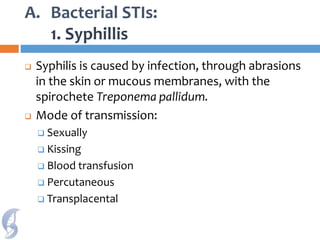
A. Bacterial STIs:
1. Syphillis
 Syphilis is caused by infection, through abrasions
in the skin or mucous membranes, with the
spirochete Treponema pallidum.
 Mode of transmission:
 Sexually
 Kissing
 Blood transfusion
 Percutaneous
 Transplacental
 Classification of syphilis:
1. Primary:
 Incubation period: between 14 and 28 days, with a
range of 9–90 days.
 Clinical findings:
 Chancre at the site of infection.
 Regional lymphadenopathy (painless).
 Primary chancre is on the penis in men while it appears on
the vulva and cervix in females.
2. Secondary syphilis:
 Incubation period: 6–8 weeks after the development
of the chancre.
 Clinical findings:
 Cutaneous rashes (flexor and valor regions, face), pinkish
or pale red in white persons; pigmented spots, copper-
colored macules in blacks.
 Generalised non-tender lymphadenopathy.
 Papules (condylomata lata).
 Alopecia.
 Fever, malaise and headache, are common.
3. Latent syphilis:
 Early latent:
 within two years of infections, infectious.
 positive serology
 Late latent:
 For many year or for lifetime
 Non-infectious
4. Tertiary Syphillis:
 may develop between 3 and 10 years after infection
 chronic granulomatous lesion (gumma)
 nodules or ulcers, scars.
 Paroxysmal cold haemoglobinuria may be seen.
5. Others:
 Cardiovascular:
 many years after initial infection.
 Aortitis is the most common feature.
 Clinical features: aortic incompetence, angina and aortic
aneurysm.
 Neurosyphilis:
 may also take years to develop.
 At first is asymptomatic with only CSF abnormalities.
 Meningovascular disease, tabes dorsalis and general
paralysis.
6. Congenital syphilis:
 After 4 months of gestation.
 Results in either:
 miscarriage or stillbirth.
 Syphilitic baby (Hutchinson teeth, scars of interstitial
keratitis, bony abnormalities (saber shins),
Hepatosplenomegaly, rash, pneumonia).
 Baby with latent syphilis.
 Diagnosis of syphilis:
 Mostly clinical findings.
 Screening tests are the VDRL and RPR.
 Treponemal (specific) antibody tests; EIA, TPHA…
 Treatment:
 Penicillin is the drug of choice, but Jarisch Herxheimer
reaction may occur in >50% of cases.
 Primary, secondary, and latent syphilis: 2.4 million units
of intramuscular benzathine penicillin once a week.
 Tertiary syphilis: penicillin 10−20 million units/day IV for 10
days.
 Pregnancy: Penicillin, Erythromycin if hypersensitive.
2. Gonnorhoea
 Gonorrhoea is caused by infection with Neisseria
gonorrhoeae, preferentially columnar epithelium
in the lower genital tract.
 Gonorrhea is second only to chlamydial infection
as the most common genitourinary tract
infections.
 Mode of transmission:
 Sexually
 During delivery
 Incubation period: usually 2–10 days.
 Clinical features:
 In men:
 Dysuria, urinary frequency, and a mucopurulent
urethral exudate.
 In women:
 May become asymptomatic, or present
 Dysuria, lower pelvic pain, and vaginal discharge.
 Diagnosis:
 Microscopic examination of smears from infected
sites, shows the Gram –ve diplococci.
 Treatment of Gonnorhea:
 Single-dose ceftriaxone and single-dose azithromycin
orally is the treatment of choice.
 As an alternative doxycycline for 7 days.
 Gonorrhea can also be treated with single-dose cefixime
 If left untreated, complications;
 Men: acute prostatitis, epididymitis, or orchitis,
Infertility.
 Women: Bartholinitis, salpingitis, PID, Ectopic pregnancy,
Infertility.
 Opthalmia neonatorum.
3. NGU and Cervicitis
 These are the most common forms of STIs.
 Etiology: C. trachomatis, Trichomonas vaginalis, U.
urealyticum, and Mycoplasma genitalium.
 The most common those chlamydial infections.
 Transmitted and presents in a similar way
to gonorrhea.
 Incubation period: varies from 1 week to a few
months.
 Clinical features:
 Purulent urethral discharge;
 dysuria,
 urgency, and
 frequency in urination.
 Reiter syndrome.
 Diagnosis:
 Serology (fluorescent antibodies) for chlamydia.
 Ligase chain reaction of urine.
 Treatment:
 Azithromycin 1 g orally as a single dose.
 Doxycycline 100 mg twice daily orally for 7 days.
4. Lymphogranuloma Venereum
 LGV is a chronic, ulcerative disease caused by
certain strains of C. trachomatis.
 Its is endemic in parts of Asia, Africa, the
Caribbean region, and South America.
 Seen with people with multiple sexual partners.
 Incubation period: may average btw 10 to 14
days.
 Clinical features:
 Small, transient, nonindurated lesion
 Unilateral enlargement of inguinal lymph nodes (Tender),
 Buboes,
 Fever, malaise, joint pains, and headaches are common.
 Diagnosis:
 made by clinical examination
 Nucleic acid amplifiation
 Treatment:
 Doxycycline,
 Erythromycin as an alternative.
5. Chancroid
 Chancroid, is an acute, ulcerative infection
caused by Haemophilus ducreyi.
 Most common in tropical and subtropical areas
and is more prevalent in lower socioeconomic
groups.
 Serves as an important cofactor in the
transmission of HIV infection.
 Incubation period: 3 to 7 days.
 Clinical features:
 Small, soft, painful papules, become shallow ulcers,
more likely to be painful in males than in females.
 Inguinal lymphadenopathy and tender.
 Diagnosis:
 on clinical findings
 Gram stain with culture
 PCR
 Treatment:
 Azithromycin single dose, or
 Ceftraixone single dose.
6. Granuloma Inguinale
 Its is a chronic inflammatory disease caused by
Calymmatobacterium granulomatis.
 Endemic in rural areas in certain tropical and
subtropical regions.
 Extensive scarring and lymphatic obstruction
occurs in untreated cases and lymphedema
develops which resembles Elephantiasis.
 Incubation period: ranges btw days to years,
median time being 50 days.
 Clinical features:
 A painless, red nodule; in males its found in penis,
scrotum, groin, and thighs. While in females its found
vulva, vagina, and perineum.
 Looks like condyloma lata or carcinoma.
 Diagnosis:
 Clinically and by performing a Giemsa or Wright stain.
 Punch biopsy
 Treatment:
 Doxycycline ceftriaxone or TMP/SMZ
4. PID
 Infections involving the fallopian tubes, uterus,
ovaries, or ligaments of the uterus.
 Etiology: N. gonorrhoeae, Chlamydia,
Mycoplasma, anaerobic bacteria, or Gram
negative bacteria.
 Incubation period: varies.
 Clinical Features:
 Lower abdominal and pelvic pain and tender.
 Fever, leukocytosis, and discharge are common.
 Cervical motion tenderness
 Diagnosis:
 Thayer-Martin for gonococcus and
 Gram stain of discharge
 Increased ESR.
 Laparoscopy
 Treatment:
 Doxycycline and cefoxitin (or cefotetan) for inpatient
therapy.
 single-dose ceftriaxone and doxycycline orally for two
weeks for outpatient.
 Complications:
 Infertility and ectopic pregnancy.
B. Viral STIs:
1. Genital Herpes
 Its very common STD caused by the Herpes virus,
Type II, although Type I can also be seen.
 May facilitate HIV transmission.
 Mode of transmission is mostly sexually but also
perinatal transmission my occur.
 Primary infection at the site of HSV entry; either
symptomatic or asymptomatic.
 Recurrences are common and primary infection is
usually the most painfull.
 Incubation period: primary GH is 3 to 7 days.
 Clinical features:
 Irritable vesicles that soon rupture to form small, tender
ulcers on the external genitalia.
 Itching and soreness
 There can be inguinal lymphadenopathy.
 Diagnosis:
 Tzanck test and culture
 Treatment:
 Oral acyclovir, famciclovir, or valacyclovir.
 chronic suppressive therapy to those with relapsing
infections.
2. Genital Warts
 Condylomata acuminata, also known as venereal
warts, are caused by HPV-6, HPV-11, HPV-16 and HPV-
18 most commonly infect the genital tract through
sexual transmission.
 Genital HPV infection may be transmitted to
neonates during vaginal delivery.
 Recurrent and potentially life-threatening papillomas
if it infects infants.
 Incubation period: 2 weeks to 8 months, with
majority of the genital warts appearing 2 to 3
months after infection.
 Clinical features:
 Genital warts commonly on warm, moist surfaces in the
genital areas.
 Appear soft, moist, minute, pink, or red swellings.
 Have cauliflower appearance
 Diagnosis:
 Clinical appearance.
 Treatment:
 Destruction (curettage, sclerotherapy, trichloroacetic acid)
 Cryotherapy
 Podophyllin
 Imiquimod (an immune stimulant)
 Laser removal.
C. Protozoan STIs
1. Trichomoniasis
 Trichomonas vaginalis is a sexually transmitted
protozoan that is a frequent cause of vaginitis.
 Causes superficial lesions.
 Such infection of females is associated with loss of
acid-producing Doderlien bacilli of vagina.
 Incubation period: 5 to 28 days.
 Clinical features:
 Most males are asymptomatic.
 Females may be asymptomatic or may present with
pruritus and a profuse, frothy, yellow vaginal discharge.
 Urinary frequency and dysuria if it colonises the urethra.
 Diagnosis:
 Microscopic examination of the secretions show the
trophozoite.
 Treatment:
 Metronidazole is the drug of choice
 Maintenance of vaginal low pH.
Alxmdulillaah ^__^

Sexually transmitted diseases presentation

  • 1.
    INFECTIOUS DISEASES I SexuallyTransmitted Infections (STIs)
  • 2.
    Group names: 1. AbdikaniIbrahem Nour 2. Ayaanle Ahmed Muhumed 3. Hafsa Hassan H. Abdisalam 4. Kamal Abdirahman Ahmed 5. Khaled Abduaziz Hussein 6. Murad Mahamed Elmi 7. Suleiman Abdirahman Warsame
  • 3.
    Sexually Transmitted Infections Sexually transmitted infections (STIs) are a group of contagious conditions whose principal mode of transmission is by intimate sexual activity involving the moist mucous membranes of the penis, vulva, vagina, cervix, anus, rectum, mouth and pharynx, along with their adjacent skin surfaces.  Most STIs affect both men and women, but in many cases the health problems they cause can be more severe for women. If a pregnant woman has an STI, it can cause serious health problems for the baby.
  • 4.
     A widerange of infections may be sexually transmitted, including syphilis, gonorrhoea, human immunodeficiency virus (HIV), genital herpes, genital warts, chlamydia and trichomoniasis.  Also Chancroid, lymphogranuloma venereum (LGV) and granuloma inguinale.  The World Health Organization estimates that 448 million curable STIs (Trichomonas vaginalis, Chlamydia trachomatis, gonorrhoea and syphilis) occur world-wide each year.
  • 5.
     Presenting complainsof both genders will be like this: Men: • Urethral Discharge • Genital itching and rash. • Genital ulceration. • Genital Lumps. Women: • Vaginal Discharge • Lower abdominal pain. • Genital ulceration. • Genital Lumps. • Chronic vulval pain and/or itch.
  • 6.
    Classification of STIs 1.According to their etiology: I. Bacterial:  Bacterial Vaginosis (BV).  Chancroid.  Gonorrhea.  Lymphogranuloma venereum.  Syphilis. II. Viral:  Viral hepatitis.  Herpes Simplex.  HIV/ AIDS.  Genital warts. III. Fungal: Candidiasis. IV. Protozoal: Trichomoniasis. V. Parasitic: Pthirus pubis
  • 7.
    Cont’d.. 2. According totheir presentation: I. Ulcerative:  Genital herpes  Syphilis (primary)  Chancroid  LGV  Granuloma inguinale  Genital warts I. Nonulcerative:  Gonnorhoea  Chlamydial infections  NGU  Secondary and Tertiary Syphillis  Candidiasis  Trichomoniasis  Bacterial Vaginosis.
  • 8.
    A. Bacterial STIs: 1.Syphillis  Syphilis is caused by infection, through abrasions in the skin or mucous membranes, with the spirochete Treponema pallidum.  Mode of transmission:  Sexually  Kissing  Blood transfusion  Percutaneous  Transplacental
  • 9.
     Classification ofsyphilis: 1. Primary:  Incubation period: between 14 and 28 days, with a range of 9–90 days.  Clinical findings:  Chancre at the site of infection.  Regional lymphadenopathy (painless).  Primary chancre is on the penis in men while it appears on the vulva and cervix in females.
  • 10.
    2. Secondary syphilis: Incubation period: 6–8 weeks after the development of the chancre.  Clinical findings:  Cutaneous rashes (flexor and valor regions, face), pinkish or pale red in white persons; pigmented spots, copper- colored macules in blacks.  Generalised non-tender lymphadenopathy.  Papules (condylomata lata).  Alopecia.  Fever, malaise and headache, are common.
  • 11.
    3. Latent syphilis: Early latent:  within two years of infections, infectious.  positive serology  Late latent:  For many year or for lifetime  Non-infectious 4. Tertiary Syphillis:  may develop between 3 and 10 years after infection  chronic granulomatous lesion (gumma)  nodules or ulcers, scars.  Paroxysmal cold haemoglobinuria may be seen.
  • 12.
    5. Others:  Cardiovascular: many years after initial infection.  Aortitis is the most common feature.  Clinical features: aortic incompetence, angina and aortic aneurysm.  Neurosyphilis:  may also take years to develop.  At first is asymptomatic with only CSF abnormalities.  Meningovascular disease, tabes dorsalis and general paralysis.
  • 13.
    6. Congenital syphilis: After 4 months of gestation.  Results in either:  miscarriage or stillbirth.  Syphilitic baby (Hutchinson teeth, scars of interstitial keratitis, bony abnormalities (saber shins), Hepatosplenomegaly, rash, pneumonia).  Baby with latent syphilis.
  • 14.
     Diagnosis ofsyphilis:  Mostly clinical findings.  Screening tests are the VDRL and RPR.  Treponemal (specific) antibody tests; EIA, TPHA…  Treatment:  Penicillin is the drug of choice, but Jarisch Herxheimer reaction may occur in >50% of cases.  Primary, secondary, and latent syphilis: 2.4 million units of intramuscular benzathine penicillin once a week.  Tertiary syphilis: penicillin 10−20 million units/day IV for 10 days.  Pregnancy: Penicillin, Erythromycin if hypersensitive.
  • 15.
    2. Gonnorhoea  Gonorrhoeais caused by infection with Neisseria gonorrhoeae, preferentially columnar epithelium in the lower genital tract.  Gonorrhea is second only to chlamydial infection as the most common genitourinary tract infections.  Mode of transmission:  Sexually  During delivery  Incubation period: usually 2–10 days.
  • 16.
     Clinical features: In men:  Dysuria, urinary frequency, and a mucopurulent urethral exudate.  In women:  May become asymptomatic, or present  Dysuria, lower pelvic pain, and vaginal discharge.  Diagnosis:  Microscopic examination of smears from infected sites, shows the Gram –ve diplococci.
  • 17.
     Treatment ofGonnorhea:  Single-dose ceftriaxone and single-dose azithromycin orally is the treatment of choice.  As an alternative doxycycline for 7 days.  Gonorrhea can also be treated with single-dose cefixime  If left untreated, complications;  Men: acute prostatitis, epididymitis, or orchitis, Infertility.  Women: Bartholinitis, salpingitis, PID, Ectopic pregnancy, Infertility.  Opthalmia neonatorum.
  • 18.
    3. NGU andCervicitis  These are the most common forms of STIs.  Etiology: C. trachomatis, Trichomonas vaginalis, U. urealyticum, and Mycoplasma genitalium.  The most common those chlamydial infections.  Transmitted and presents in a similar way to gonorrhea.  Incubation period: varies from 1 week to a few months.
  • 19.
     Clinical features: Purulent urethral discharge;  dysuria,  urgency, and  frequency in urination.  Reiter syndrome.  Diagnosis:  Serology (fluorescent antibodies) for chlamydia.  Ligase chain reaction of urine.  Treatment:  Azithromycin 1 g orally as a single dose.  Doxycycline 100 mg twice daily orally for 7 days.
  • 20.
    4. Lymphogranuloma Venereum LGV is a chronic, ulcerative disease caused by certain strains of C. trachomatis.  Its is endemic in parts of Asia, Africa, the Caribbean region, and South America.  Seen with people with multiple sexual partners.  Incubation period: may average btw 10 to 14 days.
  • 21.
     Clinical features: Small, transient, nonindurated lesion  Unilateral enlargement of inguinal lymph nodes (Tender),  Buboes,  Fever, malaise, joint pains, and headaches are common.  Diagnosis:  made by clinical examination  Nucleic acid amplifiation  Treatment:  Doxycycline,  Erythromycin as an alternative.
  • 22.
    5. Chancroid  Chancroid,is an acute, ulcerative infection caused by Haemophilus ducreyi.  Most common in tropical and subtropical areas and is more prevalent in lower socioeconomic groups.  Serves as an important cofactor in the transmission of HIV infection.  Incubation period: 3 to 7 days.
  • 23.
     Clinical features: Small, soft, painful papules, become shallow ulcers, more likely to be painful in males than in females.  Inguinal lymphadenopathy and tender.  Diagnosis:  on clinical findings  Gram stain with culture  PCR  Treatment:  Azithromycin single dose, or  Ceftraixone single dose.
  • 24.
    6. Granuloma Inguinale Its is a chronic inflammatory disease caused by Calymmatobacterium granulomatis.  Endemic in rural areas in certain tropical and subtropical regions.  Extensive scarring and lymphatic obstruction occurs in untreated cases and lymphedema develops which resembles Elephantiasis.  Incubation period: ranges btw days to years, median time being 50 days.
  • 25.
     Clinical features: A painless, red nodule; in males its found in penis, scrotum, groin, and thighs. While in females its found vulva, vagina, and perineum.  Looks like condyloma lata or carcinoma.  Diagnosis:  Clinically and by performing a Giemsa or Wright stain.  Punch biopsy  Treatment:  Doxycycline ceftriaxone or TMP/SMZ
  • 26.
    4. PID  Infectionsinvolving the fallopian tubes, uterus, ovaries, or ligaments of the uterus.  Etiology: N. gonorrhoeae, Chlamydia, Mycoplasma, anaerobic bacteria, or Gram negative bacteria.  Incubation period: varies.  Clinical Features:  Lower abdominal and pelvic pain and tender.  Fever, leukocytosis, and discharge are common.  Cervical motion tenderness
  • 27.
     Diagnosis:  Thayer-Martinfor gonococcus and  Gram stain of discharge  Increased ESR.  Laparoscopy  Treatment:  Doxycycline and cefoxitin (or cefotetan) for inpatient therapy.  single-dose ceftriaxone and doxycycline orally for two weeks for outpatient.  Complications:  Infertility and ectopic pregnancy.
  • 28.
    B. Viral STIs: 1.Genital Herpes  Its very common STD caused by the Herpes virus, Type II, although Type I can also be seen.  May facilitate HIV transmission.  Mode of transmission is mostly sexually but also perinatal transmission my occur.  Primary infection at the site of HSV entry; either symptomatic or asymptomatic.  Recurrences are common and primary infection is usually the most painfull.  Incubation period: primary GH is 3 to 7 days.
  • 29.
     Clinical features: Irritable vesicles that soon rupture to form small, tender ulcers on the external genitalia.  Itching and soreness  There can be inguinal lymphadenopathy.  Diagnosis:  Tzanck test and culture  Treatment:  Oral acyclovir, famciclovir, or valacyclovir.  chronic suppressive therapy to those with relapsing infections.
  • 30.
    2. Genital Warts Condylomata acuminata, also known as venereal warts, are caused by HPV-6, HPV-11, HPV-16 and HPV- 18 most commonly infect the genital tract through sexual transmission.  Genital HPV infection may be transmitted to neonates during vaginal delivery.  Recurrent and potentially life-threatening papillomas if it infects infants.  Incubation period: 2 weeks to 8 months, with majority of the genital warts appearing 2 to 3 months after infection.
  • 31.
     Clinical features: Genital warts commonly on warm, moist surfaces in the genital areas.  Appear soft, moist, minute, pink, or red swellings.  Have cauliflower appearance  Diagnosis:  Clinical appearance.  Treatment:  Destruction (curettage, sclerotherapy, trichloroacetic acid)  Cryotherapy  Podophyllin  Imiquimod (an immune stimulant)  Laser removal.
  • 32.
    C. Protozoan STIs 1.Trichomoniasis  Trichomonas vaginalis is a sexually transmitted protozoan that is a frequent cause of vaginitis.  Causes superficial lesions.  Such infection of females is associated with loss of acid-producing Doderlien bacilli of vagina.  Incubation period: 5 to 28 days.  Clinical features:  Most males are asymptomatic.  Females may be asymptomatic or may present with pruritus and a profuse, frothy, yellow vaginal discharge.  Urinary frequency and dysuria if it colonises the urethra.
  • 33.
     Diagnosis:  Microscopicexamination of the secretions show the trophozoite.  Treatment:  Metronidazole is the drug of choice  Maintenance of vaginal low pH.
  • 34.