Sexually Transmitted Diseases Capital Conference, June 2007 Gregory Perron, MD
Introduction Diseases Covered Genital Ulcer Disease HSV, syphilis, others Urethritis/Cervicitis GC, Chlamydia Vaginal Discharge BV, vulvovaginal candidiasis, trichomonas HPV Not Covered HIV, PID Future Trends
Useful Resources CDC: Center for Disease Control Sexually Transmitted Diseases Treatment Guidelines, 2002 http://www.cdc.gov/std/treatment/TOC2002TG.htm   Also a good source of patient handouts, statistical information, MMWR bulletins American Family Physician – article series on STD’s
 
Genital Ulcer Diseases Differential includes: HSV-1 vs HSV-2 : most common in US Primary Syphilis Chancroid - rare LGV-- lymphogranuloma venereum - rare Granuloma Inguinale  - rare
Herpes Simplex Virus Recurrent, incurable viral disease HSV-1 and HSV-2: Over 50 million affected patients in US; ~1 million new cases/year Most HSV-2 infections undiagnosed Most transmission from undiagnosed or asymptomatic pts Diagnose by clinical suspicion and  type-specific testing  (e.g. culture or DFA)- not Tzank
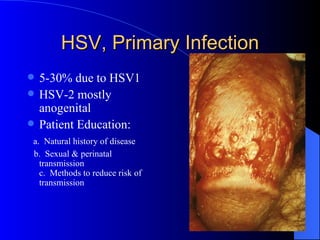
HSV, Primary Infection 5-30% due to HSV1 HSV-2 mostly anogenital Patient Education: a.  Natural history of disease b.  Sexual & perinatal transmission c.  Methods to reduce risk of transmission
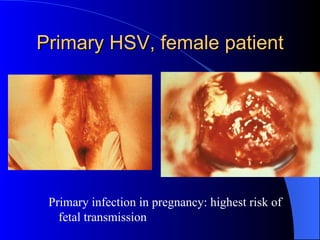
Primary HSV, female patient Primary infection in pregnancy: highest risk of fetal transmission
Medical Treatment   First Clinical Episode   Recommended Regimens Acyclovir 400 mg po tid x 7-10 days,   OR Acyclovir 200 mg po 5x/day for 7-10 days,   OR Famciclovir 250 mg po tid x 7-10 days,   OR Valacyclovir 1 gm po bid x 7-10 days.
HSV – Recurrent Episodes HSV-2 significant more likely to recur Recurrent episodes less severe than initial Episodic Treatment: Acyclovir 400 TID or 200 5X/Day or 800 BID X 5days Famvir 125 BID X 5 days Valacyclovir 500 BID X 3-5 days
HSV Suppression Suppression in pregnancy not routinely suggested by ACOG or CDC Reduces frequency of clinical flares by 70-80%, significantly reduces shedding Acyclovir 400 BID  Famvir 250 BID Valacyclovir 500mg-1000mg QD Start at 36 wks in pregnancy, or if recurrent episodes
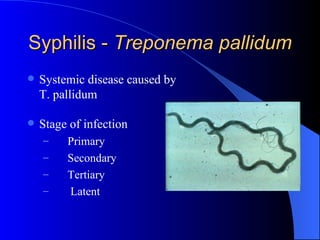
Syphilis -  Treponema pallidum Systemic disease caused by T. pallidum Stage of infection Primary Secondary Tertiary Latent
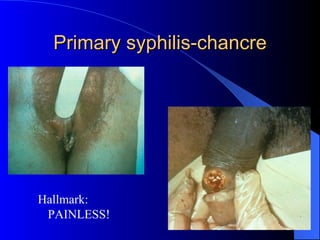
Primary syphilis-chancre Hallmark: PAINLESS!
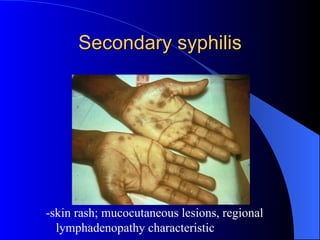
Secondary syphilis -skin rash; mucocutaneous lesions, regional lymphadenopathy characteristic
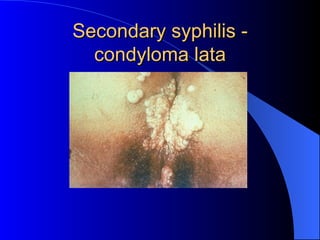
Secondary syphilis - condyloma lata
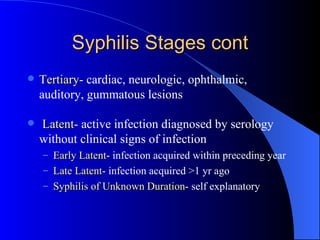
Syphilis Stages cont Tertiary - cardiac, neurologic, ophthalmic, auditory, gummatous lesions Latent - active infection diagnosed by serology without clinical signs of infection Early Latent - infection acquired within preceding year Late Latent - infection acquired >1 yr ago Syphilis of Unknown Duration - self explanatory
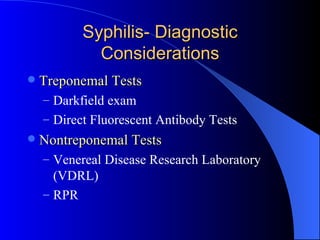
Syphilis- Diagnostic Considerations Treponemal Tests Darkfield exam Direct Fluorescent Antibody Tests Nontreponemal Tests Venereal Disease Research Laboratory (VDRL) RPR
Nontreponemal Tests Titers may wax & wane as course of disease changes 4 fold change in titer considered clinically significant  Should (but not always) become undetectable with treatment Multiple etiologies for false positives
Treponemal Tests Fluorescent Treponemal Antibody Absorbed (FTA-ABS) CSF FTA-ABS highly sensitive for neurosyphilis (i.e. if negative it excludes neurosyphilis) Microhemagglutination Assay for Antibody to T. pallidum  (MHA-TP) Most patients positive for remainder of their lives Poor marker for disease activity
Syphilis Diagnosis No single test reliable enough to diagnose  Need combination of treponemal & non-treponemal  tests and associated clinical picture
Syphilis Treatment Primary, Secondary, Early Latent No PCN allergy: Penicillin G 2.4 MU IM X1 PCN allergy Pregnant: desensitize and give penicillin Others: Doxycycline 100mg BID X 14 days - or- TCN 500 QID X 14 days
Syphilis Treatment Late Latent, Unknown Duration, Tertiary No PCN allergy penicillin G 2.4 MU IM Qweek X 3 PCN allergy Pregnant: Desensitize and treat with PCN Nonpregnant: Doxy 100 BID  X 28 days, TCN 500 QID X 28 days
Primary & Secondary cont No definitive criteria for cure or failure Follow-up VDRL/RPR at 1,3,6,12 months Think failure if titer fails to fall fourfold, or if titers rise
Primary & Secondary cont If symptoms persist, recur, or sustained titers=failure or reinfection Retest for HIV, perform LP, and retreat x3 weekly doses unless CSF studies show neurosyphilis present
Neurosyphilis Non PCN Allergic Adults Aqueous crystalline penicillin G 3-4 million units IV every 4 hours for  10-14 days Procaine penicillin 2.4 million units IM a day, PLUS Probenecid 500 mg orally four times a day, both for 10-14  days
Neurosyphilis cont Follow-Up: If CSF pleocytosis present initially, CSF examination every 6 months until the cell  count is normal If the cell count has not decreased after 6 months, or if the CSF is not entirely normal after 2 years, re-treatment should be considered
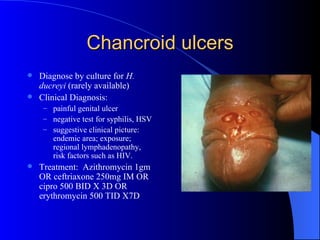
Chancroid ulcers Diagnose by culture for  H. ducreyi  (rarely available) Clinical Diagnosis: painful genital ulcer negative test for syphilis, HSV suggestive clinical picture: endemic area; exposure; regional lymphadenopathy, risk factors such as HIV.  Treatment:  Azithromycin 1gm OR ceftriaxone 250mg IM OR cipro 500 BID X 3D OR erythromycin 500 TID X7D
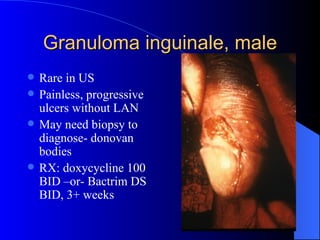
Granuloma inguinale, male Rare in US Painless, progressive ulcers without LAN May need biopsy to diagnose- donovan bodies RX: doxycycline 100 BID –or- Bactrim DS BID, 3+ weeks
Urethritis/Cervicitis Diseases Chlamydia GC MPC NGU
Chlamydia 467 per 100,000 population in 2003 Up from 79/100,000 in 1987 Asymptomatic infection common in women, less common in men Complications: infertility, PID, ectopic pregnancy
Chlamydia Diagnosis Culture- rarely recommended DNA amplification testing  PCR, Ligase Chain Reaction – urine or swab Antigen detection with EIA acceptable Annual Screening for all women <25 Some data supports Q6mo screening for women < 18, female military recruits
Chlamydia Treatment Direct Observed Therapy Is Best! Azithromycin 1gm po X 1 Doxycycline 100mg BID X 7 days Alternatives: Erythromycin 500 QID X 7D EES 800 QID X 7D Ofloxacin 300BID X 7D Levofloxacin 500 QD X 7D ALL: Treat sexual partner; screen for other STDs counsel patients to abstain from sex until 7 days after patient and partner treated
Chlamydia in Pregnancy Screen all women in 1 st  trimester, selective screening in 3 rd  trimester Treat with  Azithryomycin 1gm X single dose erythromycin 500 QID X 7D amoxicillin 500 TID X 7d Treat partners; abstain from sex until 7 days after treatment & partner treated Test of Cure in 3 weeks recommended!
Chlamydia Followup Test of Cure: recommended if doxy/azithro not used, or in pregnancy Test for REINFECTION-– test 3-4 months later, definitely by 12 months after diagnosis urine chlamydia testing ideal
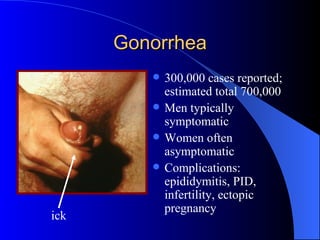
Gonorrhea 300,000 cases reported; estimated total 700,000 Men typically symptomatic Women often asymptomatic Complications: epididymitis, PID, infertility, ectopic pregnancy ick
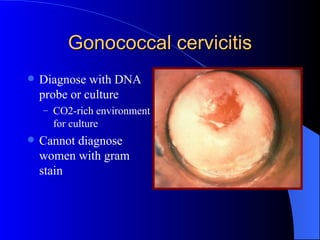
Gonococcal cervicitis Diagnose with DNA probe or culture CO2-rich environment for culture Cannot diagnose women with gram stain
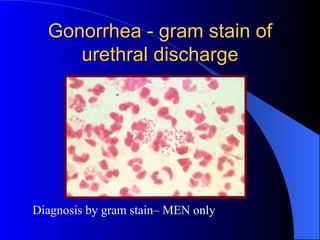
Gonorrhea - gram stain of urethral discharge Diagnosis by gram stain– MEN only
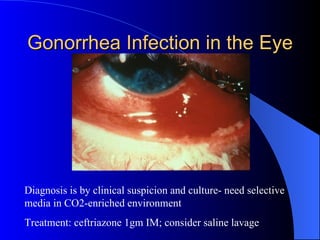
Gonorrhea Infection in the Eye Diagnosis is by clinical suspicion and culture- need selective media in CO2-enriched environment Treatment: ceftriazone 1gm IM; consider saline lavage
GC Treatment Ceftriaxone 125mg IM; ALWAYS presume chlamydia and treat Fluoroquinolones are OUT:  no longer recommended due to resistance . (cefixime 400mg PO)
MPC, NGU MPC- mucopurulent cervicitis Dx: mucopurulent discharge from os or on endocervical swab. ? Value of increased PMN’s on endocervical gram stain Test for GC, Chlamydia Consider empiric Rx NGU- nongonococcal urethritis Dx: urethral smear w/ >5WBC/hpf; no GNID; clinical hx of discharge RX: 1gm azithro or doxy 100 BID X 7d Test for GC ,Chlamdyia
Diseases Characterized by Vaginal Discharge Vulvovaginal Candidiasis Bacterial Vaginosis Trichomonas vaginitis Recommend targeted history, exam, KOH, wet prep, vaginal pH. Consider GC/Chlamdyia testing
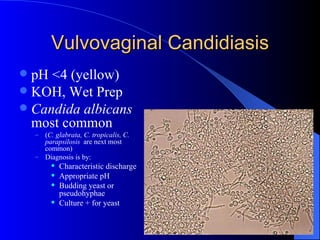
Vulvovaginal Candidiasis pH <4 (yellow) KOH, Wet Prep Candida albicans  most common  ( C. glabrata, C. tropicalis, C. parapsilosis  are next most common) Diagnosis is by: Characteristic discharge Appropriate pH Budding yeast or pseudohyphae Culture + for yeast
VVC, Cont’d Uncomplicated VVC Sporadic/infrequent episodes Mild-to-moderate VVC Likely  C. albicans Non-immunocompromised patient Complicated VVC Recurrent VVC Severe VVC disease Non-albicans candidiasis Patient factors: immunocompromised, uncontrolled DM, debilitated patients, pregnancy
Treatment of VVC Topical agents vs. Oral Agents? Why pick one over others? Treatment with two agents? Diflucan 150mg PO X 1 dose Terazol 7: 0.4% IVA X 7 days Monistat 1,3,7 (OTC) etc
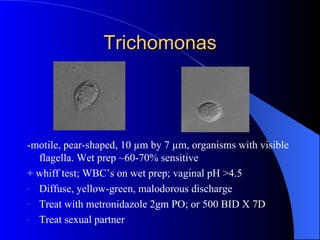
Trichomonas -motile, pear-shaped, 10 µm by 7 µm, organisms with visible flagella. Wet prep ~60-70% sensitive + whiff test; WBC’s on wet prep; vaginal pH >4.5 Diffuse, yellow-green, malodorous discharge Treat with metronidazole 2gm PO; or 500 BID X 7D Treat sexual partner
Bacterial Vaginosis Diagnostic Criteria for Bacterial Vaginosis   Homogeneous vaginal discharge (color and amount may vary) Presence of clue cells (greater than 20%) Amine (fishy) odor when potassium hydroxide solution is added to vaginal secretions (&quot;whiff test&quot;) Vaginal pH greater than 4.5 Absence of the normal vaginal lactobacilli 3+ above criteria for diagnosis. Vagin osis  – not Vagin itis
Bacterial Vaginosis Treatment Treatment Regimens: Metronidazole 500 BID PO X 7D Metronidazole 2gm PO X 1 dose Metronidazole gel 0.75% IVA BID X 5D Clindamycin 300mg PO BID X 7D Clindamycin 2% cream 5GM IVA QHS X7D Recurrence is common Treatment of sexual partners not suggested
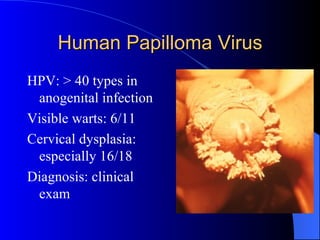
Human Papilloma Virus HPV: > 40 types in anogenital infection Visible warts: 6/11 Cervical dysplasia: especially 16/18 Diagnosis: clinical exam
HPV Factoids Most common STD (6.2 million PER YR!) Risk correlated to # of lifetime sexual partners Most infections self-limited Asymptomatic/Subclinical disease is common Visible warts don’t typically cause dysplasia
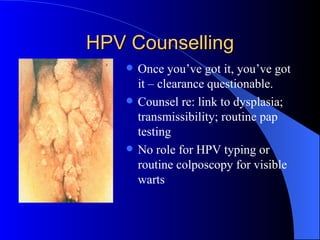
HPV Counselling Once you’ve got it, you’ve got it – clearance questionable. Counsel re: link to dysplasia; transmissibility; routine pap testing No role for HPV typing or routine colposcopy for visible warts
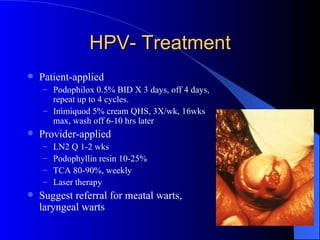
HPV- Treatment Patient-applied Podophilox 0.5% BID X 3 days, off 4 days, repeat up to 4 cycles. Inimiquod 5% cream QHS, 3X/wk, 16wks max, wash off 6-10 hrs later Provider-applied LN2 Q 1-2 wks Podophyllin resin 10-25% TCA 80-90%, weekly Laser therapy Suggest referral for meatal warts, laryngeal warts
HPV Vaccine - Gardisil Approved for use in women only, 9-26 Recommended at ages 11-12 Catch-up older patients 3 vaccine series (0,2,6 mo) Efficacy varies, outcomes studied vary But efficacy in the 90+ percentile for reduction of type-specific dysplasia Targets HPV 6/11,16/18  Based on primary capsid proteins
Other Vaccines for STDs Hepatitis A: MSM (men who have sex with men); illicit drug users, patients with chronic liver disease Hepatitis B: as per hepA, plus all teenagers; all treated for an STD; household contacts of chronic hep B patients
HPV, HSV Vaccines Won’t be on Boards tests HPV Merk’s Gardisil approved by FDA panel GSK’s Cervarix in Phase 3 testing HSV vaccines still in testing phase
Questions?

Sexually Transmitted Diseases

  • 1.
    Sexually Transmitted DiseasesCapital Conference, June 2007 Gregory Perron, MD
  • 2.
    Introduction Diseases CoveredGenital Ulcer Disease HSV, syphilis, others Urethritis/Cervicitis GC, Chlamydia Vaginal Discharge BV, vulvovaginal candidiasis, trichomonas HPV Not Covered HIV, PID Future Trends
  • 3.
    Useful Resources CDC:Center for Disease Control Sexually Transmitted Diseases Treatment Guidelines, 2002 http://www.cdc.gov/std/treatment/TOC2002TG.htm Also a good source of patient handouts, statistical information, MMWR bulletins American Family Physician – article series on STD’s
  • 4.
  • 5.
    Genital Ulcer DiseasesDifferential includes: HSV-1 vs HSV-2 : most common in US Primary Syphilis Chancroid - rare LGV-- lymphogranuloma venereum - rare Granuloma Inguinale - rare
  • 6.
    Herpes Simplex VirusRecurrent, incurable viral disease HSV-1 and HSV-2: Over 50 million affected patients in US; ~1 million new cases/year Most HSV-2 infections undiagnosed Most transmission from undiagnosed or asymptomatic pts Diagnose by clinical suspicion and type-specific testing (e.g. culture or DFA)- not Tzank
  • 7.
    HSV, Primary Infection5-30% due to HSV1 HSV-2 mostly anogenital Patient Education: a. Natural history of disease b. Sexual & perinatal transmission c. Methods to reduce risk of transmission
  • 8.
    Primary HSV, femalepatient Primary infection in pregnancy: highest risk of fetal transmission
  • 9.
    Medical Treatment First Clinical Episode Recommended Regimens Acyclovir 400 mg po tid x 7-10 days, OR Acyclovir 200 mg po 5x/day for 7-10 days, OR Famciclovir 250 mg po tid x 7-10 days, OR Valacyclovir 1 gm po bid x 7-10 days.
  • 10.
    HSV – RecurrentEpisodes HSV-2 significant more likely to recur Recurrent episodes less severe than initial Episodic Treatment: Acyclovir 400 TID or 200 5X/Day or 800 BID X 5days Famvir 125 BID X 5 days Valacyclovir 500 BID X 3-5 days
  • 11.
    HSV Suppression Suppressionin pregnancy not routinely suggested by ACOG or CDC Reduces frequency of clinical flares by 70-80%, significantly reduces shedding Acyclovir 400 BID Famvir 250 BID Valacyclovir 500mg-1000mg QD Start at 36 wks in pregnancy, or if recurrent episodes
  • 12.
    Syphilis - Treponema pallidum Systemic disease caused by T. pallidum Stage of infection Primary Secondary Tertiary Latent
  • 13.
  • 14.
    Secondary syphilis -skinrash; mucocutaneous lesions, regional lymphadenopathy characteristic
  • 15.
    Secondary syphilis -condyloma lata
  • 16.
    Syphilis Stages contTertiary - cardiac, neurologic, ophthalmic, auditory, gummatous lesions Latent - active infection diagnosed by serology without clinical signs of infection Early Latent - infection acquired within preceding year Late Latent - infection acquired >1 yr ago Syphilis of Unknown Duration - self explanatory
  • 17.
    Syphilis- Diagnostic ConsiderationsTreponemal Tests Darkfield exam Direct Fluorescent Antibody Tests Nontreponemal Tests Venereal Disease Research Laboratory (VDRL) RPR
  • 18.
    Nontreponemal Tests Titersmay wax & wane as course of disease changes 4 fold change in titer considered clinically significant Should (but not always) become undetectable with treatment Multiple etiologies for false positives
  • 19.
    Treponemal Tests FluorescentTreponemal Antibody Absorbed (FTA-ABS) CSF FTA-ABS highly sensitive for neurosyphilis (i.e. if negative it excludes neurosyphilis) Microhemagglutination Assay for Antibody to T. pallidum (MHA-TP) Most patients positive for remainder of their lives Poor marker for disease activity
  • 20.
    Syphilis Diagnosis Nosingle test reliable enough to diagnose Need combination of treponemal & non-treponemal tests and associated clinical picture
  • 21.
    Syphilis Treatment Primary,Secondary, Early Latent No PCN allergy: Penicillin G 2.4 MU IM X1 PCN allergy Pregnant: desensitize and give penicillin Others: Doxycycline 100mg BID X 14 days - or- TCN 500 QID X 14 days
  • 22.
    Syphilis Treatment LateLatent, Unknown Duration, Tertiary No PCN allergy penicillin G 2.4 MU IM Qweek X 3 PCN allergy Pregnant: Desensitize and treat with PCN Nonpregnant: Doxy 100 BID X 28 days, TCN 500 QID X 28 days
  • 23.
    Primary & Secondarycont No definitive criteria for cure or failure Follow-up VDRL/RPR at 1,3,6,12 months Think failure if titer fails to fall fourfold, or if titers rise
  • 24.
    Primary & Secondarycont If symptoms persist, recur, or sustained titers=failure or reinfection Retest for HIV, perform LP, and retreat x3 weekly doses unless CSF studies show neurosyphilis present
  • 25.
    Neurosyphilis Non PCNAllergic Adults Aqueous crystalline penicillin G 3-4 million units IV every 4 hours for 10-14 days Procaine penicillin 2.4 million units IM a day, PLUS Probenecid 500 mg orally four times a day, both for 10-14 days
  • 26.
    Neurosyphilis cont Follow-Up:If CSF pleocytosis present initially, CSF examination every 6 months until the cell count is normal If the cell count has not decreased after 6 months, or if the CSF is not entirely normal after 2 years, re-treatment should be considered
  • 27.
    Chancroid ulcers Diagnoseby culture for H. ducreyi (rarely available) Clinical Diagnosis: painful genital ulcer negative test for syphilis, HSV suggestive clinical picture: endemic area; exposure; regional lymphadenopathy, risk factors such as HIV. Treatment: Azithromycin 1gm OR ceftriaxone 250mg IM OR cipro 500 BID X 3D OR erythromycin 500 TID X7D
  • 28.
    Granuloma inguinale, maleRare in US Painless, progressive ulcers without LAN May need biopsy to diagnose- donovan bodies RX: doxycycline 100 BID –or- Bactrim DS BID, 3+ weeks
  • 29.
  • 30.
    Chlamydia 467 per100,000 population in 2003 Up from 79/100,000 in 1987 Asymptomatic infection common in women, less common in men Complications: infertility, PID, ectopic pregnancy
  • 31.
    Chlamydia Diagnosis Culture-rarely recommended DNA amplification testing PCR, Ligase Chain Reaction – urine or swab Antigen detection with EIA acceptable Annual Screening for all women <25 Some data supports Q6mo screening for women < 18, female military recruits
  • 32.
    Chlamydia Treatment DirectObserved Therapy Is Best! Azithromycin 1gm po X 1 Doxycycline 100mg BID X 7 days Alternatives: Erythromycin 500 QID X 7D EES 800 QID X 7D Ofloxacin 300BID X 7D Levofloxacin 500 QD X 7D ALL: Treat sexual partner; screen for other STDs counsel patients to abstain from sex until 7 days after patient and partner treated
  • 33.
    Chlamydia in PregnancyScreen all women in 1 st trimester, selective screening in 3 rd trimester Treat with Azithryomycin 1gm X single dose erythromycin 500 QID X 7D amoxicillin 500 TID X 7d Treat partners; abstain from sex until 7 days after treatment & partner treated Test of Cure in 3 weeks recommended!
  • 34.
    Chlamydia Followup Testof Cure: recommended if doxy/azithro not used, or in pregnancy Test for REINFECTION-– test 3-4 months later, definitely by 12 months after diagnosis urine chlamydia testing ideal
  • 35.
    Gonorrhea 300,000 casesreported; estimated total 700,000 Men typically symptomatic Women often asymptomatic Complications: epididymitis, PID, infertility, ectopic pregnancy ick
  • 36.
    Gonococcal cervicitis Diagnosewith DNA probe or culture CO2-rich environment for culture Cannot diagnose women with gram stain
  • 37.
    Gonorrhea - gramstain of urethral discharge Diagnosis by gram stain– MEN only
  • 38.
    Gonorrhea Infection inthe Eye Diagnosis is by clinical suspicion and culture- need selective media in CO2-enriched environment Treatment: ceftriazone 1gm IM; consider saline lavage
  • 39.
    GC Treatment Ceftriaxone125mg IM; ALWAYS presume chlamydia and treat Fluoroquinolones are OUT: no longer recommended due to resistance . (cefixime 400mg PO)
  • 40.
    MPC, NGU MPC-mucopurulent cervicitis Dx: mucopurulent discharge from os or on endocervical swab. ? Value of increased PMN’s on endocervical gram stain Test for GC, Chlamydia Consider empiric Rx NGU- nongonococcal urethritis Dx: urethral smear w/ >5WBC/hpf; no GNID; clinical hx of discharge RX: 1gm azithro or doxy 100 BID X 7d Test for GC ,Chlamdyia
  • 41.
    Diseases Characterized byVaginal Discharge Vulvovaginal Candidiasis Bacterial Vaginosis Trichomonas vaginitis Recommend targeted history, exam, KOH, wet prep, vaginal pH. Consider GC/Chlamdyia testing
  • 42.
    Vulvovaginal Candidiasis pH<4 (yellow) KOH, Wet Prep Candida albicans most common ( C. glabrata, C. tropicalis, C. parapsilosis are next most common) Diagnosis is by: Characteristic discharge Appropriate pH Budding yeast or pseudohyphae Culture + for yeast
  • 43.
    VVC, Cont’d UncomplicatedVVC Sporadic/infrequent episodes Mild-to-moderate VVC Likely C. albicans Non-immunocompromised patient Complicated VVC Recurrent VVC Severe VVC disease Non-albicans candidiasis Patient factors: immunocompromised, uncontrolled DM, debilitated patients, pregnancy
  • 44.
    Treatment of VVCTopical agents vs. Oral Agents? Why pick one over others? Treatment with two agents? Diflucan 150mg PO X 1 dose Terazol 7: 0.4% IVA X 7 days Monistat 1,3,7 (OTC) etc
  • 45.
    Trichomonas -motile, pear-shaped,10 µm by 7 µm, organisms with visible flagella. Wet prep ~60-70% sensitive + whiff test; WBC’s on wet prep; vaginal pH >4.5 Diffuse, yellow-green, malodorous discharge Treat with metronidazole 2gm PO; or 500 BID X 7D Treat sexual partner
  • 46.
    Bacterial Vaginosis DiagnosticCriteria for Bacterial Vaginosis Homogeneous vaginal discharge (color and amount may vary) Presence of clue cells (greater than 20%) Amine (fishy) odor when potassium hydroxide solution is added to vaginal secretions (&quot;whiff test&quot;) Vaginal pH greater than 4.5 Absence of the normal vaginal lactobacilli 3+ above criteria for diagnosis. Vagin osis – not Vagin itis
  • 47.
    Bacterial Vaginosis TreatmentTreatment Regimens: Metronidazole 500 BID PO X 7D Metronidazole 2gm PO X 1 dose Metronidazole gel 0.75% IVA BID X 5D Clindamycin 300mg PO BID X 7D Clindamycin 2% cream 5GM IVA QHS X7D Recurrence is common Treatment of sexual partners not suggested
  • 48.
    Human Papilloma VirusHPV: > 40 types in anogenital infection Visible warts: 6/11 Cervical dysplasia: especially 16/18 Diagnosis: clinical exam
  • 49.
    HPV Factoids Mostcommon STD (6.2 million PER YR!) Risk correlated to # of lifetime sexual partners Most infections self-limited Asymptomatic/Subclinical disease is common Visible warts don’t typically cause dysplasia
  • 50.
    HPV Counselling Onceyou’ve got it, you’ve got it – clearance questionable. Counsel re: link to dysplasia; transmissibility; routine pap testing No role for HPV typing or routine colposcopy for visible warts
  • 51.
    HPV- Treatment Patient-appliedPodophilox 0.5% BID X 3 days, off 4 days, repeat up to 4 cycles. Inimiquod 5% cream QHS, 3X/wk, 16wks max, wash off 6-10 hrs later Provider-applied LN2 Q 1-2 wks Podophyllin resin 10-25% TCA 80-90%, weekly Laser therapy Suggest referral for meatal warts, laryngeal warts
  • 52.
    HPV Vaccine -Gardisil Approved for use in women only, 9-26 Recommended at ages 11-12 Catch-up older patients 3 vaccine series (0,2,6 mo) Efficacy varies, outcomes studied vary But efficacy in the 90+ percentile for reduction of type-specific dysplasia Targets HPV 6/11,16/18 Based on primary capsid proteins
  • 53.
    Other Vaccines forSTDs Hepatitis A: MSM (men who have sex with men); illicit drug users, patients with chronic liver disease Hepatitis B: as per hepA, plus all teenagers; all treated for an STD; household contacts of chronic hep B patients
  • 54.
    HPV, HSV VaccinesWon’t be on Boards tests HPV Merk’s Gardisil approved by FDA panel GSK’s Cervarix in Phase 3 testing HSV vaccines still in testing phase
  • 55.