
SEXUALLY TRANSMITTED DISEASES (STDS)
(VENEREALDISEASES)
Dr. Dalia El-Shafei
Assist.Prof., Community Medicine Department, Zagazig University
http://www.slideshare.net/daliaelshafei
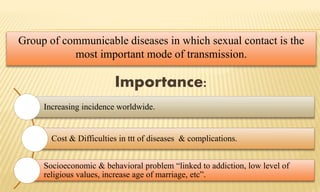
Group of communicable diseases in which sexual contact is the
most important mode of transmission.
Increasing incidence worldwide.
Cost & Difficulties in ttt of diseases & complications.
Socioeconomic & behavioral problem “linked to addiction, low level of
religious values, increase age of marriage, etc”.
Importance:
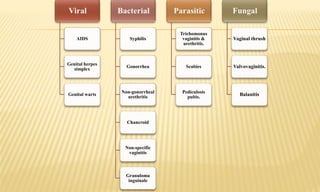
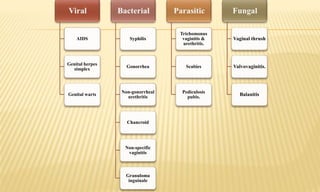
AIDS
Genital herpes
simplex
Genital warts
Syphilis
Gonorrhea
Non-gonorrheal
urethritis
Chancroid
Non-specific
vaginitis
Granuloma
inguinale
Trichomonus
vaginitis &
urethritis.
Scabies
Pediculosis
pubis.
Vaginal thrush
Valvovaginitis.
Balanitis
A life threatening clinical condition that represent the late clinical
stage of infection with HIV which results in progressive damage
to the immune and other organ systems specially CNS.
Acquired Immunodeficiency Syndrome (AIDS)
Causative agent:
 Human immune deficiency virus (HIV): DNA retrovirus.
 2 serologically & geographically distinct types with similar
epidemiological characteristics:HIV-1 & HIV-2.
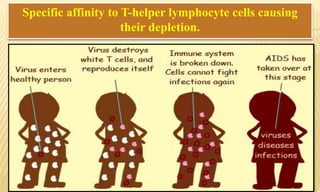
Specific affinity to T-helper lymphocyte cells causing
their depletion.
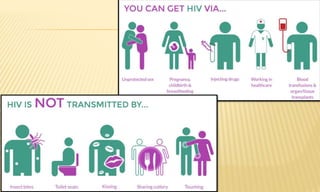
 Reservoir: man
 Exit: in blood and body fluids e.g. semen, vaginal secretion,
saliva and tears.
 Period of communicability: so long the infected person is alive.
 IP: variable, but 50% of those infected develop AIDS about 10
years after infection.
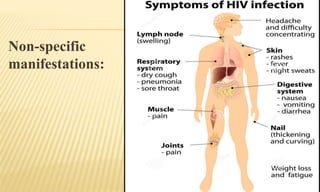
Non-specific
manifestations:
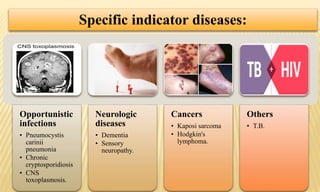
Specific indicator diseases:
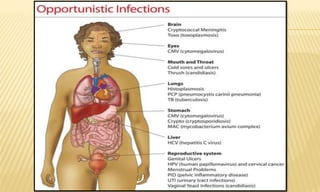
Opportunistic
infections
• Pneumocystis
carinii
pneumonia
• Chronic
cryptosporidiosis
• CNS
toxoplasmosis.
Neurologic
diseases
• Dementia
• Sensory
neuropathy.
Cancers
• Kaposi sarcoma
• Hodgkin's
lymphoma.
Others
• T.B.
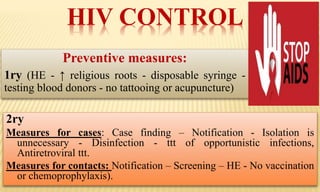
HIV CONTROL
Preventive measures:
1ry (HE - ↑ religious roots - disposable syringe -
testing blood donors - no tattooing or acupuncture)
2ry
Measures for cases: Case finding – Notification - Isolation is
unnecessary - Disinfection - ttt of opportunistic infections,
Antiretroviral ttt.
Measures for contacts: Notification – Screening – HE - No vaccination
or chemoprophylaxis).
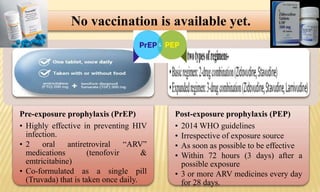
No vaccination is available yet.
Pre-exposure prophylaxis (PrEP)
• Highly effective in preventing HIV
infection.
• 2 oral antiretroviral “ARV”
medications (tenofovir &
emtricitabine)
• Co-formulated as a single pill
(Truvada) that is taken once daily.
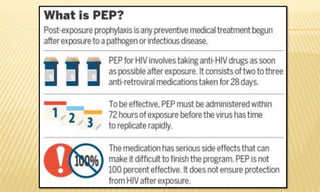
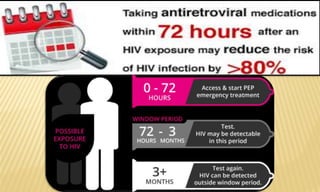
Post-exposure prophylaxis (PEP)
• 2014 WHO guidelines
• Irrespective of exposure source
• As soon as possible to be effective
• Within 72 hours (3 days) after a
possible exposure
• 3 or more ARV medicines every day
for 28 days.
N .B.
WHO recommends immunization of asymptomatic HIV infected
children with the EPI (Expanded program Immunization) vaccines;
those who are symptomatic should not receive BCG vaccine.
Live Measles-Mumps-Rubella (MMR) & polio vaccines are
recommended for all HIV-infected
AIDS
Genital herpes
simplex
Genital warts
Syphilis
Gonorrhea
Non-gonorrheal
urethritis
Chancroid
Non-specific
vaginitis
Granuloma
inguinale
Trichomonus
vaginitis &
urethritis.
Scabies
Pediculosis
pubis.
Vaginal thrush
Valvovaginitis.
Balanitis
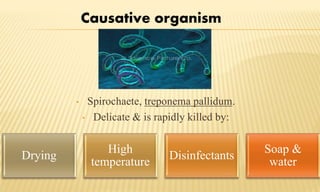
• Spirochaete, treponema pallidum.
• Delicate & is rapidly killed by:
Causative organism
Drying
High
temperature
Disinfectants
Soap &
water
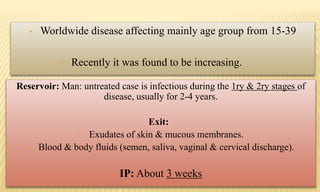
Reservoir: Man: untreated case is infectious during the 1ry & 2ry stages of
disease, usually for 2-4 years.
Exit:
• Exudates of skin & mucous membranes.
• Blood & body fluids (semen, saliva, vaginal & cervical discharge).
IP: About 3 weeks
• Worldwide disease affecting mainly age group from 15-39
• Recently it was found to be increasing.
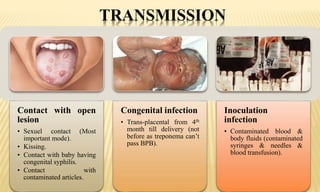
TRANSMISSION
Contact with open
lesion
• Sexuel contact (Most
important mode).
• Kissing.
• Contact with baby having
congenital syphilis.
• Contact with
contaminated articles.
Congenital infection
• Trans-placental from 4th
month till delivery (not
before as treponema can’t
pass BPB).
Inoculation
infection
• Contaminated blood &
body fluids (contaminated
syringes & needles &
blood transfusion).
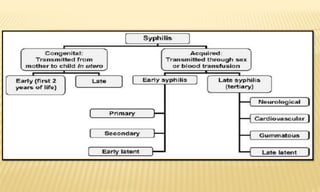
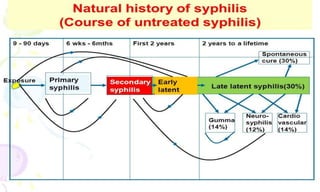
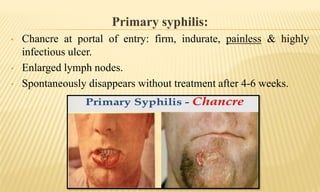
Primary syphilis:
• Chancre at portal of entry: firm, indurate, painless & highly
infectious ulcer.
• Enlarged lymph nodes.
• Spontaneously disappears without treatment after 4-6 weeks.
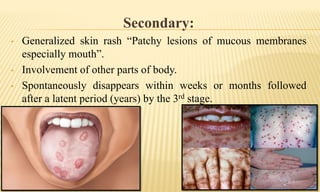
Secondary:
• Generalized skin rash “Patchy lesions of mucous membranes
especially mouth”.
• Involvement of other parts of body.
• Spontaneously disappears within weeks or months followed
after a latent period (years) by the 3rd stage.
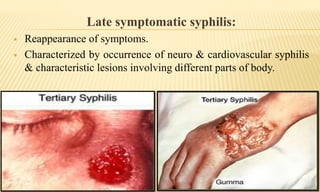
Late symptomatic syphilis:
 Reappearance of symptoms.
 Characterized by occurrence of neuro & cardiovascular syphilis
& characteristic lesions involving different parts of body.
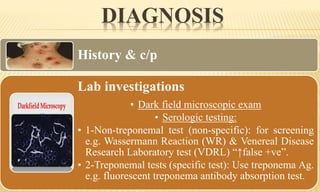
History & c/p
Lab investigations
• Dark field microscopic exam
• Serologic testing:
• 1-Non-treponemal test (non-specific): for screening
e.g. Wassermann Reaction (WR) & Venereal Disease
Research Laboratory test (VDRL) “↑false +ve”.
• 2-Treponemal tests (specific test): Use treponema Ag.
e.g. fluorescent treponema antibody absorption test.
DIAGNOSIS
PREVENTION
A. General measures:
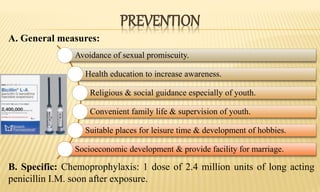
B. Specific: Chemoprophylaxis: 1 dose of 2.4 million units of long acting
penicillin I.M. soon after exposure.
Avoidance of sexual promiscuity.
Health education to increase awareness.
Religious & social guidance especially of youth.
Convenient family life & supervision of youth.
Suitable places for leisure time & development of hobbies.
Socioeconomic development & provide facility for marriage.
A. Cases:
1. Early case finding: during survey & on health appraisal:
• Premarital & prenatal examination.
• Exam of food handlers, blood donors, army recruits, child nurses.
• Suspected attendants of medical services.
• Diagnosis of congenital syphilis when mother is syphilitic.
2. Measures for cases:
• Notification confidentially to LHO.
• Isolation: not needed but avoid sexual contact till elimination of infectivity.
• Disinfection: non but precautions with blood & body fluids.
SPECIFIC TREATMENT:
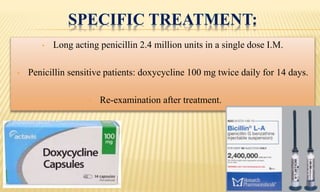
• Long acting penicillin 2.4 million units in a single dose I.M.
• Penicillin sensitive patients: doxycycline 100 mg twice daily for 14 days.
• Re-examination after treatment.
B. Contacts:
• Tracing & Enlistment.
• Examination.
• Health education.
• Surveillance.
• Chemoprophylaxis: 1 dose of 2.4 million units of long acting penicillin I.M.
C. Congenital syphilis:
• Serologic testing & ttt.
• Proper handling of baby with congenital syphilis with caution to avoid
infection.
Gonorrhea
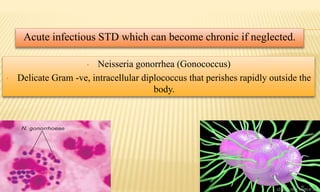
• Neisseria gonorrhea (Gonococcus)
• Delicate Gram -ve, intracellular diplococcus that perishes rapidly outside the
body.
Acute infectious STD which can become chronic if neglected.
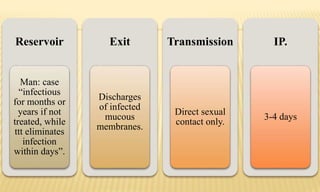
Reservoir
Man: case
“infectious
for months or
years if not
treated, while
ttt eliminates
infection
within days”.
Exit
Discharges
of infected
mucous
membranes.
Transmission
Direct sexual
contact only.
IP.
3-4 days
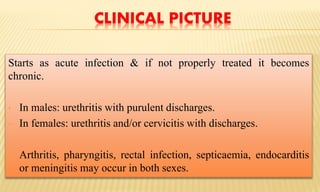
CLINICAL PICTURE
Starts as acute infection & if not properly treated it becomes
chronic.
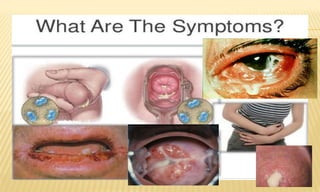
• In males: urethritis with purulent discharges.
• In females: urethritis and/or cervicitis with discharges.
• Arthritis, pharyngitis, rectal infection, septicaemia, endocarditis
or meningitis may occur in both sexes.
DIAGNOSIS
History & C/P.
Lab investigations:
• Acute case: demonstration of causative organism from film of pus
taken from cervix or urethra.
• Chronic case: serologic test such as complement fixation test.
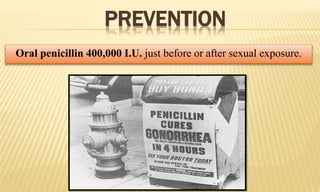
PREVENTION
Oral penicillin 400,000 I.U. just before or after sexual exposure.
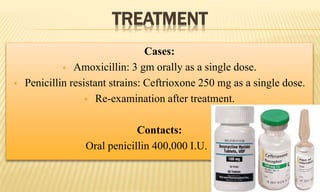
TREATMENT
Cases:
 Amoxicillin: 3 gm orally as a single dose.
 Penicillin resistant strains: Ceftrioxone 250 mg as a single dose.
 Re-examination after treatment.
Contacts:
Oral penicillin 400,000 I.U.
STD

STD

  • 1.
    SEXUALLY TRANSMITTED DISEASES(STDS) (VENEREALDISEASES) Dr. Dalia El-Shafei Assist.Prof., Community Medicine Department, Zagazig University http://www.slideshare.net/daliaelshafei
  • 2.
    Group of communicablediseases in which sexual contact is the most important mode of transmission. Increasing incidence worldwide. Cost & Difficulties in ttt of diseases & complications. Socioeconomic & behavioral problem “linked to addiction, low level of religious values, increase age of marriage, etc”. Importance:
  • 3.
  • 5.
    A life threateningclinical condition that represent the late clinical stage of infection with HIV which results in progressive damage to the immune and other organ systems specially CNS. Acquired Immunodeficiency Syndrome (AIDS) Causative agent:  Human immune deficiency virus (HIV): DNA retrovirus.  2 serologically & geographically distinct types with similar epidemiological characteristics:HIV-1 & HIV-2.
  • 7.
    Specific affinity toT-helper lymphocyte cells causing their depletion.
  • 8.
     Reservoir: man Exit: in blood and body fluids e.g. semen, vaginal secretion, saliva and tears.  Period of communicability: so long the infected person is alive.  IP: variable, but 50% of those infected develop AIDS about 10 years after infection.
  • 10.
  • 11.
    Specific indicator diseases: Opportunistic infections •Pneumocystis carinii pneumonia • Chronic cryptosporidiosis • CNS toxoplasmosis. Neurologic diseases • Dementia • Sensory neuropathy. Cancers • Kaposi sarcoma • Hodgkin's lymphoma. Others • T.B.
  • 14.
    HIV CONTROL Preventive measures: 1ry(HE - ↑ religious roots - disposable syringe - testing blood donors - no tattooing or acupuncture) 2ry Measures for cases: Case finding – Notification - Isolation is unnecessary - Disinfection - ttt of opportunistic infections, Antiretroviral ttt. Measures for contacts: Notification – Screening – HE - No vaccination or chemoprophylaxis).
  • 15.
    No vaccination isavailable yet. Pre-exposure prophylaxis (PrEP) • Highly effective in preventing HIV infection. • 2 oral antiretroviral “ARV” medications (tenofovir & emtricitabine) • Co-formulated as a single pill (Truvada) that is taken once daily. Post-exposure prophylaxis (PEP) • 2014 WHO guidelines • Irrespective of exposure source • As soon as possible to be effective • Within 72 hours (3 days) after a possible exposure • 3 or more ARV medicines every day for 28 days.
  • 18.
    N .B. WHO recommendsimmunization of asymptomatic HIV infected children with the EPI (Expanded program Immunization) vaccines; those who are symptomatic should not receive BCG vaccine. Live Measles-Mumps-Rubella (MMR) & polio vaccines are recommended for all HIV-infected
  • 20.
  • 22.
    • Spirochaete, treponemapallidum. • Delicate & is rapidly killed by: Causative organism Drying High temperature Disinfectants Soap & water
  • 23.
    Reservoir: Man: untreatedcase is infectious during the 1ry & 2ry stages of disease, usually for 2-4 years. Exit: • Exudates of skin & mucous membranes. • Blood & body fluids (semen, saliva, vaginal & cervical discharge). IP: About 3 weeks • Worldwide disease affecting mainly age group from 15-39 • Recently it was found to be increasing.
  • 24.
    TRANSMISSION Contact with open lesion •Sexuel contact (Most important mode). • Kissing. • Contact with baby having congenital syphilis. • Contact with contaminated articles. Congenital infection • Trans-placental from 4th month till delivery (not before as treponema can’t pass BPB). Inoculation infection • Contaminated blood & body fluids (contaminated syringes & needles & blood transfusion).
  • 28.
    Primary syphilis: • Chancreat portal of entry: firm, indurate, painless & highly infectious ulcer. • Enlarged lymph nodes. • Spontaneously disappears without treatment after 4-6 weeks.
  • 29.
    Secondary: • Generalized skinrash “Patchy lesions of mucous membranes especially mouth”. • Involvement of other parts of body. • Spontaneously disappears within weeks or months followed after a latent period (years) by the 3rd stage.
  • 30.
    Late symptomatic syphilis: Reappearance of symptoms.  Characterized by occurrence of neuro & cardiovascular syphilis & characteristic lesions involving different parts of body.
  • 31.
    History & c/p Labinvestigations • Dark field microscopic exam • Serologic testing: • 1-Non-treponemal test (non-specific): for screening e.g. Wassermann Reaction (WR) & Venereal Disease Research Laboratory test (VDRL) “↑false +ve”. • 2-Treponemal tests (specific test): Use treponema Ag. e.g. fluorescent treponema antibody absorption test. DIAGNOSIS
  • 32.
    PREVENTION A. General measures: B.Specific: Chemoprophylaxis: 1 dose of 2.4 million units of long acting penicillin I.M. soon after exposure. Avoidance of sexual promiscuity. Health education to increase awareness. Religious & social guidance especially of youth. Convenient family life & supervision of youth. Suitable places for leisure time & development of hobbies. Socioeconomic development & provide facility for marriage.
  • 33.
    A. Cases: 1. Earlycase finding: during survey & on health appraisal: • Premarital & prenatal examination. • Exam of food handlers, blood donors, army recruits, child nurses. • Suspected attendants of medical services. • Diagnosis of congenital syphilis when mother is syphilitic. 2. Measures for cases: • Notification confidentially to LHO. • Isolation: not needed but avoid sexual contact till elimination of infectivity. • Disinfection: non but precautions with blood & body fluids.
  • 34.
    SPECIFIC TREATMENT: • Longacting penicillin 2.4 million units in a single dose I.M. • Penicillin sensitive patients: doxycycline 100 mg twice daily for 14 days. • Re-examination after treatment.
  • 35.
    B. Contacts: • Tracing& Enlistment. • Examination. • Health education. • Surveillance. • Chemoprophylaxis: 1 dose of 2.4 million units of long acting penicillin I.M. C. Congenital syphilis: • Serologic testing & ttt. • Proper handling of baby with congenital syphilis with caution to avoid infection.
  • 36.
  • 37.
    • Neisseria gonorrhea(Gonococcus) • Delicate Gram -ve, intracellular diplococcus that perishes rapidly outside the body. Acute infectious STD which can become chronic if neglected.
  • 38.
    Reservoir Man: case “infectious for monthsor years if not treated, while ttt eliminates infection within days”. Exit Discharges of infected mucous membranes. Transmission Direct sexual contact only. IP. 3-4 days
  • 39.
    CLINICAL PICTURE Starts asacute infection & if not properly treated it becomes chronic. • In males: urethritis with purulent discharges. • In females: urethritis and/or cervicitis with discharges. • Arthritis, pharyngitis, rectal infection, septicaemia, endocarditis or meningitis may occur in both sexes.
  • 41.
    DIAGNOSIS History & C/P. Labinvestigations: • Acute case: demonstration of causative organism from film of pus taken from cervix or urethra. • Chronic case: serologic test such as complement fixation test.
  • 42.
    PREVENTION Oral penicillin 400,000I.U. just before or after sexual exposure.
  • 43.
    TREATMENT Cases:  Amoxicillin: 3gm orally as a single dose.  Penicillin resistant strains: Ceftrioxone 250 mg as a single dose.  Re-examination after treatment. Contacts: Oral penicillin 400,000 I.U.