Probability and Inferential Statistics

• Probability – probability of occurrences are
assigned in the inferential process under
conditions of uncertainty
Methods of assigning
probability
• Classical method of assigning probability
(rules and laws)
• Relative frequency of occurrence
(cumulated historical data)
• Subjective Probability (personal intuition
or reasoning)
Classical probability:
Assigning probability
• Each outcome is equally likely
• Number of outcomes leading to the event
divided by the total number of outcomes
possible which is denoted as
P(E) = ne/N
where N = total number of outcomes, and
ne = number of outcomes in event E
P(E) = probability of event E
Classical probability:
Assigning probability …. continued
Probability of event E can also be defined as
Number of outcomes favourable for E to occur
divided by
Total number of outcomes in Sample space S
Measured on a scale between 0 and 1 inclusive. If E is impossible
P(E) = 0, if E is certain then P(E) = 1.
Probability and related terms:
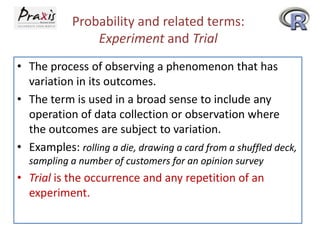
Experiment and Trial
• The process of observing a phenomenon that has
variation in its outcomes.
• The term is used in a broad sense to include any
operation of data collection or observation where
the outcomes are subject to variation.
• Examples: rolling a die, drawing a card from a shuffled deck,
sampling a number of customers for an opinion survey

• Trial is the occurrence and any repetition of an
experiment.
Probability and related terms:
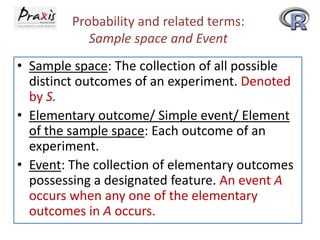
Sample space and Event
• Sample space: The collection of all possible
distinct outcomes of an experiment. Denoted
by S.
• Elementary outcome/ Simple event/ Element
of the sample space: Each outcome of an
experiment.
• Event: The collection of elementary outcomes
possessing a designated feature. An event A
occurs when any one of the elementary
outcomes in A occurs.
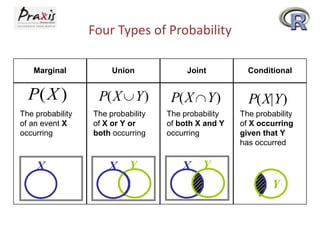
Four Types of Probability
Marginal

Union

Joint

Conditional

P( X )

P( X Y )

P( X Y )

P( X| Y )

The probability
of both X and Y
occurring

The probability
of X occurring
given that Y
has occurred

The probability
of an event X
occurring

X

The probability
of X or Y or
both occurring

X Y

X Y
Y
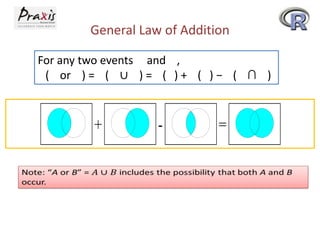
General Law of Addition
For any two events and ,
( or ) = ( ∪ ) = ( ) + ( ) − ( ∩ )

+

-

=
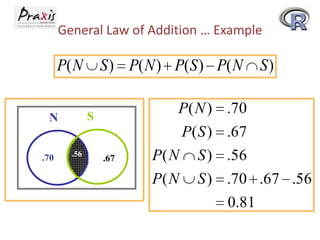
General Law of Addition … Example

P( N

.56

S)

P( N ) .70

S

N
.70

S ) P( N ) P ( S ) P ( N

.67

P( S ) .67
P( N S ) .56
P( N

S ) .70 .67 .56
0.81
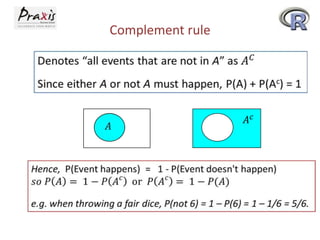
Complement rule
Law of Multiplication
• As we know, the intersection of two events is
called the joint probability
• General law of multiplication is used to find the
joint probability
• General law of multiplication gives the probability
that both events x and y will occur at the same
time
• P(x|y) is a conditional probability that can be
stated as the probability of x given y
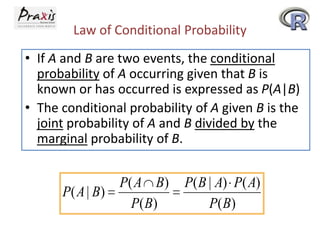
Law of Conditional Probability
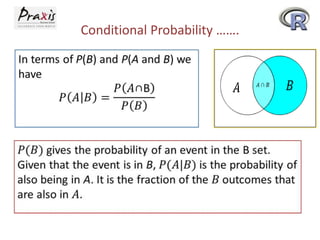
• If A and B are two events, the conditional
probability of A occurring given that B is
known or has occurred is expressed as P(A|B)
• The conditional probability of A given B is the
joint probability of A and B divided by the
marginal probability of B.

P( A B)
P( A | B)
P( B)

P( B | A) P( A)
P( B)
Conditional Probability …….
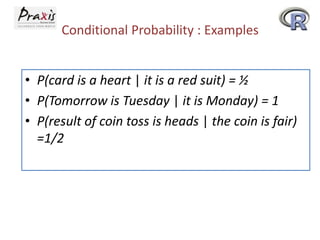
Conditional Probability : Examples
• P(card is a heart | it is a red suit) = ½
• P(Tomorrow is Tuesday | it is Monday) = 1
• P(result of coin toss is heads | the coin is fair)
=1/2
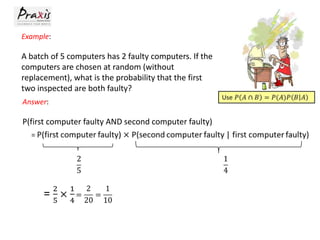
Example:

A batch of 5 computers has 2 faulty computers. If the
computers are chosen at random (without
replacement), what is the probability that the first
two inspected are both faulty?
Answer:

P(first computer faulty AND second computer faulty)
Drawing cards

Drawing two random cards from a pack
without replacement, what is the
probability of getting two hearts?
[13 of the 52 cards in a pack are hearts]

1.
2.
3.
4.

1/16
3/51
3/52
1/4

46%

31%

14%

1

2

3

10%

4
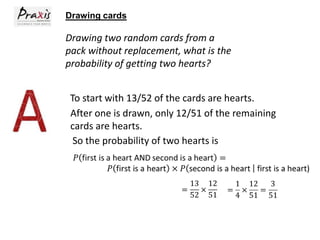
Drawing cards

Drawing two random cards from a
pack without replacement, what is the
probability of getting two hearts?
To start with 13/52 of the cards are hearts.
After one is drawn, only 12/51 of the remaining
cards are hearts.
So the probability of two hearts is
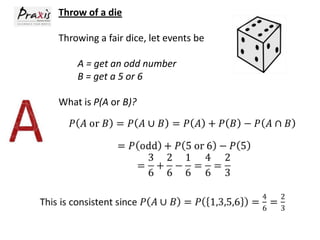
Throw of a die
Throwing a fair dice, let events be
A = get an odd number
B = get a 5 or 6

What is P(A or B)?
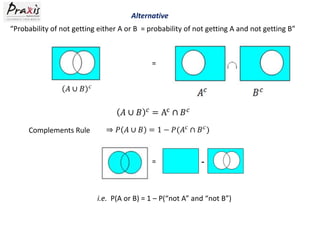
Alternative
“Probability of not getting either A or B = probability of not getting A and not getting B”

=

Complements Rule

=

i.e. P(A or B) = 1 – P(“not A” and “not B”)
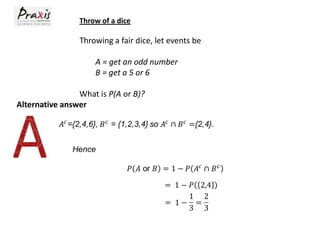
Throw of a dice

Throwing a fair dice, let events be
A = get an odd number
B = get a 5 or 6
What is P(A or B)?
Alternative answer
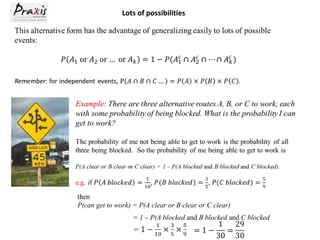
Lots of possibilities

then
P(can get to work) = P(A clear or B clear or C clear)
= 1 – P(A blocked and B blocked and C blocked
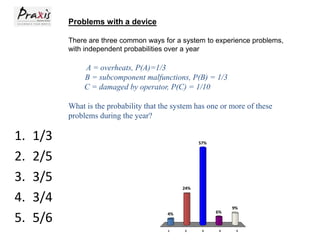
Problems with a device
There are three common ways for a system to experience problems,
with independent probabilities over a year

A = overheats, P(A)=1/3
B = subcomponent malfunctions, P(B) = 1/3
C = damaged by operator, P(C) = 1/10
What is the probability that the system has one or more of these
problems during the year?

1.
2.
3.
4.
5.

1/3
2/5
3/5
3/4
5/6

57%

24%

6%

4%

1

2

3

4

9%

5
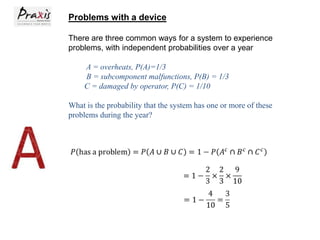
Problems with a device
There are three common ways for a system to experience
problems, with independent probabilities over a year
A = overheats, P(A)=1/3
B = subcomponent malfunctions, P(B) = 1/3
C = damaged by operator, P(C) = 1/10
What is the probability that the system has one or more of these
problems during the year?
B
A

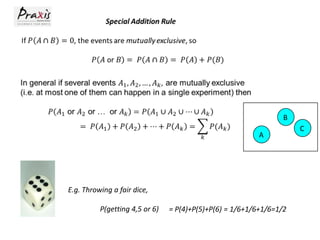
E.g. Throwing a fair dice,
P(getting 4,5 or 6)

= P(4)+P(5)+P(6) = 1/6+1/6+1/6=1/2

C
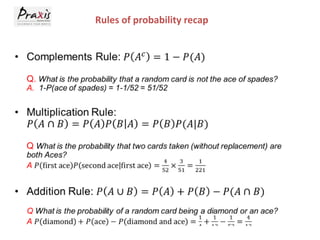
Rules of probability recap
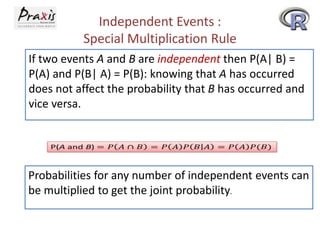
Independent Events :
Special Multiplication Rule
If two events A and B are independent then P(A| B) =
P(A) and P(B| A) = P(B): knowing that A has occurred
does not affect the probability that B has occurred and
vice versa.

Probabilities for any number of independent events can
be multiplied to get the joint probability.
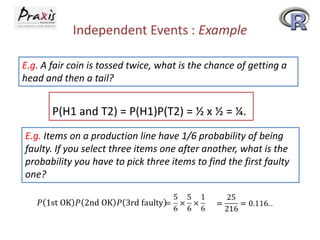
Independent Events : Example
E.g. A fair coin is tossed twice, what is the chance of getting a
head and then a tail?

P(H1 and T2) = P(H1)P(T2) = ½ x ½ = ¼.
E.g. Items on a production line have 1/6 probability of being
faulty. If you select three items one after another, what is the
probability you have to pick three items to find the first faulty
one?

Statr sessions 7 to 8

  • 1.
    Probability and InferentialStatistics • Probability – probability of occurrences are assigned in the inferential process under conditions of uncertainty
  • 2.
    Methods of assigning probability •Classical method of assigning probability (rules and laws) • Relative frequency of occurrence (cumulated historical data) • Subjective Probability (personal intuition or reasoning)
  • 3.
    Classical probability: Assigning probability •Each outcome is equally likely • Number of outcomes leading to the event divided by the total number of outcomes possible which is denoted as P(E) = ne/N where N = total number of outcomes, and ne = number of outcomes in event E P(E) = probability of event E
  • 4.
    Classical probability: Assigning probability…. continued Probability of event E can also be defined as Number of outcomes favourable for E to occur divided by Total number of outcomes in Sample space S Measured on a scale between 0 and 1 inclusive. If E is impossible P(E) = 0, if E is certain then P(E) = 1.
  • 5.
    Probability and relatedterms: Experiment and Trial • The process of observing a phenomenon that has variation in its outcomes. • The term is used in a broad sense to include any operation of data collection or observation where the outcomes are subject to variation. • Examples: rolling a die, drawing a card from a shuffled deck, sampling a number of customers for an opinion survey • Trial is the occurrence and any repetition of an experiment.
  • 6.
    Probability and relatedterms: Sample space and Event • Sample space: The collection of all possible distinct outcomes of an experiment. Denoted by S. • Elementary outcome/ Simple event/ Element of the sample space: Each outcome of an experiment. • Event: The collection of elementary outcomes possessing a designated feature. An event A occurs when any one of the elementary outcomes in A occurs.
  • 7.
    Four Types ofProbability Marginal Union Joint Conditional P( X ) P( X Y ) P( X Y ) P( X| Y ) The probability of both X and Y occurring The probability of X occurring given that Y has occurred The probability of an event X occurring X The probability of X or Y or both occurring X Y X Y Y
  • 8.
    General Law ofAddition For any two events and , ( or ) = ( ∪ ) = ( ) + ( ) − ( ∩ ) + - =
  • 9.
    General Law ofAddition … Example P( N .56 S) P( N ) .70 S N .70 S ) P( N ) P ( S ) P ( N .67 P( S ) .67 P( N S ) .56 P( N S ) .70 .67 .56 0.81
  • 10.
  • 11.
    Law of Multiplication •As we know, the intersection of two events is called the joint probability • General law of multiplication is used to find the joint probability • General law of multiplication gives the probability that both events x and y will occur at the same time • P(x|y) is a conditional probability that can be stated as the probability of x given y
  • 12.
    Law of ConditionalProbability • If A and B are two events, the conditional probability of A occurring given that B is known or has occurred is expressed as P(A|B) • The conditional probability of A given B is the joint probability of A and B divided by the marginal probability of B. P( A B) P( A | B) P( B) P( B | A) P( A) P( B)
  • 13.
  • 14.
    Conditional Probability :Examples • P(card is a heart | it is a red suit) = ½ • P(Tomorrow is Tuesday | it is Monday) = 1 • P(result of coin toss is heads | the coin is fair) =1/2
  • 15.
    Example: A batch of5 computers has 2 faulty computers. If the computers are chosen at random (without replacement), what is the probability that the first two inspected are both faulty? Answer: P(first computer faulty AND second computer faulty)
  • 16.
    Drawing cards Drawing tworandom cards from a pack without replacement, what is the probability of getting two hearts? [13 of the 52 cards in a pack are hearts] 1. 2. 3. 4. 1/16 3/51 3/52 1/4 46% 31% 14% 1 2 3 10% 4
  • 17.
    Drawing cards Drawing tworandom cards from a pack without replacement, what is the probability of getting two hearts? To start with 13/52 of the cards are hearts. After one is drawn, only 12/51 of the remaining cards are hearts. So the probability of two hearts is
  • 18.
    Throw of adie Throwing a fair dice, let events be A = get an odd number B = get a 5 or 6 What is P(A or B)?
  • 19.
    Alternative “Probability of notgetting either A or B = probability of not getting A and not getting B” = Complements Rule = i.e. P(A or B) = 1 – P(“not A” and “not B”)
  • 20.
    Throw of adice Throwing a fair dice, let events be A = get an odd number B = get a 5 or 6 What is P(A or B)? Alternative answer
  • 21.
    Lots of possibilities then P(canget to work) = P(A clear or B clear or C clear) = 1 – P(A blocked and B blocked and C blocked
  • 22.
    Problems with adevice There are three common ways for a system to experience problems, with independent probabilities over a year A = overheats, P(A)=1/3 B = subcomponent malfunctions, P(B) = 1/3 C = damaged by operator, P(C) = 1/10 What is the probability that the system has one or more of these problems during the year? 1. 2. 3. 4. 5. 1/3 2/5 3/5 3/4 5/6 57% 24% 6% 4% 1 2 3 4 9% 5
  • 23.
    Problems with adevice There are three common ways for a system to experience problems, with independent probabilities over a year A = overheats, P(A)=1/3 B = subcomponent malfunctions, P(B) = 1/3 C = damaged by operator, P(C) = 1/10 What is the probability that the system has one or more of these problems during the year?
  • 24.
    B A E.g. Throwing afair dice, P(getting 4,5 or 6) = P(4)+P(5)+P(6) = 1/6+1/6+1/6=1/2 C
  • 25.
  • 26.
    Independent Events : SpecialMultiplication Rule If two events A and B are independent then P(A| B) = P(A) and P(B| A) = P(B): knowing that A has occurred does not affect the probability that B has occurred and vice versa. Probabilities for any number of independent events can be multiplied to get the joint probability.
  • 27.
    Independent Events :Example E.g. A fair coin is tossed twice, what is the chance of getting a head and then a tail? P(H1 and T2) = P(H1)P(T2) = ½ x ½ = ¼. E.g. Items on a production line have 1/6 probability of being faulty. If you select three items one after another, what is the probability you have to pick three items to find the first faulty one?