Correlation and Regression Analysis:
Learning Objectives
• Explain the purpose of regression analysis and the
meaning of independent versus dependent variables.
• Compute the equation of a simple regression line from a
sample of data, and interpret the slope and intercept of
the equation.
• Estimate values of Y to forecast outcomes using the
regression model.
• Understand residual analysis in testing the assumptions
and in examining the fit underlying the regression line.
• Compute a standard error of the estimate and interpret
its meaning.
• Compute a coefficient of determination and interpret it.
Correlation
• Correlation is a measure of the degree of relatedness
of variables.
• Coefficient of Correlation (r) - applicable only if both
variables being analyzed have at least an interval level
of data.
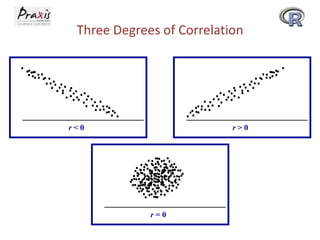
Three Degrees of Correlation

r<0

r>0

r=0
Degree of Correlation
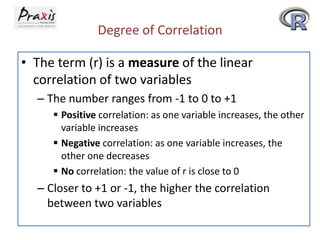
• The term (r) is a measure of the linear
correlation of two variables
– The number ranges from -1 to 0 to +1
 Positive correlation: as one variable increases, the other
variable increases
 Negative correlation: as one variable increases, the
other one decreases
 No correlation: the value of r is close to 0

– Closer to +1 or -1, the higher the correlation
between two variables
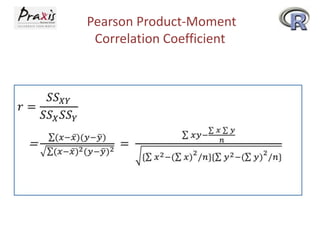
Pearson Product-Moment
Correlation Coefficient
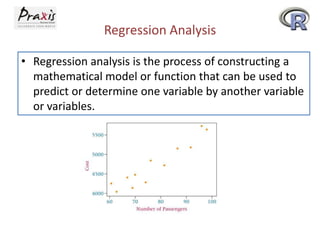
Regression Analysis
• Regression analysis is the process of constructing a
mathematical model or function that can be used to
predict or determine one variable by another variable
or variables.
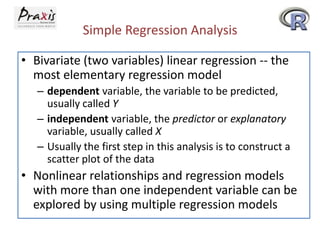
Simple Regression Analysis
• Bivariate (two variables) linear regression -- the
most elementary regression model
– dependent variable, the variable to be predicted,
usually called Y
– independent variable, the predictor or explanatory
variable, usually called X
– Usually the first step in this analysis is to construct a
scatter plot of the data

• Nonlinear relationships and regression models
with more than one independent variable can be
explored by using multiple regression models
Regression Models
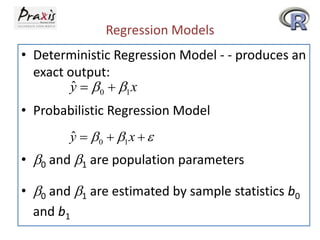
• Deterministic Regression Model - - produces an
exact output:
ˆ
y   0  1 x
• Probabilistic Regression Model
ˆ
y   0  1 x  

• 0 and 1 are population parameters
• 0 and 1 are estimated by sample statistics b0
and b1
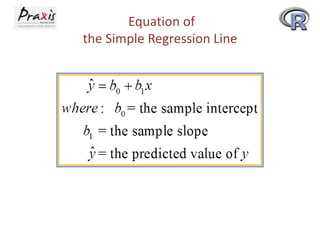
Equation of
the Simple Regression Line
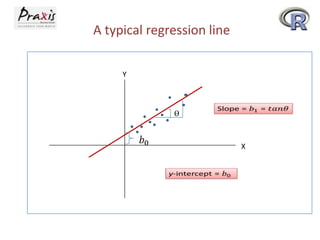
A typical regression line
Y

ϴ

X
Least Squares Analysis
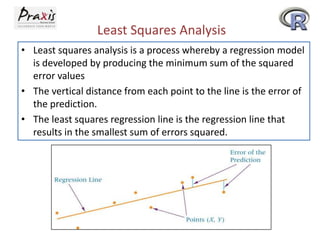
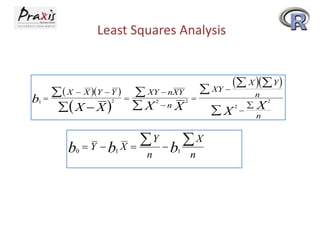
• Least squares analysis is a process whereby a regression model
is developed by producing the minimum sum of the squared
error values
• The vertical distance from each point to the line is the error of
the prediction.
• The least squares regression line is the regression line that
results in the smallest sum of errors squared.
Least Squares Analysis

  X  X Y  Y    XY  nXY

b
 X n X
 X  X 
2

1

2

2





Y   X
b Y b X  n b n
0

1

1

 X  Y 
XY 
n

X

2





X
n

2
Least Squares Analysis
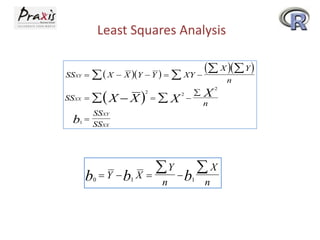
SSXY    X  X Y  Y   
SSXX  

b1 

X  X

2



X

 X  Y 
XY 
n

2





X

2

n

SSXY
SSXX

Y   X
b  Y b X  n b n
0

1

1
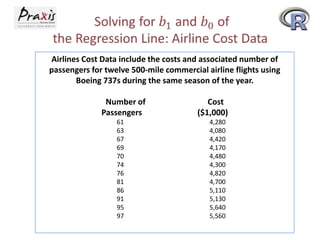
Airlines Cost Data include the costs and associated number of
passengers for twelve 500-mile commercial airline flights using
Boeing 737s during the same season of the year.
Number of
Passengers
61
63
67
69
70
74
76
81
86
91
95
97

Cost
($1,000)
4,280
4,080
4,420
4,170
4,480
4,300
4,820
4,700
5,110
5,130
5,640
5,560
Number of
Passengers
x

x2

61
63
67
69
70
74
76
81
86
91
95
97

x

Cost ($1,000)
y
4.28
4.08
4.42
4.17
4.48
4.30
4.82
4.70
5.11
5.13
5.64
5.56

3,721
3,969
4,489
4,761
4,900
5,476
5,776
6,561
7,396
8,281
9,025
9,409

= 930

y

= 56.69

x

2

= 73,764

xy
261.08
257.04
296.14
287.73
313.60
318.20
366.32
380.70
439.46
466.83
535.80
539.32

 xy

= 4,462.22
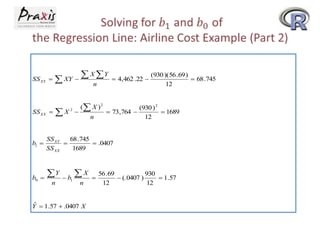
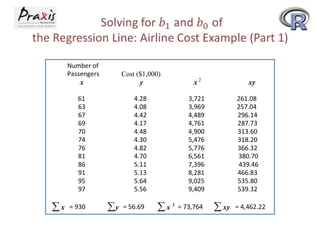
SS XY 

 XY 

SS XX 

X

b1 

b0 

2



 X Y
n
( X ) 2
n

 4,462 .22 

(930 )( 56 .69 )
 68 .745
12

(930 ) 2
 73,764 
 1689
12

SS XY
68 .745

 .0407
SS XX
1689

Y
n

 b1

X
n

ˆ
Y  1.57  .0407 X



56 .69
930
 (. 0407 )
 1.57
12
12
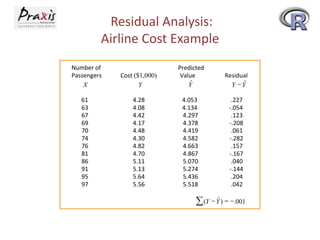
Residual Analysis
Residual Analysis:
Airline Cost Example
Number of
Passengers
X
61
63
67
69
70
74
76
81
86
91
95
97

Cost ($1,000)
Y

Predicted
Value
ˆ
Y

Residual
ˆ
Y Y

4.28
4.08
4.42
4.17
4.48
4.30
4.82
4.70
5.11
5.13
5.64
5.56

4.053
4.134
4.297
4.378
4.419
4.582
4.663
4.867
5.070
5.274
5.436
5.518

.227
-.054
.123
-.208
.061
-.282
.157
-.167
.040
-.144
.204
.042

 (Y  Yˆ )  .001
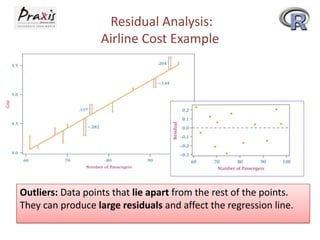
Residual Analysis:
Airline Cost Example

Outliers: Data points that lie apart from the rest of the points.
They can produce large residuals and affect the regression line.
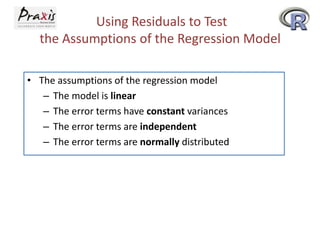
Using Residuals to Test
the Assumptions of the Regression Model
• The assumptions of the regression model
– The model is linear
– The error terms have constant variances
– The error terms are independent
– The error terms are normally distributed
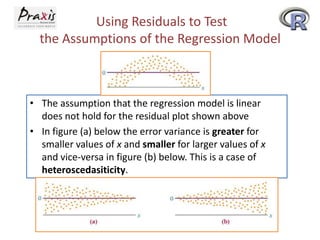
Using Residuals to Test
the Assumptions of the Regression Model

• The assumption that the regression model is linear
does not hold for the residual plot shown above
• In figure (a) below the error variance is greater for
smaller values of x and smaller for larger values of x
and vice-versa in figure (b) below. This is a case of
heteroscedasiticity.
Standard Error of the Estimate
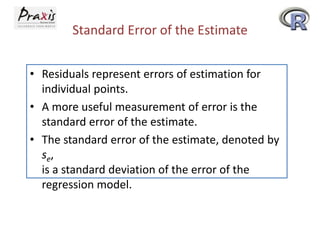
• Residuals represent errors of estimation for
individual points.
• A more useful measurement of error is the
standard error of the estimate.
• The standard error of the estimate, denoted by
se,
is a standard deviation of the error of the
regression model.
Standard Error of the Estimate

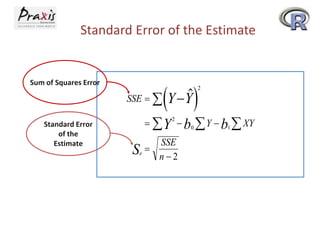
Sum of Squares Error

SSE  
Standard Error
of the
Estimate

 

Y Y

2

  Y  b0  Y  b1  XY
2

SSE
Se  n  2
Determining SSE for the
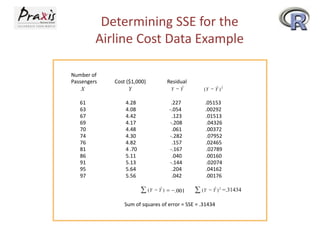
Airline Cost Data Example
Number of
Passengers
X

Cost ($1,000)
Y

Residual
ˆ
Y Y

ˆ
(Y  Y ) 2

61
63
67
69
70
74
76
81
86
91
95
97

4.28
4.08
4.42
4.17
4.48
4.30
4.82
4 .70
5.11
5.13
5.64
5.56

.227
-.054
.123
-.208
.061
-.282
.157
-.167
.040
-.144
.204
.042

.05153
.00292
.01513
.04326
.00372
.07952
.02465
.02789
.00160
.02074
.04162
.00176

 (Y

ˆ
 Y )  .001

 (Y

ˆ
 Y ) 2 =.31434

Sum of squares of error = SSE = .31434
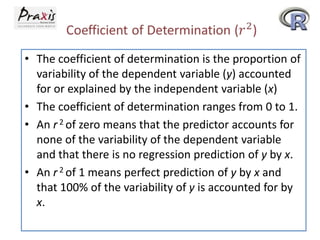
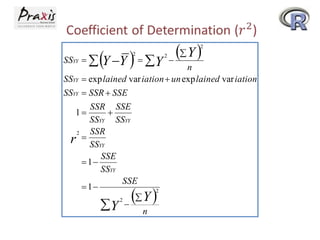
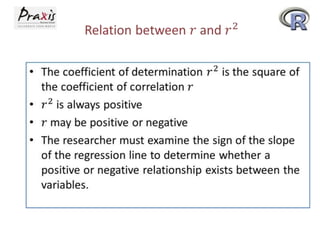
• The coefficient of determination is the proportion of
variability of the dependent variable (y) accounted
for or explained by the independent variable (x)
• The coefficient of determination ranges from 0 to 1.
• An r 2 of zero means that the predictor accounts for
none of the variability of the dependent variable
and that there is no regression prediction of y by x.
• An r 2 of 1 means perfect prediction of y by x and
that 100% of the variability of y is accounted for by
x.
SSYY  

Y Y   Y
2

 Y 


2

2

n
SSYY  exp lained var iation  un exp lained var iation
SSYY  SSR  SSE
SSR SSE
1

SSYY SSYY
SSR
2

r SSYY
SSE
 1
SSYY
SSE
 1
2
Y
2
Y  n

 
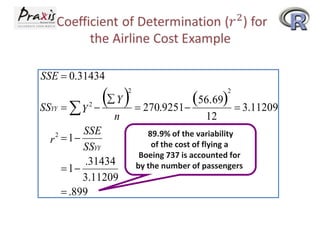
SSE  0.31434

 Y   270.9251 56.69  3.11209
 Y 
2

SSYY

2

n

SSE
r  1
SSYY
.31434
 1
3.11209
 .899
2

2

12

89.9% of the variability
of the cost of flying a
Boeing 737 is accounted for
by the number of passengers.
Exercise in R:
Linear Regression

Open URL: www.openintro.org
Go to Labs in R and select 7 - Linear Regression

Statr session14, Jan 11

  • 1.
    Correlation and RegressionAnalysis: Learning Objectives • Explain the purpose of regression analysis and the meaning of independent versus dependent variables. • Compute the equation of a simple regression line from a sample of data, and interpret the slope and intercept of the equation. • Estimate values of Y to forecast outcomes using the regression model. • Understand residual analysis in testing the assumptions and in examining the fit underlying the regression line. • Compute a standard error of the estimate and interpret its meaning. • Compute a coefficient of determination and interpret it.
  • 2.
    Correlation • Correlation isa measure of the degree of relatedness of variables. • Coefficient of Correlation (r) - applicable only if both variables being analyzed have at least an interval level of data.
  • 3.
    Three Degrees ofCorrelation r<0 r>0 r=0
  • 4.
    Degree of Correlation •The term (r) is a measure of the linear correlation of two variables – The number ranges from -1 to 0 to +1  Positive correlation: as one variable increases, the other variable increases  Negative correlation: as one variable increases, the other one decreases  No correlation: the value of r is close to 0 – Closer to +1 or -1, the higher the correlation between two variables
  • 5.
  • 6.
    Regression Analysis • Regressionanalysis is the process of constructing a mathematical model or function that can be used to predict or determine one variable by another variable or variables.
  • 7.
    Simple Regression Analysis •Bivariate (two variables) linear regression -- the most elementary regression model – dependent variable, the variable to be predicted, usually called Y – independent variable, the predictor or explanatory variable, usually called X – Usually the first step in this analysis is to construct a scatter plot of the data • Nonlinear relationships and regression models with more than one independent variable can be explored by using multiple regression models
  • 8.
    Regression Models • DeterministicRegression Model - - produces an exact output: ˆ y   0  1 x • Probabilistic Regression Model ˆ y   0  1 x   • 0 and 1 are population parameters • 0 and 1 are estimated by sample statistics b0 and b1
  • 9.
    Equation of the SimpleRegression Line
  • 10.
  • 11.
    Least Squares Analysis •Least squares analysis is a process whereby a regression model is developed by producing the minimum sum of the squared error values • The vertical distance from each point to the line is the error of the prediction. • The least squares regression line is the regression line that results in the smallest sum of errors squared.
  • 12.
    Least Squares Analysis  X  X Y  Y    XY  nXY  b  X n X  X  X  2 1 2 2   Y   X b Y b X  n b n 0 1 1  X  Y  XY  n X 2   X n 2
  • 13.
    Least Squares Analysis SSXY   X  X Y  Y    SSXX   b1  X  X 2  X  X  Y  XY  n 2   X 2 n SSXY SSXX Y   X b  Y b X  n b n 0 1 1
  • 14.
    Airlines Cost Datainclude the costs and associated number of passengers for twelve 500-mile commercial airline flights using Boeing 737s during the same season of the year. Number of Passengers 61 63 67 69 70 74 76 81 86 91 95 97 Cost ($1,000) 4,280 4,080 4,420 4,170 4,480 4,300 4,820 4,700 5,110 5,130 5,640 5,560
  • 15.
  • 16.
    SS XY  XY  SS XX  X b1  b0  2   X Y n ( X ) 2 n  4,462 .22  (930 )( 56 .69 )  68 .745 12 (930 ) 2  73,764   1689 12 SS XY 68 .745   .0407 SS XX 1689 Y n  b1 X n ˆ Y  1.57  .0407 X  56 .69 930  (. 0407 )  1.57 12 12
  • 17.
  • 18.
    Residual Analysis: Airline CostExample Number of Passengers X 61 63 67 69 70 74 76 81 86 91 95 97 Cost ($1,000) Y Predicted Value ˆ Y Residual ˆ Y Y 4.28 4.08 4.42 4.17 4.48 4.30 4.82 4.70 5.11 5.13 5.64 5.56 4.053 4.134 4.297 4.378 4.419 4.582 4.663 4.867 5.070 5.274 5.436 5.518 .227 -.054 .123 -.208 .061 -.282 .157 -.167 .040 -.144 .204 .042  (Y  Yˆ )  .001
  • 19.
    Residual Analysis: Airline CostExample Outliers: Data points that lie apart from the rest of the points. They can produce large residuals and affect the regression line.
  • 20.
    Using Residuals toTest the Assumptions of the Regression Model • The assumptions of the regression model – The model is linear – The error terms have constant variances – The error terms are independent – The error terms are normally distributed
  • 21.
    Using Residuals toTest the Assumptions of the Regression Model • The assumption that the regression model is linear does not hold for the residual plot shown above • In figure (a) below the error variance is greater for smaller values of x and smaller for larger values of x and vice-versa in figure (b) below. This is a case of heteroscedasiticity.
  • 22.
    Standard Error ofthe Estimate • Residuals represent errors of estimation for individual points. • A more useful measurement of error is the standard error of the estimate. • The standard error of the estimate, denoted by se, is a standard deviation of the error of the regression model.
  • 23.
    Standard Error ofthe Estimate Sum of Squares Error SSE   Standard Error of the Estimate    Y Y 2   Y  b0  Y  b1  XY 2 SSE Se  n  2
  • 24.
    Determining SSE forthe Airline Cost Data Example Number of Passengers X Cost ($1,000) Y Residual ˆ Y Y ˆ (Y  Y ) 2 61 63 67 69 70 74 76 81 86 91 95 97 4.28 4.08 4.42 4.17 4.48 4.30 4.82 4 .70 5.11 5.13 5.64 5.56 .227 -.054 .123 -.208 .061 -.282 .157 -.167 .040 -.144 .204 .042 .05153 .00292 .01513 .04326 .00372 .07952 .02465 .02789 .00160 .02074 .04162 .00176  (Y ˆ  Y )  .001  (Y ˆ  Y ) 2 =.31434 Sum of squares of error = SSE = .31434
  • 25.
    • The coefficientof determination is the proportion of variability of the dependent variable (y) accounted for or explained by the independent variable (x) • The coefficient of determination ranges from 0 to 1. • An r 2 of zero means that the predictor accounts for none of the variability of the dependent variable and that there is no regression prediction of y by x. • An r 2 of 1 means perfect prediction of y by x and that 100% of the variability of y is accounted for by x.
  • 26.
    SSYY   YY   Y 2  Y   2 2 n SSYY  exp lained var iation  un exp lained var iation SSYY  SSR  SSE SSR SSE 1  SSYY SSYY SSR 2  r SSYY SSE  1 SSYY SSE  1 2 Y 2 Y  n  
  • 27.
    SSE  0.31434 Y   270.9251 56.69  3.11209  Y  2 SSYY 2 n SSE r  1 SSYY .31434  1 3.11209  .899 2 2 12 89.9% of the variability of the cost of flying a Boeing 737 is accounted for by the number of passengers.
  • 29.
    Exercise in R: LinearRegression Open URL: www.openintro.org Go to Labs in R and select 7 - Linear Regression