Probability and Random process
Probability and Random Variables
section two
Eng. Abdirahman Farah Ali
C.raxmaanfc@gmail.com
1
2
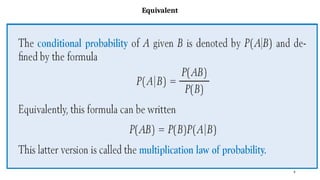
Conditional Probability
Conditional probability is defined as the likelihood of an event or outcome occurring,
based on the occurrence of a previous event or outcome.
 Conditional probability is calculated by multiplying the probability of the preceding
event by the updated probability of the succeeding, or conditional, event.
For example:
Event A is that an individual applying for college will be accepted.
There is an 80% chance that this individual will be accepted to college.
Event B is that this individual will be given dormitory housing.
 Dormitory housing will only be provided for 60% of all of the accepted students.
P (Accepted and dormitory housing) = P (Dormitory Housing | Accepted) P (Accepted) =
(0.60)*(0.80) = 0.48.
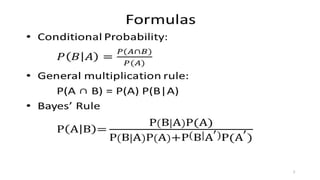
Equivalent
4
5
CONTINUE…….
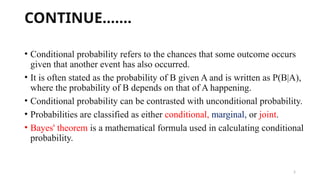
• Conditional probability refers to the chances that some outcome occurs
given that another event has also occurred.
• It is often stated as the probability of B given A and is written as P(B|A),
where the probability of B depends on that of A happening.
• Conditional probability can be contrasted with unconditional probability.
• Probabilities are classified as either conditional, marginal, or joint.
• Bayes' theorem is a mathematical formula used in calculating conditional
probability.
6
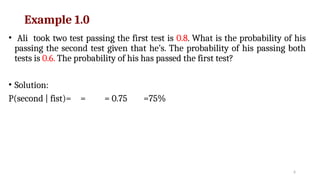
Example 1.0
• Ali took two test passing the first test is 0.8. What is the probability of his
passing the second test given that he’s. The probability of his passing both
tests is 0.6. The probability of his has passed the first test?
• Solution:
P(second | fist)= = = 0.75 =75%
7
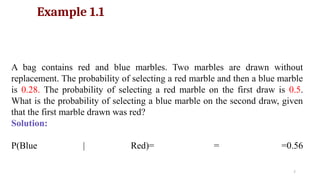
Example 1.1
A bag contains red and blue marbles. Two marbles are drawn without
replacement. The probability of selecting a red marble and then a blue marble
is 0.28. The probability of selecting a red marble on the first draw is 0.5.
What is the probability of selecting a blue marble on the second draw, given
that the first marble drawn was red?
Solution:
P(Blue | Red)= = =0.56
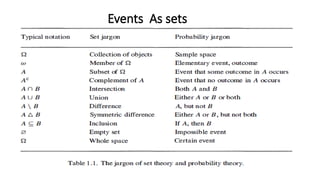
Events As sets
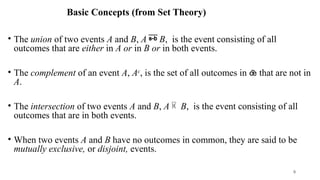
Basic Concepts (from Set Theory)
• The union of two events A and B, A  B, is the event consisting of all
outcomes that are either in A or in B or in both events.
• The complement of an event A, Ac
, is the set of all outcomes in  that are not in
A.
• The intersection of two events A and B, A  B, is the event consisting of all
outcomes that are in both events.
• When two events A and B have no outcomes in common, they are said to be
mutually exclusive, or disjoint, events.
9
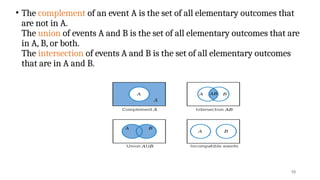
• The complement of an event A is the set of all elementary outcomes that
are not in A.
The union of events A and B is the set of all elementary outcomes that are
in A, B, or both.
The intersection of events A and B is the set of all elementary outcomes
that are in A and B.
10
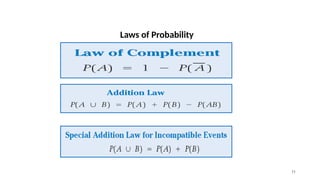
Laws of Probability
11
Universal Set
• A universal set is a set that contains all the elements we are interested in.
This would have to be defined by the context.
• A complement is relative to the universal set, so Ac contains all the elements in the
universal set that are not in A.
Examples
a) If we were discussing searching for books, the universal set might be all the books in
the library.
b) If we were grouping your Facebook friends, the universal set would be all your
Facebook friends.
c) If you were working with sets of numbers, the universal set might be all whole
numbers, all integers, or all real numbers
• Example
• Suppose the universal set is U = all whole numbers from 1 to 9. If A = {1, 2, 4}, then
• Ac
= {3, 5, 6, 7, 8, 9}.
Types of events
• There are many types of events you will need to able to identify and work with:
• Impossible and Sure Events
• Simple Events
• Compound Events
• Independent and Dependent Events
• Mutually Exclusive Events
• Exhaustive Events
• Complementary Events
We will talk some of them
Sure and Unsure Events:
An event whose chances of happening is 100 % is called a sure event.
The probability of such an event is 1. In a sure event, one is likely to get the
desired output in the whole sample experiment.
On the other hand, when there are no chances of an event happening, the
probability of such an event is likely to be zero. This is said to be an impossible
event.
On the basis of quality events, these are classified into three types which are
as follows:
Independent Events
Dependent Events
Mutually-Exclusive Events
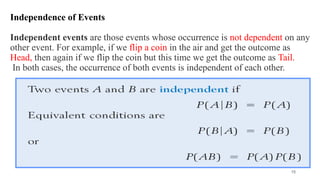
Independence of Events
Independent events are those events whose occurrence is not dependent on any
other event. For example, if we flip a coin in the air and get the outcome as
Head, then again if we flip the coin but this time we get the outcome as Tail.
In both cases, the occurrence of both events is independent of each other.
15
Example 1
A mechanical system consists of two components. Component 1 has reliability
(probability of not failing) 0 .98 and component 2 has reliability 0 .95. If the system
can function only if both components function, what is the reliability of the system?
Solution
Let
A1 denote “component 1 functions”,
A2 denote “component 2 functions”,
S denote “system functions”.
Given that the components operate independently, we take the events A1 and A2 to be
independent.
Thus, P(S) = P(A1) P(A2) = 0.98 *0 .95 = 0.931
16
17
Prior
• Prior probability is the probability of an event occurring before any
data has been gathered to determine the probability.
• It is the probability as determined by a prior belief. Prior probability
is a component of Bayesian statistical inference.
Rule of Addition
• The rule of addition (also known as the "OR" rule) states that the probability of two or
more mutually exclusive events occurring is the sum of the probabilities of the individual events
occurring.
• Example 1: if you have a coin and you want to know the probability of it landing on heads "or"
tails, then the answer would be 1/2 + 1/2 = 1. This means that there is a 100% chance that either
heads or tails will occur.
• Example 2: If you have two events, A and B, and the probability of event A occurring is 0.40 and
the probability of event B occurring is 0.30, the probability of events A "or" B occurring is 0.40 +
0.30 = 0.70.
• The above two examples apply when events are mutually exclusive, which means that they
cannot happen at the same time. In this case, the rule of addition says that the probability of either
event happening is the sum of the probabilities of each event happening individually
Cont.….
• On the other hand, if events are not mutually exclusive, it means that they can happen at
the same time.
• In this case, the rule of addition says that the probability of either event happening is the
sum of each event's probabilities minus the probability of both events happening
simultaneously.
• Example 3: If the probability of event A happening is 30% and the probability of event B
happening is 50%, and the probability of both events happening at the same time is 10%,
the probability of either event A or event B happening is 30% + 50% - 10% = 70%.
Rule of Multiplication:
• The multiplication rule (also known as the "AND" rule) states that the probability of
two independent events occurring together is equal to the product of their individual
probabilities.
• Example 1: For example, if you have two events A and B, and the probability of event A
occurring is 0.40 and the probability of event B occurring is 0.30, the probability of events A
"and" B occurring simultaneously is 0.40 * 0.30 = 0.12. This is because the probability of
both events occurring simultaneously is the product of the probabilities of the individual
events occurring.
• Example 2: If you want to calculate the probability of getting a head on the first coin flip and
tails on the second coin flip, you will use the rule of multiplication to determine that the
probability is 0.25 because the probability of getting heads on the first coin flip is 0.50. The
probability of getting tails on the second coin flip is also 0.50, and the probability of both
events occurring simultaneously is 0.50 * 0.50 = 0.25.
• Example 3: Suppose you have a bag containing 3 red balls and 2 green balls. If you want to
find the probability of drawing a red ball (then put this back in the bag: With replacement)
and in the second draw you get a green ball, you would use the rule of multiplication
• P(red AND green) = P(red) * P(green) = (3/5) * (2/5) = 6/25 =0.24
• The rule of addition for mutually exclusive events: P(A or B) = P(A) + P(B)
• The rule of addition for non-mutually exclusive events: P(A or B) = P(A) + P(B) - P(A
and B)
• The rule of multiplication for dependent events: P(A and B) = P(A) * P(B/A)
• The rule of multiplication for non-dependent events: P(A and B) = P(A) * P(B)
Cont…
• When we require the probability of two events occurring simultaneously or
the probability of one or the other or both of two events occurring , then
we need probability laws to carry out the calculations.
• For example, if a traffic management engineer looking at accident rates
wishes to know the probability that cyclists and motorcyclists are injured
during a particular period in a city, he or she must take into account the
fact that a cyclist and a motorcyclist might collide. (Both events can
happen simultaneously.)
Remember
As we have already noted, the sample space S is the set of all possible
outcomes of a given experiment.
Certain events A and B are subsets of S.
A B
∪ denotes the event that event A or event B (or both) occur when the
experiment is performed.
 A ∩ B denotes the event that both A and B occur together.
Mutually exclusive events
• Mutually exclusive events are events that by definition cannot happen
together.
• For example, when tossing a coin, the events ‘head’ and ‘tail’ are mutually
exclusive; when testing a switch ‘operate’ and ‘fail’ are mutually exclusive;
• In such cases, the probability of both events occurring together must be zero.
• Hence, using the usual set theory notation for events A and B, we may write:
P(A ∩ B) = 0, provided that A and B are mutually exclusive events
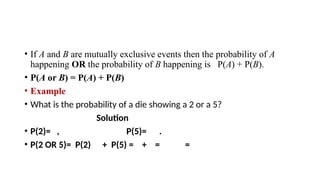
• If A and B are mutually exclusive events then the probability of A
happening OR the probability of B happening is P(A) + P(B).
• P(A or B) = P(A) + P(B)
• Example
• What is the probability of a die showing a 2 or a 5?
Solution
• P(2)= , P(5)= .
• P(2 OR 5)= P(2) + P(5) = + = =
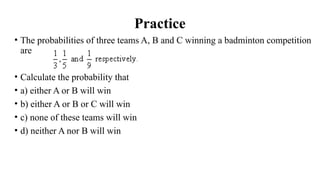
Practice
• The probabilities of three teams A, B and C winning a badminton competition
are
• Calculate the probability that
• a) either A or B will win
• b) either A or B or C will win
• c) none of these teams will win
• d) neither A nor B will win
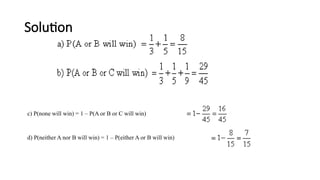
Solution
c) P(none will win) = 1 – P(A or B or C will win)
d) P(neither A nor B will win) = 1 – P(either A or B will win)
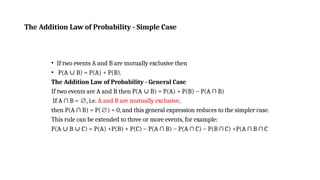
The Addition Law of Probability - Simple Case
• If two events A and B are mutually exclusive then
• P(A B) = P(A) + P(B).
∪
The Addition Law of Probability - General Case
If two events are A and B then P(A B) = P(A) + P(B) − P(A ∩ B)
∪
If A ∩ B = , i.e.
∅ A and B are mutually exclusive,
then P(A ∩ B) = P( ) = 0, and this general expression reduces to the simpler case.
∅
This rule can be extended to three or more events, for example:
P(A B C) = P(A) +P(B) + P(C) − P(A ∩ B) − P(A ∩ C) − P(B ∩ C) +P(A ∩ B ∩ C
∪ ∪
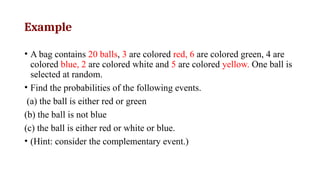
Example
• A bag contains 20 balls, 3 are colored red, 6 are colored green, 4 are
colored blue, 2 are colored white and 5 are colored yellow. One ball is
selected at random.
• Find the probabilities of the following events.
(a) the ball is either red or green
(b) the ball is not blue
(c) the ball is either red or white or blue.
• (Hint: consider the complementary event.)
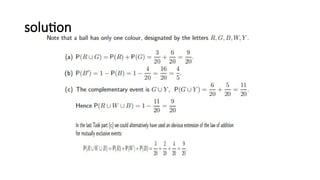
solution
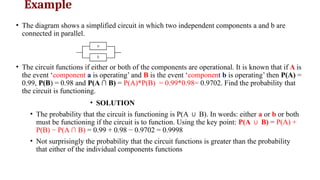
Example
• The diagram shows a simplified circuit in which two independent components a and b are
connected in parallel.
• The circuit functions if either or both of the components are operational. It is known that if A is
the event ‘component a is operating’ and B is the event ‘component b is operating’ then P(A) =
0.99, P(B) = 0.98 and P(A ∩ B) = P(A)*P(B) = 0.99*0.98= 0.9702. Find the probability that
the circuit is functioning.
• SOLUTION
• The probability that the circuit is functioning is P(A B). In words: either
∪ a or b or both
must be functioning if the circuit is to function. Using the key point: P(A B)
∪ = P(A) +
P(B) − P(A ∩ B) = 0.99 + 0.98 − 0.9702 = 0.9998
• Not surprisingly the probability that the circuit functions is greater than the probability
that either of the individual components functions
Practice
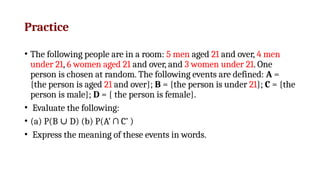
• The following people are in a room: 5 men aged 21 and over, 4 men
under 21, 6 women aged 21 and over, and 3 women under 21. One
person is chosen at random. The following events are defined: A =
{the person is aged 21 and over}; B = {the person is under 21}; C = {the
person is male}; D = { the person is female}.
• Evaluate the following:
• (a) P(B D) (b) P(A’ ∩ C’ )
∪
• Express the meaning of these events in words.
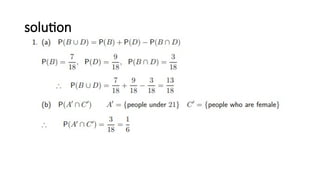
solution
Example 7
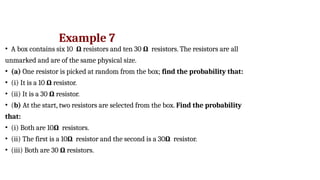
• A box contains six 10 Ω resistors and ten 30 Ω resistors. The resistors are all
unmarked and are of the same physical size.
• (a) One resistor is picked at random from the box; find the probability that:
• (i) It is a 10 Ω resistor.
• (ii) It is a 30 Ω resistor.
• (b) At the start, two resistors are selected from the box. Find the probability
that:
• (i) Both are 10Ω resistors.
• (ii) The first is a 10Ω resistor and the second is a 30Ω resistor.
• (iii) Both are 30 Ω resistors.
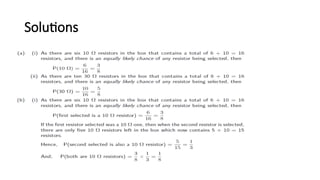
Solutions
Example
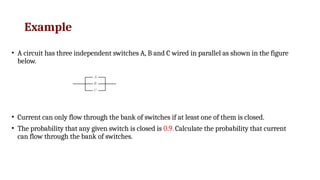
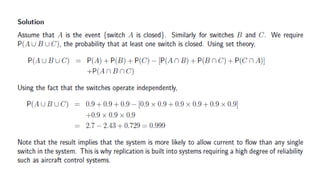
• A circuit has three independent switches A, B and C wired in parallel as shown in the figure
below.
• Current can only flow through the bank of switches if at least one of them is closed.
• The probability that any given switch is closed is 0.9. Calculate the probability that current
can flow through the bank of switches.
practice
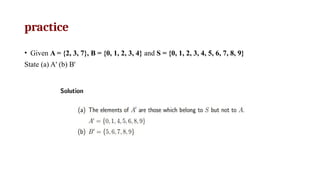
• Given A = {2, 3, 7}, B = {0, 1, 2, 3, 4} and S = {0, 1, 2, 3, 4, 5, 6, 7, 8, 9}
State (a) A' (b) B'
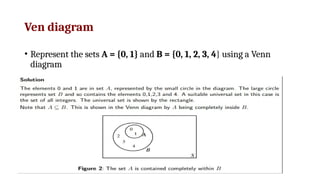
Ven diagram
• Represent the sets A = {0, 1} and B = {0, 1, 2, 3, 4} using a Venn
diagram
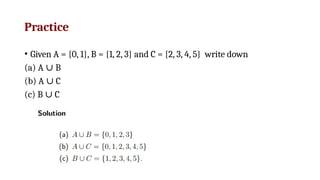
Practice
• Given A = {0, 1}, B = {1, 2, 3} and C = {2, 3, 4, 5} write down
(a) A B
∪
(b) A C
∪
(c) B C
∪
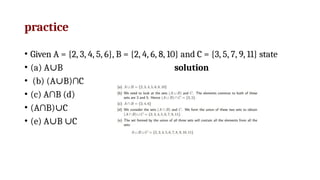
practice
• Given A = {2, 3, 4, 5, 6}, B = {2, 4, 6, 8, 10} and C = {3, 5, 7, 9, 11} state
• (a) A B
∪ solution
• (b) (A B)∩C
∪
• (c) A∩B (d)
• (A∩B) C
∪
• (e) A B C
∪ ∪
Three Diagram
• A tree diagram represents the hierarchy of the events that need to be completed when solving
a problem. The tree diagram starts with one node, and each node has its branches that further
extend into more branches, and a tree-like structure is formed.
• In mathematics, tree diagrams make it easy to visualize and solve probability problems. They
are a significant tool in breaking the problem down in a schematic way. While tree diagrams
can convert many complicated problems into simple ones, they are not very useful when the
sample space becomes too large.
• Tree diagram definition:
• A probability tree diagram represents all the possible outcomes of an event in an organized
manner. It starts with a dot and extends into branches. The probability of each outcome is
written on its branch.
• How to make a tree diagram
Example
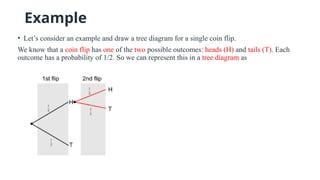
• Let’s consider an example and draw a tree diagram for a single coin flip.
We know that a coin flip has one of the two possible outcomes: heads (H) and tails (T). Each
outcome has a probability of 1/2. So we can represent this in a tree diagram as
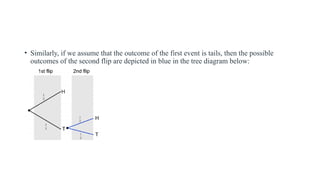
• Similarly, if we assume that the outcome of the first event is tails, then the possible
outcomes of the second flip are depicted in blue in the tree diagram below:
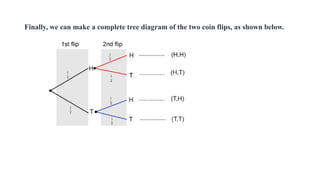
Finally, we can make a complete tree diagram of the two coin flips, as shown below.
Practice
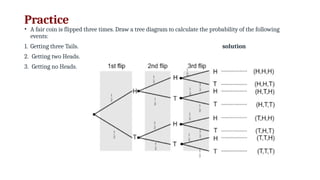
• A fair coin is flipped three times. Draw a tree diagram to calculate the probability of the following
events:
1. Getting three Tails. solution
2. Getting two Heads.
3. Getting no Heads.

Chapter_01.1 Concept Of Probability.pptx

  • 1.
    Probability and Randomprocess Probability and Random Variables section two Eng. Abdirahman Farah Ali C.raxmaanfc@gmail.com 1
  • 2.
    2 Conditional Probability Conditional probabilityis defined as the likelihood of an event or outcome occurring, based on the occurrence of a previous event or outcome.  Conditional probability is calculated by multiplying the probability of the preceding event by the updated probability of the succeeding, or conditional, event. For example: Event A is that an individual applying for college will be accepted. There is an 80% chance that this individual will be accepted to college. Event B is that this individual will be given dormitory housing.  Dormitory housing will only be provided for 60% of all of the accepted students. P (Accepted and dormitory housing) = P (Dormitory Housing | Accepted) P (Accepted) = (0.60)*(0.80) = 0.48.
  • 4.
  • 5.
    5 CONTINUE……. • Conditional probabilityrefers to the chances that some outcome occurs given that another event has also occurred. • It is often stated as the probability of B given A and is written as P(B|A), where the probability of B depends on that of A happening. • Conditional probability can be contrasted with unconditional probability. • Probabilities are classified as either conditional, marginal, or joint. • Bayes' theorem is a mathematical formula used in calculating conditional probability.
  • 6.
    6 Example 1.0 • Alitook two test passing the first test is 0.8. What is the probability of his passing the second test given that he’s. The probability of his passing both tests is 0.6. The probability of his has passed the first test? • Solution: P(second | fist)= = = 0.75 =75%
  • 7.
    7 Example 1.1 A bagcontains red and blue marbles. Two marbles are drawn without replacement. The probability of selecting a red marble and then a blue marble is 0.28. The probability of selecting a red marble on the first draw is 0.5. What is the probability of selecting a blue marble on the second draw, given that the first marble drawn was red? Solution: P(Blue | Red)= = =0.56
  • 8.
  • 9.
    Basic Concepts (fromSet Theory) • The union of two events A and B, A  B, is the event consisting of all outcomes that are either in A or in B or in both events. • The complement of an event A, Ac , is the set of all outcomes in  that are not in A. • The intersection of two events A and B, A  B, is the event consisting of all outcomes that are in both events. • When two events A and B have no outcomes in common, they are said to be mutually exclusive, or disjoint, events. 9
  • 10.
    • The complementof an event A is the set of all elementary outcomes that are not in A. The union of events A and B is the set of all elementary outcomes that are in A, B, or both. The intersection of events A and B is the set of all elementary outcomes that are in A and B. 10
  • 11.
  • 12.
    Universal Set • Auniversal set is a set that contains all the elements we are interested in. This would have to be defined by the context. • A complement is relative to the universal set, so Ac contains all the elements in the universal set that are not in A. Examples a) If we were discussing searching for books, the universal set might be all the books in the library. b) If we were grouping your Facebook friends, the universal set would be all your Facebook friends. c) If you were working with sets of numbers, the universal set might be all whole numbers, all integers, or all real numbers • Example • Suppose the universal set is U = all whole numbers from 1 to 9. If A = {1, 2, 4}, then • Ac = {3, 5, 6, 7, 8, 9}.
  • 13.
    Types of events •There are many types of events you will need to able to identify and work with: • Impossible and Sure Events • Simple Events • Compound Events • Independent and Dependent Events • Mutually Exclusive Events • Exhaustive Events • Complementary Events We will talk some of them
  • 14.
    Sure and UnsureEvents: An event whose chances of happening is 100 % is called a sure event. The probability of such an event is 1. In a sure event, one is likely to get the desired output in the whole sample experiment. On the other hand, when there are no chances of an event happening, the probability of such an event is likely to be zero. This is said to be an impossible event. On the basis of quality events, these are classified into three types which are as follows: Independent Events Dependent Events Mutually-Exclusive Events
  • 15.
    Independence of Events Independentevents are those events whose occurrence is not dependent on any other event. For example, if we flip a coin in the air and get the outcome as Head, then again if we flip the coin but this time we get the outcome as Tail. In both cases, the occurrence of both events is independent of each other. 15
  • 16.
    Example 1 A mechanicalsystem consists of two components. Component 1 has reliability (probability of not failing) 0 .98 and component 2 has reliability 0 .95. If the system can function only if both components function, what is the reliability of the system? Solution Let A1 denote “component 1 functions”, A2 denote “component 2 functions”, S denote “system functions”. Given that the components operate independently, we take the events A1 and A2 to be independent. Thus, P(S) = P(A1) P(A2) = 0.98 *0 .95 = 0.931 16
  • 17.
    17 Prior • Prior probabilityis the probability of an event occurring before any data has been gathered to determine the probability. • It is the probability as determined by a prior belief. Prior probability is a component of Bayesian statistical inference.
  • 18.
    Rule of Addition •The rule of addition (also known as the "OR" rule) states that the probability of two or more mutually exclusive events occurring is the sum of the probabilities of the individual events occurring. • Example 1: if you have a coin and you want to know the probability of it landing on heads "or" tails, then the answer would be 1/2 + 1/2 = 1. This means that there is a 100% chance that either heads or tails will occur. • Example 2: If you have two events, A and B, and the probability of event A occurring is 0.40 and the probability of event B occurring is 0.30, the probability of events A "or" B occurring is 0.40 + 0.30 = 0.70. • The above two examples apply when events are mutually exclusive, which means that they cannot happen at the same time. In this case, the rule of addition says that the probability of either event happening is the sum of the probabilities of each event happening individually
  • 19.
    Cont.…. • On theother hand, if events are not mutually exclusive, it means that they can happen at the same time. • In this case, the rule of addition says that the probability of either event happening is the sum of each event's probabilities minus the probability of both events happening simultaneously. • Example 3: If the probability of event A happening is 30% and the probability of event B happening is 50%, and the probability of both events happening at the same time is 10%, the probability of either event A or event B happening is 30% + 50% - 10% = 70%.
  • 20.
    Rule of Multiplication: •The multiplication rule (also known as the "AND" rule) states that the probability of two independent events occurring together is equal to the product of their individual probabilities. • Example 1: For example, if you have two events A and B, and the probability of event A occurring is 0.40 and the probability of event B occurring is 0.30, the probability of events A "and" B occurring simultaneously is 0.40 * 0.30 = 0.12. This is because the probability of both events occurring simultaneously is the product of the probabilities of the individual events occurring. • Example 2: If you want to calculate the probability of getting a head on the first coin flip and tails on the second coin flip, you will use the rule of multiplication to determine that the probability is 0.25 because the probability of getting heads on the first coin flip is 0.50. The probability of getting tails on the second coin flip is also 0.50, and the probability of both events occurring simultaneously is 0.50 * 0.50 = 0.25. • Example 3: Suppose you have a bag containing 3 red balls and 2 green balls. If you want to find the probability of drawing a red ball (then put this back in the bag: With replacement) and in the second draw you get a green ball, you would use the rule of multiplication • P(red AND green) = P(red) * P(green) = (3/5) * (2/5) = 6/25 =0.24
  • 21.
    • The ruleof addition for mutually exclusive events: P(A or B) = P(A) + P(B) • The rule of addition for non-mutually exclusive events: P(A or B) = P(A) + P(B) - P(A and B) • The rule of multiplication for dependent events: P(A and B) = P(A) * P(B/A) • The rule of multiplication for non-dependent events: P(A and B) = P(A) * P(B)
  • 22.
    Cont… • When werequire the probability of two events occurring simultaneously or the probability of one or the other or both of two events occurring , then we need probability laws to carry out the calculations. • For example, if a traffic management engineer looking at accident rates wishes to know the probability that cyclists and motorcyclists are injured during a particular period in a city, he or she must take into account the fact that a cyclist and a motorcyclist might collide. (Both events can happen simultaneously.)
  • 23.
    Remember As we havealready noted, the sample space S is the set of all possible outcomes of a given experiment. Certain events A and B are subsets of S. A B ∪ denotes the event that event A or event B (or both) occur when the experiment is performed.  A ∩ B denotes the event that both A and B occur together.
  • 24.
    Mutually exclusive events •Mutually exclusive events are events that by definition cannot happen together. • For example, when tossing a coin, the events ‘head’ and ‘tail’ are mutually exclusive; when testing a switch ‘operate’ and ‘fail’ are mutually exclusive; • In such cases, the probability of both events occurring together must be zero. • Hence, using the usual set theory notation for events A and B, we may write: P(A ∩ B) = 0, provided that A and B are mutually exclusive events
  • 25.
    • If Aand B are mutually exclusive events then the probability of A happening OR the probability of B happening is P(A) + P(B). • P(A or B) = P(A) + P(B) • Example • What is the probability of a die showing a 2 or a 5? Solution • P(2)= , P(5)= . • P(2 OR 5)= P(2) + P(5) = + = =
  • 26.
    Practice • The probabilitiesof three teams A, B and C winning a badminton competition are • Calculate the probability that • a) either A or B will win • b) either A or B or C will win • c) none of these teams will win • d) neither A nor B will win
  • 27.
    Solution c) P(none willwin) = 1 – P(A or B or C will win) d) P(neither A nor B will win) = 1 – P(either A or B will win)
  • 28.
    The Addition Lawof Probability - Simple Case • If two events A and B are mutually exclusive then • P(A B) = P(A) + P(B). ∪ The Addition Law of Probability - General Case If two events are A and B then P(A B) = P(A) + P(B) − P(A ∩ B) ∪ If A ∩ B = , i.e. ∅ A and B are mutually exclusive, then P(A ∩ B) = P( ) = 0, and this general expression reduces to the simpler case. ∅ This rule can be extended to three or more events, for example: P(A B C) = P(A) +P(B) + P(C) − P(A ∩ B) − P(A ∩ C) − P(B ∩ C) +P(A ∩ B ∩ C ∪ ∪
  • 29.
    Example • A bagcontains 20 balls, 3 are colored red, 6 are colored green, 4 are colored blue, 2 are colored white and 5 are colored yellow. One ball is selected at random. • Find the probabilities of the following events. (a) the ball is either red or green (b) the ball is not blue (c) the ball is either red or white or blue. • (Hint: consider the complementary event.)
  • 30.
  • 31.
    Example • The diagramshows a simplified circuit in which two independent components a and b are connected in parallel. • The circuit functions if either or both of the components are operational. It is known that if A is the event ‘component a is operating’ and B is the event ‘component b is operating’ then P(A) = 0.99, P(B) = 0.98 and P(A ∩ B) = P(A)*P(B) = 0.99*0.98= 0.9702. Find the probability that the circuit is functioning. • SOLUTION • The probability that the circuit is functioning is P(A B). In words: either ∪ a or b or both must be functioning if the circuit is to function. Using the key point: P(A B) ∪ = P(A) + P(B) − P(A ∩ B) = 0.99 + 0.98 − 0.9702 = 0.9998 • Not surprisingly the probability that the circuit functions is greater than the probability that either of the individual components functions
  • 32.
    Practice • The followingpeople are in a room: 5 men aged 21 and over, 4 men under 21, 6 women aged 21 and over, and 3 women under 21. One person is chosen at random. The following events are defined: A = {the person is aged 21 and over}; B = {the person is under 21}; C = {the person is male}; D = { the person is female}. • Evaluate the following: • (a) P(B D) (b) P(A’ ∩ C’ ) ∪ • Express the meaning of these events in words.
  • 33.
  • 34.
    Example 7 • Abox contains six 10 Ω resistors and ten 30 Ω resistors. The resistors are all unmarked and are of the same physical size. • (a) One resistor is picked at random from the box; find the probability that: • (i) It is a 10 Ω resistor. • (ii) It is a 30 Ω resistor. • (b) At the start, two resistors are selected from the box. Find the probability that: • (i) Both are 10Ω resistors. • (ii) The first is a 10Ω resistor and the second is a 30Ω resistor. • (iii) Both are 30 Ω resistors.
  • 35.
  • 36.
    Example • A circuithas three independent switches A, B and C wired in parallel as shown in the figure below. • Current can only flow through the bank of switches if at least one of them is closed. • The probability that any given switch is closed is 0.9. Calculate the probability that current can flow through the bank of switches.
  • 38.
    practice • Given A= {2, 3, 7}, B = {0, 1, 2, 3, 4} and S = {0, 1, 2, 3, 4, 5, 6, 7, 8, 9} State (a) A' (b) B'
  • 39.
    Ven diagram • Representthe sets A = {0, 1} and B = {0, 1, 2, 3, 4} using a Venn diagram
  • 40.
    Practice • Given A= {0, 1}, B = {1, 2, 3} and C = {2, 3, 4, 5} write down (a) A B ∪ (b) A C ∪ (c) B C ∪
  • 41.
    practice • Given A= {2, 3, 4, 5, 6}, B = {2, 4, 6, 8, 10} and C = {3, 5, 7, 9, 11} state • (a) A B ∪ solution • (b) (A B)∩C ∪ • (c) A∩B (d) • (A∩B) C ∪ • (e) A B C ∪ ∪
  • 42.
    Three Diagram • Atree diagram represents the hierarchy of the events that need to be completed when solving a problem. The tree diagram starts with one node, and each node has its branches that further extend into more branches, and a tree-like structure is formed. • In mathematics, tree diagrams make it easy to visualize and solve probability problems. They are a significant tool in breaking the problem down in a schematic way. While tree diagrams can convert many complicated problems into simple ones, they are not very useful when the sample space becomes too large. • Tree diagram definition: • A probability tree diagram represents all the possible outcomes of an event in an organized manner. It starts with a dot and extends into branches. The probability of each outcome is written on its branch. • How to make a tree diagram
  • 43.
    Example • Let’s consideran example and draw a tree diagram for a single coin flip. We know that a coin flip has one of the two possible outcomes: heads (H) and tails (T). Each outcome has a probability of 1/2. So we can represent this in a tree diagram as
  • 44.
    • Similarly, ifwe assume that the outcome of the first event is tails, then the possible outcomes of the second flip are depicted in blue in the tree diagram below:
  • 45.
    Finally, we canmake a complete tree diagram of the two coin flips, as shown below.
  • 46.
    Practice • A faircoin is flipped three times. Draw a tree diagram to calculate the probability of the following events: 1. Getting three Tails. solution 2. Getting two Heads. 3. Getting no Heads.