www.mathxtc.com
Applicable Mathematics
“Probability”
Definitions
Probability is the mathematics of chance.
It tells us the relative frequency with which we can expect an
event to occur
The greater the probability the more
likely the event will occur.
It can be written as a fraction, decimal, percent, or ratio.
Definitions
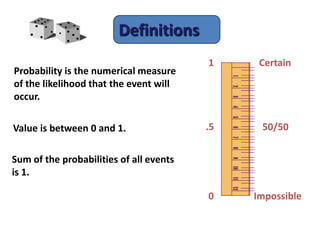
Certain
Impossible
.5
1
0
50/50
Probability is the numerical measure
of the likelihood that the event will
occur.
Value is between 0 and 1.
Sum of the probabilities of all events
is 1.
Definitions
A probability experiment is an action through which specific
results (counts, measurements, or responses) are obtained.
The result of a single trial in a probability experiment is an
outcome.
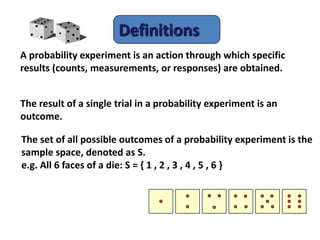
The set of all possible outcomes of a probability experiment is the
sample space, denoted as S.
e.g. All 6 faces of a die: S = { 1 , 2 , 3 , 4 , 5 , 6 }
Definitions
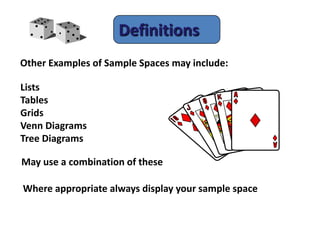
Other Examples of Sample Spaces may include:
Lists
Tables
Grids
Venn Diagrams
Tree Diagrams
May use a combination of these
Where appropriate always display your sample space
Definitions
An event consists of one or more outcomes and is a subset of
the sample space.
Events are often represented by uppercase letters, such as A,
B, or C.
Notation: The probability that event E will occur is written
P(E) and is read
“the probability of event E.”
Definitions
• The Probability of an Event, E:
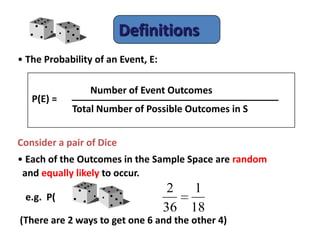
Consider a pair of Dice
• Each of the Outcomes in the Sample Space are random
and equally likely to occur.
e.g. P( ) =
(There are 2 ways to get one 6 and the other 4)
P(E) =
Number of Event Outcomes
Total Number of Possible Outcomes in S
18
1
36
2
Definitions
There are three types of probability
1. Theoretical Probability
Theoretical probability is used when each outcome in a
sample space is equally likely to occur.
P(E) =
Number of Event Outcomes
Total Number of Possible Outcomes in S
The Ultimate probability formula 
Definitions
There are three types of probability
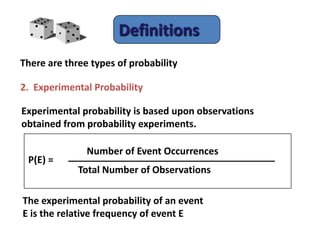
2. Experimental Probability
Experimental probability is based upon observations
obtained from probability experiments.
The experimental probability of an event
E is the relative frequency of event E
P(E) =
Number of Event Occurrences
Total Number of Observations
Definitions
There are three types of probability
3. Subjective Probability
Subjective probability is a probability measure resulting from
intuition, educated guesses, and
estimates.
Therefore, there is no formula to calculate it.
Usually found by consulting an expert.
Definitions
Law of Large Numbers.
As an experiment is repeated over and over, the experimental
probability of an event approaches
the theoretical probability of the event.
The greater the number of trials the more likely the
experimental probability of an event will equal its theoretical
probability.
Complimentary Events
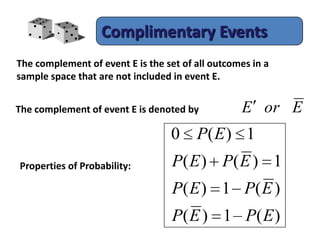
The complement of event E is the set of all outcomes in a
sample space that are not included in event E.
The complement of event E is denoted by
Properties of Probability:
EorE
)(1)(
)(1)(
1)()(
1)(0
EPEP
EPEP
EPEP
EP

Probability part 4

  • 1.
  • 2.
    Definitions Probability is themathematics of chance. It tells us the relative frequency with which we can expect an event to occur The greater the probability the more likely the event will occur. It can be written as a fraction, decimal, percent, or ratio.
  • 3.
    Definitions Certain Impossible .5 1 0 50/50 Probability is thenumerical measure of the likelihood that the event will occur. Value is between 0 and 1. Sum of the probabilities of all events is 1.
  • 4.
    Definitions A probability experimentis an action through which specific results (counts, measurements, or responses) are obtained. The result of a single trial in a probability experiment is an outcome. The set of all possible outcomes of a probability experiment is the sample space, denoted as S. e.g. All 6 faces of a die: S = { 1 , 2 , 3 , 4 , 5 , 6 }
  • 5.
    Definitions Other Examples ofSample Spaces may include: Lists Tables Grids Venn Diagrams Tree Diagrams May use a combination of these Where appropriate always display your sample space
  • 6.
    Definitions An event consistsof one or more outcomes and is a subset of the sample space. Events are often represented by uppercase letters, such as A, B, or C. Notation: The probability that event E will occur is written P(E) and is read “the probability of event E.”
  • 7.
    Definitions • The Probabilityof an Event, E: Consider a pair of Dice • Each of the Outcomes in the Sample Space are random and equally likely to occur. e.g. P( ) = (There are 2 ways to get one 6 and the other 4) P(E) = Number of Event Outcomes Total Number of Possible Outcomes in S 18 1 36 2
  • 8.
    Definitions There are threetypes of probability 1. Theoretical Probability Theoretical probability is used when each outcome in a sample space is equally likely to occur. P(E) = Number of Event Outcomes Total Number of Possible Outcomes in S The Ultimate probability formula 
  • 9.
    Definitions There are threetypes of probability 2. Experimental Probability Experimental probability is based upon observations obtained from probability experiments. The experimental probability of an event E is the relative frequency of event E P(E) = Number of Event Occurrences Total Number of Observations
  • 10.
    Definitions There are threetypes of probability 3. Subjective Probability Subjective probability is a probability measure resulting from intuition, educated guesses, and estimates. Therefore, there is no formula to calculate it. Usually found by consulting an expert.
  • 11.
    Definitions Law of LargeNumbers. As an experiment is repeated over and over, the experimental probability of an event approaches the theoretical probability of the event. The greater the number of trials the more likely the experimental probability of an event will equal its theoretical probability.
  • 12.
    Complimentary Events The complementof event E is the set of all outcomes in a sample space that are not included in event E. The complement of event E is denoted by Properties of Probability: EorE )(1)( )(1)( 1)()( 1)(0 EPEP EPEP EPEP EP