STATISTICS
(Kinds of Graphs)
OBJECTIVES:
1. Present data in graphs, tables
and charts.
2. Analyze and interpret data from
graphs, tables and charts.
3. Appreciate the importance of the
lesson in the real-life situation.
GRAPHS
 Good

graphs convey information
quickly and easily to the user.
 Graphs highlight salient features
of the data. They can show
relationships that are not obvious
from studying a list of numbers.
 Graphs can also provide a
convenient way to compare
different sets of data.
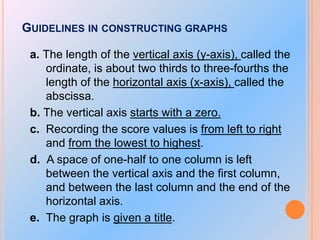
GUIDELINES IN CONSTRUCTING GRAPHS
a. The length of the vertical axis (y-axis), called the
ordinate, is about two thirds to three-fourths the
length of the horizontal axis (x-axis), called the
abscissa.
b. The vertical axis starts with a zero.
c. Recording the score values is from left to right
and from the lowest to highest.
d. A space of one-half to one column is left
between the vertical axis and the first column,
and between the last column and the end of the
horizontal axis.
e. The graph is given a title.
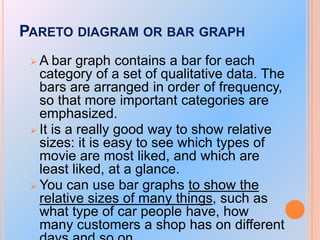
PARETO DIAGRAM OR BAR GRAPH
A

bar graph contains a bar for each
category of a set of qualitative data. The
bars are arranged in order of frequency,
so that more important categories are
emphasized.
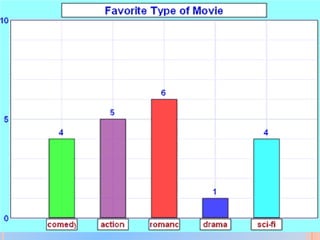
 It is a really good way to show relative
sizes: it is easy to see which types of
movie are most liked, and which are
least liked, at a glance.
 You can use bar graphs to show the
relative sizes of many things, such as
what type of car people have, how
many customers a shop has on different
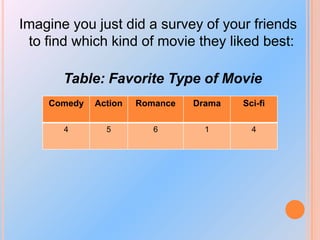
Imagine you just did a survey of your friends
to find which kind of movie they liked best:
Table: Favorite Type of Movie
Comedy

Action

Romance

Drama

Sci-fi

4

5

6

1

4
PIE CHART OR CIRCLE GRAPH


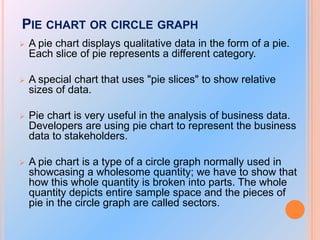
A pie chart displays qualitative data in the form of a pie.
Each slice of pie represents a different category.



A special chart that uses "pie slices" to show relative
sizes of data.



Pie chart is very useful in the analysis of business data.
Developers are using pie chart to represent the business
data to stakeholders.



A pie chart is a type of a circle graph normally used in
showcasing a wholesome quantity; we have to show that
how this whole quantity is broken into parts. The whole
quantity depicts entire sample space and the pieces of
pie in the circle graph are called sectors.
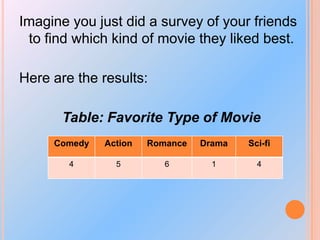
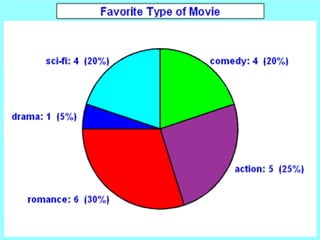
Imagine you just did a survey of your friends
to find which kind of movie they liked best.
Here are the results:
Table: Favorite Type of Movie
Comedy

Action

Romance

Drama

Sci-fi

4

5

6

1

4
HISTOGRAM


A histogram in another kind of graph that uses bars
in its display. This type of graph is used with

quantitative data. Ranges of values, called classes,
are listed at the bottom, and the classes with
greater frequencies have taller bars.


A Histogram is a graphical display of data using
bars of different heights.



Histograms are a great way to show results
of continuous data, such as: weight, height, how
much time and the like.
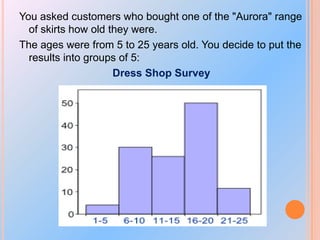
You asked customers who bought one of the "Aurora" range
of skirts how old they were.
The ages were from 5 to 25 years old. You decide to put the
results into groups of 5:
Dress Shop Survey
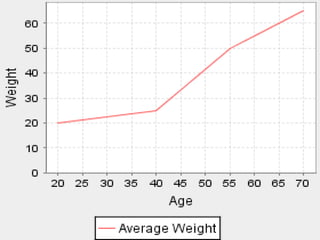
LINE GRAPHS
A

line graph is a way of representing
two pieces of information, which is
usually related and vary with respect
to each other. This is useful when
comparisons are needed.

 At

each end of the polygon, a line is
drawn back to zero.
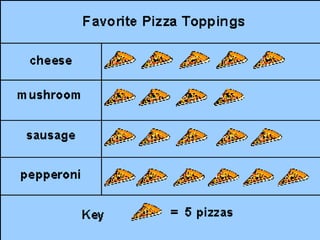
PICTOGRAPH
A

Pictograph is a way of showing data
using images.
 Each image stands for a certain
number of things.
 A pictograph uses one or more rows of
identical symbols, has a key
explaining the meaning of the symbol,
and is frequently used to compare
output.
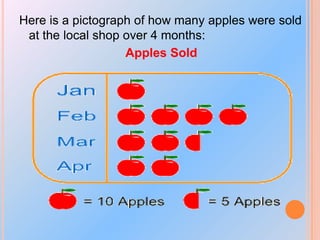
Here is a pictograph of how many apples were sold
at the local shop over 4 months:
Apples Sold
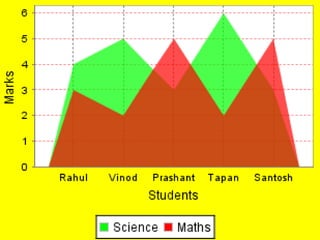
AREA GRAPHS
 These

graphs are used to show how
something changes with respect to
time.
A. Choose only one. Make your own
pictograph.
 How much money you have (week by
week)
 How much exercise you get (each day)
 How many hours you watch TV every week
 How many sports stories are in each
newspaper
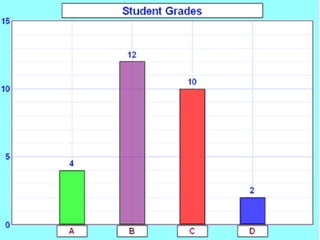
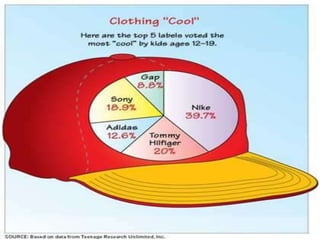
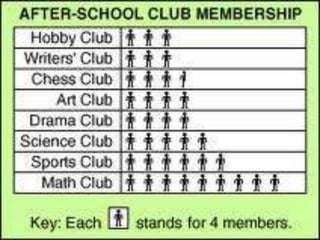
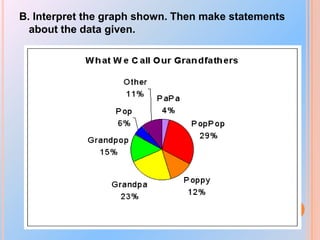
B. Interpret the graph shown. Then make statements
about the data given.
REFERENCES:



mathisfun.com (internet)
Making connections in mathematics.
THANK YOU!


PREPARED BY:
Ms. Aries M. Masbate
Student Teacher in Mathematics
Mrs. Elizabeth Belbes
Cooperating Teacher

Statistics

  • 1.
  • 2.
    OBJECTIVES: 1. Present datain graphs, tables and charts. 2. Analyze and interpret data from graphs, tables and charts. 3. Appreciate the importance of the lesson in the real-life situation.
  • 3.
    GRAPHS  Good graphs conveyinformation quickly and easily to the user.  Graphs highlight salient features of the data. They can show relationships that are not obvious from studying a list of numbers.  Graphs can also provide a convenient way to compare different sets of data.
  • 4.
    GUIDELINES IN CONSTRUCTINGGRAPHS a. The length of the vertical axis (y-axis), called the ordinate, is about two thirds to three-fourths the length of the horizontal axis (x-axis), called the abscissa. b. The vertical axis starts with a zero. c. Recording the score values is from left to right and from the lowest to highest. d. A space of one-half to one column is left between the vertical axis and the first column, and between the last column and the end of the horizontal axis. e. The graph is given a title.
  • 5.
    PARETO DIAGRAM ORBAR GRAPH A bar graph contains a bar for each category of a set of qualitative data. The bars are arranged in order of frequency, so that more important categories are emphasized.  It is a really good way to show relative sizes: it is easy to see which types of movie are most liked, and which are least liked, at a glance.  You can use bar graphs to show the relative sizes of many things, such as what type of car people have, how many customers a shop has on different
  • 6.
    Imagine you justdid a survey of your friends to find which kind of movie they liked best: Table: Favorite Type of Movie Comedy Action Romance Drama Sci-fi 4 5 6 1 4
  • 9.
    PIE CHART ORCIRCLE GRAPH  A pie chart displays qualitative data in the form of a pie. Each slice of pie represents a different category.  A special chart that uses "pie slices" to show relative sizes of data.  Pie chart is very useful in the analysis of business data. Developers are using pie chart to represent the business data to stakeholders.  A pie chart is a type of a circle graph normally used in showcasing a wholesome quantity; we have to show that how this whole quantity is broken into parts. The whole quantity depicts entire sample space and the pieces of pie in the circle graph are called sectors.
  • 10.
    Imagine you justdid a survey of your friends to find which kind of movie they liked best. Here are the results: Table: Favorite Type of Movie Comedy Action Romance Drama Sci-fi 4 5 6 1 4
  • 13.
    HISTOGRAM  A histogram inanother kind of graph that uses bars in its display. This type of graph is used with quantitative data. Ranges of values, called classes, are listed at the bottom, and the classes with greater frequencies have taller bars.  A Histogram is a graphical display of data using bars of different heights.  Histograms are a great way to show results of continuous data, such as: weight, height, how much time and the like.
  • 14.
    You asked customerswho bought one of the "Aurora" range of skirts how old they were. The ages were from 5 to 25 years old. You decide to put the results into groups of 5: Dress Shop Survey
  • 15.
    LINE GRAPHS A line graphis a way of representing two pieces of information, which is usually related and vary with respect to each other. This is useful when comparisons are needed.  At each end of the polygon, a line is drawn back to zero.
  • 17.
    PICTOGRAPH A Pictograph is away of showing data using images.  Each image stands for a certain number of things.  A pictograph uses one or more rows of identical symbols, has a key explaining the meaning of the symbol, and is frequently used to compare output.
  • 18.
    Here is apictograph of how many apples were sold at the local shop over 4 months: Apples Sold
  • 21.
    AREA GRAPHS  These graphsare used to show how something changes with respect to time.
  • 23.
    A. Choose onlyone. Make your own pictograph.  How much money you have (week by week)  How much exercise you get (each day)  How many hours you watch TV every week  How many sports stories are in each newspaper
  • 24.
    B. Interpret thegraph shown. Then make statements about the data given.
  • 25.
  • 26.
  • 27.
    PREPARED BY: Ms. AriesM. Masbate Student Teacher in Mathematics Mrs. Elizabeth Belbes Cooperating Teacher