Chapter 4
          Statistics: Data and Graphs
Click the mouse or press the space bar to continue.
Statistics: Data and Graphs
4


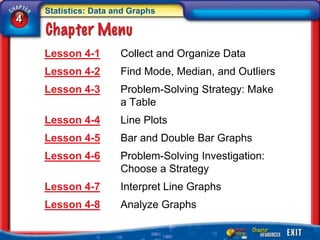
    Lesson 4-1        Collect and Organize Data
    Lesson 4-2        Find Mode, Median, and Outliers
    Lesson 4-3        Problem-Solving Strategy: Make
                      a Table
    Lesson 4-4        Line Plots
    Lesson 4-5        Bar and Double Bar Graphs
    Lesson 4-6        Problem-Solving Investigation:
                      Choose a Strategy
    Lesson 4-7        Interpret Line Graphs
    Lesson 4-8        Analyze Graphs
4-1     Collect and Organize Data


      Five-Minute Check (over Chapter 3)
      Main Idea and Vocabulary
      California Standards
      Example 1
4-1      Collect and Organize Data


      • I will take a survey, and collect and organize data.


      • survey                 • tally chart
      • data                   • frequency table
4-1     Collect and Organize Data


      Standard 4SDAP1.1 Formulate survey questions;
      systematically collect and represent data on a
      number line; and coordinate graphs, tables, and
      charts.
4-1   Collect and Organize Data


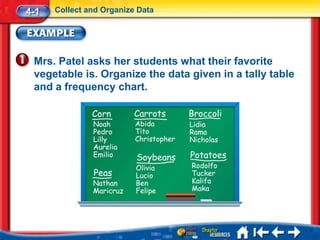
 Mrs. Patel asks her students what their favorite
 vegetable is. Organize the data given in a tally table
 and a frequency chart.
4-1   Collect and Organize Data


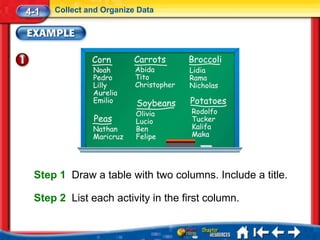
 Step 1 Draw a table with two columns. Include a title.
 Step 2 List each activity in the first column.
4-1   Collect and Organize Data


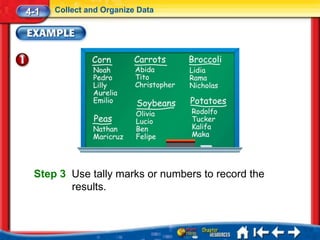
 Step 3 Use tally marks or numbers to record the
        results.
4-1   Collect and Organize Data


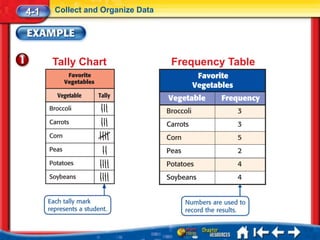
      Tally Chart                 Frequency Table
4-1   Collect and Organize Data


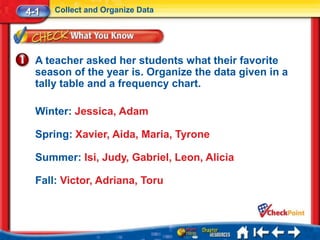
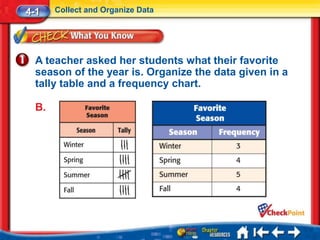
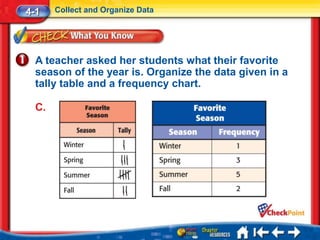
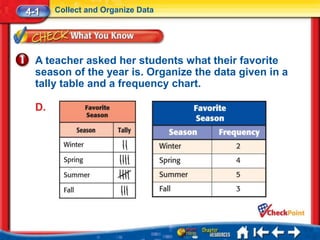
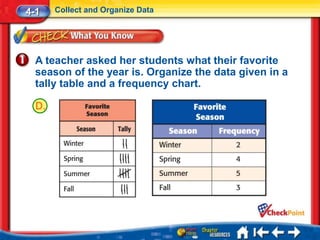
  A teacher asked her students what their favorite
  season of the year is. Organize the data given in a
  tally table and a frequency chart.

  Winter: Jessica, Adam

  Spring: Xavier, Aida, Maria, Tyrone

  Summer: Isi, Judy, Gabriel, Leon, Alicia

  Fall: Victor, Adriana, Toru
4-1    Collect and Organize Data


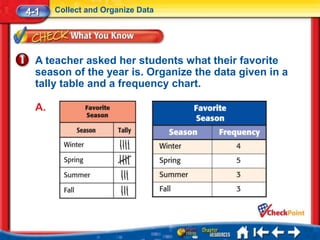
  A teacher asked her students what their favorite
  season of the year is. Organize the data given in a
  tally table and a frequency chart.

  A.
4-1    Collect and Organize Data


  A teacher asked her students what their favorite
  season of the year is. Organize the data given in a
  tally table and a frequency chart.

  B.
4-1    Collect and Organize Data


  A teacher asked her students what their favorite
  season of the year is. Organize the data given in a
  tally table and a frequency chart.

  C.
4-1    Collect and Organize Data


  A teacher asked her students what their favorite
  season of the year is. Organize the data given in a
  tally table and a frequency chart.

  D.
4-1    Collect and Organize Data


  A teacher asked her students what their favorite
  season of the year is. Organize the data given in a
  tally table and a frequency chart.

  D.
4-2     Find Mode, Median, and Outliers


      Five-Minute Check (over Lesson 4-1)
      Main Idea and Vocabulary
      California Standards
      Example 1
      Example 2
4-2      Find Mode, Median, and Outliers


      • I will identify the mode, median, and outliers of
        a set of data.


      • mode
      • median
      • outlier
4-2     Find Mode, Median, and Outliers


      Standard 4SDAP1.2 Identify the mode(s) for sets
      of categorical data and the mode(s), median, and
      any apparent outliers for numerical data sets.
4-2     Find Mode, Median, and Outliers


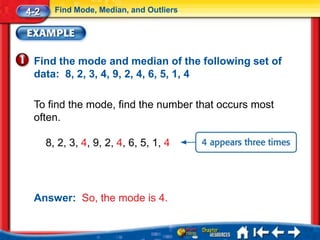
 Find the mode and median of the following set of
 data: 8, 2, 3, 4, 9, 2, 4, 6, 5, 1, 4

 To find the mode, find the number that occurs most
 often.

      8, 2, 3, 4, 9, 2, 4, 6, 5, 1, 4


 Answer: So, the mode is 4.
4-2   Find Mode, Median, and Outliers


 Find the mode and median of the following set of
 data: 8, 2, 3, 4, 9, 2, 4, 6, 5, 1, 4


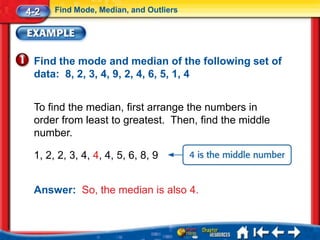
 To find the median, first arrange the numbers in
 order from least to greatest. Then, find the middle
 number.

 1, 2, 2, 3, 4, 4, 4, 5, 6, 8, 9


 Answer: So, the median is also 4.
4-2    Find Mode, Median, and Outliers


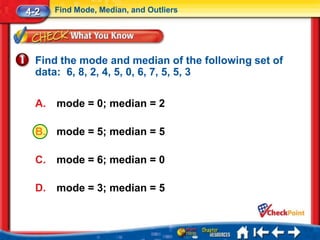
  Find the mode and median of the following set of
  data: 6, 8, 2, 4, 5, 0, 6, 7, 5, 5, 3

  A.   mode = 0; median = 2

  B.   mode = 5; median = 5

  C.   mode = 6; median = 0

  D.   mode = 3; median = 5
4-2   Find Mode, Median, and Outliers


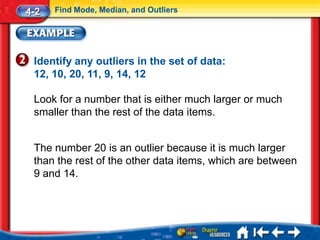
 Identify any outliers in the set of data:
 12, 10, 20, 11, 9, 14, 12

 Look for a number that is either much larger or much
 smaller than the rest of the data items.


 The number 20 is an outlier because it is much larger
 than the rest of the other data items, which are between
 9 and 14.
4-2    Find Mode, Median, and Outliers


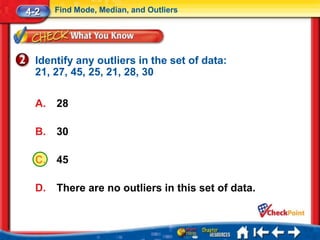
  Identify any outliers in the set of data:
  21, 27, 45, 25, 21, 28, 30

  A.   28

  B.   30

  C.   45

  D.   There are no outliers in this set of data.
4-3     Problem-Solving Strategy: Make a Table


      Five-Minute Check (over Lesson 4-2)
      Main Idea
      California Standards
      Example 1: Problem-Solving Strategy
4-3      Problem-Solving Strategy: Make a Table


      • I will solve problems by making a table.
4-3     Problem-Solving Strategy: Make a Table


      Standard 4MR2.3 Use a variety of methods, such
      as words, numbers, symbols, charts, graphs,
      tables, diagrams, and models, to explain
      mathematical reasoning.
4-3     Problem-Solving Strategy: Make a Table


            Standard 4NS3.0 Students solve
      problems involving addition, subtraction,
      multiplication, and division of whole numbers
      and understand the relationships among the
      operations.
4-3   Problem-Solving Strategy: Make a Table


 The music club at Steven’s school is going to a
 concert. There are 2 teachers going to the
 concert for every 9 students going. If there are
 16 teachers going, how many students are
 going to the concert?
4-3   Problem-Solving Strategy: Make a Table


 Understand
 What facts do you know?
 • There are 2 teachers going for every 9 students
   going to the concert.
 • The total number of teachers going is 16.

 What do you need to find?
 • Find how many students are going to the
   concert.
4-3   Problem-Solving Strategy: Make a Table


 Plan
 You can make a table to solve the problem.
4-3   Problem-Solving Strategy: Make a Table


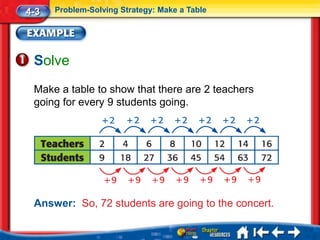
 Solve
 Make a table to show that there are 2 teachers
 going for every 9 students going.


 Answer: So, 72 students are going to the concert.
4-3   Problem-Solving Strategy: Make a Table


 Check
 Divide the total number of teachers by the
 number of teachers per group.

 16 ÷ 2 = 8

 There are 8 groups going. There are 9 students
 in each group. So, there are 8 x 9 = 72 students
 going altogether. The answer is correct.
4-4     Line Plots


      Five-Minute Check (over Lesson 4-3)
      Main Idea and Vocabulary
      California Standards
      Example 1
      Example 2
4-4      Line Plots


      • I will represent and interpret data in a line plot.


      • line plot
4-4     Line Plots


      Standard 4SDAP1.3 Interpret one- and two-
      variable data graphs to answer questions about
      a situation.

      Standard 4SDAP1.2 Identify the mode(s) for sets
      of categorical data and the mode(s), median, and
      any apparent outliers for numerical data sets.
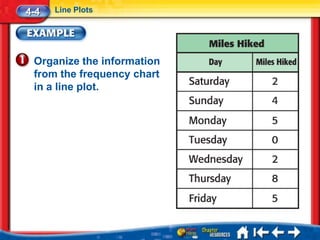
4-4   Line Plots


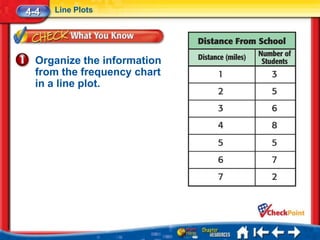
 Organize the information
 from the frequency chart
 in a line plot.
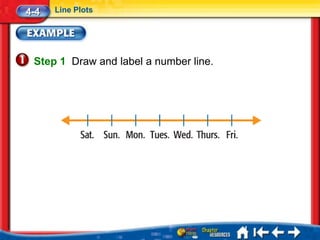
4-4   Line Plots


 Step 1 Draw and label a number line.
4-4   Line Plots


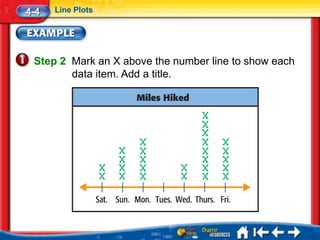
 Step 2 Mark an X above the number line to show each
        data item. Add a title.
4-4   Line Plots


  Organize the information
  from the frequency chart
  in a line plot.
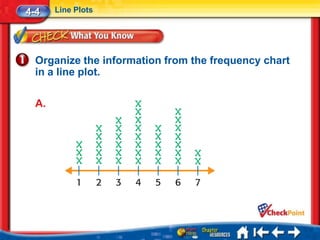
4-4    Line Plots


  Organize the information from the frequency chart
  in a line plot.

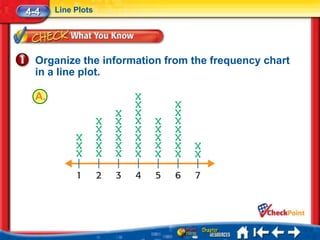
  A.
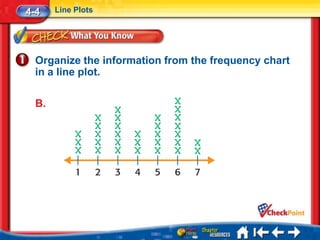
4-4    Line Plots


  Organize the information from the frequency chart
  in a line plot.

  B.
4-4    Line Plots


  Organize the information from the frequency chart
  in a line plot.

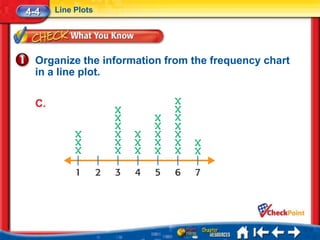
  C.
4-4    Line Plots


  Organize the information from the frequency chart
  in a line plot.

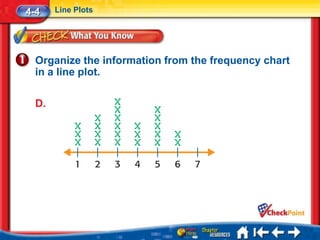
  D.
4-4    Line Plots


  Organize the information from the frequency chart
  in a line plot.

  A.
4-4   Line Plots


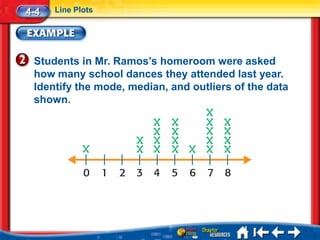
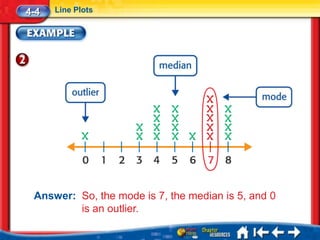
 Students in Mr. Ramos’s homeroom were asked
 how many school dances they attended last year.
 Identify the mode, median, and outliers of the data
 shown.
4-4   Line Plots


 Answer: So, the mode is 7, the median is 5, and 0
         is an outlier.
4-4   Line Plots


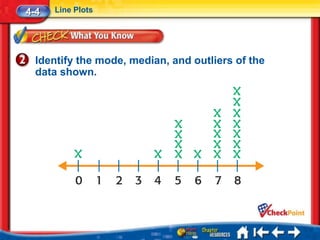
  Identify the mode, median, and outliers of the
  data shown.
4-4    Line Plots


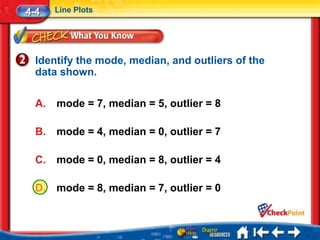
  Identify the mode, median, and outliers of the
  data shown.

  A.   mode = 7, median = 5, outlier = 8

  B.   mode = 4, median = 0, outlier = 7

  C.   mode = 0, median = 8, outlier = 4

  D.   mode = 8, median = 7, outlier = 0
4-5     Bar and Double Bar Graphs


      Five-Minute Check (over Lesson 4-4)
      Main Idea and Vocabulary
      California Standards
      Example 1


                                      Make Double Bar Graphs
4-5      Bar and Double Bar Graphs


      • I will use bar graphs to answer questions about
        a situation.


      • double bar graph
4-5     Bar and Double Bar Graphs


      Standard 4SDAP1.3 Interpret one- and two-
      variable data graphs to answer questions
      about a situation.
4-5   Bar and Double Bar Graphs


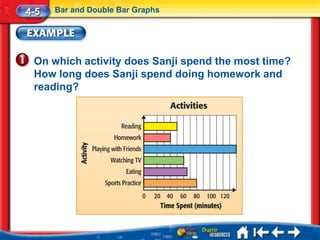
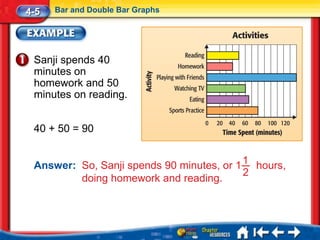
 On which activity does Sanji spend the most time?
 How long does Sanji spend doing homework and
 reading?
4-5   Bar and Double Bar Graphs


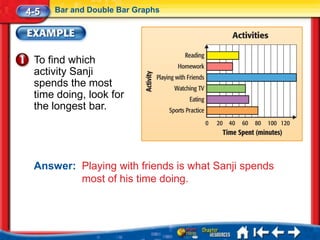
 To find which
 activity Sanji
 spends the most
 time doing, look for
 the longest bar.


 Answer: Playing with friends is what Sanji spends
         most of his time doing.
4-5   Bar and Double Bar Graphs


 Sanji spends 40
 minutes on
 homework and 50
 minutes on reading.


 40 + 50 = 90


 Answer: So, Sanji spends 90 minutes, or 1 1 hours,
                                           2
         doing homework and reading.
4-5   Bar and Double Bar Graphs


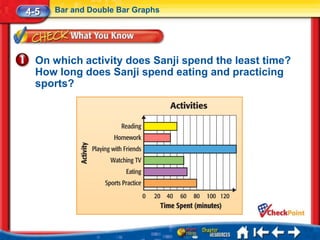
  On which activity does Sanji spend the least time?
  How long does Sanji spend eating and practicing
  sports?
4-5    Bar and Double Bar Graphs


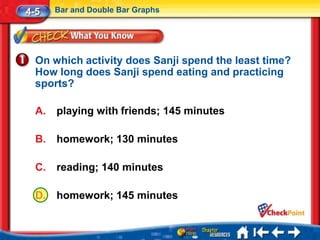
  On which activity does Sanji spend the least time?
  How long does Sanji spend eating and practicing
  sports?

  A.   playing with friends; 145 minutes

  B.   homework; 130 minutes

  C.   reading; 140 minutes

  D.   homework; 145 minutes
4-6     Problem-Solving Investigation: Choose a Strategy


      Five-Minute Check (over Lesson 4-5)
      Main Idea
      California Standards
      Example 1: Problem-Solving Investigation
4-6      Problem-Solving Investigation: Choose a Strategy


      • I will choose the best strategy to solve a problem.
4-6     Problem-Solving Investigation: Choose a Strategy


      Standard 4MR2.3 Use a variety of methods, such
      as words, numbers, symbols, chart, graphs, tables,
      diagrams, and models, to explain mathematical
      reasoning.

      Standard 4NS2.1 Estimate and compute the sum
      or difference of whole numbers and positive
      decimals in two places.
4-6    Problem-Solving Investigation: Choose a Strategy


      TAO: I take the subway to get to
      school and back. Each round trip
      costs $1.50. My subway card has a
      value of $10.


      YOUR MISSION: Find how many round
      trips Tao can make with $10.
4-6     Problem-Solving Investigation: Choose a Strategy


      Understand
      What facts do you know?
      • Each round trip costs $1.50.
      • Tao’s subway card has a value of $10.

      What do you need to find?

      • Find out how many round trips he can make.
4-6     Problem-Solving Investigation: Choose a Strategy


      Plan
      Organize the data in a table to solve the problem.
4-6     Problem-Solving Investigation: Choose a Strategy


      Solve
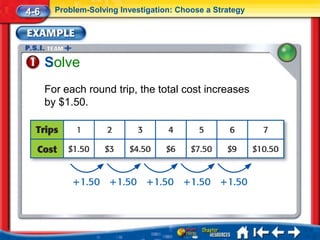
      For each round trip, the total cost increases
      by $1.50.
4-6     Problem-Solving Investigation: Choose a Strategy


      Solve
      Tao’s card has a value of $10. He cannot
      make a seventh trip because after making 6
      trips he has only $1 left. This is not enough
      for another trip.


      Answer: So, he can make 6 trips to school
              and back.
4-6     Problem-Solving Investigation: Choose a Strategy


      Check
      Use a set of play money that is in piles of
      $1.50. Add the money until you have more
      than $10.
4-7     Interpret Line Graphs


      Five-Minute Check (over Lesson 4-6)
      Main Idea and Vocabulary
      California Standards
      Example 1
      Example 2


                                        Make a Line Graph
4-7      Interpret Line Graphs


      • I will interpret data in a line graph.


      • line graph
4-7     Interpret Line Graphs


      Standard 4SDAP1.3 Interpret one- and two-
      variable data graphs to answer questions about
      a situation.
4-7   Interpret Line Graphs


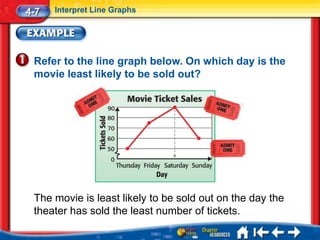
 Refer to the line graph below. On which day is the
 movie least likely to be sold out?


 The movie is least likely to be sold out on the day the
 theater has sold the least number of tickets.
4-7   Interpret Line Graphs


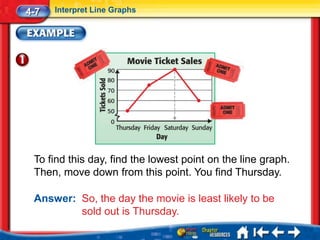
 To find this day, find the lowest point on the line graph.
 Then, move down from this point. You find Thursday.

 Answer: So, the day the movie is least likely to be
         sold out is Thursday.
4-7   Interpret Line Graphs


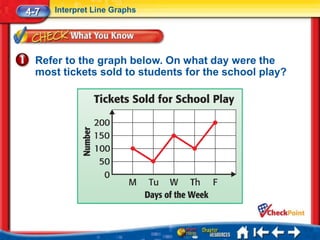
  Refer to the graph below. On what day were the
  most tickets sold to students for the school play?
4-7    Interpret Line Graphs


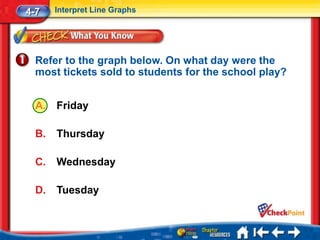
  Refer to the graph below. On what day were the
  most tickets sold to students for the school play?


  A.   Friday

  B.   Thursday

  C.   Wednesday

  D.   Tuesday
4-7   Interpret Line Graphs


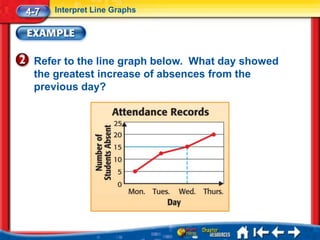
 Refer to the line graph below. What day showed
 the greatest increase of absences from the
 previous day?
4-7   Interpret Line Graphs


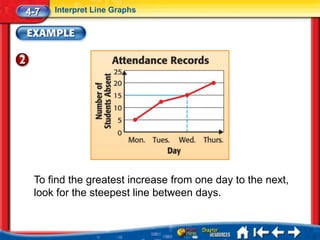
 To find the greatest increase from one day to the next,
 look for the steepest line between days.
4-7   Interpret Line Graphs


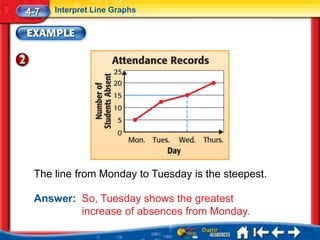
 The line from Monday to Tuesday is the steepest.

 Answer: So, Tuesday shows the greatest
         increase of absences from Monday.
4-7   Interpret Line Graphs


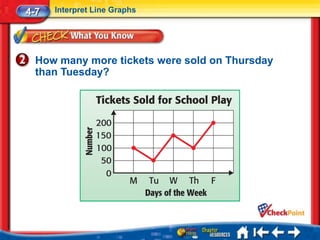
  How many more tickets were sold on Thursday
  than Tuesday?
4-7   Interpret Line Graphs


  How many more tickets were sold on Thursday
  than Tuesday?

  A. 200

  B. 150

  C. 100

  D. 50
4-8     Analyze Graphs


      Five-Minute Check (over Lesson 4-7)
      Main Idea
      California Standards
      Example 1
      Example 2
      Example 3
4-8      Analyze Graphs


      • I will use graphs to display different kinds of data.
4-8     Analyze Graphs


      Standard 4SDAP1.3 Interpret one- and two-
      variable data graphs to answer questions
      about a situation.

      Standard 4SDAP1.1 Formulate survey questions;
      systematically collect and represent data on a
      number line; and coordinate graphs, tables and
      charts.
4-8   Analyze Graphs


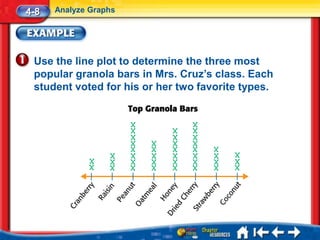
 Use the line plot to determine the three most
 popular granola bars in Mrs. Cruz’s class. Each
 student voted for his or her two favorite types.
4-8   Analyze Graphs


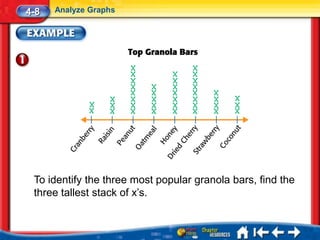
 To identify the three most popular granola bars, find the
 three tallest stack of x’s.
4-8   Analyze Graphs


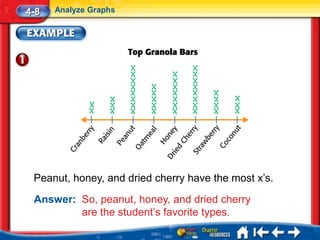
 Peanut, honey, and dried cherry have the most x’s.
 Answer: So, peanut, honey, and dried cherry
         are the student’s favorite types.
4-8   Analyze Graphs


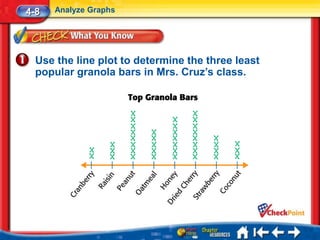
  Use the line plot to determine the three least
  popular granola bars in Mrs. Cruz’s class.
4-8    Analyze Graphs


  Use the line plot to determine the three least
  popular granola bars in Mrs. Cruz’s class.

  A.   cranberry, raisin, and strawberry

  B.   raisin, peanut, and oatmeal

  C.   cranberry, raisin, and coconut

  D.   peanut, honey, and dried cherry
4-8   Analyze Graphs


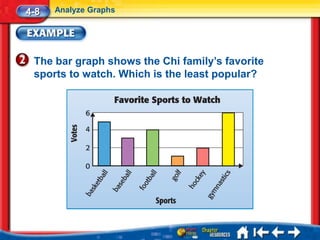
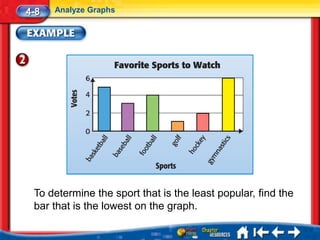
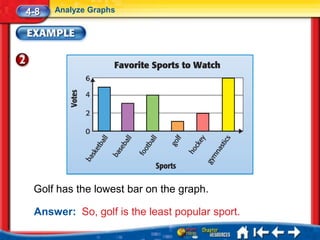
 The bar graph shows the Chi family’s favorite
 sports to watch. Which is the least popular?
4-8   Analyze Graphs


 To determine the sport that is the least popular, find the
 bar that is the lowest on the graph.
4-8   Analyze Graphs


 Golf has the lowest bar on the graph.

 Answer: So, golf is the least popular sport.
4-8   Analyze Graphs


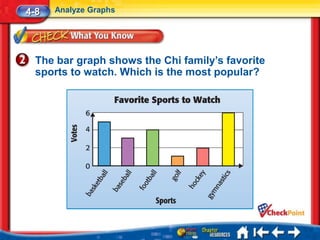
  The bar graph shows the Chi family’s favorite
  sports to watch. Which is the most popular?
4-8    Analyze Graphs


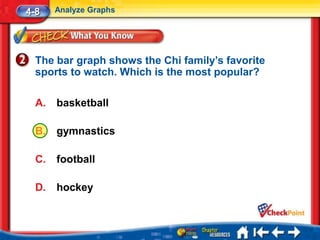
  The bar graph shows the Chi family’s favorite
  sports to watch. Which is the most popular?

  A.   basketball

  B.   gymnastics

  C.   football

  D.   hockey
4-8   Analyze Graphs


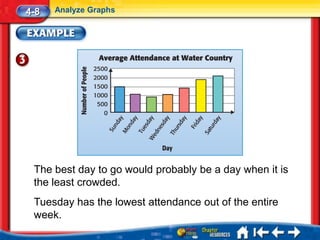
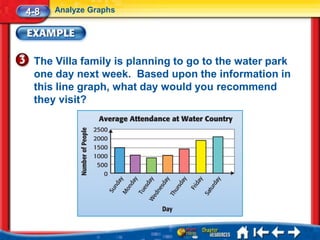
 The Villa family is planning to go to the water park
 one day next week. Based upon the information in
 this line graph, what day would you recommend
 they visit?
4-8   Analyze Graphs


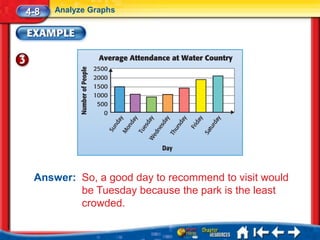
 The best day to go would probably be a day when it is
 the least crowded.
 Tuesday has the lowest attendance out of the entire
 week.
4-8   Analyze Graphs


 Answer: So, a good day to recommend to visit would
         be Tuesday because the park is the least
         crowded.
4-8    Analyze Graphs


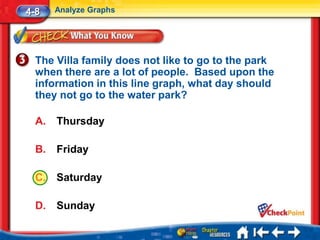
  The Villa family does not like to go to the park
  when there are a lot of people. Based upon the
  information in this line graph, what day should
  they not go to the water park?

  A.   Thursday

  B.   Friday

  C.   Saturday

  D.   Sunday
Statistics: Data and Graphs
4


                   Five-Minute Checks


                   Make Double Bar Graphs

                   Make a Line Graph
Statistics: Data and Graphs
4


    Lesson 4-1       (over Chapter 3)
    Lesson 4-2       (over Lesson 4-1)
    Lesson 4-3       (over Lesson 4-2)
    Lesson 4-4       (over Lesson 4-3)
    Lesson 4-5       (over Lesson 4-4)
    Lesson 4-6       (over Lesson 4-5)
    Lesson 4-7       (over Lesson 4-6)
    Lesson 4-8       (over Lesson 4-7)
Statistics: Data and Graphs
4
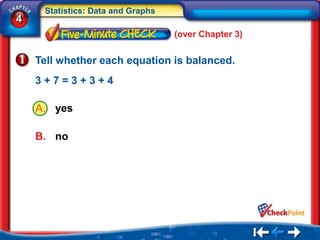
                                   (over Chapter 3)


    Tell whether each equation is balanced.
    3+7=3+3+4

    A. yes

    B. no
Statistics: Data and Graphs
4
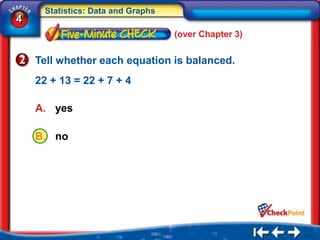
                                    (over Chapter 3)


    Tell whether each equation is balanced.
    22 + 13 = 22 + 7 + 4

    A. yes

    B. no
Statistics: Data and Graphs
4
                                    (over Chapter 3)


    Tell whether each equation is balanced.
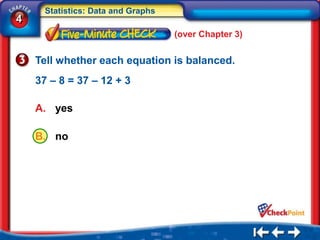
    37 – 8 = 37 – 12 + 3

    A. yes

    B. no
Statistics: Data and Graphs
4
                                    (over Chapter 3)


    Tell whether each equation is balanced.
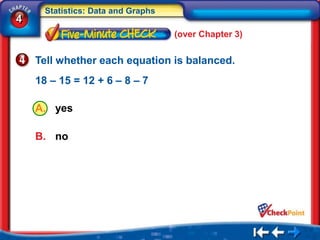
    18 – 15 = 12 + 6 – 8 – 7

    A. yes

    B. no
Statistics: Data and Graphs
4
                                    (over Lesson 4-1)


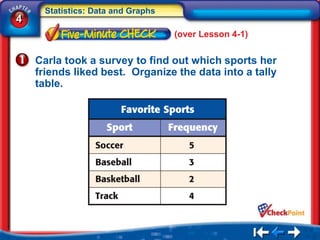
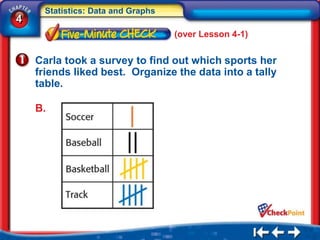
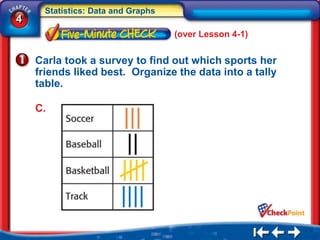
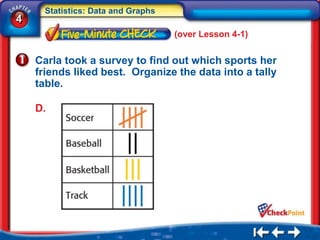
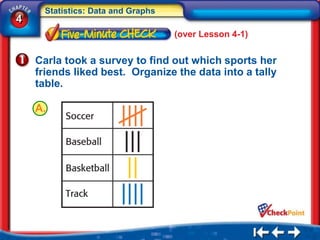
    Carla took a survey to find out which sports her
    friends liked best. Organize the data into a tally
    table.
Statistics: Data and Graphs
4
                                    (over Lesson 4-1)


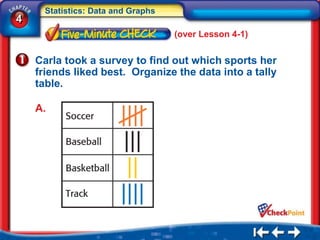
    Carla took a survey to find out which sports her
    friends liked best. Organize the data into a tally
    table.

    A.
Statistics: Data and Graphs
4
                                    (over Lesson 4-1)


    Carla took a survey to find out which sports her
    friends liked best. Organize the data into a tally
    table.

    B.
Statistics: Data and Graphs
4
                                    (over Lesson 4-1)


    Carla took a survey to find out which sports her
    friends liked best. Organize the data into a tally
    table.

    C.
Statistics: Data and Graphs
4
                                    (over Lesson 4-1)


    Carla took a survey to find out which sports her
    friends liked best. Organize the data into a tally
    table.

    D.
Statistics: Data and Graphs
4
                                    (over Lesson 4-1)


    Carla took a survey to find out which sports her
    friends liked best. Organize the data into a tally
    table.

    A.
Statistics: Data and Graphs
4
                                   (over Lesson 4-1)


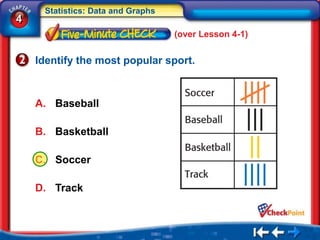
    Identify the most popular sport.


    A. Baseball

    B. Basketball

    C. Soccer

    D. Track
Statistics: Data and Graphs
4
                                    (over Lesson 4-2)


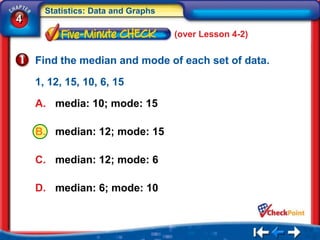
    Find the median and mode of each set of data.

    1, 12, 15, 10, 6, 15

    A. media: 10; mode: 15

    B. median: 12; mode: 15

    C. median: 12; mode: 6

    D. median: 6; mode: 10
Statistics: Data and Graphs
4
                                    (over Lesson 4-2)


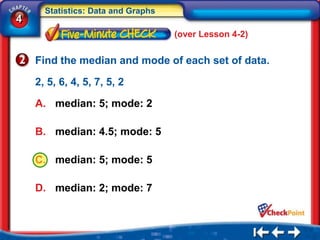
    Find the median and mode of each set of data.

    2, 5, 6, 4, 5, 7, 5, 2

    A. median: 5; mode: 2

    B. median: 4.5; mode: 5

    C. median: 5; mode: 5

    D. median: 2; mode: 7
Statistics: Data and Graphs
4
                                    (over Lesson 4-2)


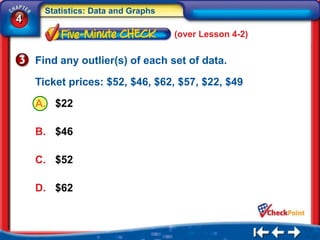
    Find any outlier(s) of each set of data.

    Ticket prices: $52, $46, $62, $57, $22, $49

    A. $22

    B. $46

    C. $52

    D. $62
Statistics: Data and Graphs
4
                                    (over Lesson 4-2)


    Find any outlier(s) of each set of data.

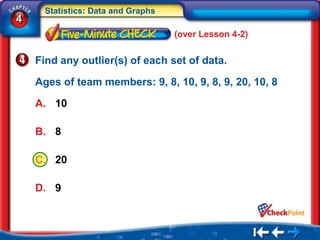
    Ages of team members: 9, 8, 10, 9, 8, 9, 20, 10, 8

    A. 10

    B. 8

    C. 20

    D. 9
Statistics: Data and Graphs
4
                                   (over Lesson 4-3)


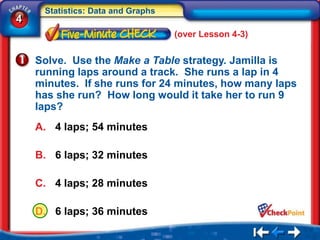
    Solve. Use the Make a Table strategy. Jamilla is
    running laps around a track. She runs a lap in 4
    minutes. If she runs for 24 minutes, how many laps
    has she run? How long would it take her to run 9
    laps?
    A. 4 laps; 54 minutes

    B. 6 laps; 32 minutes

    C. 4 laps; 28 minutes

    D. 6 laps; 36 minutes
Statistics: Data and Graphs
4
                                    (over Lesson 4-4)


    Identify the mode, median and outlier for each data
    set.
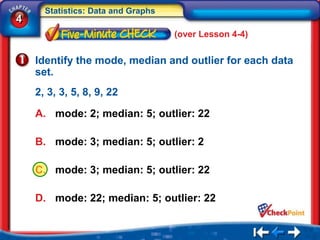
    2, 3, 3, 5, 8, 9, 22

    A. mode: 2; median: 5; outlier: 22

    B. mode: 3; median: 5; outlier: 2

    C. mode: 3; median: 5; outlier: 22

    D. mode: 22; median: 5; outlier: 22
Statistics: Data and Graphs
4
                                    (over Lesson 4-4)


    Identify the mode, median and outlier for each data
    set.
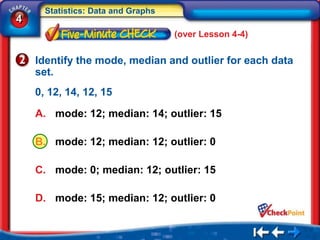
    0, 12, 14, 12, 15

    A. mode: 12; median: 14; outlier: 15

    B. mode: 12; median: 12; outlier: 0

    C. mode: 0; median: 12; outlier: 15

    D. mode: 15; median: 12; outlier: 0
Statistics: Data and Graphs
4
                                   (over Lesson 4-5)


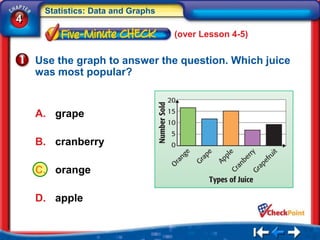
    Use the graph to answer the question. Which juice
    was most popular?


    A. grape

    B. cranberry

    C. orange

    D. apple
Statistics: Data and Graphs
4
                                   (over Lesson 4-5)


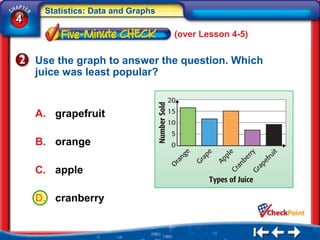
    Use the graph to answer the question. Which
    juice was least popular?


    A. grapefruit

    B. orange

    C. apple

    D. cranberry
Statistics: Data and Graphs
4
                                   (over Lesson 4-5)


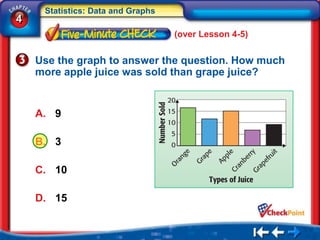
    Use the graph to answer the question. How much
    more apple juice was sold than grape juice?


    A. 9

    B. 3

    C. 10

    D. 15
Statistics: Data and Graphs
4
                                   (over Lesson 4-6)


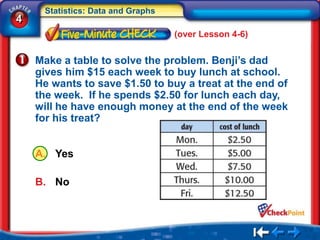
    Make a table to solve the problem. Benji’s dad
    gives him $15 each week to buy lunch at school.
    He wants to save $1.50 to buy a treat at the end of
    the week. If he spends $2.50 for lunch each day,
    will he have enough money at the end of the week
    for his treat?


    A. Yes

    B. No
Statistics: Data and Graphs
4
                                   (over Lesson 4-7)


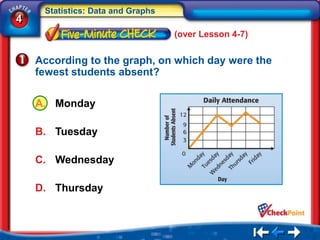
    According to the graph, on which day were the
    fewest students absent?

    A. Monday

    B. Tuesday

    C. Wednesday

    D. Thursday
Statistics: Data and Graphs
4
                                   (over Lesson 4-7)


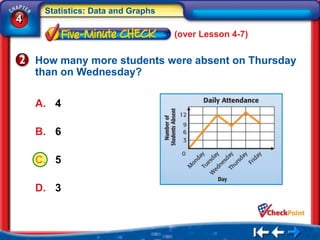
    How many more students were absent on Thursday
    than on Wednesday?

    A. 4

    B. 6

    C. 5

    D. 3
This slide is intentionally blank.

Math Gr4 Ch4

  • 1.
    Chapter 4 Statistics: Data and Graphs Click the mouse or press the space bar to continue.
  • 2.
    Statistics: Data andGraphs 4 Lesson 4-1 Collect and Organize Data Lesson 4-2 Find Mode, Median, and Outliers Lesson 4-3 Problem-Solving Strategy: Make a Table Lesson 4-4 Line Plots Lesson 4-5 Bar and Double Bar Graphs Lesson 4-6 Problem-Solving Investigation: Choose a Strategy Lesson 4-7 Interpret Line Graphs Lesson 4-8 Analyze Graphs
  • 3.
    4-1 Collect and Organize Data Five-Minute Check (over Chapter 3) Main Idea and Vocabulary California Standards Example 1
  • 4.
    4-1 Collect and Organize Data • I will take a survey, and collect and organize data. • survey • tally chart • data • frequency table
  • 5.
    4-1 Collect and Organize Data Standard 4SDAP1.1 Formulate survey questions; systematically collect and represent data on a number line; and coordinate graphs, tables, and charts.
  • 6.
    4-1 Collect and Organize Data Mrs. Patel asks her students what their favorite vegetable is. Organize the data given in a tally table and a frequency chart.
  • 7.
    4-1 Collect and Organize Data Step 1 Draw a table with two columns. Include a title. Step 2 List each activity in the first column.
  • 8.
    4-1 Collect and Organize Data Step 3 Use tally marks or numbers to record the results.
  • 9.
    4-1 Collect and Organize Data Tally Chart Frequency Table
  • 10.
    4-1 Collect and Organize Data A teacher asked her students what their favorite season of the year is. Organize the data given in a tally table and a frequency chart. Winter: Jessica, Adam Spring: Xavier, Aida, Maria, Tyrone Summer: Isi, Judy, Gabriel, Leon, Alicia Fall: Victor, Adriana, Toru
  • 11.
    4-1 Collect and Organize Data A teacher asked her students what their favorite season of the year is. Organize the data given in a tally table and a frequency chart. A.
  • 12.
    4-1 Collect and Organize Data A teacher asked her students what their favorite season of the year is. Organize the data given in a tally table and a frequency chart. B.
  • 13.
    4-1 Collect and Organize Data A teacher asked her students what their favorite season of the year is. Organize the data given in a tally table and a frequency chart. C.
  • 14.
    4-1 Collect and Organize Data A teacher asked her students what their favorite season of the year is. Organize the data given in a tally table and a frequency chart. D.
  • 15.
    4-1 Collect and Organize Data A teacher asked her students what their favorite season of the year is. Organize the data given in a tally table and a frequency chart. D.
  • 17.
    4-2 Find Mode, Median, and Outliers Five-Minute Check (over Lesson 4-1) Main Idea and Vocabulary California Standards Example 1 Example 2
  • 18.
    4-2 Find Mode, Median, and Outliers • I will identify the mode, median, and outliers of a set of data. • mode • median • outlier
  • 19.
    4-2 Find Mode, Median, and Outliers Standard 4SDAP1.2 Identify the mode(s) for sets of categorical data and the mode(s), median, and any apparent outliers for numerical data sets.
  • 20.
    4-2 Find Mode, Median, and Outliers Find the mode and median of the following set of data: 8, 2, 3, 4, 9, 2, 4, 6, 5, 1, 4 To find the mode, find the number that occurs most often. 8, 2, 3, 4, 9, 2, 4, 6, 5, 1, 4 Answer: So, the mode is 4.
  • 21.
    4-2 Find Mode, Median, and Outliers Find the mode and median of the following set of data: 8, 2, 3, 4, 9, 2, 4, 6, 5, 1, 4 To find the median, first arrange the numbers in order from least to greatest. Then, find the middle number. 1, 2, 2, 3, 4, 4, 4, 5, 6, 8, 9 Answer: So, the median is also 4.
  • 22.
    4-2 Find Mode, Median, and Outliers Find the mode and median of the following set of data: 6, 8, 2, 4, 5, 0, 6, 7, 5, 5, 3 A. mode = 0; median = 2 B. mode = 5; median = 5 C. mode = 6; median = 0 D. mode = 3; median = 5
  • 23.
    4-2 Find Mode, Median, and Outliers Identify any outliers in the set of data: 12, 10, 20, 11, 9, 14, 12 Look for a number that is either much larger or much smaller than the rest of the data items. The number 20 is an outlier because it is much larger than the rest of the other data items, which are between 9 and 14.
  • 24.
    4-2 Find Mode, Median, and Outliers Identify any outliers in the set of data: 21, 27, 45, 25, 21, 28, 30 A. 28 B. 30 C. 45 D. There are no outliers in this set of data.
  • 26.
    4-3 Problem-Solving Strategy: Make a Table Five-Minute Check (over Lesson 4-2) Main Idea California Standards Example 1: Problem-Solving Strategy
  • 27.
    4-3 Problem-Solving Strategy: Make a Table • I will solve problems by making a table.
  • 28.
    4-3 Problem-Solving Strategy: Make a Table Standard 4MR2.3 Use a variety of methods, such as words, numbers, symbols, charts, graphs, tables, diagrams, and models, to explain mathematical reasoning.
  • 29.
    4-3 Problem-Solving Strategy: Make a Table Standard 4NS3.0 Students solve problems involving addition, subtraction, multiplication, and division of whole numbers and understand the relationships among the operations.
  • 30.
    4-3 Problem-Solving Strategy: Make a Table The music club at Steven’s school is going to a concert. There are 2 teachers going to the concert for every 9 students going. If there are 16 teachers going, how many students are going to the concert?
  • 31.
    4-3 Problem-Solving Strategy: Make a Table Understand What facts do you know? • There are 2 teachers going for every 9 students going to the concert. • The total number of teachers going is 16. What do you need to find? • Find how many students are going to the concert.
  • 32.
    4-3 Problem-Solving Strategy: Make a Table Plan You can make a table to solve the problem.
  • 33.
    4-3 Problem-Solving Strategy: Make a Table Solve Make a table to show that there are 2 teachers going for every 9 students going. Answer: So, 72 students are going to the concert.
  • 34.
    4-3 Problem-Solving Strategy: Make a Table Check Divide the total number of teachers by the number of teachers per group. 16 ÷ 2 = 8 There are 8 groups going. There are 9 students in each group. So, there are 8 x 9 = 72 students going altogether. The answer is correct.
  • 36.
    4-4 Line Plots Five-Minute Check (over Lesson 4-3) Main Idea and Vocabulary California Standards Example 1 Example 2
  • 37.
    4-4 Line Plots • I will represent and interpret data in a line plot. • line plot
  • 38.
    4-4 Line Plots Standard 4SDAP1.3 Interpret one- and two- variable data graphs to answer questions about a situation. Standard 4SDAP1.2 Identify the mode(s) for sets of categorical data and the mode(s), median, and any apparent outliers for numerical data sets.
  • 39.
    4-4 Line Plots Organize the information from the frequency chart in a line plot.
  • 40.
    4-4 Line Plots Step 1 Draw and label a number line.
  • 41.
    4-4 Line Plots Step 2 Mark an X above the number line to show each data item. Add a title.
  • 42.
    4-4 Line Plots Organize the information from the frequency chart in a line plot.
  • 43.
    4-4 Line Plots Organize the information from the frequency chart in a line plot. A.
  • 44.
    4-4 Line Plots Organize the information from the frequency chart in a line plot. B.
  • 45.
    4-4 Line Plots Organize the information from the frequency chart in a line plot. C.
  • 46.
    4-4 Line Plots Organize the information from the frequency chart in a line plot. D.
  • 47.
    4-4 Line Plots Organize the information from the frequency chart in a line plot. A.
  • 48.
    4-4 Line Plots Students in Mr. Ramos’s homeroom were asked how many school dances they attended last year. Identify the mode, median, and outliers of the data shown.
  • 49.
    4-4 Line Plots Answer: So, the mode is 7, the median is 5, and 0 is an outlier.
  • 50.
    4-4 Line Plots Identify the mode, median, and outliers of the data shown.
  • 51.
    4-4 Line Plots Identify the mode, median, and outliers of the data shown. A. mode = 7, median = 5, outlier = 8 B. mode = 4, median = 0, outlier = 7 C. mode = 0, median = 8, outlier = 4 D. mode = 8, median = 7, outlier = 0
  • 53.
    4-5 Bar and Double Bar Graphs Five-Minute Check (over Lesson 4-4) Main Idea and Vocabulary California Standards Example 1 Make Double Bar Graphs
  • 54.
    4-5 Bar and Double Bar Graphs • I will use bar graphs to answer questions about a situation. • double bar graph
  • 55.
    4-5 Bar and Double Bar Graphs Standard 4SDAP1.3 Interpret one- and two- variable data graphs to answer questions about a situation.
  • 56.
    4-5 Bar and Double Bar Graphs On which activity does Sanji spend the most time? How long does Sanji spend doing homework and reading?
  • 57.
    4-5 Bar and Double Bar Graphs To find which activity Sanji spends the most time doing, look for the longest bar. Answer: Playing with friends is what Sanji spends most of his time doing.
  • 58.
    4-5 Bar and Double Bar Graphs Sanji spends 40 minutes on homework and 50 minutes on reading. 40 + 50 = 90 Answer: So, Sanji spends 90 minutes, or 1 1 hours, 2 doing homework and reading.
  • 59.
    4-5 Bar and Double Bar Graphs On which activity does Sanji spend the least time? How long does Sanji spend eating and practicing sports?
  • 60.
    4-5 Bar and Double Bar Graphs On which activity does Sanji spend the least time? How long does Sanji spend eating and practicing sports? A. playing with friends; 145 minutes B. homework; 130 minutes C. reading; 140 minutes D. homework; 145 minutes
  • 62.
    4-6 Problem-Solving Investigation: Choose a Strategy Five-Minute Check (over Lesson 4-5) Main Idea California Standards Example 1: Problem-Solving Investigation
  • 63.
    4-6 Problem-Solving Investigation: Choose a Strategy • I will choose the best strategy to solve a problem.
  • 64.
    4-6 Problem-Solving Investigation: Choose a Strategy Standard 4MR2.3 Use a variety of methods, such as words, numbers, symbols, chart, graphs, tables, diagrams, and models, to explain mathematical reasoning. Standard 4NS2.1 Estimate and compute the sum or difference of whole numbers and positive decimals in two places.
  • 65.
    4-6 Problem-Solving Investigation: Choose a Strategy TAO: I take the subway to get to school and back. Each round trip costs $1.50. My subway card has a value of $10. YOUR MISSION: Find how many round trips Tao can make with $10.
  • 66.
    4-6 Problem-Solving Investigation: Choose a Strategy Understand What facts do you know? • Each round trip costs $1.50. • Tao’s subway card has a value of $10. What do you need to find? • Find out how many round trips he can make.
  • 67.
    4-6 Problem-Solving Investigation: Choose a Strategy Plan Organize the data in a table to solve the problem.
  • 68.
    4-6 Problem-Solving Investigation: Choose a Strategy Solve For each round trip, the total cost increases by $1.50.
  • 69.
    4-6 Problem-Solving Investigation: Choose a Strategy Solve Tao’s card has a value of $10. He cannot make a seventh trip because after making 6 trips he has only $1 left. This is not enough for another trip. Answer: So, he can make 6 trips to school and back.
  • 70.
    4-6 Problem-Solving Investigation: Choose a Strategy Check Use a set of play money that is in piles of $1.50. Add the money until you have more than $10.
  • 72.
    4-7 Interpret Line Graphs Five-Minute Check (over Lesson 4-6) Main Idea and Vocabulary California Standards Example 1 Example 2 Make a Line Graph
  • 73.
    4-7 Interpret Line Graphs • I will interpret data in a line graph. • line graph
  • 74.
    4-7 Interpret Line Graphs Standard 4SDAP1.3 Interpret one- and two- variable data graphs to answer questions about a situation.
  • 75.
    4-7 Interpret Line Graphs Refer to the line graph below. On which day is the movie least likely to be sold out? The movie is least likely to be sold out on the day the theater has sold the least number of tickets.
  • 76.
    4-7 Interpret Line Graphs To find this day, find the lowest point on the line graph. Then, move down from this point. You find Thursday. Answer: So, the day the movie is least likely to be sold out is Thursday.
  • 77.
    4-7 Interpret Line Graphs Refer to the graph below. On what day were the most tickets sold to students for the school play?
  • 78.
    4-7 Interpret Line Graphs Refer to the graph below. On what day were the most tickets sold to students for the school play? A. Friday B. Thursday C. Wednesday D. Tuesday
  • 79.
    4-7 Interpret Line Graphs Refer to the line graph below. What day showed the greatest increase of absences from the previous day?
  • 80.
    4-7 Interpret Line Graphs To find the greatest increase from one day to the next, look for the steepest line between days.
  • 81.
    4-7 Interpret Line Graphs The line from Monday to Tuesday is the steepest. Answer: So, Tuesday shows the greatest increase of absences from Monday.
  • 82.
    4-7 Interpret Line Graphs How many more tickets were sold on Thursday than Tuesday?
  • 83.
    4-7 Interpret Line Graphs How many more tickets were sold on Thursday than Tuesday? A. 200 B. 150 C. 100 D. 50
  • 85.
    4-8 Analyze Graphs Five-Minute Check (over Lesson 4-7) Main Idea California Standards Example 1 Example 2 Example 3
  • 86.
    4-8 Analyze Graphs • I will use graphs to display different kinds of data.
  • 87.
    4-8 Analyze Graphs Standard 4SDAP1.3 Interpret one- and two- variable data graphs to answer questions about a situation. Standard 4SDAP1.1 Formulate survey questions; systematically collect and represent data on a number line; and coordinate graphs, tables and charts.
  • 88.
    4-8 Analyze Graphs Use the line plot to determine the three most popular granola bars in Mrs. Cruz’s class. Each student voted for his or her two favorite types.
  • 89.
    4-8 Analyze Graphs To identify the three most popular granola bars, find the three tallest stack of x’s.
  • 90.
    4-8 Analyze Graphs Peanut, honey, and dried cherry have the most x’s. Answer: So, peanut, honey, and dried cherry are the student’s favorite types.
  • 91.
    4-8 Analyze Graphs Use the line plot to determine the three least popular granola bars in Mrs. Cruz’s class.
  • 92.
    4-8 Analyze Graphs Use the line plot to determine the three least popular granola bars in Mrs. Cruz’s class. A. cranberry, raisin, and strawberry B. raisin, peanut, and oatmeal C. cranberry, raisin, and coconut D. peanut, honey, and dried cherry
  • 93.
    4-8 Analyze Graphs The bar graph shows the Chi family’s favorite sports to watch. Which is the least popular?
  • 94.
    4-8 Analyze Graphs To determine the sport that is the least popular, find the bar that is the lowest on the graph.
  • 95.
    4-8 Analyze Graphs Golf has the lowest bar on the graph. Answer: So, golf is the least popular sport.
  • 96.
    4-8 Analyze Graphs The bar graph shows the Chi family’s favorite sports to watch. Which is the most popular?
  • 97.
    4-8 Analyze Graphs The bar graph shows the Chi family’s favorite sports to watch. Which is the most popular? A. basketball B. gymnastics C. football D. hockey
  • 98.
    4-8 Analyze Graphs The Villa family is planning to go to the water park one day next week. Based upon the information in this line graph, what day would you recommend they visit?
  • 99.
    4-8 Analyze Graphs The best day to go would probably be a day when it is the least crowded. Tuesday has the lowest attendance out of the entire week.
  • 100.
    4-8 Analyze Graphs Answer: So, a good day to recommend to visit would be Tuesday because the park is the least crowded.
  • 101.
    4-8 Analyze Graphs The Villa family does not like to go to the park when there are a lot of people. Based upon the information in this line graph, what day should they not go to the water park? A. Thursday B. Friday C. Saturday D. Sunday
  • 103.
    Statistics: Data andGraphs 4 Five-Minute Checks Make Double Bar Graphs Make a Line Graph
  • 104.
    Statistics: Data andGraphs 4 Lesson 4-1 (over Chapter 3) Lesson 4-2 (over Lesson 4-1) Lesson 4-3 (over Lesson 4-2) Lesson 4-4 (over Lesson 4-3) Lesson 4-5 (over Lesson 4-4) Lesson 4-6 (over Lesson 4-5) Lesson 4-7 (over Lesson 4-6) Lesson 4-8 (over Lesson 4-7)
  • 105.
    Statistics: Data andGraphs 4 (over Chapter 3) Tell whether each equation is balanced. 3+7=3+3+4 A. yes B. no
  • 106.
    Statistics: Data andGraphs 4 (over Chapter 3) Tell whether each equation is balanced. 22 + 13 = 22 + 7 + 4 A. yes B. no
  • 107.
    Statistics: Data andGraphs 4 (over Chapter 3) Tell whether each equation is balanced. 37 – 8 = 37 – 12 + 3 A. yes B. no
  • 108.
    Statistics: Data andGraphs 4 (over Chapter 3) Tell whether each equation is balanced. 18 – 15 = 12 + 6 – 8 – 7 A. yes B. no
  • 109.
    Statistics: Data andGraphs 4 (over Lesson 4-1) Carla took a survey to find out which sports her friends liked best. Organize the data into a tally table.
  • 110.
    Statistics: Data andGraphs 4 (over Lesson 4-1) Carla took a survey to find out which sports her friends liked best. Organize the data into a tally table. A.
  • 111.
    Statistics: Data andGraphs 4 (over Lesson 4-1) Carla took a survey to find out which sports her friends liked best. Organize the data into a tally table. B.
  • 112.
    Statistics: Data andGraphs 4 (over Lesson 4-1) Carla took a survey to find out which sports her friends liked best. Organize the data into a tally table. C.
  • 113.
    Statistics: Data andGraphs 4 (over Lesson 4-1) Carla took a survey to find out which sports her friends liked best. Organize the data into a tally table. D.
  • 114.
    Statistics: Data andGraphs 4 (over Lesson 4-1) Carla took a survey to find out which sports her friends liked best. Organize the data into a tally table. A.
  • 115.
    Statistics: Data andGraphs 4 (over Lesson 4-1) Identify the most popular sport. A. Baseball B. Basketball C. Soccer D. Track
  • 116.
    Statistics: Data andGraphs 4 (over Lesson 4-2) Find the median and mode of each set of data. 1, 12, 15, 10, 6, 15 A. media: 10; mode: 15 B. median: 12; mode: 15 C. median: 12; mode: 6 D. median: 6; mode: 10
  • 117.
    Statistics: Data andGraphs 4 (over Lesson 4-2) Find the median and mode of each set of data. 2, 5, 6, 4, 5, 7, 5, 2 A. median: 5; mode: 2 B. median: 4.5; mode: 5 C. median: 5; mode: 5 D. median: 2; mode: 7
  • 118.
    Statistics: Data andGraphs 4 (over Lesson 4-2) Find any outlier(s) of each set of data. Ticket prices: $52, $46, $62, $57, $22, $49 A. $22 B. $46 C. $52 D. $62
  • 119.
    Statistics: Data andGraphs 4 (over Lesson 4-2) Find any outlier(s) of each set of data. Ages of team members: 9, 8, 10, 9, 8, 9, 20, 10, 8 A. 10 B. 8 C. 20 D. 9
  • 120.
    Statistics: Data andGraphs 4 (over Lesson 4-3) Solve. Use the Make a Table strategy. Jamilla is running laps around a track. She runs a lap in 4 minutes. If she runs for 24 minutes, how many laps has she run? How long would it take her to run 9 laps? A. 4 laps; 54 minutes B. 6 laps; 32 minutes C. 4 laps; 28 minutes D. 6 laps; 36 minutes
  • 121.
    Statistics: Data andGraphs 4 (over Lesson 4-4) Identify the mode, median and outlier for each data set. 2, 3, 3, 5, 8, 9, 22 A. mode: 2; median: 5; outlier: 22 B. mode: 3; median: 5; outlier: 2 C. mode: 3; median: 5; outlier: 22 D. mode: 22; median: 5; outlier: 22
  • 122.
    Statistics: Data andGraphs 4 (over Lesson 4-4) Identify the mode, median and outlier for each data set. 0, 12, 14, 12, 15 A. mode: 12; median: 14; outlier: 15 B. mode: 12; median: 12; outlier: 0 C. mode: 0; median: 12; outlier: 15 D. mode: 15; median: 12; outlier: 0
  • 123.
    Statistics: Data andGraphs 4 (over Lesson 4-5) Use the graph to answer the question. Which juice was most popular? A. grape B. cranberry C. orange D. apple
  • 124.
    Statistics: Data andGraphs 4 (over Lesson 4-5) Use the graph to answer the question. Which juice was least popular? A. grapefruit B. orange C. apple D. cranberry
  • 125.
    Statistics: Data andGraphs 4 (over Lesson 4-5) Use the graph to answer the question. How much more apple juice was sold than grape juice? A. 9 B. 3 C. 10 D. 15
  • 126.
    Statistics: Data andGraphs 4 (over Lesson 4-6) Make a table to solve the problem. Benji’s dad gives him $15 each week to buy lunch at school. He wants to save $1.50 to buy a treat at the end of the week. If he spends $2.50 for lunch each day, will he have enough money at the end of the week for his treat? A. Yes B. No
  • 127.
    Statistics: Data andGraphs 4 (over Lesson 4-7) According to the graph, on which day were the fewest students absent? A. Monday B. Tuesday C. Wednesday D. Thursday
  • 128.
    Statistics: Data andGraphs 4 (over Lesson 4-7) How many more students were absent on Thursday than on Wednesday? A. 4 B. 6 C. 5 D. 3
  • 129.
    This slide isintentionally blank.