Reformulation of Nash Equilibrium with an
Application to Interchangeability
Yosuke YASUDA
Osaka University, Department of Economics
yasuda@econ.osaka-u.ac.jp
August, 2016
1 / 20
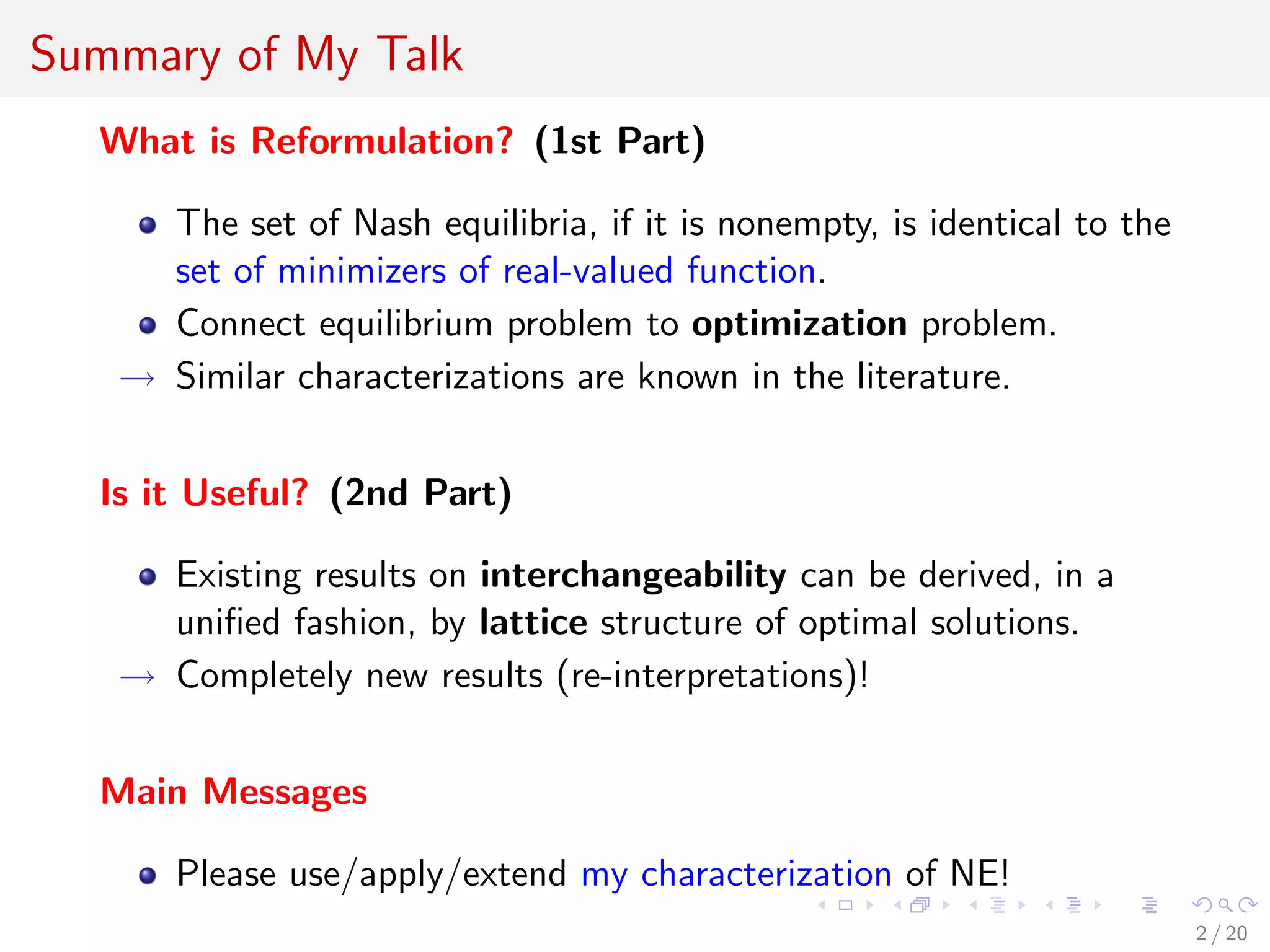
Summary of My Talk
What is Reformulation? (1st Part)
The set of Nash equilibria, if it is nonempty, is identical to the
set of minimizers of real-valued function.
Connect equilibrium problem to optimization problem.
→ Similar characterizations are known in the literature.
Is it Useful? (2nd Part)
Existing results on interchangeability can be derived, in a
unified fashion, by lattice structure of optimal solutions.
→ Completely new results (re-interpretations)!
Main Messages
Please use/apply/extend my characterization of NE!
2 / 20
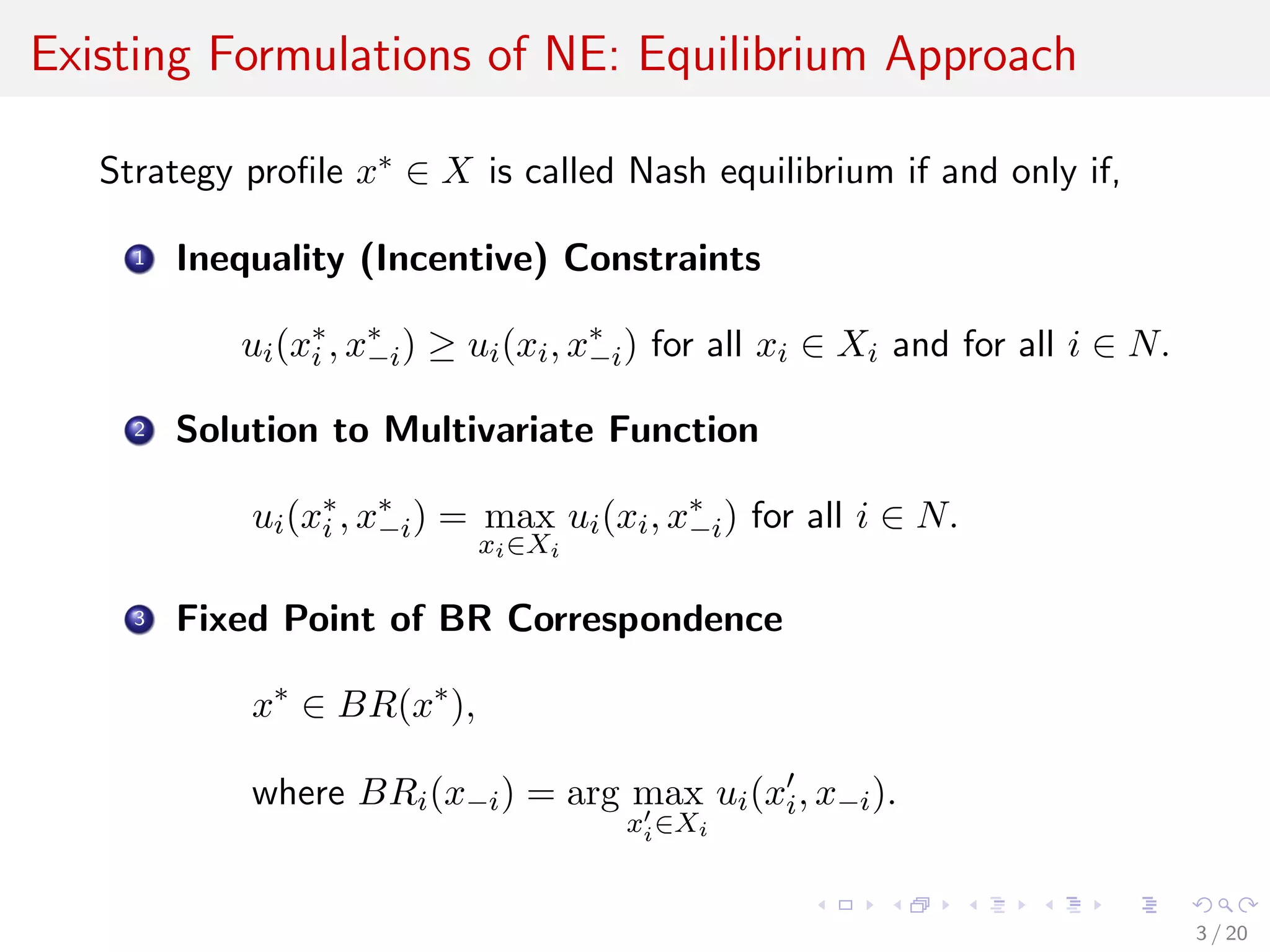
Existing Formulations of NE: Equilibrium Approach
Strategy profile x∗ ∈ X is called Nash equilibrium if and only if,
1 Inequality (Incentive) Constraints
ui(x∗
i , x∗
−i) ≥ ui(xi, x∗
−i) for all xi ∈ Xi and for all i ∈ N.
2 Solution to Multivariate Function
ui(x∗
i , x∗
−i) = max
xi∈Xi
ui(xi, x∗
−i) for all i ∈ N.
3 Fixed Point of BR Correspondence
x∗
∈ BR(x∗
),
where BRi(x−i) = arg max
xi∈Xi
ui(xi, x−i).
3 / 20
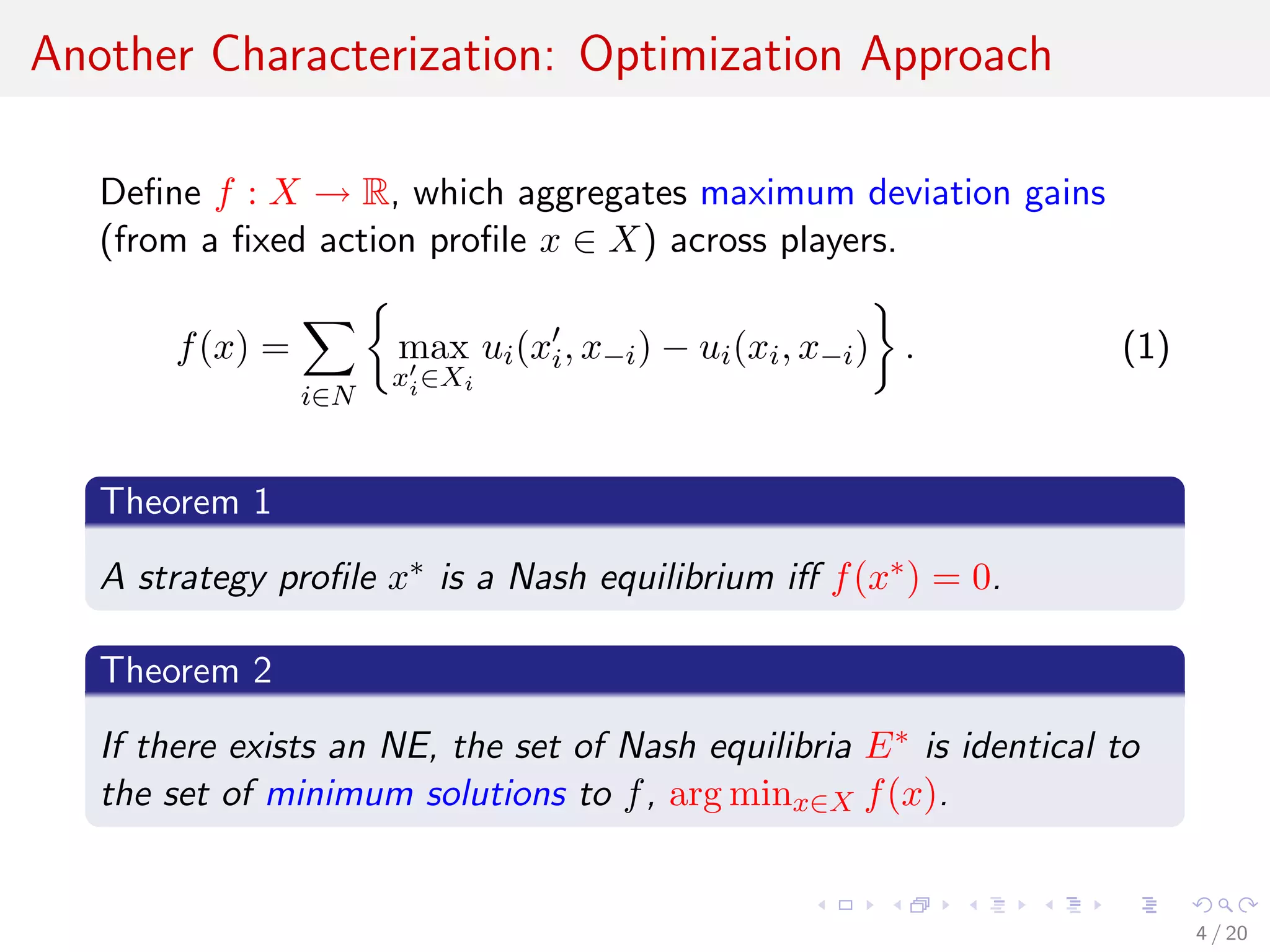
Another Characterization: Optimization Approach
Define f : X → R, which aggregates maximum deviation gains
(from a fixed action profile x ∈ X) across players.
f(x) =
i∈N
max
xi∈Xi
ui(xi, x−i) − ui(xi, x−i) . (1)
Theorem 1
A strategy profile x∗ is a Nash equilibrium iff f(x∗) = 0.
Theorem 2
If there exists an NE, the set of Nash equilibria E∗ is identical to
the set of minimum solutions to f, arg minx∈X f(x).
4 / 20
Slight Modifications
Let g(x) = −f(x). The set of Nash equilibria, if it is
nonempty, is identical to the set of maximum solutions to g.
arg max
x∈X
g(x).
Let t be a parameter contained in a parameter set T. Then,
(1) can be rewritten to incorporate this parameterization.
f(x, t) =
i∈N
max
xi∈Xi
ui(xi, x−i; t) − ui(xi, x−i; t) . (2)
Could be useful for (monotone) comparative statics:
e.g., to analyze conditions under which the set of optimal
solutions, or its selection, is increasing in t ∈ T.
5 / 20
Upper-hemi Continuity
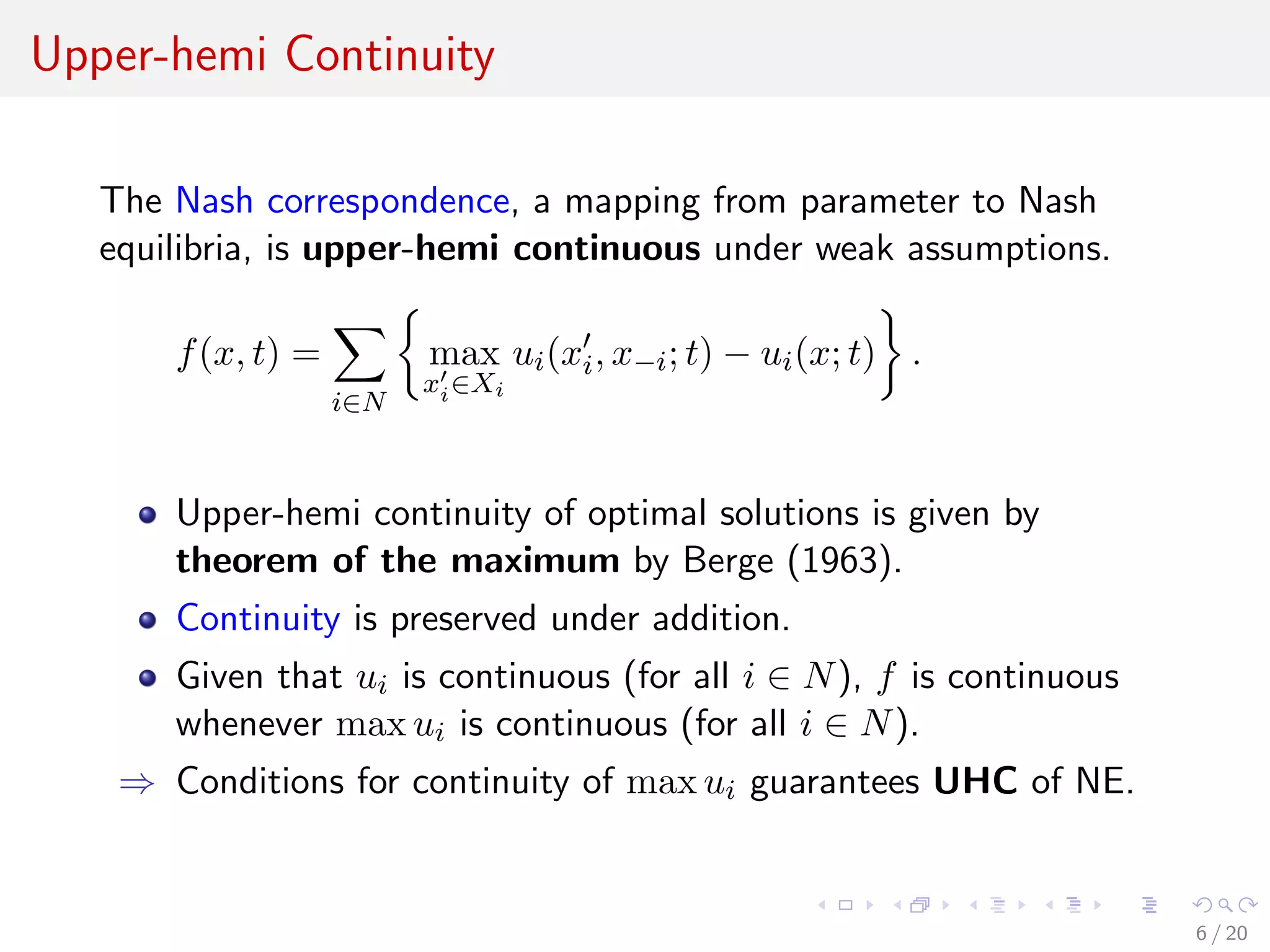
The Nash correspondence, a mapping from parameter to Nash
equilibria, is upper-hemi continuous under weak assumptions.
f(x, t) =
i∈N
max
xi∈Xi
ui(xi, x−i; t) − ui(x; t) .
Upper-hemi continuity of optimal solutions is given by
theorem of the maximum by Berge (1963).
Continuity is preserved under addition.
Given that ui is continuous (for all i ∈ N), f is continuous
whenever max ui is continuous (for all i ∈ N).
⇒ Conditions for continuity of max ui guarantees UHC of NE.
6 / 20
Special Case: Best Reply
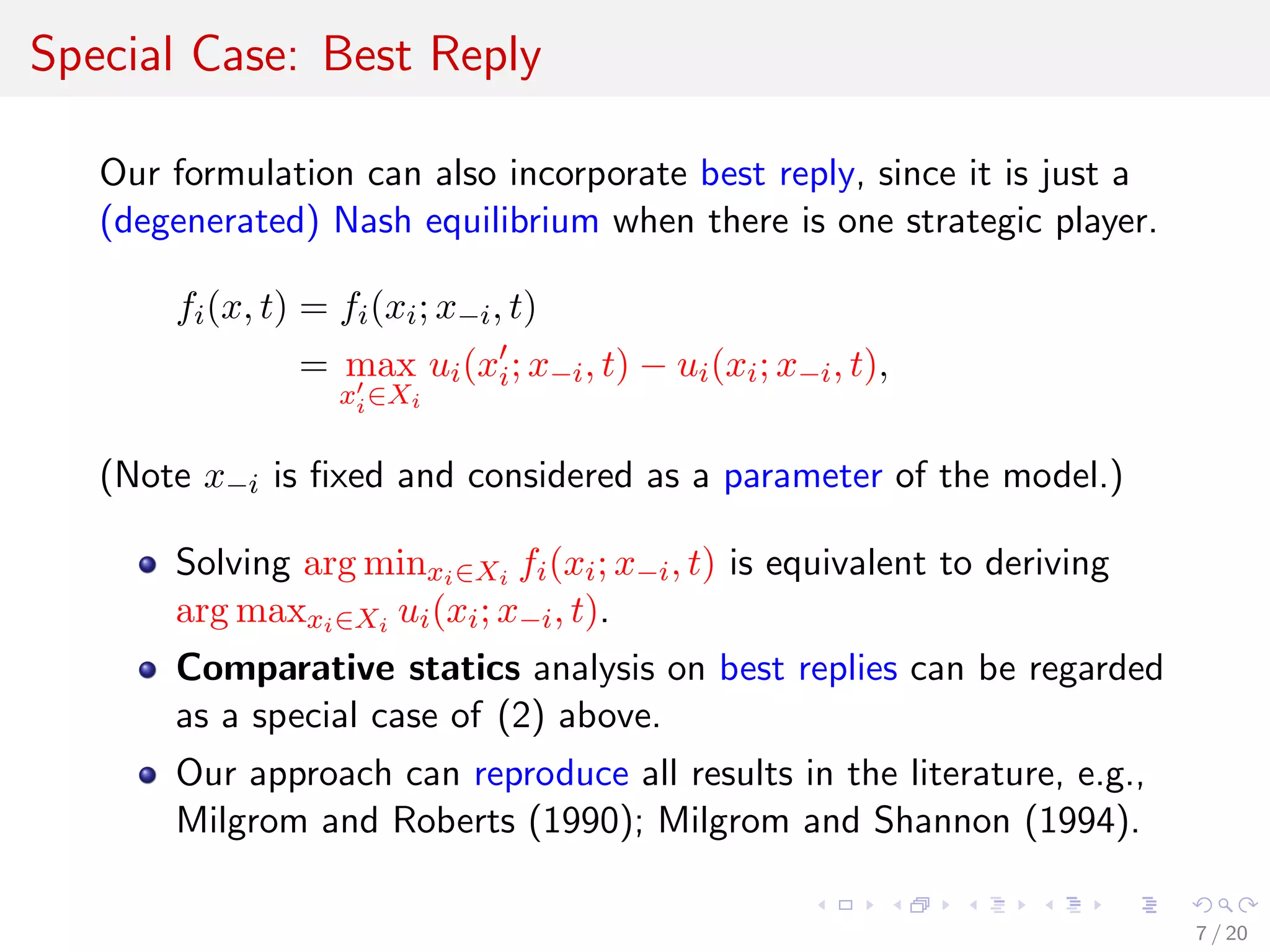
Our formulation can also incorporate best reply, since it is just a
(degenerated) Nash equilibrium when there is one strategic player.
fi(x, t) = fi(xi; x−i, t)
= max
xi∈Xi
ui(xi; x−i, t) − ui(xi; x−i, t),
(Note x−i is fixed and considered as a parameter of the model.)
Solving arg minxi∈Xi fi(xi; x−i, t) is equivalent to deriving
arg maxxi∈Xi ui(xi; x−i, t).
Comparative statics analysis on best replies can be regarded
as a special case of (2) above.
Our approach can reproduce all results in the literature, e.g.,
Milgrom and Roberts (1990); Milgrom and Shannon (1994).
7 / 20
From “Sum” to “Product”
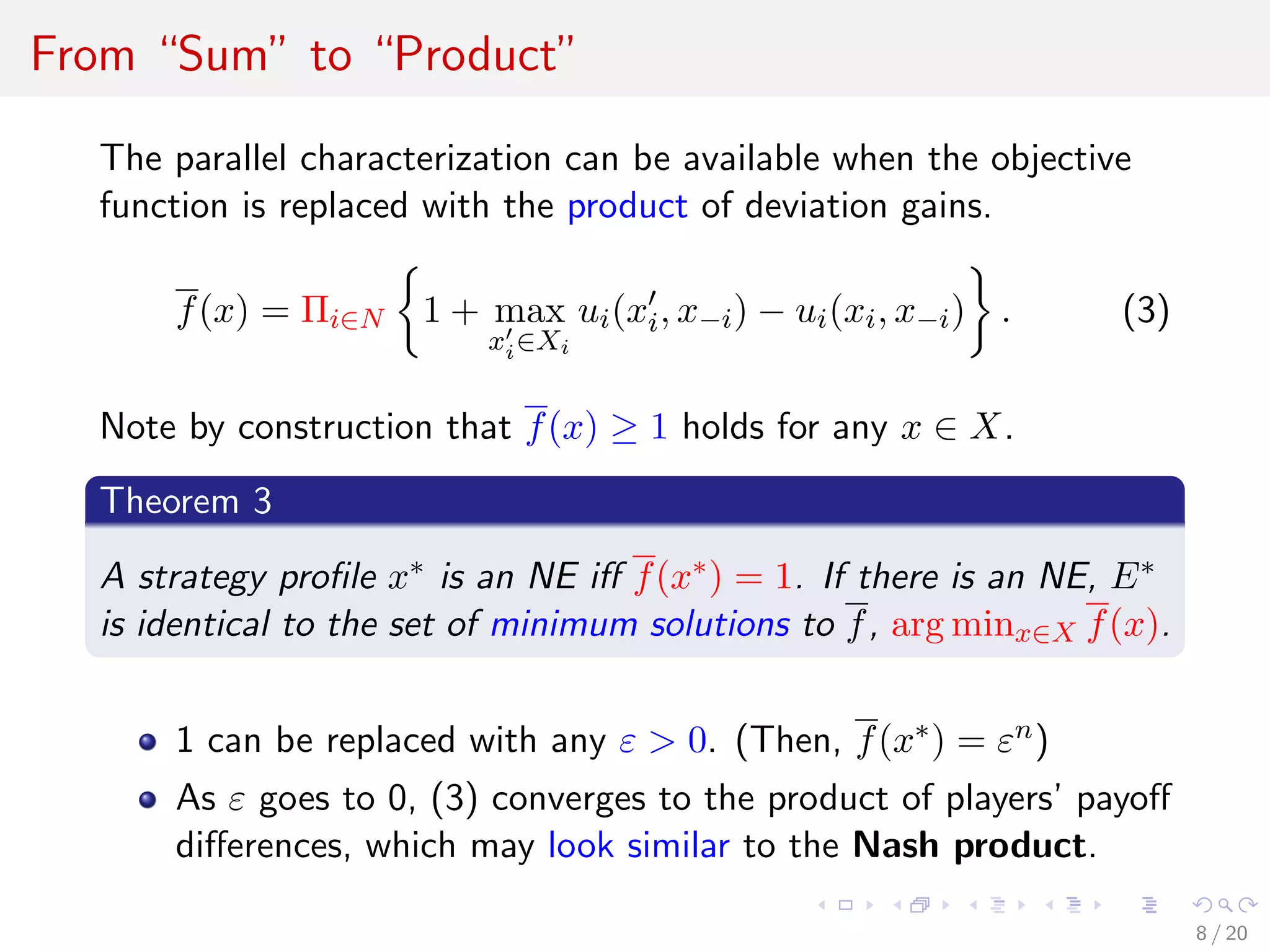
The parallel characterization can be available when the objective
function is replaced with the product of deviation gains.
f(x) = Πi∈N 1 + max
xi∈Xi
ui(xi, x−i) − ui(xi, x−i) . (3)
Note by construction that f(x) ≥ 1 holds for any x ∈ X.
Theorem 3
A strategy profile x∗ is an NE iff f(x∗) = 1. If there is an NE, E∗
is identical to the set of minimum solutions to f, arg minx∈X f(x).
1 can be replaced with any ε > 0. (Then, f(x∗) = εn)
As ε goes to 0, (3) converges to the product of players’ payoff
differences, which may look similar to the Nash product.
8 / 20
Interchangeability for Two-Person Games
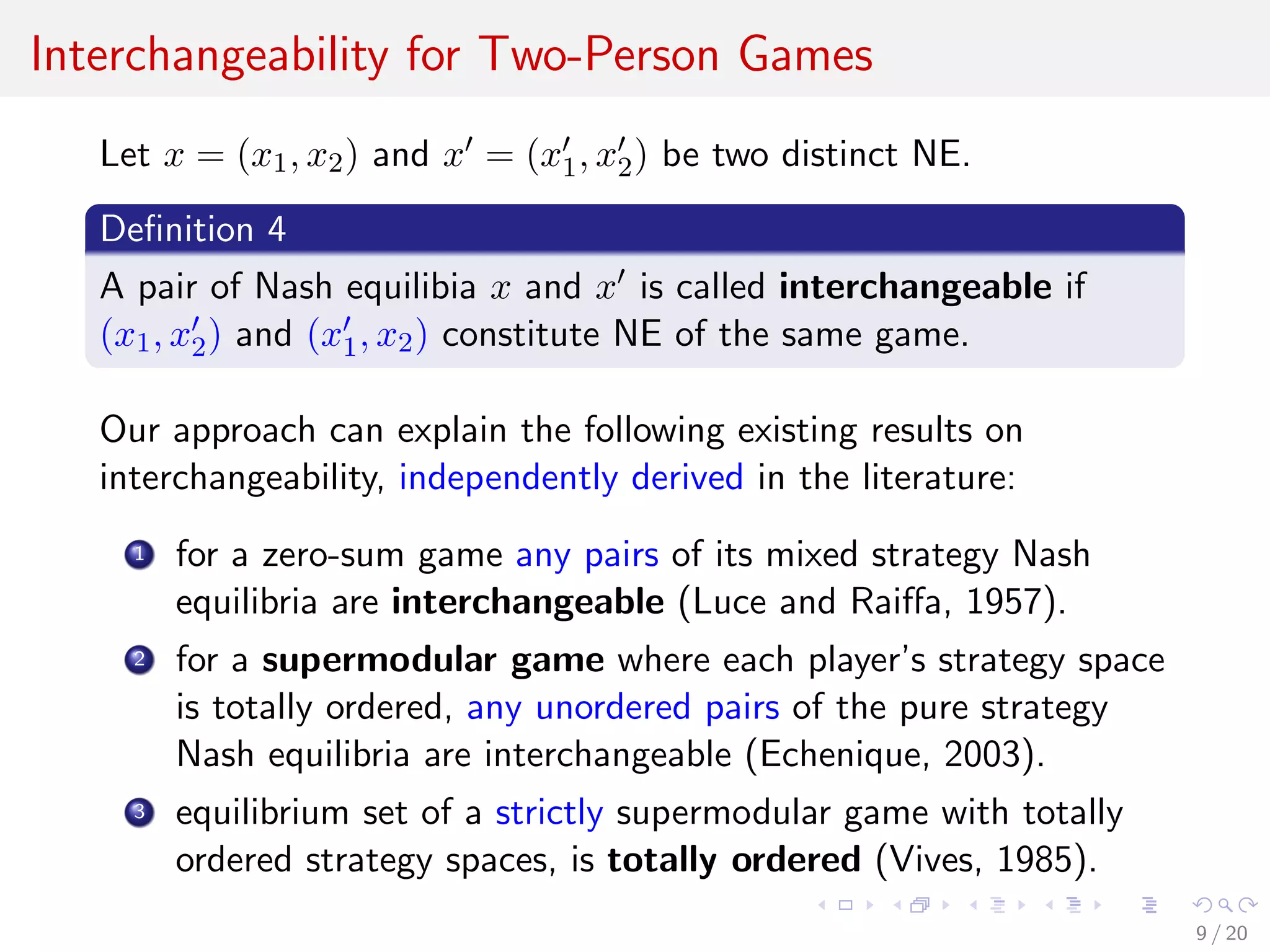
Let x = (x1, x2) and x = (x1, x2) be two distinct NE.
Definition 4
A pair of Nash equilibia x and x is called interchangeable if
(x1, x2) and (x1, x2) constitute NE of the same game.
Our approach can explain the following existing results on
interchangeability, independently derived in the literature:
1 for a zero-sum game any pairs of its mixed strategy Nash
equilibria are interchangeable (Luce and Raiffa, 1957).
2 for a supermodular game where each player’s strategy space
is totally ordered, any unordered pairs of the pure strategy
Nash equilibria are interchangeable (Echenique, 2003).
3 equilibrium set of a strictly supermodular game with totally
ordered strategy spaces, is totally ordered (Vives, 1985).
9 / 20
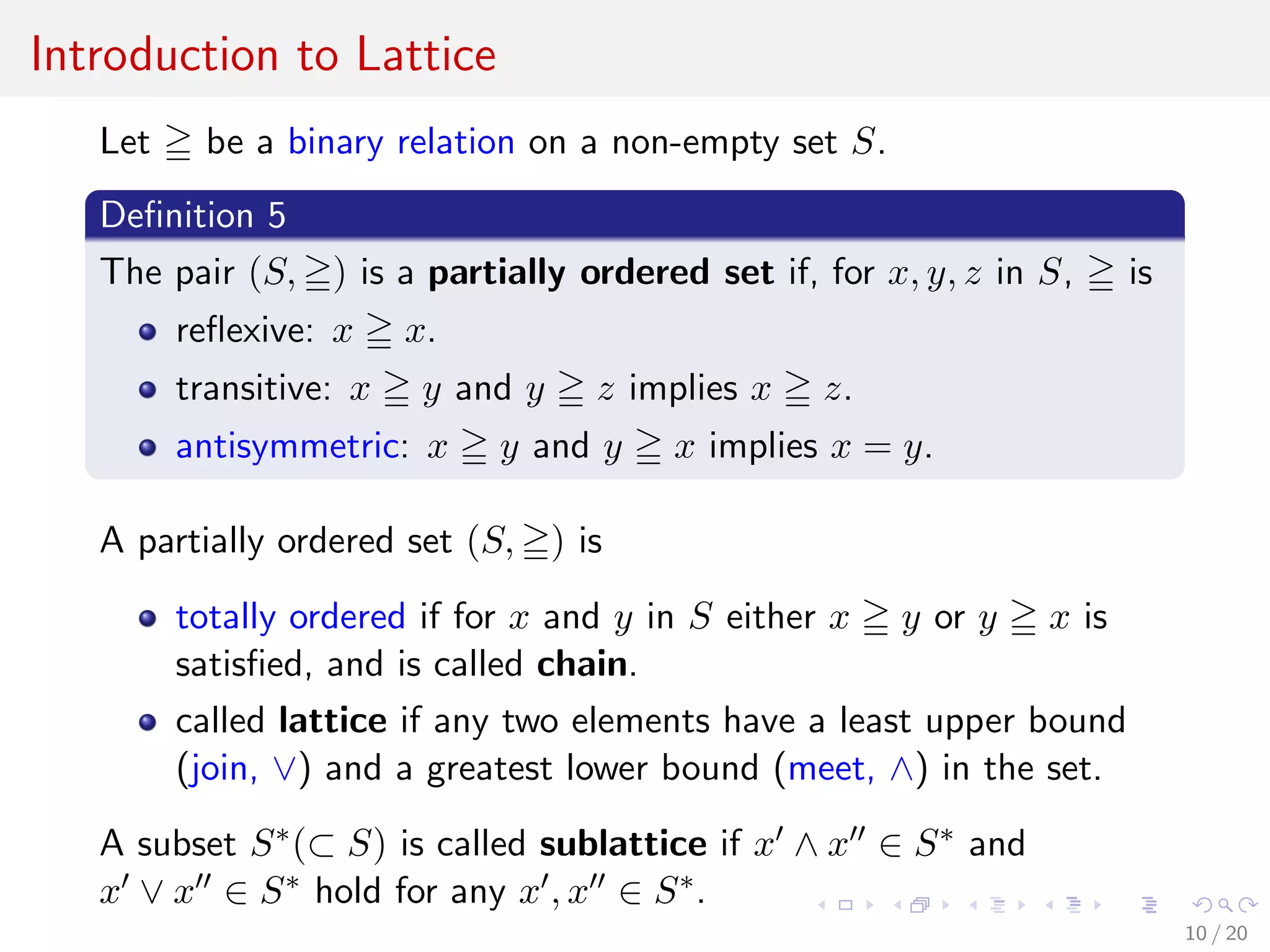
Introduction to Lattice
Let be a binary relation on a non-empty set S.
Definition 5
The pair (S, ) is a partially ordered set if, for x, y, z in S, is
reflexive: x x.
transitive: x y and y z implies x z.
antisymmetric: x y and y x implies x = y.
A partially ordered set (S, ) is
totally ordered if for x and y in S either x y or y x is
satisfied, and is called chain.
called lattice if any two elements have a least upper bound
(join, ∨) and a greatest lower bound (meet, ∧) in the set.
A subset S∗(⊂ S) is called sublattice if x ∧ x ∈ S∗ and
x ∨ x ∈ S∗ hold for any x , x ∈ S∗.
10 / 20
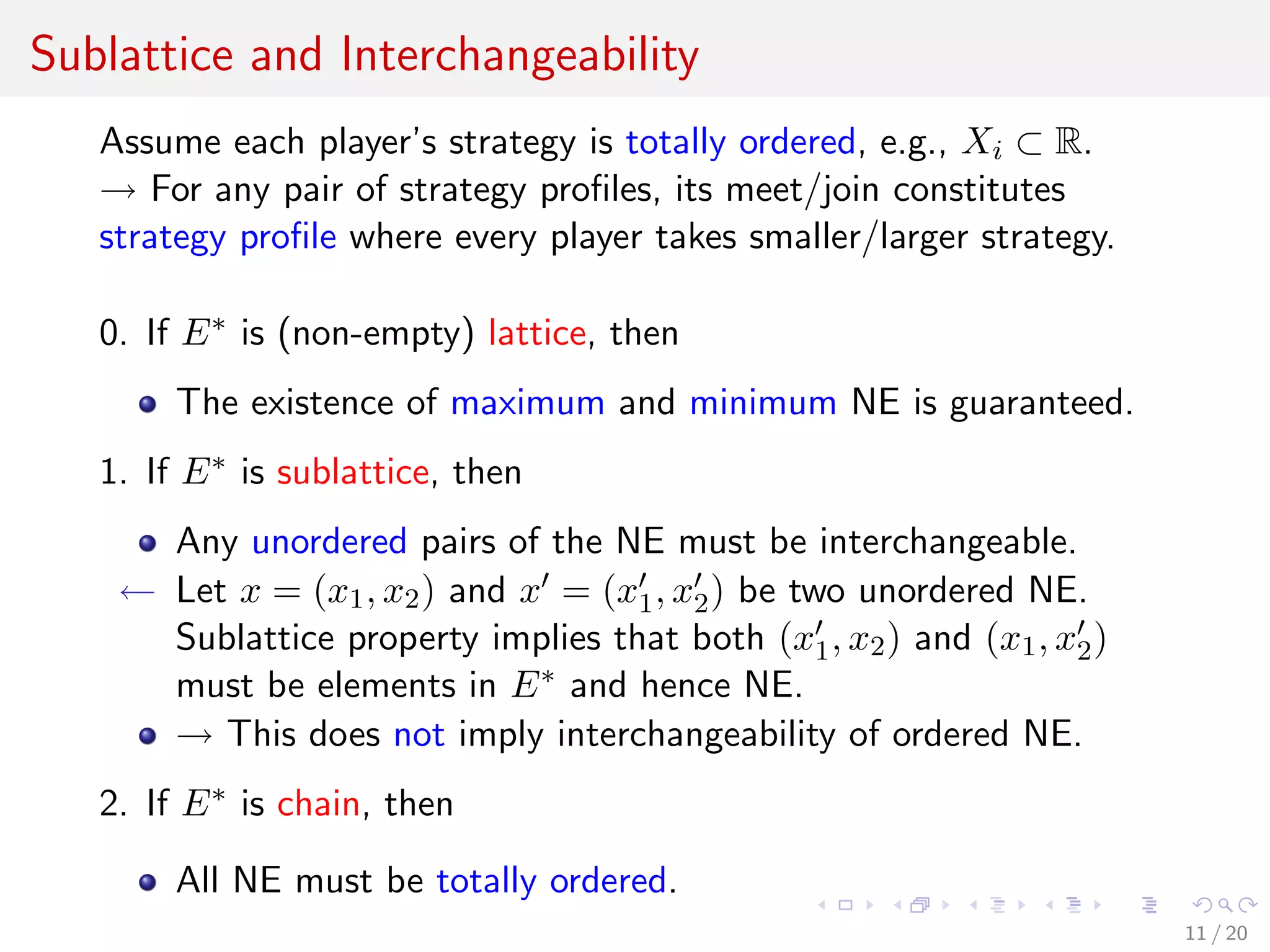
Sublattice and Interchangeability
Assume each player’s strategy is totally ordered, e.g., Xi ⊂ R.
→ For any pair of strategy profiles, its meet/join constitutes
strategy profile where every player takes smaller/larger strategy.
0. If E∗ is (non-empty) lattice, then
The existence of maximum and minimum NE is guaranteed.
1. If E∗ is sublattice, then
Any unordered pairs of the NE must be interchangeable.
← Let x = (x1, x2) and x = (x1, x2) be two unordered NE.
Sublattice property implies that both (x1, x2) and (x1, x2)
must be elements in E∗ and hence NE.
→ This does not imply interchangeability of ordered NE.
2. If E∗ is chain, then
All NE must be totally ordered.
11 / 20
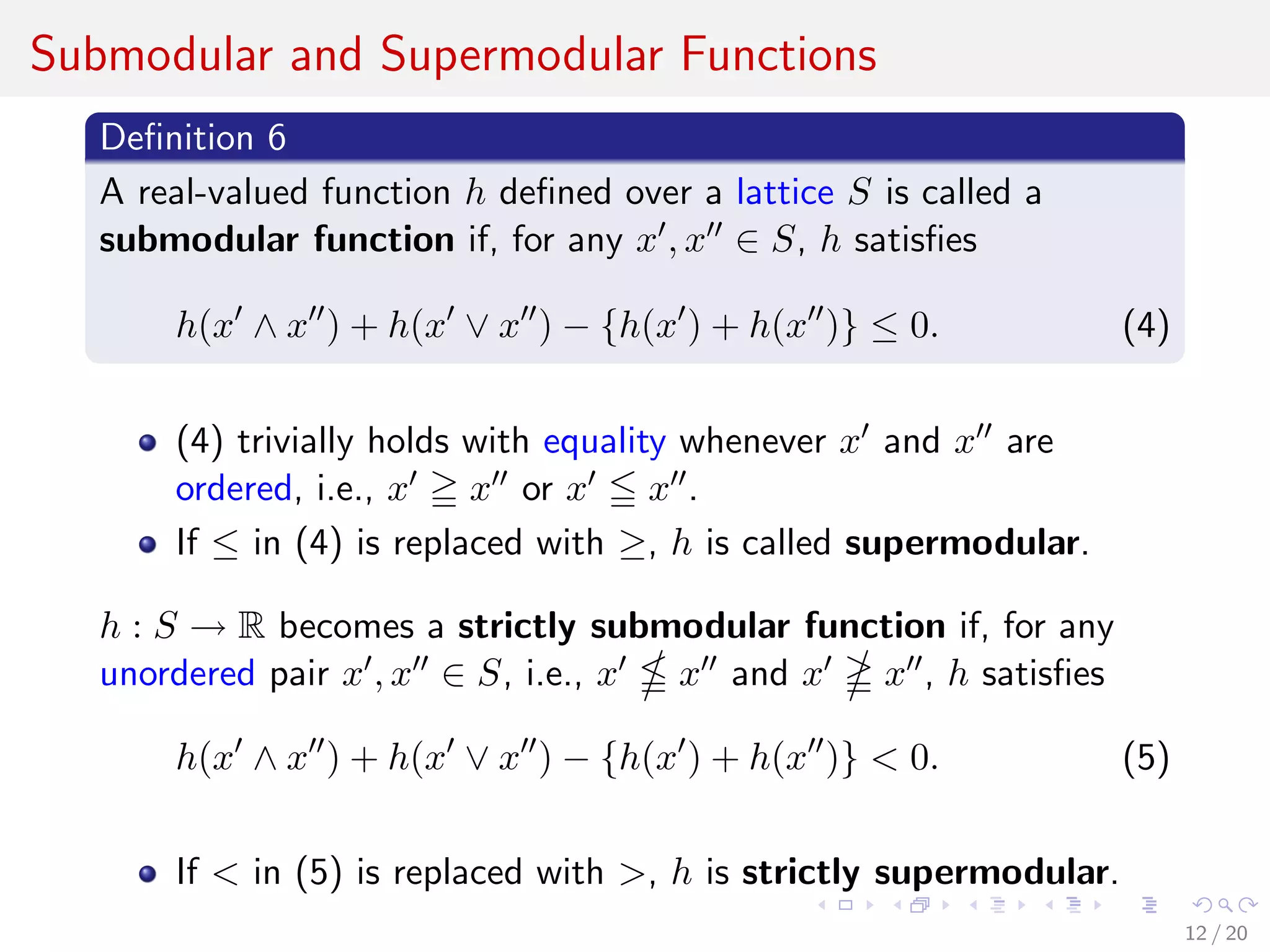
Submodular and Supermodular Functions
Definition 6
A real-valued function h defined over a lattice S is called a
submodular function if, for any x , x ∈ S, h satisfies
h(x ∧ x ) + h(x ∨ x ) − {h(x ) + h(x )} ≤ 0. (4)
(4) trivially holds with equality whenever x and x are
ordered, i.e., x x or x x .
If ≤ in (4) is replaced with ≥, h is called supermodular.
h : S → R becomes a strictly submodular function if, for any
unordered pair x , x ∈ S, i.e., x x and x x , h satisfies
h(x ∧ x ) + h(x ∨ x ) − {h(x ) + h(x )} < 0. (5)
If < in (5) is replaced with >, h is strictly supermodular.
12 / 20
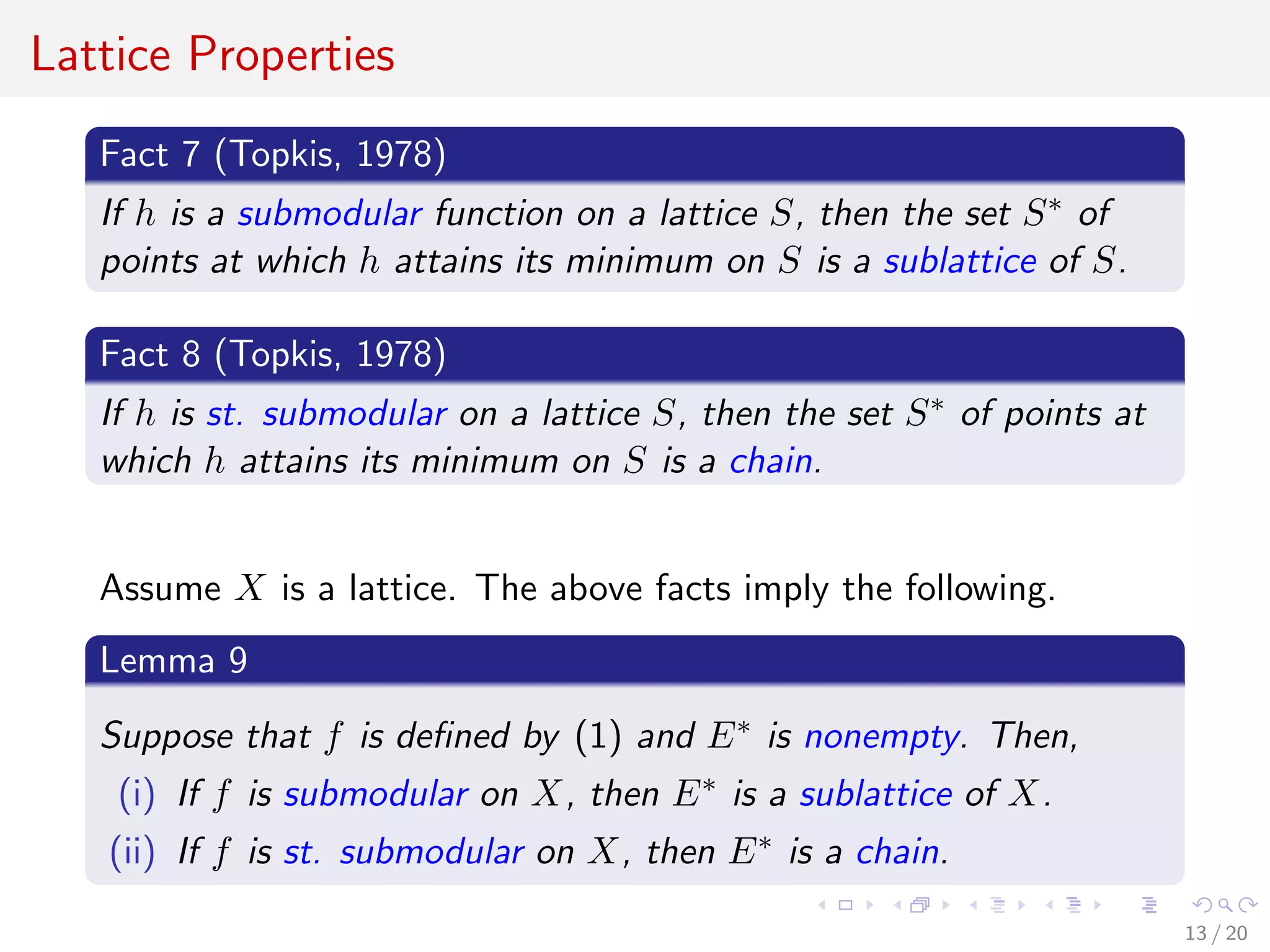
Lattice Properties
Fact 7 (Topkis, 1978)
If h is a submodular function on a lattice S, then the set S∗ of
points at which h attains its minimum on S is a sublattice of S.
Fact 8 (Topkis, 1978)
If h is st. submodular on a lattice S, then the set S∗ of points at
which h attains its minimum on S is a chain.
Assume X is a lattice. The above facts imply the following.
Lemma 9
Suppose that f is defined by (1) and E∗ is nonempty. Then,
(i) If f is submodular on X, then E∗ is a sublattice of X.
(ii) If f is st. submodular on X, then E∗ is a chain.
13 / 20
Supermodular Game
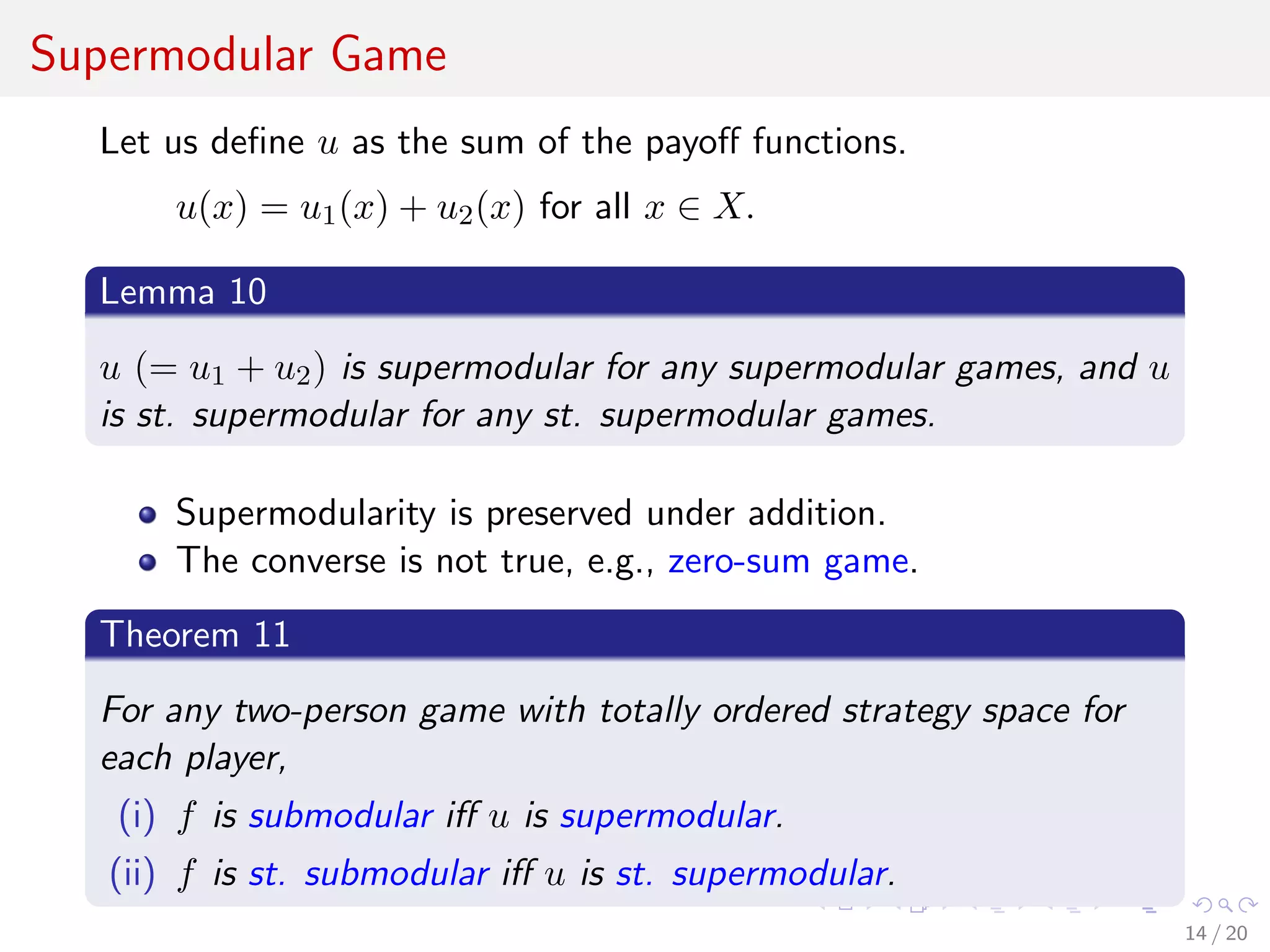
Let us define u as the sum of the payoff functions.
u(x) = u1(x) + u2(x) for all x ∈ X.
Lemma 10
u (= u1 + u2) is supermodular for any supermodular games, and u
is st. supermodular for any st. supermodular games.
Supermodularity is preserved under addition.
The converse is not true, e.g., zero-sum game.
Theorem 11
For any two-person game with totally ordered strategy space for
each player,
(i) f is submodular iff u is supermodular.
(ii) f is st. submodular iff u is st. supermodular.
14 / 20
Proof (1)
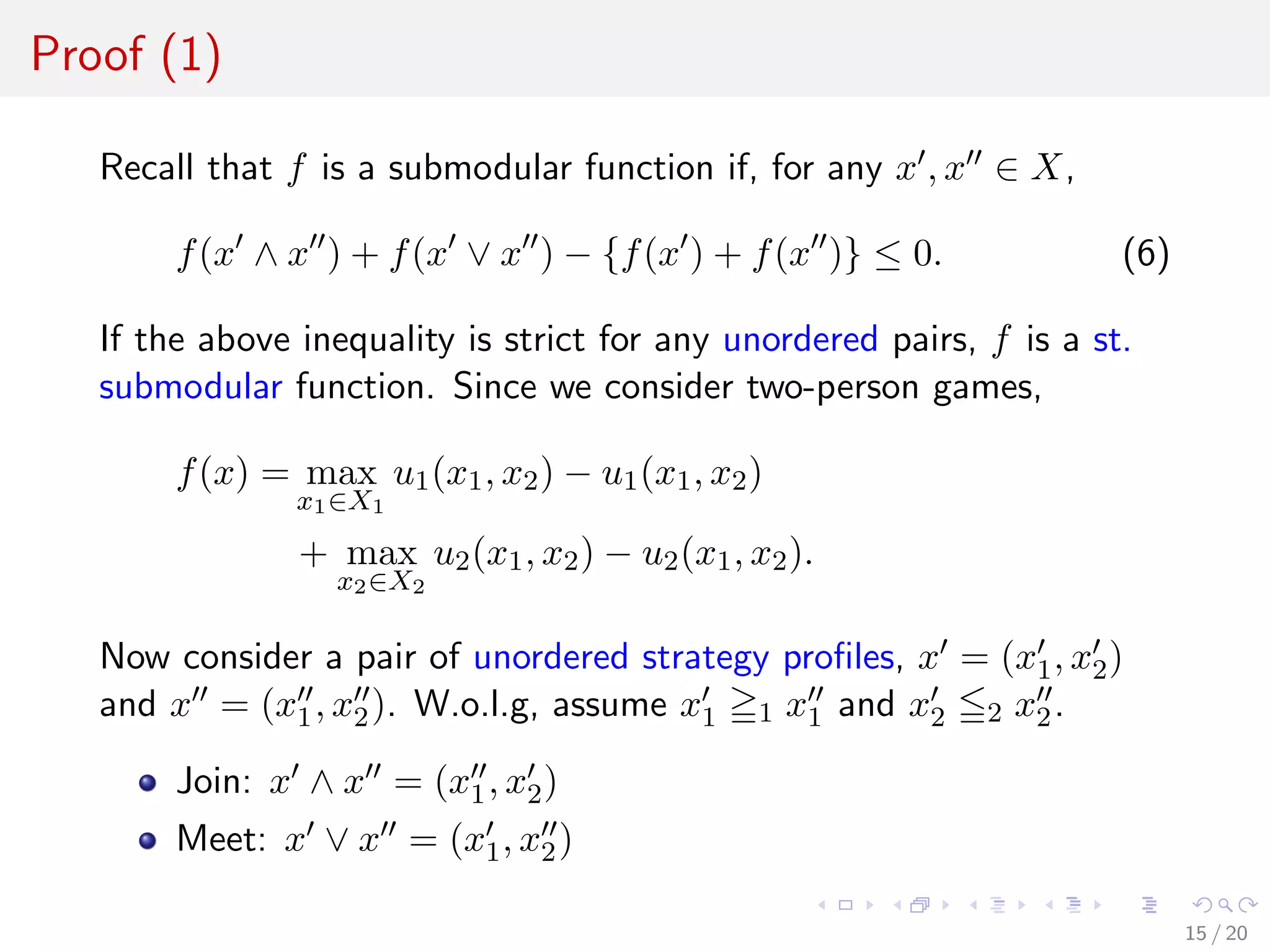
Recall that f is a submodular function if, for any x , x ∈ X,
f(x ∧ x ) + f(x ∨ x ) − {f(x ) + f(x )} ≤ 0. (6)
If the above inequality is strict for any unordered pairs, f is a st.
submodular function. Since we consider two-person games,
f(x) = max
x1∈X1
u1(x1, x2) − u1(x1, x2)
+ max
x2∈X2
u2(x1, x2) − u2(x1, x2).
Now consider a pair of unordered strategy profiles, x = (x1, x2)
and x = (x1, x2). W.o.l.g, assume x1 1 x1 and x2 2 x2.
Join: x ∧ x = (x1, x2)
Meet: x ∨ x = (x1, x2)
15 / 20
Proof (2)
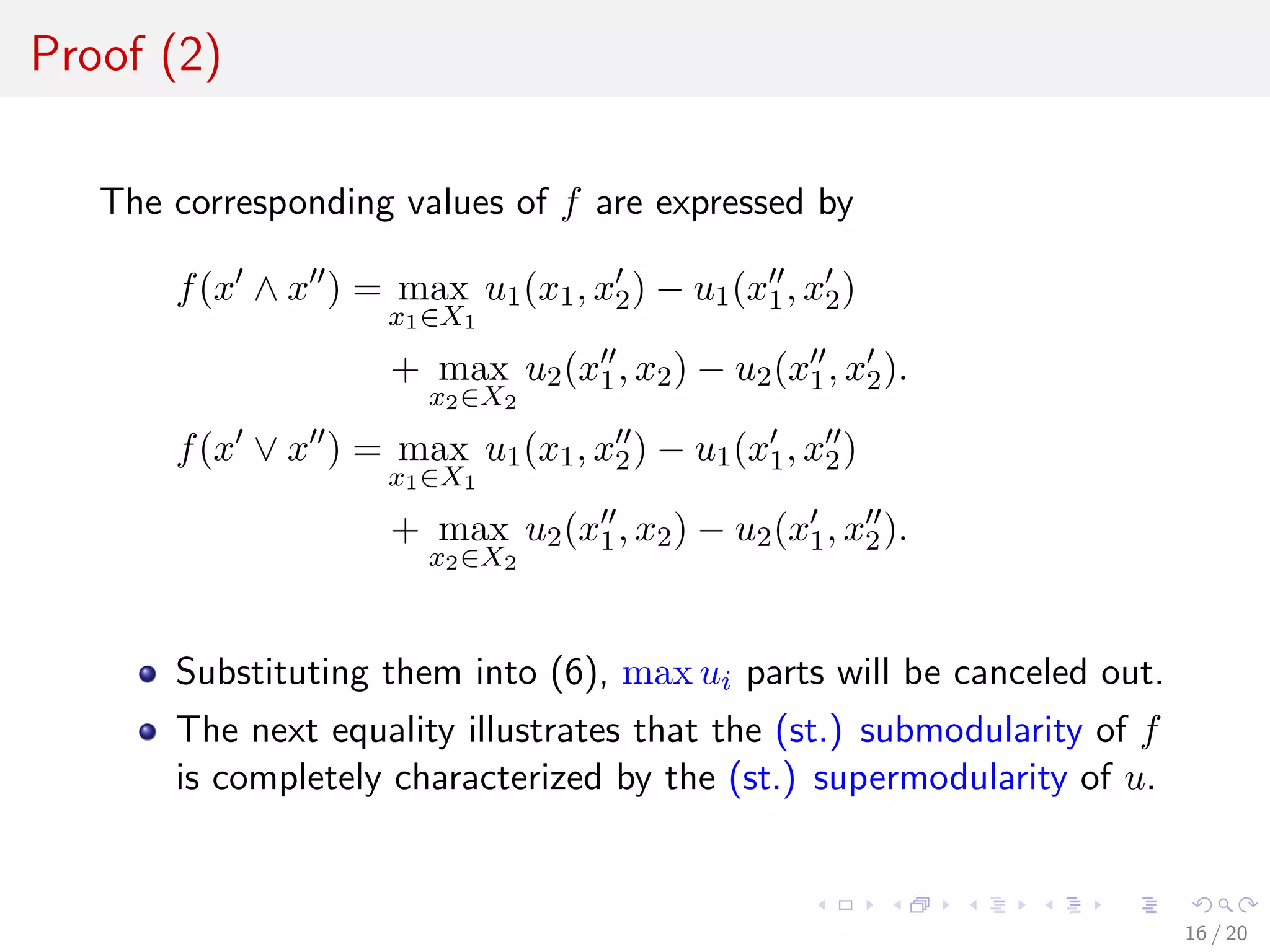
The corresponding values of f are expressed by
f(x ∧ x ) = max
x1∈X1
u1(x1, x2) − u1(x1, x2)
+ max
x2∈X2
u2(x1, x2) − u2(x1, x2).
f(x ∨ x ) = max
x1∈X1
u1(x1, x2) − u1(x1, x2)
+ max
x2∈X2
u2(x1, x2) − u2(x1, x2).
Substituting them into (6), max ui parts will be canceled out.
The next equality illustrates that the (st.) submodularity of f
is completely characterized by the (st.) supermodularity of u.
16 / 20
Proof (3)
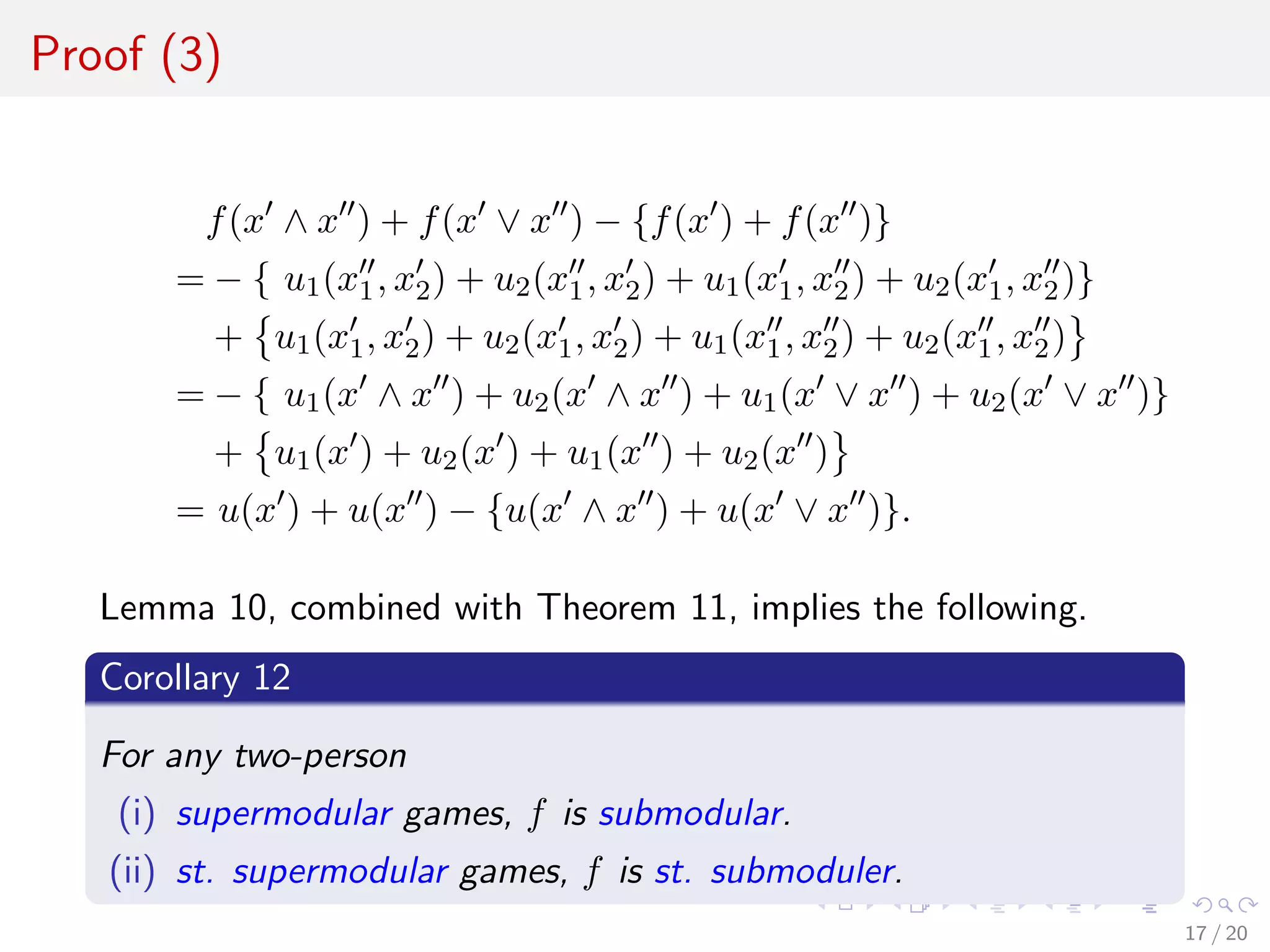
f(x ∧ x ) + f(x ∨ x ) − {f(x ) + f(x )}
= − { u1(x1, x2) + u2(x1, x2) + u1(x1, x2) + u2(x1, x2)}
+ u1(x1, x2) + u2(x1, x2) + u1(x1, x2) + u2(x1, x2)
= − { u1(x ∧ x ) + u2(x ∧ x ) + u1(x ∨ x ) + u2(x ∨ x )}
+ u1(x ) + u2(x ) + u1(x ) + u2(x )
= u(x ) + u(x ) − {u(x ∧ x ) + u(x ∨ x )}.
Lemma 10, combined with Theorem 11, implies the following.
Corollary 12
For any two-person
(i) supermodular games, f is submodular.
(ii) st. supermodular games, f is st. submoduler.
17 / 20
Interchangeability for Zero-Sum Game
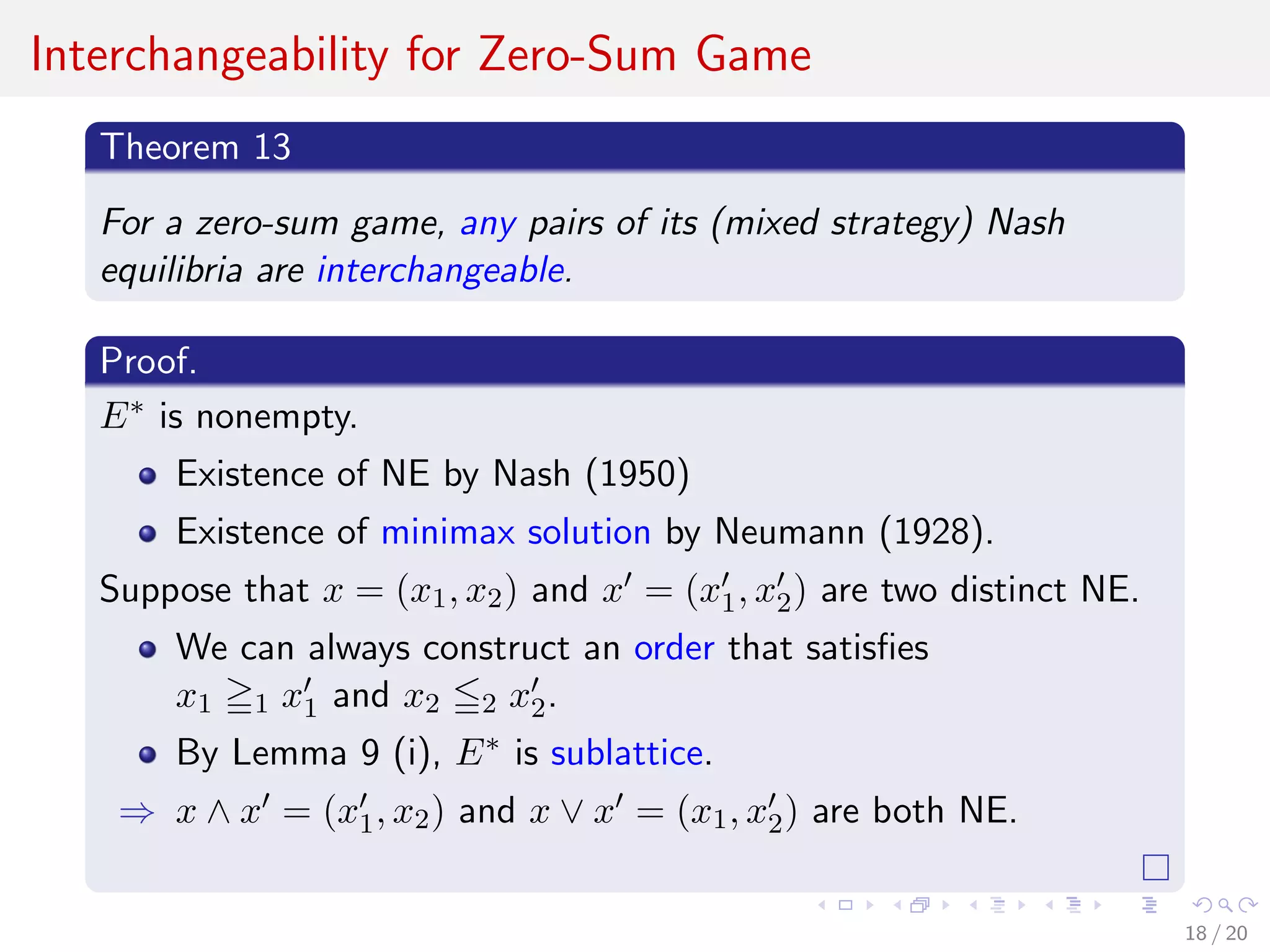
Theorem 13
For a zero-sum game, any pairs of its (mixed strategy) Nash
equilibria are interchangeable.
Proof.
E∗ is nonempty.
Existence of NE by Nash (1950)
Existence of minimax solution by Neumann (1928).
Suppose that x = (x1, x2) and x = (x1, x2) are two distinct NE.
We can always construct an order that satisfies
x1 1 x1 and x2 2 x2.
By Lemma 9 (i), E∗ is sublattice.
⇒ x ∧ x = (x1, x2) and x ∨ x = (x1, x2) are both NE.
18 / 20
Interchangeability for Supermodular Game
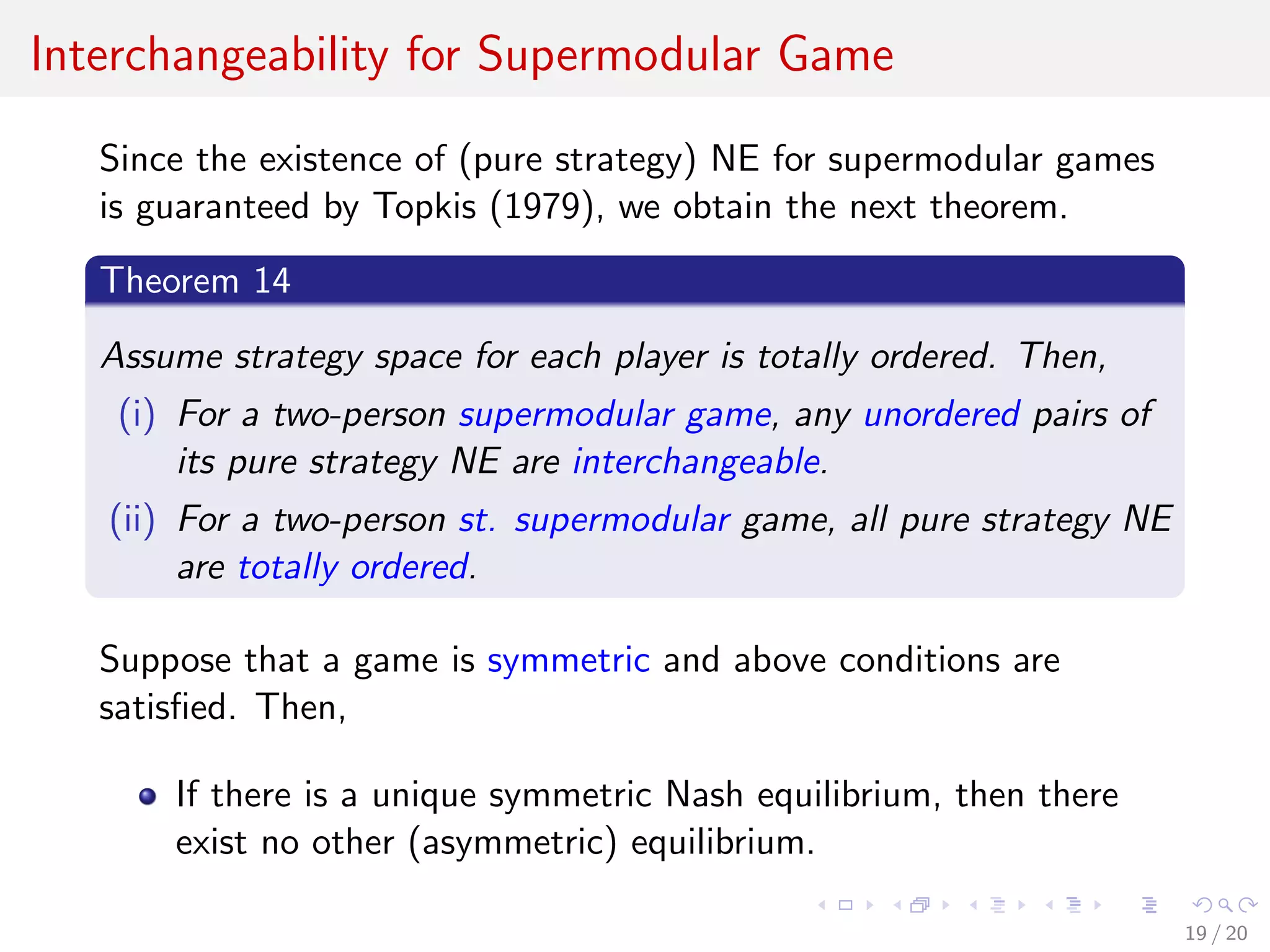
Since the existence of (pure strategy) NE for supermodular games
is guaranteed by Topkis (1979), we obtain the next theorem.
Theorem 14
Assume strategy space for each player is totally ordered. Then,
(i) For a two-person supermodular game, any unordered pairs of
its pure strategy NE are interchangeable.
(ii) For a two-person st. supermodular game, all pure strategy NE
are totally ordered.
Suppose that a game is symmetric and above conditions are
satisfied. Then,
If there is a unique symmetric Nash equilibrium, then there
exist no other (asymmetric) equilibrium.
19 / 20
Conclusion
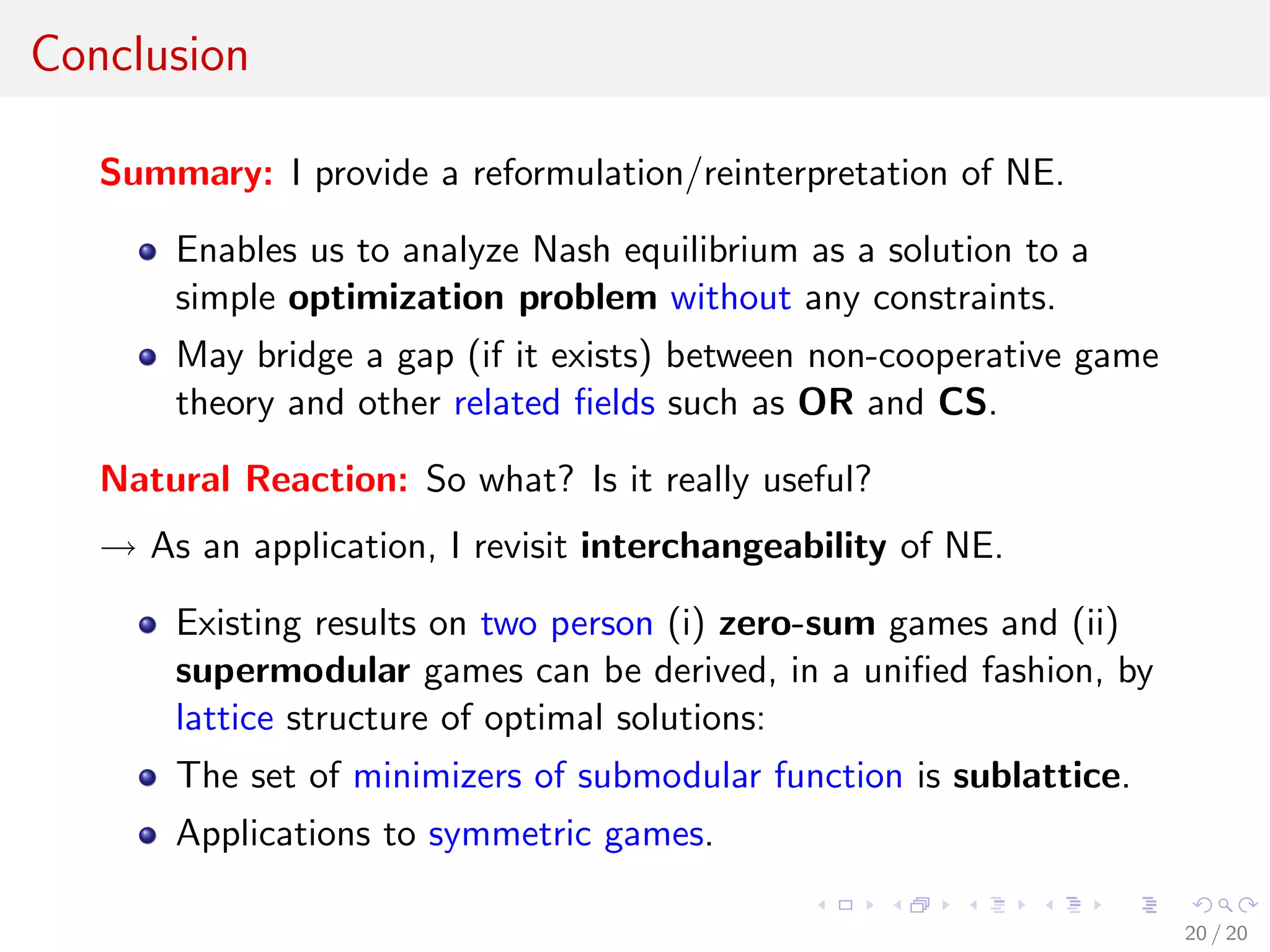
Summary: I provide a reformulation/reinterpretation of NE.
Enables us to analyze Nash equilibrium as a solution to a
simple optimization problem without any constraints.
May bridge a gap (if it exists) between non-cooperative game
theory and other related fields such as OR and CS.
Natural Reaction: So what? Is it really useful?
→ As an application, I revisit interchangeability of NE.
Existing results on two person (i) zero-sum games and (ii)
supermodular games can be derived, in a unified fashion, by
lattice structure of optimal solutions:
The set of minimizers of submodular function is sublattice.
Applications to symmetric games.
20 / 20

Reformulation of Nash Equilibrium with an Application to Interchangeability

  • 1.
    Reformulation of NashEquilibrium with an Application to Interchangeability Yosuke YASUDA Osaka University, Department of Economics yasuda@econ.osaka-u.ac.jp August, 2016 1 / 20
  • 2.
    Summary of MyTalk What is Reformulation? (1st Part) The set of Nash equilibria, if it is nonempty, is identical to the set of minimizers of real-valued function. Connect equilibrium problem to optimization problem. → Similar characterizations are known in the literature. Is it Useful? (2nd Part) Existing results on interchangeability can be derived, in a unified fashion, by lattice structure of optimal solutions. → Completely new results (re-interpretations)! Main Messages Please use/apply/extend my characterization of NE! 2 / 20
  • 3.
    Existing Formulations ofNE: Equilibrium Approach Strategy profile x∗ ∈ X is called Nash equilibrium if and only if, 1 Inequality (Incentive) Constraints ui(x∗ i , x∗ −i) ≥ ui(xi, x∗ −i) for all xi ∈ Xi and for all i ∈ N. 2 Solution to Multivariate Function ui(x∗ i , x∗ −i) = max xi∈Xi ui(xi, x∗ −i) for all i ∈ N. 3 Fixed Point of BR Correspondence x∗ ∈ BR(x∗ ), where BRi(x−i) = arg max xi∈Xi ui(xi, x−i). 3 / 20
  • 4.
    Another Characterization: OptimizationApproach Define f : X → R, which aggregates maximum deviation gains (from a fixed action profile x ∈ X) across players. f(x) = i∈N max xi∈Xi ui(xi, x−i) − ui(xi, x−i) . (1) Theorem 1 A strategy profile x∗ is a Nash equilibrium iff f(x∗) = 0. Theorem 2 If there exists an NE, the set of Nash equilibria E∗ is identical to the set of minimum solutions to f, arg minx∈X f(x). 4 / 20
  • 5.
    Slight Modifications Let g(x)= −f(x). The set of Nash equilibria, if it is nonempty, is identical to the set of maximum solutions to g. arg max x∈X g(x). Let t be a parameter contained in a parameter set T. Then, (1) can be rewritten to incorporate this parameterization. f(x, t) = i∈N max xi∈Xi ui(xi, x−i; t) − ui(xi, x−i; t) . (2) Could be useful for (monotone) comparative statics: e.g., to analyze conditions under which the set of optimal solutions, or its selection, is increasing in t ∈ T. 5 / 20
  • 6.
    Upper-hemi Continuity The Nashcorrespondence, a mapping from parameter to Nash equilibria, is upper-hemi continuous under weak assumptions. f(x, t) = i∈N max xi∈Xi ui(xi, x−i; t) − ui(x; t) . Upper-hemi continuity of optimal solutions is given by theorem of the maximum by Berge (1963). Continuity is preserved under addition. Given that ui is continuous (for all i ∈ N), f is continuous whenever max ui is continuous (for all i ∈ N). ⇒ Conditions for continuity of max ui guarantees UHC of NE. 6 / 20
  • 7.
    Special Case: BestReply Our formulation can also incorporate best reply, since it is just a (degenerated) Nash equilibrium when there is one strategic player. fi(x, t) = fi(xi; x−i, t) = max xi∈Xi ui(xi; x−i, t) − ui(xi; x−i, t), (Note x−i is fixed and considered as a parameter of the model.) Solving arg minxi∈Xi fi(xi; x−i, t) is equivalent to deriving arg maxxi∈Xi ui(xi; x−i, t). Comparative statics analysis on best replies can be regarded as a special case of (2) above. Our approach can reproduce all results in the literature, e.g., Milgrom and Roberts (1990); Milgrom and Shannon (1994). 7 / 20
  • 8.
    From “Sum” to“Product” The parallel characterization can be available when the objective function is replaced with the product of deviation gains. f(x) = Πi∈N 1 + max xi∈Xi ui(xi, x−i) − ui(xi, x−i) . (3) Note by construction that f(x) ≥ 1 holds for any x ∈ X. Theorem 3 A strategy profile x∗ is an NE iff f(x∗) = 1. If there is an NE, E∗ is identical to the set of minimum solutions to f, arg minx∈X f(x). 1 can be replaced with any ε > 0. (Then, f(x∗) = εn) As ε goes to 0, (3) converges to the product of players’ payoff differences, which may look similar to the Nash product. 8 / 20
  • 9.
    Interchangeability for Two-PersonGames Let x = (x1, x2) and x = (x1, x2) be two distinct NE. Definition 4 A pair of Nash equilibia x and x is called interchangeable if (x1, x2) and (x1, x2) constitute NE of the same game. Our approach can explain the following existing results on interchangeability, independently derived in the literature: 1 for a zero-sum game any pairs of its mixed strategy Nash equilibria are interchangeable (Luce and Raiffa, 1957). 2 for a supermodular game where each player’s strategy space is totally ordered, any unordered pairs of the pure strategy Nash equilibria are interchangeable (Echenique, 2003). 3 equilibrium set of a strictly supermodular game with totally ordered strategy spaces, is totally ordered (Vives, 1985). 9 / 20
  • 10.
    Introduction to Lattice Letbe a binary relation on a non-empty set S. Definition 5 The pair (S, ) is a partially ordered set if, for x, y, z in S, is reflexive: x x. transitive: x y and y z implies x z. antisymmetric: x y and y x implies x = y. A partially ordered set (S, ) is totally ordered if for x and y in S either x y or y x is satisfied, and is called chain. called lattice if any two elements have a least upper bound (join, ∨) and a greatest lower bound (meet, ∧) in the set. A subset S∗(⊂ S) is called sublattice if x ∧ x ∈ S∗ and x ∨ x ∈ S∗ hold for any x , x ∈ S∗. 10 / 20
  • 11.
    Sublattice and Interchangeability Assumeeach player’s strategy is totally ordered, e.g., Xi ⊂ R. → For any pair of strategy profiles, its meet/join constitutes strategy profile where every player takes smaller/larger strategy. 0. If E∗ is (non-empty) lattice, then The existence of maximum and minimum NE is guaranteed. 1. If E∗ is sublattice, then Any unordered pairs of the NE must be interchangeable. ← Let x = (x1, x2) and x = (x1, x2) be two unordered NE. Sublattice property implies that both (x1, x2) and (x1, x2) must be elements in E∗ and hence NE. → This does not imply interchangeability of ordered NE. 2. If E∗ is chain, then All NE must be totally ordered. 11 / 20
  • 12.
    Submodular and SupermodularFunctions Definition 6 A real-valued function h defined over a lattice S is called a submodular function if, for any x , x ∈ S, h satisfies h(x ∧ x ) + h(x ∨ x ) − {h(x ) + h(x )} ≤ 0. (4) (4) trivially holds with equality whenever x and x are ordered, i.e., x x or x x . If ≤ in (4) is replaced with ≥, h is called supermodular. h : S → R becomes a strictly submodular function if, for any unordered pair x , x ∈ S, i.e., x x and x x , h satisfies h(x ∧ x ) + h(x ∨ x ) − {h(x ) + h(x )} < 0. (5) If < in (5) is replaced with >, h is strictly supermodular. 12 / 20
  • 13.
    Lattice Properties Fact 7(Topkis, 1978) If h is a submodular function on a lattice S, then the set S∗ of points at which h attains its minimum on S is a sublattice of S. Fact 8 (Topkis, 1978) If h is st. submodular on a lattice S, then the set S∗ of points at which h attains its minimum on S is a chain. Assume X is a lattice. The above facts imply the following. Lemma 9 Suppose that f is defined by (1) and E∗ is nonempty. Then, (i) If f is submodular on X, then E∗ is a sublattice of X. (ii) If f is st. submodular on X, then E∗ is a chain. 13 / 20
  • 14.
    Supermodular Game Let usdefine u as the sum of the payoff functions. u(x) = u1(x) + u2(x) for all x ∈ X. Lemma 10 u (= u1 + u2) is supermodular for any supermodular games, and u is st. supermodular for any st. supermodular games. Supermodularity is preserved under addition. The converse is not true, e.g., zero-sum game. Theorem 11 For any two-person game with totally ordered strategy space for each player, (i) f is submodular iff u is supermodular. (ii) f is st. submodular iff u is st. supermodular. 14 / 20
  • 15.
    Proof (1) Recall thatf is a submodular function if, for any x , x ∈ X, f(x ∧ x ) + f(x ∨ x ) − {f(x ) + f(x )} ≤ 0. (6) If the above inequality is strict for any unordered pairs, f is a st. submodular function. Since we consider two-person games, f(x) = max x1∈X1 u1(x1, x2) − u1(x1, x2) + max x2∈X2 u2(x1, x2) − u2(x1, x2). Now consider a pair of unordered strategy profiles, x = (x1, x2) and x = (x1, x2). W.o.l.g, assume x1 1 x1 and x2 2 x2. Join: x ∧ x = (x1, x2) Meet: x ∨ x = (x1, x2) 15 / 20
  • 16.
    Proof (2) The correspondingvalues of f are expressed by f(x ∧ x ) = max x1∈X1 u1(x1, x2) − u1(x1, x2) + max x2∈X2 u2(x1, x2) − u2(x1, x2). f(x ∨ x ) = max x1∈X1 u1(x1, x2) − u1(x1, x2) + max x2∈X2 u2(x1, x2) − u2(x1, x2). Substituting them into (6), max ui parts will be canceled out. The next equality illustrates that the (st.) submodularity of f is completely characterized by the (st.) supermodularity of u. 16 / 20
  • 17.
    Proof (3) f(x ∧x ) + f(x ∨ x ) − {f(x ) + f(x )} = − { u1(x1, x2) + u2(x1, x2) + u1(x1, x2) + u2(x1, x2)} + u1(x1, x2) + u2(x1, x2) + u1(x1, x2) + u2(x1, x2) = − { u1(x ∧ x ) + u2(x ∧ x ) + u1(x ∨ x ) + u2(x ∨ x )} + u1(x ) + u2(x ) + u1(x ) + u2(x ) = u(x ) + u(x ) − {u(x ∧ x ) + u(x ∨ x )}. Lemma 10, combined with Theorem 11, implies the following. Corollary 12 For any two-person (i) supermodular games, f is submodular. (ii) st. supermodular games, f is st. submoduler. 17 / 20
  • 18.
    Interchangeability for Zero-SumGame Theorem 13 For a zero-sum game, any pairs of its (mixed strategy) Nash equilibria are interchangeable. Proof. E∗ is nonempty. Existence of NE by Nash (1950) Existence of minimax solution by Neumann (1928). Suppose that x = (x1, x2) and x = (x1, x2) are two distinct NE. We can always construct an order that satisfies x1 1 x1 and x2 2 x2. By Lemma 9 (i), E∗ is sublattice. ⇒ x ∧ x = (x1, x2) and x ∨ x = (x1, x2) are both NE. 18 / 20
  • 19.
    Interchangeability for SupermodularGame Since the existence of (pure strategy) NE for supermodular games is guaranteed by Topkis (1979), we obtain the next theorem. Theorem 14 Assume strategy space for each player is totally ordered. Then, (i) For a two-person supermodular game, any unordered pairs of its pure strategy NE are interchangeable. (ii) For a two-person st. supermodular game, all pure strategy NE are totally ordered. Suppose that a game is symmetric and above conditions are satisfied. Then, If there is a unique symmetric Nash equilibrium, then there exist no other (asymmetric) equilibrium. 19 / 20
  • 20.
    Conclusion Summary: I providea reformulation/reinterpretation of NE. Enables us to analyze Nash equilibrium as a solution to a simple optimization problem without any constraints. May bridge a gap (if it exists) between non-cooperative game theory and other related fields such as OR and CS. Natural Reaction: So what? Is it really useful? → As an application, I revisit interchangeability of NE. Existing results on two person (i) zero-sum games and (ii) supermodular games can be derived, in a unified fashion, by lattice structure of optimal solutions: The set of minimizers of submodular function is sublattice. Applications to symmetric games. 20 / 20