Statistics for
Experiments
ARIF RAHMAN
1
Statistics Prerequisite
2
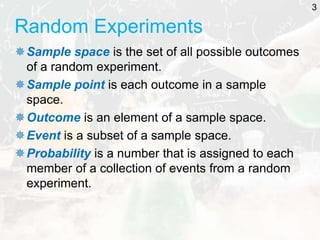
Random Experiments
Sample space is the set of all possible outcomes
of a random experiment.
Sample point is each outcome in a sample
space.
Outcome is an element of a sample space.
Event is a subset of a sample space.
Probability is a number that is assigned to each
member of a collection of events from a random
experiment.
3
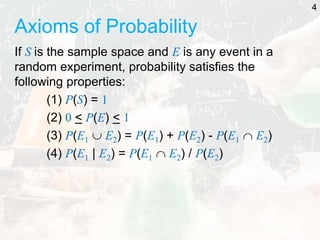
Axioms of Probability
If S is the sample space and E is any event in a
random experiment, probability satisfies the
following properties:
(1) P(S) = 1
(2) 0 < P(E) < 1
(3) P(E1  E2) = P(E1) + P(E2) - P(E1  E2)
(4) P(E1 | E2) = P(E1  E2) / P(E2)
4
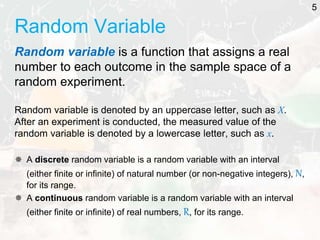
Random Variable
Random variable is a function that assigns a real
number to each outcome in the sample space of a
random experiment.
Random variable is denoted by an uppercase letter, such as X.
After an experiment is conducted, the measured value of the
random variable is denoted by a lowercase letter, such as x.
 A discrete random variable is a random variable with an interval
(either finite or infinite) of natural number (or non-negative integers), N,
for its range.
 A continuous random variable is a random variable with an interval
(either finite or infinite) of real numbers, R, for its range.
5
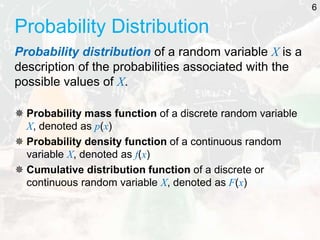
Probability Distribution
Probability distribution of a random variable X is a
description of the probabilities associated with the
possible values of X.
 Probability mass function of a discrete random variable
X, denoted as p(x)
 Probability density function of a continuous random
variable X, denoted as f(x)
 Cumulative distribution function of a discrete or
continuous random variable X, denoted as F(x)
6
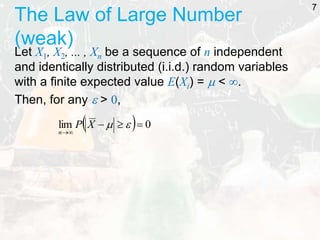
The Law of Large Number
(weak)
Let X1, X2, ... , Xn be a sequence of n independent
and identically distributed (i.i.d.) random variables
with a finite expected value E(Xi) =  < .
Then, for any  > 0,
7
  0
lim 






X
P
n
The Law of Large Number
(strong)
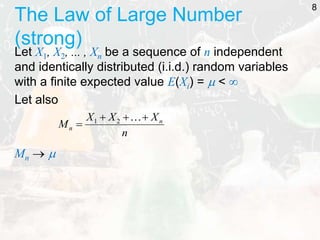
Let X1, X2, ... , Xn be a sequence of n independent
and identically distributed (i.i.d.) random variables
with a finite expected value E(Xi) =  < 
Let also
Mn  
8
n
X
X
X
M n
n





2
1
The Central Limit Theorem
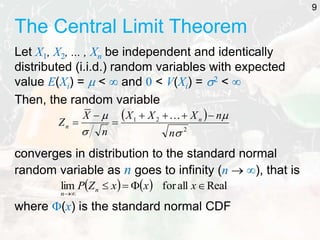
Let X1, X2, ... , Xn be independent and identically
distributed (i.i.d.) random variables with expected
value E(Xi) =  <  and 0 < V(Xi) = 2 < 
Then, the random variable
converges in distribution to the standard normal
random variable as n goes to infinity (n  ), that is
where (x) is the standard normal CDF
9
 
2
2
1




n
n
X
X
X
n
X
Z n
n








    Real
all
for
lim 





x
x
x
Z
P n
n
Cochran’s Theorem
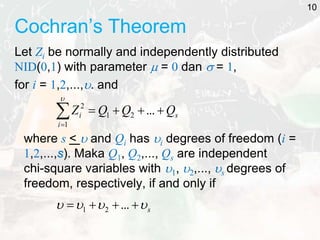
Let Zi be normally and independently distributed
NID(0,1) with parameter  = 0 dan  = 1,
for i = 1,2,...,. and
where s <  and Qi has i degrees of freedom (i =
1,2,...,s). Maka Q1, Q2,..., Qs are independent
chi-square variables with 1, 2,..., s degrees of
freedom, respectively, if and only if
s
i
i Q
Q
Q
Z 





...
2
1
1
2

s



 


 ...
2
1
10
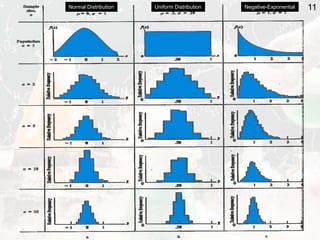
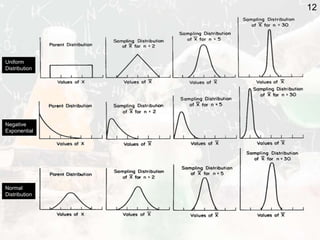
Normal Distribution Uniform Distribution Negative-Exponential 11
Normal
Distribution
Uniform
Distribution
Negative
Exponential
12
Normal Distribution
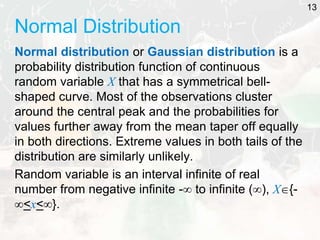
Normal distribution or Gaussian distribution is a
probability distribution function of continuous
random variable X that has a symmetrical bell-
shaped curve. Most of the observations cluster
around the central peak and the probabilities for
values further away from the mean taper off equally
in both directions. Extreme values in both tails of the
distribution are similarly unlikely.
Random variable is an interval infinite of real
number from negative infinite - to infinite (), X{-
<x<}.
13
Normal Distribution
Penerapan Distribusi Normal antara lain
untuk menunjukkan sebaran data hasil
pengukuran ilmiah baik observasi ataupun
eksperimen, sebaran kesalahan, sebaran
rata-rata data subgrup, sebaran data yang
sangat banyak (Law of Large Number dan
Central Limit Theorem).
14
Normal Distribution
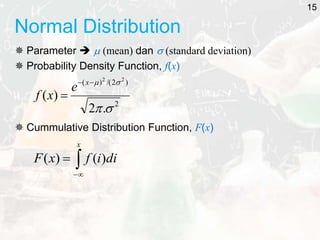
 Parameter   (mean) dan  (standard deviation)
 Probability Density Function, f(x)
 Cummulative Distribution Function, F(x)
2
)
2
/(
)
(
.
2
)
(
2
2







x
e
x
f



x
di
i
f
x
F )
(
)
(
15
Normal Distribution
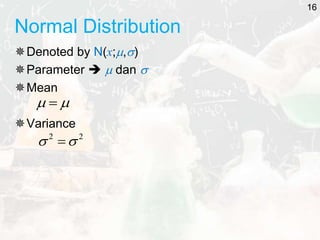
Denoted by N(x;,)
Parameter   dan 
Mean
Variance

 
2
2

 
16
Standardized Normal Distribution
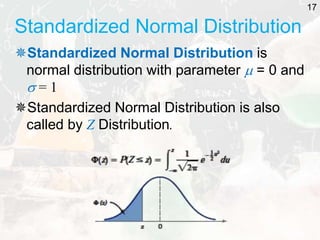
Standardized Normal Distribution is
normal distribution with parameter  = 0 and
 = 1
Standardized Normal Distribution is also
called by Z Distribution.
17
Standardized Normal Distribution
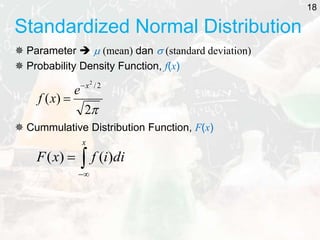
 Parameter   (mean) dan  (standard deviation)
 Probability Density Function, f(x)
 Cummulative Distribution Function, F(x)

2
)
(
2
/
2
x
e
x
f





x
di
i
f
x
F )
(
)
(
18
Distribusi Standardized Normal
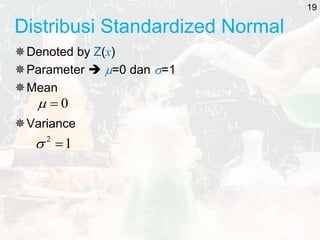
Denoted by Z(x)
Parameter  =0 dan =1
Mean
Variance
0


1
2


19
Student’s t Distribution
Distribusi Student’s t adalah sebaran
variabel acak yang merupakan model
gabungan variabel acak X berdistribusi
Standard Normal yang mempunyai
parameter =0 dan =1 dengan variabel
acak Y berdistribusi Chi square dengan
derajat bebas sebesar  yang mempunyai
parameter =/2 dan =2.









Y
X
20
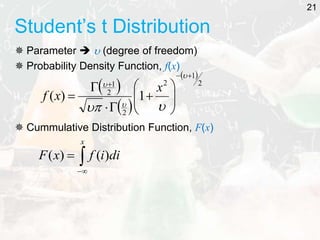
Student’s t Distribution
 Parameter   (degree of freedom)
 Probability Density Function, f(x)
 Cummulative Distribution Function, F(x)
 
 
 
2
1
2
2
2
1
1
)
(





















x
x
f



x
di
i
f
x
F )
(
)
(
21
Student’s t Distribution
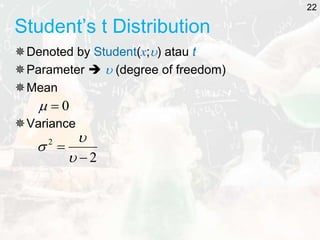
Denoted by Student(x;) atau t
Parameter   (degree of freedom)
Mean
Variance
0


2
2





22
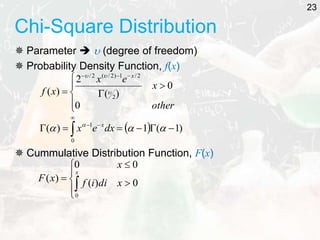
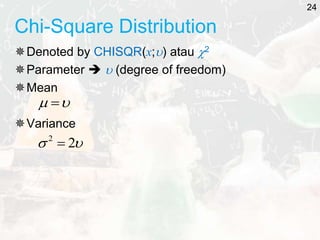
Chi-Square Distribution
 Parameter   (degree of freedom)
 Probability Density Function, f(x)
 Cummulative Distribution Function, F(x)








 0
)
(
0
0
)
(
0
x
di
i
f
x
x
F
x











other
x
e
x
x
f
x
0
0
)
(
2
)
( 2
2
/
1
)
2
/
(
2
/



  )
1
(
1
)
(
0
1





 





 
dx
e
x x
23
Chi-Square Distribution
Denoted by CHISQR(x;) atau 2
Parameter   (degree of freedom)
Mean
Variance

 

 2
2

24
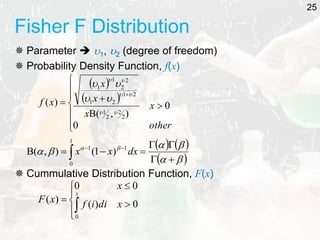
Fisher F Distribution
 Parameter  1, 2 (degree of freedom)
 Probability Density Function, f(x)
 Cummulative Distribution Function, F(x)








 0
)
(
0
0
)
(
0
x
di
i
f
x
x
F
x
 
 












other
x
x
x
x
x
f
0
0
)
,
(
)
(
2
2
2
1
2
1
2
1
2
2
1
1










   
 





 








 


1
0
1
1
)
1
(
)
,
( dx
x
x
25
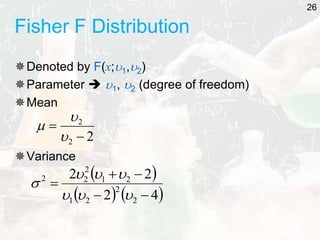
Fisher F Distribution
Denoted by F(x;1,2)
Parameter  1, 2 (degree of freedom)
Mean
Variance
2
2
2





 
   
4
2
2
2
2
2
2
1
2
1
2
2
2












26
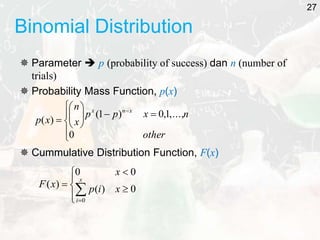
Binomial Distribution
 Parameter  p (probability of success) dan n (number of
trials)
 Probability Mass Function, p(x)
 Cummulative Distribution Function, F(x)

















other
n
x
p
p
x
n
x
p
x
n
x
0
,...,
1
,
0
)
1
(
)
(










0
)
(
0
0
)
(
0
x
i
p
x
x
F
x
i
27
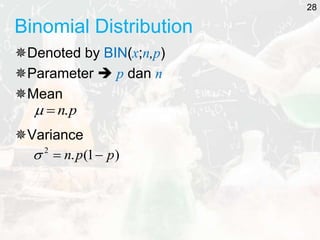
Binomial Distribution
Denoted by BIN(x;n,p)
Parameter  p dan n
Mean
Variance
p
n.


)
1
(
.
2
p
p
n 


28
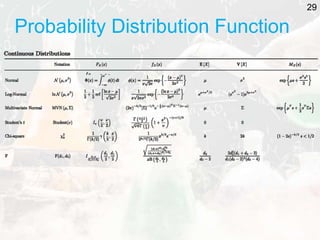
Probability Distribution Function
29
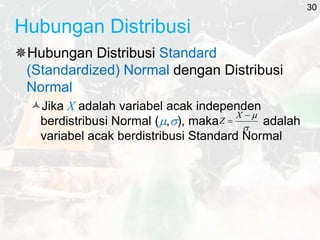
Hubungan Distribusi
Hubungan Distribusi Standard
(Standardized) Normal dengan Distribusi
Normal
Jika X adalah variabel acak independen
berdistribusi Normal (,), maka adalah
variabel acak berdistribusi Standard Normal




X
Z
30
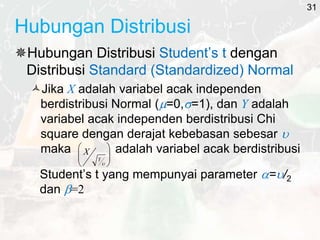
Hubungan Distribusi
Hubungan Distribusi Student’s t dengan
Distribusi Standard (Standardized) Normal
Jika X adalah variabel acak independen
berdistribusi Normal (=0,=1), dan Y adalah
variabel acak independen berdistribusi Chi
square dengan derajat kebebasan sebesar 
maka adalah variabel acak berdistribusi
Student’s t yang mempunyai parameter =/2
dan =2









Y
X
31
Hubungan Distribusi
Hubungan Distribusi Chi Square dengan
Distribusi Normal
Jika X adalah variabel acak independen
berdistribusi Normal (,) dengan derajat
kebebasan sebesar , maka X2 adalah variabel
acak berdistribusi Chi Square
32
Hubungan Distribusi
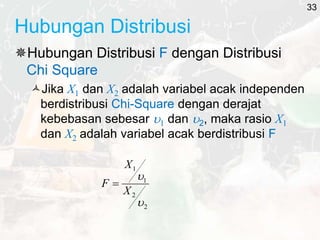
Hubungan Distribusi F dengan Distribusi
Chi Square
Jika X1 dan X2 adalah variabel acak independen
berdistribusi Chi-Square dengan derajat
kebebasan sebesar 1 dan 2, maka rasio X1
dan X2 adalah variabel acak berdistribusi F
2
2
1
1


X
X
F 
33
Hubungan Distribusi
Hubungan Distribusi Binomial dengan
Distribusi Normal
Jika X adalah variabel acak independen
berdistribusi Binomial dengan parameter n
(sangat besar, n) dan p (sangat kecil, n0),
maka X dapat diaproksimasi sebagai variabel
acak berdistribusi Normal dengan parameter
=np dan =np(1-p)
34
Hubungan Distribusi
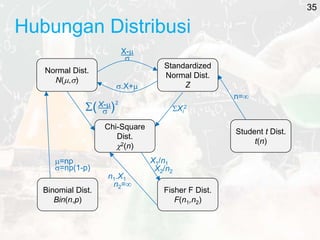
Standardized
Normal Dist.
Z
Normal Dist.
N(,)
Student t Dist.
t(n)
Chi-Square
Dist.
2(n)
Fisher F Dist.
F(n1,n2)
X-

.X+
n=
Xi
2
X- 2

( )
X1/n1
X2/n2
n1.X1
n2=
Binomial Dist.
Bin(n,p)
=np
=np(1-p)
35
Estimasi Parameter
Estimasi parameter
rata-rata
Estimasi parameter
variansi
 








n
x
dx
x
f
x
x
E
x
n
i
i
1
)
(

   
 
1
)
(
1
2
2
2
2











n
x
x
dx
x
f
x
x
x
V
s
n
i
i

36
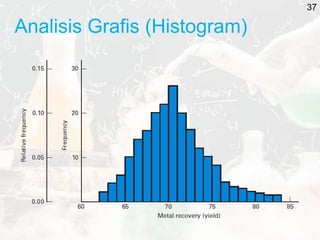
Analisis Grafis (Histogram)
37
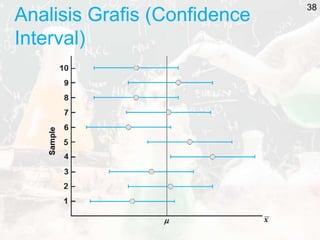
Analisis Grafis (Confidence
Interval)
38
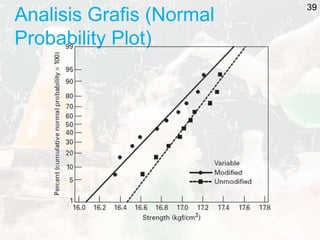
Analisis Grafis (Normal
Probability Plot)
39
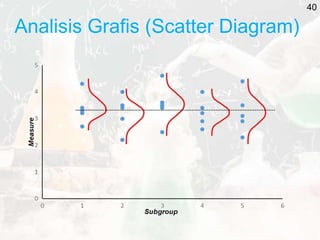
Analisis Grafis (Scatter Diagram)
40
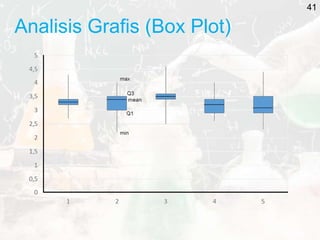
Analisis Grafis (Box Plot)
41
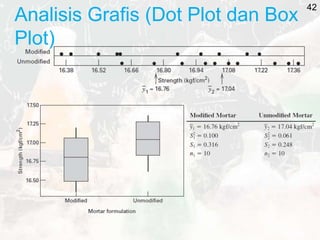
Analisis Grafis (Dot Plot dan Box
Plot)
42
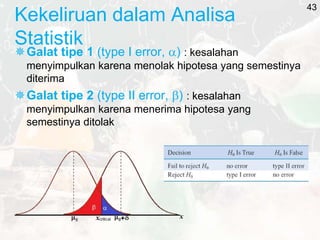
Kekeliruan dalam Analisa
Statistik
Galat tipe 1 (type I error, ) : kesalahan
menyimpulkan karena menolak hipotesa yang semestinya
diterima
Galat tipe 2 (type II error, ) : kesalahan
menyimpulkan karena menerima hipotesa yang
semestinya ditolak
43
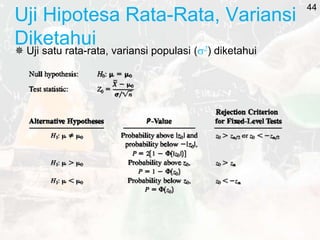
Uji Hipotesa Rata-Rata, Variansi
Diketahui
 Uji satu rata-rata, variansi populasi (2) diketahui
44
Uji Hipotesa Rata-Rata, Variansi
Diketahui
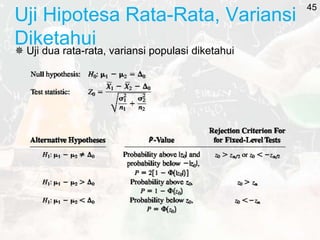
 Uji dua rata-rata, variansi populasi diketahui
45
Uji Hipotesa Rata-Rata, Variansi
Diketahui
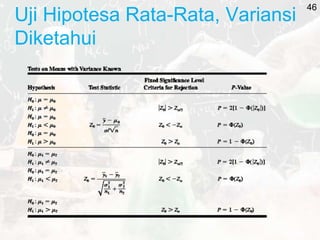
46
Uji Hipotesa Rata-Rata, Variansi
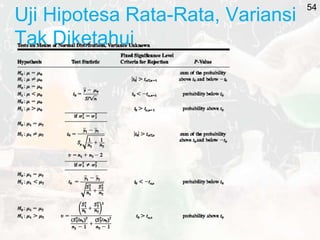
Tak Diketahui
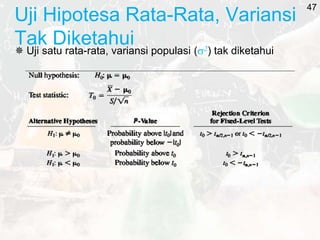
 Uji satu rata-rata, variansi populasi (2) tak diketahui
47
Uji Hipotesa Rata-Rata, Variansi
Tak Diketahui
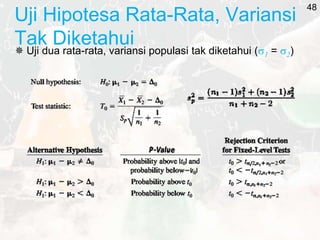
 Uji dua rata-rata, variansi populasi tak diketahui (1 = 2)
48
Uji Hipotesa Rata-Rata, Variansi
Tak Diketahui
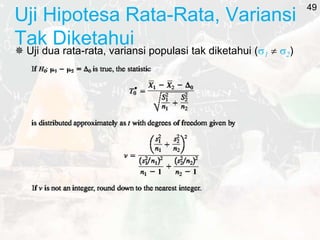
 Uji dua rata-rata, variansi populasi tak diketahui (1  2)
49
Uji Hipotesa Rata-Rata, Variansi
Tak Diketahui
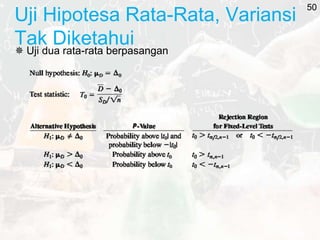
 Uji dua rata-rata berpasangan
50
Uji Hipotesa Rata-Rata, Variansi
Tak Diketahui
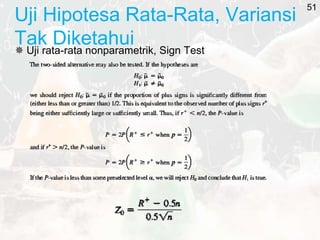
 Uji rata-rata nonparametrik, Sign Test
51
Uji Hipotesa Rata-Rata, Variansi
Tak Diketahui
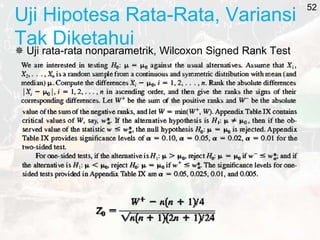
 Uji rata-rata nonparametrik, Wilcoxon Signed Rank Test
52
Uji Hipotesa Rata-Rata, Variansi
Tak Diketahui
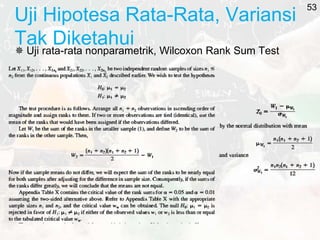
 Uji rata-rata nonparametrik, Wilcoxon Rank Sum Test
53
Uji Hipotesa Rata-Rata, Variansi
Tak Diketahui
54
Uji Hipotesa Variansi
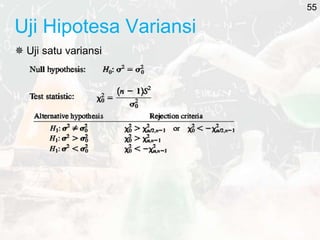
 Uji satu variansi
55
Uji Hipotesa Variansi
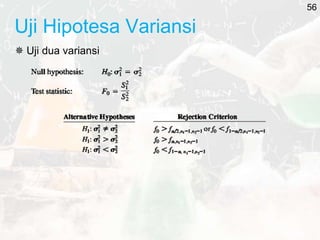
 Uji dua variansi
56
Uji Hipotesa Variansi
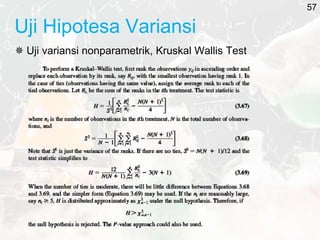
 Uji variansi nonparametrik, Kruskal Wallis Test
57
Uji Hipotesa Variansi
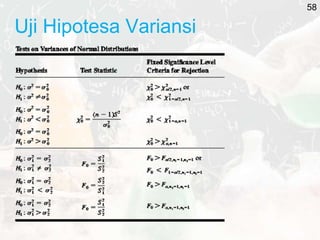
58
Uji Hipotesa Proporsi
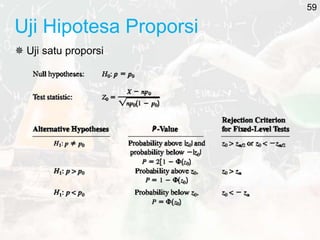
 Uji satu proporsi
59
Uji Hipotesa Proporsi
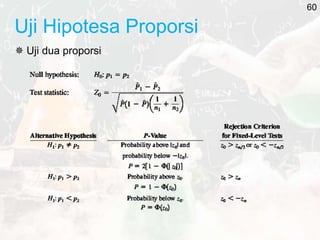
 Uji dua proporsi
60
Analysis Of Variance
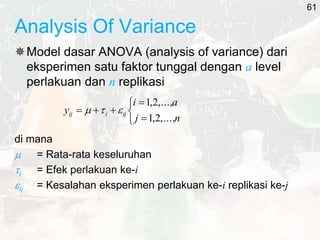
Model dasar ANOVA (analysis of variance) dari
eksperimen satu faktor tunggal dengan a level
perlakuan dan n replikasi
di mana
 = Rata-rata keseluruhan
i = Efek perlakuan ke-i
ij = Kesalahan eksperimen perlakuan ke-i replikasi ke-j








n
j
a
i
y ij
i
ij
,...,
2
,
1
,...,
2
,
1



61
Analysis Of Variance
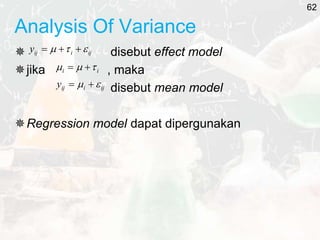
 disebut effect model
jika , maka
disebut mean model
Regression model dapat dipergunakan
ij
i
ij
y 

 


i
i 

 

ij
i
ij
y 
 

62
Analysis Of Variance
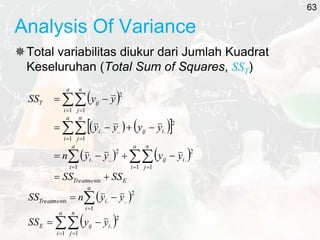
Total variabilitas diukur dari Jumlah Kuadrat
Keseluruhan (Total Sum of Squares, SST)
 
   
 
   
E
Treatments
a
i
n
j
i
ij
a
i
i
a
i
n
j
i
ij
i
a
i
n
j
ij
T
SS
SS
y
y
y
y
n
y
y
y
y
y
y
SS
















 

 
 
1 1
2
.
1
2
..
.
1 1
2
.
..
.
1 1
2
 




a
i
i
Treatments y
y
n
SS
1
2
..
.
 

 


a
i
n
j
i
ij
E y
y
SS
1 1
2
.
63
Analysis Of Variance
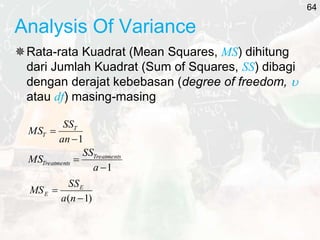
Rata-rata Kuadrat (Mean Squares, MS) dihitung
dari Jumlah Kuadrat (Sum of Squares, SS) dibagi
dengan derajat kebebasan (degree of freedom, 
atau df) masing-masing
1


an
SS
MS T
T
1


a
SS
MS Treatments
Treatments
)
1
( 

n
a
SS
MS E
E
64
Analysis Of Variance
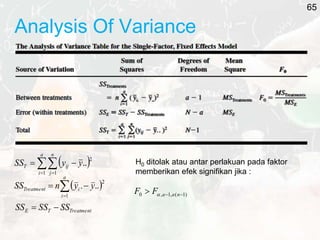
65
 

 


a
i
n
j
ij
T y
y
SS
1 1
2
..
 




a
i
i
Treatment y
y
n
SS
1
2
..
.
Treatment
T
E SS
SS
SS 

H0 ditolak atau antar perlakuan pada faktor
memberikan efek signifikan jika :
)
1
(
,
1
,
0 

 n
a
a
F
F 
Analysis Of Variance (Fixed
Effect Factor)
66
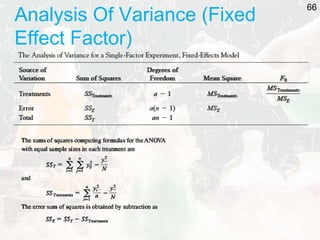
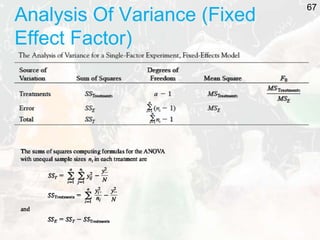
Analysis Of Variance (Fixed
Effect Factor)
67
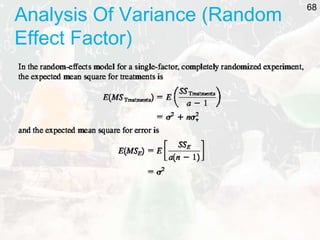
Analysis Of Variance (Random
Effect Factor)
68
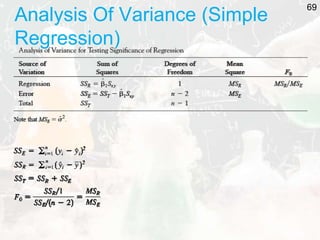
Analysis Of Variance (Simple
Regression)
69
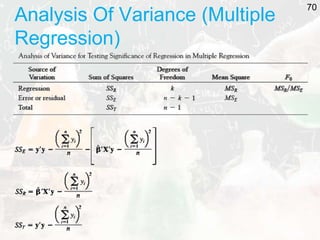
Analysis Of Variance (Multiple
Regression)
70
71
Terima kasih ...
... Ada pertanyaan ???

Doe02 statistics

  • 1.
  • 2.
  • 3.
    Random Experiments Sample spaceis the set of all possible outcomes of a random experiment. Sample point is each outcome in a sample space. Outcome is an element of a sample space. Event is a subset of a sample space. Probability is a number that is assigned to each member of a collection of events from a random experiment. 3
  • 4.
    Axioms of Probability IfS is the sample space and E is any event in a random experiment, probability satisfies the following properties: (1) P(S) = 1 (2) 0 < P(E) < 1 (3) P(E1  E2) = P(E1) + P(E2) - P(E1  E2) (4) P(E1 | E2) = P(E1  E2) / P(E2) 4
  • 5.
    Random Variable Random variableis a function that assigns a real number to each outcome in the sample space of a random experiment. Random variable is denoted by an uppercase letter, such as X. After an experiment is conducted, the measured value of the random variable is denoted by a lowercase letter, such as x.  A discrete random variable is a random variable with an interval (either finite or infinite) of natural number (or non-negative integers), N, for its range.  A continuous random variable is a random variable with an interval (either finite or infinite) of real numbers, R, for its range. 5
  • 6.
    Probability Distribution Probability distributionof a random variable X is a description of the probabilities associated with the possible values of X.  Probability mass function of a discrete random variable X, denoted as p(x)  Probability density function of a continuous random variable X, denoted as f(x)  Cumulative distribution function of a discrete or continuous random variable X, denoted as F(x) 6
  • 7.
    The Law ofLarge Number (weak) Let X1, X2, ... , Xn be a sequence of n independent and identically distributed (i.i.d.) random variables with a finite expected value E(Xi) =  < . Then, for any  > 0, 7   0 lim        X P n
  • 8.
    The Law ofLarge Number (strong) Let X1, X2, ... , Xn be a sequence of n independent and identically distributed (i.i.d.) random variables with a finite expected value E(Xi) =  <  Let also Mn   8 n X X X M n n      2 1
  • 9.
    The Central LimitTheorem Let X1, X2, ... , Xn be independent and identically distributed (i.i.d.) random variables with expected value E(Xi) =  <  and 0 < V(Xi) = 2 <  Then, the random variable converges in distribution to the standard normal random variable as n goes to infinity (n  ), that is where (x) is the standard normal CDF 9   2 2 1     n n X X X n X Z n n             Real all for lim       x x x Z P n n
  • 10.
    Cochran’s Theorem Let Zibe normally and independently distributed NID(0,1) with parameter  = 0 dan  = 1, for i = 1,2,...,. and where s <  and Qi has i degrees of freedom (i = 1,2,...,s). Maka Q1, Q2,..., Qs are independent chi-square variables with 1, 2,..., s degrees of freedom, respectively, if and only if s i i Q Q Q Z       ... 2 1 1 2  s         ... 2 1 10
  • 11.
    Normal Distribution UniformDistribution Negative-Exponential 11
  • 12.
  • 13.
    Normal Distribution Normal distributionor Gaussian distribution is a probability distribution function of continuous random variable X that has a symmetrical bell- shaped curve. Most of the observations cluster around the central peak and the probabilities for values further away from the mean taper off equally in both directions. Extreme values in both tails of the distribution are similarly unlikely. Random variable is an interval infinite of real number from negative infinite - to infinite (), X{- <x<}. 13
  • 14.
    Normal Distribution Penerapan DistribusiNormal antara lain untuk menunjukkan sebaran data hasil pengukuran ilmiah baik observasi ataupun eksperimen, sebaran kesalahan, sebaran rata-rata data subgrup, sebaran data yang sangat banyak (Law of Large Number dan Central Limit Theorem). 14
  • 15.
    Normal Distribution  Parameter  (mean) dan  (standard deviation)  Probability Density Function, f(x)  Cummulative Distribution Function, F(x) 2 ) 2 /( ) ( . 2 ) ( 2 2        x e x f    x di i f x F ) ( ) ( 15
  • 16.
    Normal Distribution Denoted byN(x;,) Parameter   dan  Mean Variance    2 2    16
  • 17.
    Standardized Normal Distribution StandardizedNormal Distribution is normal distribution with parameter  = 0 and  = 1 Standardized Normal Distribution is also called by Z Distribution. 17
  • 18.
    Standardized Normal Distribution Parameter   (mean) dan  (standard deviation)  Probability Density Function, f(x)  Cummulative Distribution Function, F(x)  2 ) ( 2 / 2 x e x f      x di i f x F ) ( ) ( 18
  • 19.
    Distribusi Standardized Normal Denotedby Z(x) Parameter  =0 dan =1 Mean Variance 0   1 2   19
  • 20.
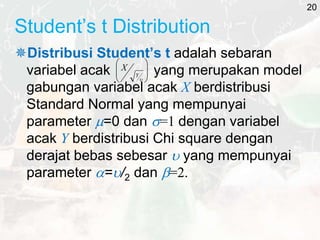
    Student’s t Distribution DistribusiStudent’s t adalah sebaran variabel acak yang merupakan model gabungan variabel acak X berdistribusi Standard Normal yang mempunyai parameter =0 dan =1 dengan variabel acak Y berdistribusi Chi square dengan derajat bebas sebesar  yang mempunyai parameter =/2 dan =2.          Y X 20
  • 21.
    Student’s t Distribution Parameter   (degree of freedom)  Probability Density Function, f(x)  Cummulative Distribution Function, F(x)       2 1 2 2 2 1 1 ) (                      x x f    x di i f x F ) ( ) ( 21
  • 22.
    Student’s t Distribution Denotedby Student(x;) atau t Parameter   (degree of freedom) Mean Variance 0   2 2      22
  • 23.
    Chi-Square Distribution  Parameter  (degree of freedom)  Probability Density Function, f(x)  Cummulative Distribution Function, F(x)          0 ) ( 0 0 ) ( 0 x di i f x x F x            other x e x x f x 0 0 ) ( 2 ) ( 2 2 / 1 ) 2 / ( 2 /      ) 1 ( 1 ) ( 0 1               dx e x x 23
  • 24.
    Chi-Square Distribution Denoted byCHISQR(x;) atau 2 Parameter   (degree of freedom) Mean Variance      2 2  24
  • 25.
    Fisher F Distribution Parameter  1, 2 (degree of freedom)  Probability Density Function, f(x)  Cummulative Distribution Function, F(x)          0 ) ( 0 0 ) ( 0 x di i f x x F x                 other x x x x x f 0 0 ) , ( ) ( 2 2 2 1 2 1 2 1 2 2 1 1                                    1 0 1 1 ) 1 ( ) , ( dx x x 25
  • 26.
    Fisher F Distribution Denotedby F(x;1,2) Parameter  1, 2 (degree of freedom) Mean Variance 2 2 2            4 2 2 2 2 2 2 1 2 1 2 2 2             26
  • 27.
    Binomial Distribution  Parameter p (probability of success) dan n (number of trials)  Probability Mass Function, p(x)  Cummulative Distribution Function, F(x)                  other n x p p x n x p x n x 0 ,..., 1 , 0 ) 1 ( ) (           0 ) ( 0 0 ) ( 0 x i p x x F x i 27
  • 28.
    Binomial Distribution Denoted byBIN(x;n,p) Parameter  p dan n Mean Variance p n.   ) 1 ( . 2 p p n    28
  • 29.
  • 30.
    Hubungan Distribusi Hubungan DistribusiStandard (Standardized) Normal dengan Distribusi Normal Jika X adalah variabel acak independen berdistribusi Normal (,), maka adalah variabel acak berdistribusi Standard Normal     X Z 30
  • 31.
    Hubungan Distribusi Hubungan DistribusiStudent’s t dengan Distribusi Standard (Standardized) Normal Jika X adalah variabel acak independen berdistribusi Normal (=0,=1), dan Y adalah variabel acak independen berdistribusi Chi square dengan derajat kebebasan sebesar  maka adalah variabel acak berdistribusi Student’s t yang mempunyai parameter =/2 dan =2          Y X 31
  • 32.
    Hubungan Distribusi Hubungan DistribusiChi Square dengan Distribusi Normal Jika X adalah variabel acak independen berdistribusi Normal (,) dengan derajat kebebasan sebesar , maka X2 adalah variabel acak berdistribusi Chi Square 32
  • 33.
    Hubungan Distribusi Hubungan DistribusiF dengan Distribusi Chi Square Jika X1 dan X2 adalah variabel acak independen berdistribusi Chi-Square dengan derajat kebebasan sebesar 1 dan 2, maka rasio X1 dan X2 adalah variabel acak berdistribusi F 2 2 1 1   X X F  33
  • 34.
    Hubungan Distribusi Hubungan DistribusiBinomial dengan Distribusi Normal Jika X adalah variabel acak independen berdistribusi Binomial dengan parameter n (sangat besar, n) dan p (sangat kecil, n0), maka X dapat diaproksimasi sebagai variabel acak berdistribusi Normal dengan parameter =np dan =np(1-p) 34
  • 35.
    Hubungan Distribusi Standardized Normal Dist. Z NormalDist. N(,) Student t Dist. t(n) Chi-Square Dist. 2(n) Fisher F Dist. F(n1,n2) X-  .X+ n= Xi 2 X- 2  ( ) X1/n1 X2/n2 n1.X1 n2= Binomial Dist. Bin(n,p) =np =np(1-p) 35
  • 36.
    Estimasi Parameter Estimasi parameter rata-rata Estimasiparameter variansi           n x dx x f x x E x n i i 1 ) (        1 ) ( 1 2 2 2 2            n x x dx x f x x x V s n i i  36
  • 37.
  • 38.
  • 39.
  • 40.
  • 41.
  • 42.
    Analisis Grafis (DotPlot dan Box Plot) 42
  • 43.
    Kekeliruan dalam Analisa Statistik Galattipe 1 (type I error, ) : kesalahan menyimpulkan karena menolak hipotesa yang semestinya diterima Galat tipe 2 (type II error, ) : kesalahan menyimpulkan karena menerima hipotesa yang semestinya ditolak 43
  • 44.
    Uji Hipotesa Rata-Rata,Variansi Diketahui  Uji satu rata-rata, variansi populasi (2) diketahui 44
  • 45.
    Uji Hipotesa Rata-Rata,Variansi Diketahui  Uji dua rata-rata, variansi populasi diketahui 45
  • 46.
    Uji Hipotesa Rata-Rata,Variansi Diketahui 46
  • 47.
    Uji Hipotesa Rata-Rata,Variansi Tak Diketahui  Uji satu rata-rata, variansi populasi (2) tak diketahui 47
  • 48.
    Uji Hipotesa Rata-Rata,Variansi Tak Diketahui  Uji dua rata-rata, variansi populasi tak diketahui (1 = 2) 48
  • 49.
    Uji Hipotesa Rata-Rata,Variansi Tak Diketahui  Uji dua rata-rata, variansi populasi tak diketahui (1  2) 49
  • 50.
    Uji Hipotesa Rata-Rata,Variansi Tak Diketahui  Uji dua rata-rata berpasangan 50
  • 51.
    Uji Hipotesa Rata-Rata,Variansi Tak Diketahui  Uji rata-rata nonparametrik, Sign Test 51
  • 52.
    Uji Hipotesa Rata-Rata,Variansi Tak Diketahui  Uji rata-rata nonparametrik, Wilcoxon Signed Rank Test 52
  • 53.
    Uji Hipotesa Rata-Rata,Variansi Tak Diketahui  Uji rata-rata nonparametrik, Wilcoxon Rank Sum Test 53
  • 54.
    Uji Hipotesa Rata-Rata,Variansi Tak Diketahui 54
  • 55.
    Uji Hipotesa Variansi Uji satu variansi 55
  • 56.
    Uji Hipotesa Variansi Uji dua variansi 56
  • 57.
    Uji Hipotesa Variansi Uji variansi nonparametrik, Kruskal Wallis Test 57
  • 58.
  • 59.
    Uji Hipotesa Proporsi Uji satu proporsi 59
  • 60.
    Uji Hipotesa Proporsi Uji dua proporsi 60
  • 61.
    Analysis Of Variance Modeldasar ANOVA (analysis of variance) dari eksperimen satu faktor tunggal dengan a level perlakuan dan n replikasi di mana  = Rata-rata keseluruhan i = Efek perlakuan ke-i ij = Kesalahan eksperimen perlakuan ke-i replikasi ke-j         n j a i y ij i ij ,..., 2 , 1 ,..., 2 , 1    61
  • 62.
    Analysis Of Variance disebut effect model jika , maka disebut mean model Regression model dapat dipergunakan ij i ij y       i i      ij i ij y     62
  • 63.
    Analysis Of Variance Totalvariabilitas diukur dari Jumlah Kuadrat Keseluruhan (Total Sum of Squares, SST)             E Treatments a i n j i ij a i i a i n j i ij i a i n j ij T SS SS y y y y n y y y y y y SS                        1 1 2 . 1 2 .. . 1 1 2 . .. . 1 1 2       a i i Treatments y y n SS 1 2 .. .        a i n j i ij E y y SS 1 1 2 . 63
  • 64.
    Analysis Of Variance Rata-rataKuadrat (Mean Squares, MS) dihitung dari Jumlah Kuadrat (Sum of Squares, SS) dibagi dengan derajat kebebasan (degree of freedom,  atau df) masing-masing 1   an SS MS T T 1   a SS MS Treatments Treatments ) 1 (   n a SS MS E E 64
  • 65.
    Analysis Of Variance 65       a i n j ij T y y SS 1 1 2 ..       a i i Treatment y y n SS 1 2 .. . Treatment T E SS SS SS   H0 ditolak atau antar perlakuan pada faktor memberikan efek signifikan jika : ) 1 ( , 1 , 0    n a a F F 
  • 66.
    Analysis Of Variance(Fixed Effect Factor) 66
  • 67.
    Analysis Of Variance(Fixed Effect Factor) 67
  • 68.
    Analysis Of Variance(Random Effect Factor) 68
  • 69.
    Analysis Of Variance(Simple Regression) 69
  • 70.
    Analysis Of Variance(Multiple Regression) 70
  • 71.
    71 Terima kasih ... ...Ada pertanyaan ???