Statistical Quality Control (SQC)
DEFINITION:
    Statistical Quality Control is the term used to
 describe the set of statistical tools to evaluate
 organizational quality.

 CLASSIFICATION OF SQC:
     1.Descriptive statistics
     2.Statistical process control
     3.Acceptance sampling
DESCRIPTIVE STATISTICS
    Statistics used to describe quality characteristics
 and relationships.
  Eg:
     Mean, Standard deviation, Range
STATISTICAL PROCESS CONTROL
          A statistical tool that involve inspecting a
    random sample of the output from a process and
    deciding whether the process is producing
    products with characteristics that fall within a
    predetermined range.

          It answers the question whether the process
    is functioning properly or not.
ACCEPTANCE SAMPLING
                  The process of randomly inspecting
   a sample of goods and deciding whether to accept
   the entire lot based on the results.
                  It determines whether a batch of
   goods should be accepted or rejeted
VARIATION
        It is the change in some quality
  characteristic of the product or process.

 CLASSIFICATION OF VARIATION:
      1. In-control variation
      2.Out-of-cotrol variation
 IN-CONTROL VARIATION:
     Due to common causes(random causes)
 that can’t be identified.

 OUT-OF-CONTROL VARIATION
    Due to assignable causes(outside influences)
 that can be identified and eliminated.
CONTROL CHART
(PROCESS CHART / QUALITY CONTROL CHART)
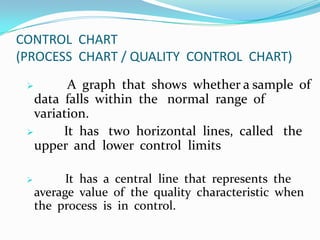
        A graph that shows whether a sample of
   data falls within the normal range of
   variation.
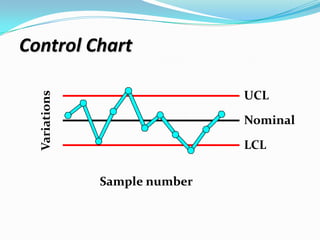
       It has two horizontal lines, called the
   upper and lower control limits

          It has a central line that represents the
     average value of the quality characteristic when
     the process is in control.
Control Chart

                               UCL
  Variations


                               Nominal
                               LCL

               Sample number
Types of the control charts

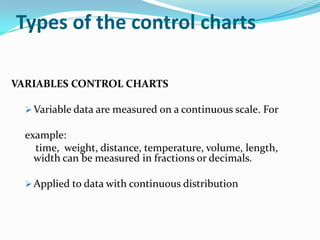
VARIABLES CONTROL CHARTS

   Variable data are measured on a continuous scale. For

  example:
    time, weight, distance, temperature, volume, length,
    width can be measured in fractions or decimals.

   Applied to data with continuous distribution
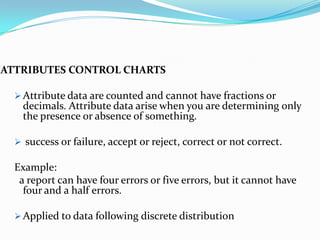
ATTRIBUTES CONTROL CHARTS

   Attribute data are counted and cannot have fractions or
    decimals. Attribute data arise when you are determining only
    the presence or absence of something.

   success or failure, accept or reject, correct or not correct.

  Example:
   a report can have four errors or five errors, but it cannot have
    four and a half errors.

   Applied to data following discrete distribution
WHY CONTROL CHARTS ?
 Predicting the expected range of outcomes from
  a process.

 Determining whether a process is stable (in
  statistical control).

 Analyzing patterns of process variation from
  assignable causes or common causes .
PROCEDURE TO DRAW CONTROL
CHART
 Choose the appropriate control chart for
  the data.
 Determine the appropriate time period
  for collecting and plotting data.
 Collect data, construct the chart and
  analyze the data.
 Look for “out-of-control signals” on the
  control chart. When one is identified,
  mark it on the chart and investigate the
  cause.
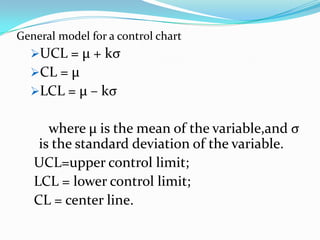
General model for a control chart
  UCL = μ + kσ
  CL = μ
  LCL = μ – kσ


      where μ is the mean of the variable,and σ
    is the standard deviation of the variable.
   UCL=upper control limit;
   LCL = lower control limit;
   CL = center line.
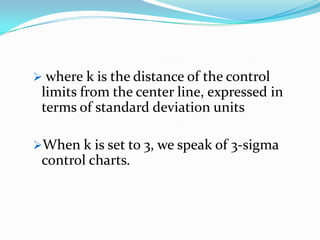
 where k is the distance of the control
 limits from the center line, expressed in
 terms of standard deviation units

When k is set to 3, we speak of 3-sigma
 control charts.
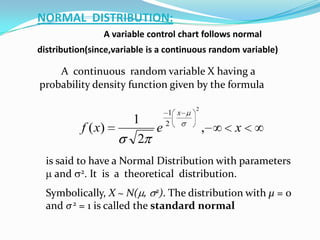
NORMAL DISTRIBUTION:
                A variable control chart follows normal
distribution(since,variable is a continuous random variable)

    A continuous random variable X having a
probability density function given by the formula

                                       2
                                1 x
                       1       2
           f ( x)         e                ,     x
                        2
  is said to have a Normal Distribution with parameters
     and 2. It is a theoretical distribution.
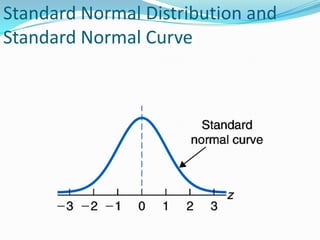
  Symbolically, X ~ N( , 2). The distribution with μ = 0
  and σ 2 = 1 is called the standard normal
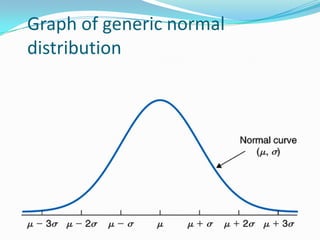
Graph of generic normal
distribution
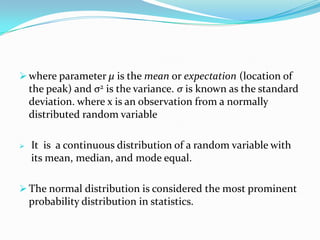
 where parameter μ is the mean or expectation (location of
    the peak) and σ2 is the variance. σ is known as the standard
    deviation. where x is an observation from a normally
    distributed random variable

   It is a continuous distribution of a random variable with
    its mean, median, and mode equal.

 The normal distribution is considered the most prominent
    probability distribution in statistics.
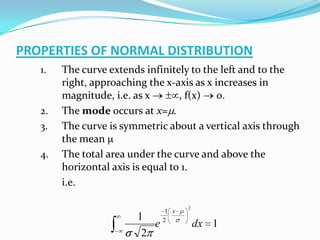
PROPERTIES OF NORMAL DISTRIBUTION
   1.   The curve extends infinitely to the left and to the
        right, approaching the x-axis as x increases in
        magnitude, i.e. as x       , f(x) 0.
   2.   The mode occurs at x= .
   3.   The curve is symmetric about a vertical axis through
        the mean
   4.   The total area under the curve and above the
        horizontal axis is equal to 1.
        i.e.

                                      2
                                1 x
                        1      2
                           e              dx 1
                         2
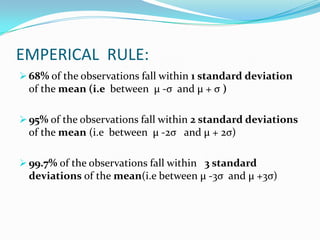
 The mean identifies the position of the center and the
  standard deviation determines the height and width of the
  bell

 All normal density curves satisfy the following property
  which is often referred to as the Empirical Rule or 68-95-
  99.7 rule
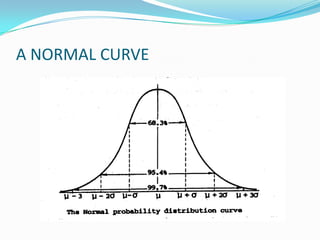
EMPERICAL RULE:
 68% of the observations fall within 1 standard deviation
  of the mean (i.e between μ -σ and μ + σ )

 95% of the observations fall within 2 standard deviations
  of the mean (i.e between μ -2σ and μ + 2σ)

 99.7% of the observations fall within 3 standard
  deviations of the mean(i.e between μ -3σ and μ +3σ)
A NORMAL CURVE
Eg:
         A good example of a bell curve or normal distribution
          is the roll of two dice. The distribution is centered
          around the number 7 and the probability decreases as
          you move away from the center
STANDARDIZING PROCESS
This can be done by means of the transformation.

The mean of Z is zero and the variance is respectively,
                                x
                            z

                                                     X
                   X                Var( Z ) Var
     E (Z )   E
                                                1
                                                2
                                                    Var( X     )
              1
                  E X
                                                1
                                                2
                                                    Var( X )
              1
                  [E( X )   ]                   1      2
                                                2
              0
                                            1
Standard Normal Distribution and
Standard Normal Curve
TYPES OF VARIABLE CONTROL CHART
 Control of the process average or mean quality
  level is usually done with the control chart for mean called
  xbar chart.

 Process variability can be monitor with either
a control chart for the standard deviation, called the s chart,
or a control chart for the range, called an R chart.

 We can use X-bar and R charts for any process with a
  subgroup size greater than one. Typically, it is used when
  the subgroup size falls between two and ten,
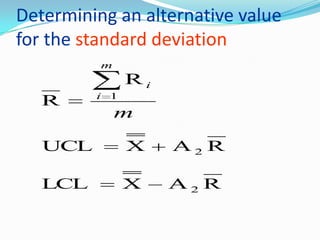
Determining an alternative value
for the standard deviation
          m
               Ri
         i 1
   R
              m

   UCL         X    A2 R

   LCL         X    A2 R
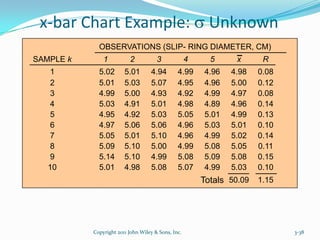
x-bar Chart Example:                                     Unknown
             OBSERVATIONS (SLIP- RING DIAMETER, CM)
SAMPLE k       1          2           3             4     5      x      R
    1        5.02       5.01       4.94        4.99     4.96   4.98    0.08
    2        5.01       5.03       5.07        4.95     4.96   5.00    0.12
    3        4.99       5.00       4.93        4.92     4.99   4.97    0.08
    4        5.03       4.91       5.01        4.98     4.89   4.96    0.14
    5        4.95       4.92       5.03        5.05     5.01   4.99    0.13
    6        4.97       5.06       5.06        4.96     5.03   5.01    0.10
    7        5.05       5.01       5.10        4.96     4.99   5.02    0.14
    8        5.09       5.10       5.00        4.99     5.08   5.05    0.11
    9        5.14       5.10       4.99        5.08     5.09   5.08    0.15
   10        5.01       4.98       5.08        5.07     4.99   5.03    0.10
                                                        Totals 50.09   1.15


           Copyright 2011 John Wiley & Sons, Inc.                             3-38
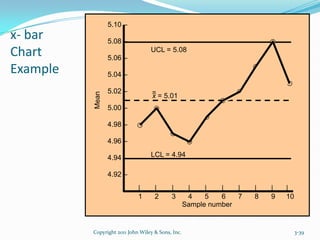
5.10 –
x- bar           5.08 –
Chart            5.06 –
                                  UCL = 5.08

Example          5.04 –

                 5.02 –            = = 5.01
          Mean                     x
                 5.00 –

                 4.98 –

                 4.96 –

                 4.94 –           LCL = 4.94

                 4.92 –
                             |      |      |        |    |   |   |   |   |   |
                             1      2      3        4    5   6   7   8   9   10
                                                   Sample number


          Copyright 2011 John Wiley & Sons, Inc.                                  3-39
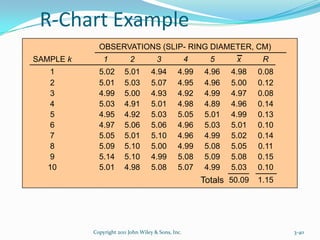
R-Chart Example
             OBSERVATIONS (SLIP- RING DIAMETER, CM)
SAMPLE k       1          2           3             4     5      x      R
    1        5.02       5.01       4.94        4.99     4.96   4.98    0.08
    2        5.01       5.03       5.07        4.95     4.96   5.00    0.12
    3        4.99       5.00       4.93        4.92     4.99   4.97    0.08
    4        5.03       4.91       5.01        4.98     4.89   4.96    0.14
    5        4.95       4.92       5.03        5.05     5.01   4.99    0.13
    6        4.97       5.06       5.06        4.96     5.03   5.01    0.10
    7        5.05       5.01       5.10        4.96     4.99   5.02    0.14
    8        5.09       5.10       5.00        4.99     5.08   5.05    0.11
    9        5.14       5.10       4.99        5.08     5.09   5.08    0.15
   10        5.01       4.98       5.08        5.07     4.99   5.03    0.10
                                                        Totals 50.09   1.15


           Copyright 2011 John Wiley & Sons, Inc.                             3-40
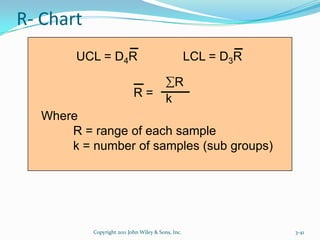
R- Chart
       UCL = D4R                                    LCL = D3R

                                              R
                            R=            k
  Where
      R = range of each sample
      k = number of samples (sub groups)


           Copyright 2011 John Wiley & Sons, Inc.               3-41
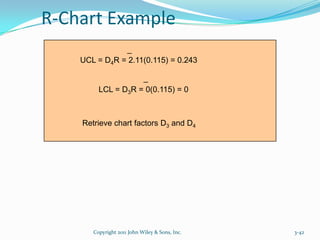
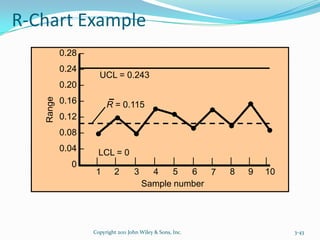
R-Chart Example
               _
    UCL = D4R = 2.11(0.115) = 0.243

                    _
         LCL = D3R = 0(0.115) = 0


    Retrieve chart factors D3 and D4


       Copyright 2011 John Wiley & Sons, Inc.   3-42
R-Chart Example
           0.28 –
           0.24 –
                      UCL = 0.243
           0.20 –
           0.16 –
   Range


                         R = 0.115
           0.12 –
           0.08 –
           0.04 –      LCL = 0
              0–     |    |    |          |    |  |   |      |   |   |
                     1    2    3          4    5  6   7      8   9   10
                                        Sample number


                    Copyright 2011 John Wiley & Sons, Inc.                3-43
THANK YOU…..

Statistical quality__control_2

  • 2.
    Statistical Quality Control(SQC) DEFINITION: Statistical Quality Control is the term used to describe the set of statistical tools to evaluate organizational quality. CLASSIFICATION OF SQC: 1.Descriptive statistics 2.Statistical process control 3.Acceptance sampling
  • 3.
    DESCRIPTIVE STATISTICS Statistics used to describe quality characteristics and relationships. Eg: Mean, Standard deviation, Range
  • 4.
    STATISTICAL PROCESS CONTROL  A statistical tool that involve inspecting a random sample of the output from a process and deciding whether the process is producing products with characteristics that fall within a predetermined range.  It answers the question whether the process is functioning properly or not.
  • 5.
    ACCEPTANCE SAMPLING  The process of randomly inspecting a sample of goods and deciding whether to accept the entire lot based on the results.  It determines whether a batch of goods should be accepted or rejeted
  • 6.
    VARIATION It is the change in some quality characteristic of the product or process. CLASSIFICATION OF VARIATION: 1. In-control variation 2.Out-of-cotrol variation
  • 7.
     IN-CONTROL VARIATION: Due to common causes(random causes) that can’t be identified.  OUT-OF-CONTROL VARIATION Due to assignable causes(outside influences) that can be identified and eliminated.
  • 8.
    CONTROL CHART (PROCESS CHART/ QUALITY CONTROL CHART)  A graph that shows whether a sample of data falls within the normal range of variation.  It has two horizontal lines, called the upper and lower control limits  It has a central line that represents the average value of the quality characteristic when the process is in control.
  • 9.
    Control Chart UCL Variations Nominal LCL Sample number
  • 10.
    Types of thecontrol charts VARIABLES CONTROL CHARTS  Variable data are measured on a continuous scale. For example: time, weight, distance, temperature, volume, length, width can be measured in fractions or decimals.  Applied to data with continuous distribution
  • 11.
    ATTRIBUTES CONTROL CHARTS  Attribute data are counted and cannot have fractions or decimals. Attribute data arise when you are determining only the presence or absence of something.  success or failure, accept or reject, correct or not correct. Example: a report can have four errors or five errors, but it cannot have four and a half errors.  Applied to data following discrete distribution
  • 12.
    WHY CONTROL CHARTS? Predicting the expected range of outcomes from a process. Determining whether a process is stable (in statistical control). Analyzing patterns of process variation from assignable causes or common causes .
  • 13.
    PROCEDURE TO DRAWCONTROL CHART Choose the appropriate control chart for the data. Determine the appropriate time period for collecting and plotting data. Collect data, construct the chart and analyze the data. Look for “out-of-control signals” on the control chart. When one is identified, mark it on the chart and investigate the cause.
  • 14.
    General model fora control chart UCL = μ + kσ CL = μ LCL = μ – kσ where μ is the mean of the variable,and σ is the standard deviation of the variable. UCL=upper control limit; LCL = lower control limit; CL = center line.
  • 15.
     where kis the distance of the control limits from the center line, expressed in terms of standard deviation units When k is set to 3, we speak of 3-sigma control charts.
  • 16.
    NORMAL DISTRIBUTION: A variable control chart follows normal distribution(since,variable is a continuous random variable) A continuous random variable X having a probability density function given by the formula 2 1 x 1 2 f ( x) e , x 2 is said to have a Normal Distribution with parameters and 2. It is a theoretical distribution. Symbolically, X ~ N( , 2). The distribution with μ = 0 and σ 2 = 1 is called the standard normal
  • 17.
    Graph of genericnormal distribution
  • 18.
     where parameterμ is the mean or expectation (location of the peak) and σ2 is the variance. σ is known as the standard deviation. where x is an observation from a normally distributed random variable  It is a continuous distribution of a random variable with its mean, median, and mode equal.  The normal distribution is considered the most prominent probability distribution in statistics.
  • 19.
    PROPERTIES OF NORMALDISTRIBUTION 1. The curve extends infinitely to the left and to the right, approaching the x-axis as x increases in magnitude, i.e. as x , f(x) 0. 2. The mode occurs at x= . 3. The curve is symmetric about a vertical axis through the mean 4. The total area under the curve and above the horizontal axis is equal to 1. i.e. 2 1 x 1 2 e dx 1 2
  • 20.
     The meanidentifies the position of the center and the standard deviation determines the height and width of the bell  All normal density curves satisfy the following property which is often referred to as the Empirical Rule or 68-95- 99.7 rule
  • 21.
    EMPERICAL RULE:  68%of the observations fall within 1 standard deviation of the mean (i.e between μ -σ and μ + σ )  95% of the observations fall within 2 standard deviations of the mean (i.e between μ -2σ and μ + 2σ)  99.7% of the observations fall within 3 standard deviations of the mean(i.e between μ -3σ and μ +3σ)
  • 22.
  • 23.
    Eg:  A good example of a bell curve or normal distribution is the roll of two dice. The distribution is centered around the number 7 and the probability decreases as you move away from the center
  • 24.
    STANDARDIZING PROCESS This canbe done by means of the transformation. The mean of Z is zero and the variance is respectively, x z X X Var( Z ) Var E (Z ) E 1 2 Var( X ) 1 E X 1 2 Var( X ) 1 [E( X ) ] 1 2 2 0 1
  • 25.
    Standard Normal Distributionand Standard Normal Curve
  • 26.
    TYPES OF VARIABLECONTROL CHART  Control of the process average or mean quality level is usually done with the control chart for mean called xbar chart.  Process variability can be monitor with either a control chart for the standard deviation, called the s chart, or a control chart for the range, called an R chart.  We can use X-bar and R charts for any process with a subgroup size greater than one. Typically, it is used when the subgroup size falls between two and ten,
  • 27.
    Determining an alternativevalue for the standard deviation m Ri i 1 R m UCL X A2 R LCL X A2 R
  • 28.
    x-bar Chart Example: Unknown OBSERVATIONS (SLIP- RING DIAMETER, CM) SAMPLE k 1 2 3 4 5 x R 1 5.02 5.01 4.94 4.99 4.96 4.98 0.08 2 5.01 5.03 5.07 4.95 4.96 5.00 0.12 3 4.99 5.00 4.93 4.92 4.99 4.97 0.08 4 5.03 4.91 5.01 4.98 4.89 4.96 0.14 5 4.95 4.92 5.03 5.05 5.01 4.99 0.13 6 4.97 5.06 5.06 4.96 5.03 5.01 0.10 7 5.05 5.01 5.10 4.96 4.99 5.02 0.14 8 5.09 5.10 5.00 4.99 5.08 5.05 0.11 9 5.14 5.10 4.99 5.08 5.09 5.08 0.15 10 5.01 4.98 5.08 5.07 4.99 5.03 0.10 Totals 50.09 1.15 Copyright 2011 John Wiley & Sons, Inc. 3-38
  • 29.
    5.10 – x- bar 5.08 – Chart 5.06 – UCL = 5.08 Example 5.04 – 5.02 – = = 5.01 Mean x 5.00 – 4.98 – 4.96 – 4.94 – LCL = 4.94 4.92 – | | | | | | | | | | 1 2 3 4 5 6 7 8 9 10 Sample number Copyright 2011 John Wiley & Sons, Inc. 3-39
  • 30.
    R-Chart Example OBSERVATIONS (SLIP- RING DIAMETER, CM) SAMPLE k 1 2 3 4 5 x R 1 5.02 5.01 4.94 4.99 4.96 4.98 0.08 2 5.01 5.03 5.07 4.95 4.96 5.00 0.12 3 4.99 5.00 4.93 4.92 4.99 4.97 0.08 4 5.03 4.91 5.01 4.98 4.89 4.96 0.14 5 4.95 4.92 5.03 5.05 5.01 4.99 0.13 6 4.97 5.06 5.06 4.96 5.03 5.01 0.10 7 5.05 5.01 5.10 4.96 4.99 5.02 0.14 8 5.09 5.10 5.00 4.99 5.08 5.05 0.11 9 5.14 5.10 4.99 5.08 5.09 5.08 0.15 10 5.01 4.98 5.08 5.07 4.99 5.03 0.10 Totals 50.09 1.15 Copyright 2011 John Wiley & Sons, Inc. 3-40
  • 31.
    R- Chart UCL = D4R LCL = D3R R R= k Where R = range of each sample k = number of samples (sub groups) Copyright 2011 John Wiley & Sons, Inc. 3-41
  • 32.
    R-Chart Example _ UCL = D4R = 2.11(0.115) = 0.243 _ LCL = D3R = 0(0.115) = 0 Retrieve chart factors D3 and D4 Copyright 2011 John Wiley & Sons, Inc. 3-42
  • 33.
    R-Chart Example 0.28 – 0.24 – UCL = 0.243 0.20 – 0.16 – Range R = 0.115 0.12 – 0.08 – 0.04 – LCL = 0 0– | | | | | | | | | | 1 2 3 4 5 6 7 8 9 10 Sample number Copyright 2011 John Wiley & Sons, Inc. 3-43
  • 34.