PARSING


          9/3/2012   1
PARSING

 In the design of a compiler the second stage after
  lexical analysis is parsing. It is also called as syntax
  analysis.
 Parser will take the stream of tokens generated by
  the lexical analyzer , check if it is grammatically
  correct and generate a parse tree.
 The fundamental theory behind parsing is grammar
  theory.


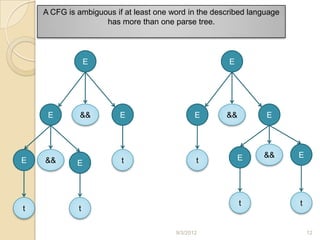
                             9/3/2012                        2
CONTEXT FREE GRAMMAR

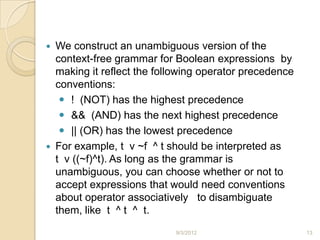
   A CFG, G=(N, T, P, S) where:
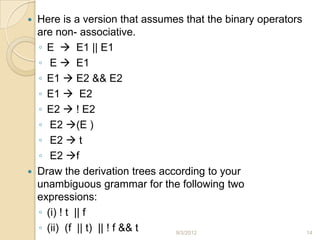
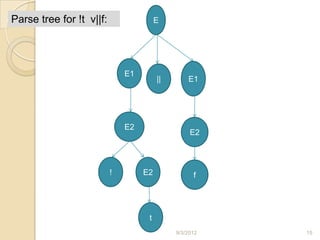
     N is a set of non-terminals.
     T is a set of terminals.
     P is a set of productions (or rules) which are given by
         A->α
         where A denotes a single non-terminal.
                  α denotes a set of terminals and non-
      terminals.
     S is the start state. If not specified, then it is the non-
      terminal that appears on the left-hand side of the first
      production.


                                 9/3/2012                       3
Parse trees

Parse trees are labeled trees characterized by
the following:
– The root is labeled by the start symbol.
– Each leaf is labeled by a token or !.
– Each interior node is labeled by a non-
  terminal.
– If A is the non-terminal labeling some interior
node and X1, X2, …, Xn are the labels of the
children of that node from left to right, then
A ::= X1, X2, …, Xn
is a production in the grammar.
                       9/3/2012                     4
AMBIGUITY AND UNAMBIGUITY :
    A word is said to be ambiguously derivable if there
     are more than one derivations existing for the
     word, that is if there are more than one distinct
     parse tree generated for that word.

     There are two kinds of derivations that are important.
     •A derivation is a leftmost derivation if it is always the
     leftmost non-terminal that is chosen to be replaced.
     •It is a rightmost derivation if it is always the rightmost
     one.

     Ambiguity is considered only when words are derived
     using the same kind of derivation.


                                  9/3/2012                         5
AMBIGUITY AND UNAMBIGUITY
    A grammar is said to be ambiguous if there exists
     at least one word which is ambiguously derivable.

    A grammar is said to be unambiguous if all the
     words derived from it are unambiguous.


                            9/3/2012                     6
 A language L is said to be unambiguous if there
   exists at least one grammar which is unambiguous.
  A language L is said to be ambiguous if all the
   grammar of the language are ambiguous.


Programming language grammars must be
unambiguous.


                         9/3/2012                      7
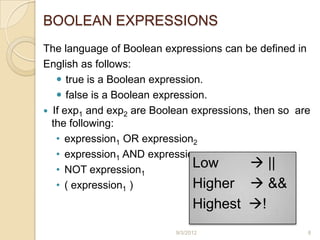
BOOLEAN EXPRESSIONS
The language of Boolean expressions can be defined in
English as follows:
    true is a Boolean expression.
    false is a Boolean expression.
 If exp1 and exp2 are Boolean expressions, then so are
  the following:
   • expression1 OR expression2
   • expression1 AND expression2
   • NOT expression1
                                Low         ||
   • ( expression1 )            Higher  &&
                                 Highest !
                           9/3/2012                   8
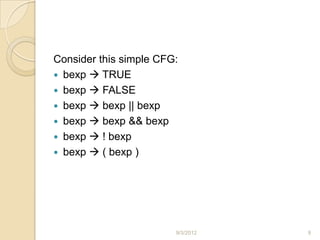
Consider this simple CFG:
 bexp  TRUE
 bexp  FALSE
 bexp  bexp || bexp
 bexp  bexp && bexp
 bexp  ! bexp
 bexp  ( bexp )


                        9/3/2012   9
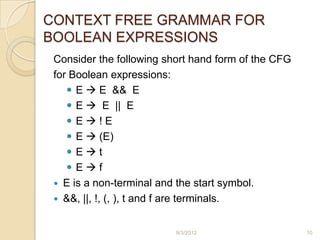
CONTEXT FREE GRAMMAR FOR
BOOLEAN EXPRESSIONS
 Consider the following short hand form of the CFG
 for Boolean expressions:
     E  E && E
     E  E || E
    E!E
     E  (E)
    Et
    Ef
  E is a non-terminal and the start symbol.
  &&, ||, !, (, ), t and f are terminals.


                          9/3/2012                   10
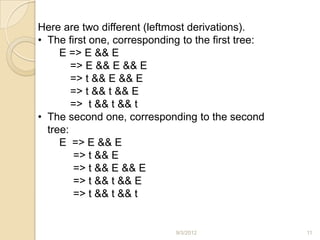
Here are two different (leftmost derivations).
• The first one, corresponding to the first tree:
     E => E && E
        => E && E && E
        => t && E && E
        => t && t && E
        => t && t && t
• The second one, corresponding to the second
  tree:
     E => E && E
        => t && E
        => t && E && E
        => t && t && E
        => t && t && t


                             9/3/2012               11
A CFG is ambiguous if at least one word in the described language
                    has more than one parse tree.


                 E                                     E


     E        &&         E                     E      &&         E


                                                           E    &&      E
E   &&       E           t                     t


                                                           t            t
t            t

                                        9/3/2012                            12
   We construct an unambiguous version of the
    context-free grammar for Boolean expressions by
    making it reflect the following operator precedence
    conventions:
      ! (NOT) has the highest precedence
      && (AND) has the next highest precedence
      || (OR) has the lowest precedence
   For example, t v ~f ^ t should be interpreted as
    t v ((~f)^t). As long as the grammar is
    unambiguous, you can choose whether or not to
    accept expressions that would need conventions
    about operator associatively to disambiguate
    them, like t ^ t ^ t.
                             9/3/2012                     13
   Here is a version that assumes that the binary operators
    are non- associative.
    ◦ E  E1 || E1
    ◦ E  E1
    ◦ E1  E2 && E2
    ◦ E1  E2
    ◦ E2  ! E2
    ◦ E2 (E )
    ◦ E2  t
    ◦ E2 f
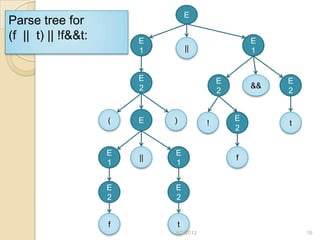
   Draw the derivation trees according to your
    unambiguous grammar for the following two
    expressions:
    ◦ (i) ! t || f
    ◦ (ii) (f || t) || ! f && t  9/3/2012                      14
Parse tree for !t v||f:                 E


                              E1
                                        ||       E1


                              E2
                                                  E2


                          !        E2              f


                                    t
                                             9/3/2012   15
E
Parse tree for
(f || t) || !f&&t:       E                             E
                         1            ||               1


                         E                     E            E
                         2                             &&
                                               2            2


                     (   E    )                    E
                                           !                t
                                                   2


                     E        E
                         ||                        f
                     1        1


                     E        E
                     2        2


                     f            t
                              9/3/2012                          16
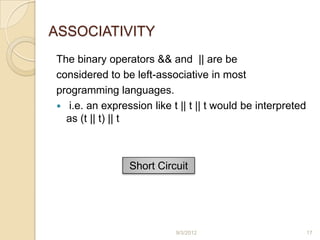
ASSOCIATIVITY
The binary operators && and || are be
considered to be left-associative in most
programming languages.
 i.e. an expression like t || t || t would be interpreted
  as (t || t) || t


                Short Circuit


                           9/3/2012                          17
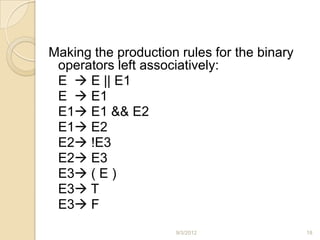
Making the production rules for the binary
 operators left associatively:
 E  E || E1
 E  E1
 E1 E1 && E2
 E1 E2
 E2 !E3
 E2 E3
 E3 ( E )
 E3 T
 E3 F
                     9/3/2012                18
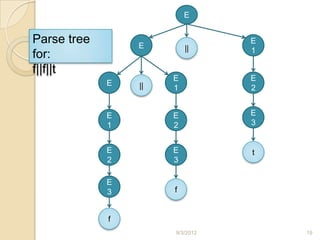
E


Parse tree       E
                                 E
                          ||     1
for:
f||f||t
                      E          E
             E   ||   1          2


             E        E          E
             1        2          3


             E        E          t
             2        3

             E
             3        f


             f
                      9/3/2012       19
THANK
YOU..


      9/3/2012   20

Parsing

  • 1.
    PARSING 9/3/2012 1
  • 2.
    PARSING  In thedesign of a compiler the second stage after lexical analysis is parsing. It is also called as syntax analysis.  Parser will take the stream of tokens generated by the lexical analyzer , check if it is grammatically correct and generate a parse tree.  The fundamental theory behind parsing is grammar theory. 9/3/2012 2
  • 3.
    CONTEXT FREE GRAMMAR  A CFG, G=(N, T, P, S) where:  N is a set of non-terminals.  T is a set of terminals.  P is a set of productions (or rules) which are given by A->α where A denotes a single non-terminal. α denotes a set of terminals and non- terminals.  S is the start state. If not specified, then it is the non- terminal that appears on the left-hand side of the first production. 9/3/2012 3
  • 4.
    Parse trees Parse treesare labeled trees characterized by the following: – The root is labeled by the start symbol. – Each leaf is labeled by a token or !. – Each interior node is labeled by a non- terminal. – If A is the non-terminal labeling some interior node and X1, X2, …, Xn are the labels of the children of that node from left to right, then A ::= X1, X2, …, Xn is a production in the grammar. 9/3/2012 4
  • 5.
    AMBIGUITY AND UNAMBIGUITY:  A word is said to be ambiguously derivable if there are more than one derivations existing for the word, that is if there are more than one distinct parse tree generated for that word. There are two kinds of derivations that are important. •A derivation is a leftmost derivation if it is always the leftmost non-terminal that is chosen to be replaced. •It is a rightmost derivation if it is always the rightmost one. Ambiguity is considered only when words are derived using the same kind of derivation. 9/3/2012 5
  • 6.
    AMBIGUITY AND UNAMBIGUITY  A grammar is said to be ambiguous if there exists at least one word which is ambiguously derivable.  A grammar is said to be unambiguous if all the words derived from it are unambiguous. 9/3/2012 6
  • 7.
     A languageL is said to be unambiguous if there exists at least one grammar which is unambiguous.  A language L is said to be ambiguous if all the grammar of the language are ambiguous. Programming language grammars must be unambiguous. 9/3/2012 7
  • 8.
    BOOLEAN EXPRESSIONS The languageof Boolean expressions can be defined in English as follows:  true is a Boolean expression.  false is a Boolean expression.  If exp1 and exp2 are Boolean expressions, then so are the following: • expression1 OR expression2 • expression1 AND expression2 • NOT expression1 Low  || • ( expression1 ) Higher  && Highest ! 9/3/2012 8
  • 9.
    Consider this simpleCFG:  bexp  TRUE  bexp  FALSE  bexp  bexp || bexp  bexp  bexp && bexp  bexp  ! bexp  bexp  ( bexp ) 9/3/2012 9
  • 10.
    CONTEXT FREE GRAMMARFOR BOOLEAN EXPRESSIONS Consider the following short hand form of the CFG for Boolean expressions:  E  E && E  E  E || E E!E  E  (E) Et Ef  E is a non-terminal and the start symbol.  &&, ||, !, (, ), t and f are terminals. 9/3/2012 10
  • 11.
    Here are twodifferent (leftmost derivations). • The first one, corresponding to the first tree: E => E && E => E && E && E => t && E && E => t && t && E => t && t && t • The second one, corresponding to the second tree: E => E && E => t && E => t && E && E => t && t && E => t && t && t 9/3/2012 11
  • 12.
    A CFG isambiguous if at least one word in the described language has more than one parse tree. E E E && E E && E E && E E && E t t t t t t 9/3/2012 12
  • 13.
    We construct an unambiguous version of the context-free grammar for Boolean expressions by making it reflect the following operator precedence conventions:  ! (NOT) has the highest precedence  && (AND) has the next highest precedence  || (OR) has the lowest precedence  For example, t v ~f ^ t should be interpreted as t v ((~f)^t). As long as the grammar is unambiguous, you can choose whether or not to accept expressions that would need conventions about operator associatively to disambiguate them, like t ^ t ^ t. 9/3/2012 13
  • 14.
    Here is a version that assumes that the binary operators are non- associative. ◦ E  E1 || E1 ◦ E  E1 ◦ E1  E2 && E2 ◦ E1  E2 ◦ E2  ! E2 ◦ E2 (E ) ◦ E2  t ◦ E2 f  Draw the derivation trees according to your unambiguous grammar for the following two expressions: ◦ (i) ! t || f ◦ (ii) (f || t) || ! f && t 9/3/2012 14
  • 15.
    Parse tree for!t v||f: E E1 || E1 E2 E2 ! E2 f t 9/3/2012 15
  • 16.
    E Parse tree for (f|| t) || !f&&t: E E 1 || 1 E E E 2 && 2 2 ( E ) E ! t 2 E E || f 1 1 E E 2 2 f t 9/3/2012 16
  • 17.
    ASSOCIATIVITY The binary operators&& and || are be considered to be left-associative in most programming languages.  i.e. an expression like t || t || t would be interpreted as (t || t) || t Short Circuit 9/3/2012 17
  • 18.
    Making the productionrules for the binary operators left associatively: E  E || E1 E  E1 E1 E1 && E2 E1 E2 E2 !E3 E2 E3 E3 ( E ) E3 T E3 F 9/3/2012 18
  • 19.
    E Parse tree E E || 1 for: f||f||t E E E || 1 2 E E E 1 2 3 E E t 2 3 E 3 f f 9/3/2012 19
  • 20.
    THANK YOU.. 9/3/2012 20