Quality Standard – ISO 9000
By : Somya Agrawal
Quality Management System
• A quality management system (QMS) defines and establishes
an organization's quality policy and objectives.
• It also allows an organization to document and implement the
procedures needed to attain these goals.
• A properly implemented QMS ensures that procedures are
carried out consistently, that problems can be identified and
resolved, and that the organization can continuously review
and improve its procedures, products and services.
• It is a mechanism for maintaining and improving the quality
of products or services so that they consistently meet or
exceed the customer's implied or stated needs and fulfill their
quality objectives
Introduction to ISO 9000
• The ISO 9000 family of standards is related to
quality management systems and designed to
help organizations ensure that they meet the
needs of customers and other stakeholders while
meeting statutory and regulatory requirements.
• ISO 9000 deals with the fundamentals of quality
management systems, including the eight
management principles on which the family of
standards is based.
• International standards promote international trade
by providing one consistent set of requirements
recognized around the world.
• ISO 9000 can help a company satisfy its customers,
meet regulatory requirements and achieve continual
improvement. It provides the base level of a quality
system, not a complete guarantee of quality.
• Originally published in 1987 by the International
Organization for Standardization (ISO), a
specialized international agency for standardization
composed of the national standards bodies of 90
countries.
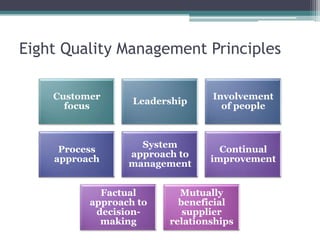
Eight Quality Management Principles
Customer
focus

Leadership

Involvement
of people

Process
approach

System
approach to
management

Continual
improvement

Factual
approach to
decisionmaking

Mutually
beneficial
supplier
relationships
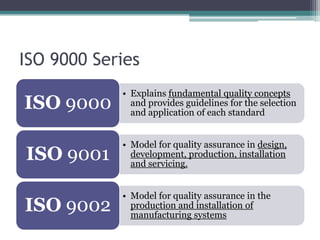
ISO 9000 Series

ISO 9000

• Explains fundamental quality concepts
and provides guidelines for the selection
and application of each standard

ISO 9001

• Model for quality assurance in design,
development, production, installation
and servicing.

ISO 9002

• Model for quality assurance in the
production and installation of
manufacturing systems
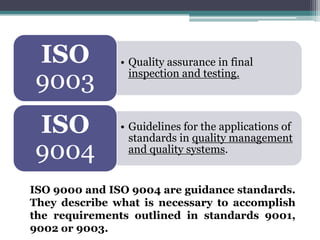
ISO
9003

• Quality assurance in final
inspection and testing.

ISO
9004

• Guidelines for the applications of
standards in quality management
and quality systems.

ISO 9000 and ISO 9004 are guidance standards.
They describe what is necessary to accomplish
the requirements outlined in standards 9001,
9002 or 9003.
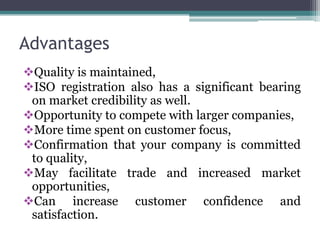
Advantages
Quality is maintained,
ISO registration also has a significant bearing
on market credibility as well.
Opportunity to compete with larger companies,
More time spent on customer focus,
Confirmation that your company is committed
to quality,
May facilitate trade and increased market
opportunities,
Can increase customer confidence and
satisfaction.
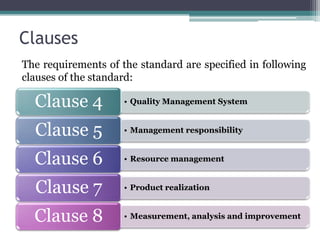
Clauses
The requirements of the standard are specified in following
clauses of the standard:

Clause 4

• Quality Management System

Clause 5

• Management responsibility

Clause 6

• Resource management

Clause 7

• Product realization

Clause 8

• Measurement, analysis and improvement
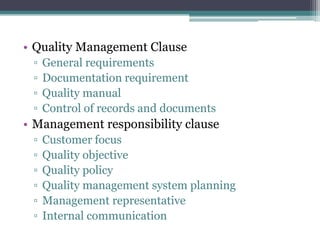
• Quality Management Clause
▫
▫
▫
▫

General requirements
Documentation requirement
Quality manual
Control of records and documents

• Management responsibility clause
▫
▫
▫
▫
▫
▫

Customer focus
Quality objective
Quality policy
Quality management system planning
Management representative
Internal communication
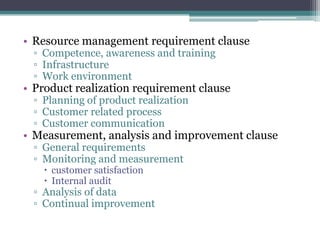
• Resource management requirement clause
▫ Competence, awareness and training
▫ Infrastructure
▫ Work environment

• Product realization requirement clause
▫ Planning of product realization
▫ Customer related process
▫ Customer communication

• Measurement, analysis and improvement clause
▫ General requirements
▫ Monitoring and measurement
 customer satisfaction
 Internal audit

▫ Analysis of data
▫ Continual improvement
ISO 9000

ISO 9000

  • 1.
    Quality Standard –ISO 9000 By : Somya Agrawal
  • 3.
    Quality Management System •A quality management system (QMS) defines and establishes an organization's quality policy and objectives. • It also allows an organization to document and implement the procedures needed to attain these goals. • A properly implemented QMS ensures that procedures are carried out consistently, that problems can be identified and resolved, and that the organization can continuously review and improve its procedures, products and services. • It is a mechanism for maintaining and improving the quality of products or services so that they consistently meet or exceed the customer's implied or stated needs and fulfill their quality objectives
  • 4.
    Introduction to ISO9000 • The ISO 9000 family of standards is related to quality management systems and designed to help organizations ensure that they meet the needs of customers and other stakeholders while meeting statutory and regulatory requirements. • ISO 9000 deals with the fundamentals of quality management systems, including the eight management principles on which the family of standards is based.
  • 5.
    • International standardspromote international trade by providing one consistent set of requirements recognized around the world. • ISO 9000 can help a company satisfy its customers, meet regulatory requirements and achieve continual improvement. It provides the base level of a quality system, not a complete guarantee of quality. • Originally published in 1987 by the International Organization for Standardization (ISO), a specialized international agency for standardization composed of the national standards bodies of 90 countries.
  • 6.
    Eight Quality ManagementPrinciples Customer focus Leadership Involvement of people Process approach System approach to management Continual improvement Factual approach to decisionmaking Mutually beneficial supplier relationships
  • 7.
    ISO 9000 Series ISO9000 • Explains fundamental quality concepts and provides guidelines for the selection and application of each standard ISO 9001 • Model for quality assurance in design, development, production, installation and servicing. ISO 9002 • Model for quality assurance in the production and installation of manufacturing systems
  • 8.
    ISO 9003 • Quality assurancein final inspection and testing. ISO 9004 • Guidelines for the applications of standards in quality management and quality systems. ISO 9000 and ISO 9004 are guidance standards. They describe what is necessary to accomplish the requirements outlined in standards 9001, 9002 or 9003.
  • 9.
    Advantages Quality is maintained, ISOregistration also has a significant bearing on market credibility as well. Opportunity to compete with larger companies, More time spent on customer focus, Confirmation that your company is committed to quality, May facilitate trade and increased market opportunities, Can increase customer confidence and satisfaction.
  • 10.
    Clauses The requirements ofthe standard are specified in following clauses of the standard: Clause 4 • Quality Management System Clause 5 • Management responsibility Clause 6 • Resource management Clause 7 • Product realization Clause 8 • Measurement, analysis and improvement
  • 11.
    • Quality ManagementClause ▫ ▫ ▫ ▫ General requirements Documentation requirement Quality manual Control of records and documents • Management responsibility clause ▫ ▫ ▫ ▫ ▫ ▫ Customer focus Quality objective Quality policy Quality management system planning Management representative Internal communication
  • 12.
    • Resource managementrequirement clause ▫ Competence, awareness and training ▫ Infrastructure ▫ Work environment • Product realization requirement clause ▫ Planning of product realization ▫ Customer related process ▫ Customer communication • Measurement, analysis and improvement clause ▫ General requirements ▫ Monitoring and measurement  customer satisfaction  Internal audit ▫ Analysis of data ▫ Continual improvement