DEFINITION
 Quality Audit is termed as a “systematic and independent examination to
determine whether activities and related results comply with planned arrangements
and whether these arrangements are implemented effectively and are suitable to
achieve objectives”.
Quality audit means a systematic examination of
a quality system.
Quality audits are typically performed at
defined intervals.
Any failure in their proper implementation may
be published publicly and may lead to a
revocation of quality certififcation.
SCOPE AND OBJECTIVES
- To ensure the quality of product
- To access the effectiveness of QA system
- It permit timely correction of problem
- It establish high degree of confidence
- It provide a stimulus for improvement
- Build interdepartmental trust , understanding
and communication
Reasons for Quality Auditing
 INTERNAL-in order to:
• Determine the level of compliance
• Build confidence in GMP and the QA system
• Determine measures necessary to improve,
e.g.,:
• Premises, equipment, environment
• Operations, actions
• Personnel/training
• Monitor improvement
 EXTERNAL-in order to:
• Establish and monitor capability of supplier or
contractor to deliver
• Goods and services that are fit for purpose
• Build mutual confidence
• Promote understanding and communication
between the parties involved{both sides can
learn}
DIFFERENCES BETWEEN AUDIT AND
PERIODIC EVALUATION
Quality Audit Periodic Evaluation
Quality audit is periodic, independent, and
documented examination and verification of
activities, records and other elements of a
quality system to determine their conformity
with requirements of a quality standard such
as GMP
Periodic evaluations are routine reviews and
assessments of the quality standards of each
drug product that are made to determine the
need for changes in drug product
specifications or manufacturing or control
procedures.
Auditors should not have direct
responsibilities for the operations they
review
Audit is the function of Quality assurance
Report is prepared by Q.C personnel
Employees who directly responsible for
system review normally perform periodic
evaluations
Periodic evaluation is a function of Quality
control department
Quality control management personnel
usually prepared periodic evaluations.
SELF-INSPECTION
PRINCIPLE:-
 To evaluate the manufacturer’s compliance with GMP in all aspects of production
and Quality control.
 Designed to detect any shortcomings in the implementation of GMP and to
recommend the necessary corrective actions
 Performed routinely as well as occasionally, e.g. in the cases of product recalls or
repeated rejections.
ITEMS OF SELF-INSPECTION:-
 Personnel
 Premises including personnel facilities
 Maintenance of buildings and equipment’s
 Storage of materials and finished products
 Equipment
 Production and in-process controls
 Quality control
 Documentation
 Sanitation and hygiene
 Validation and revalidation programmes
 Calibration of instruments
 Recall procedures
 Complaints management
 Labels control
 Results of previous self-inspections and any correctives steps taken
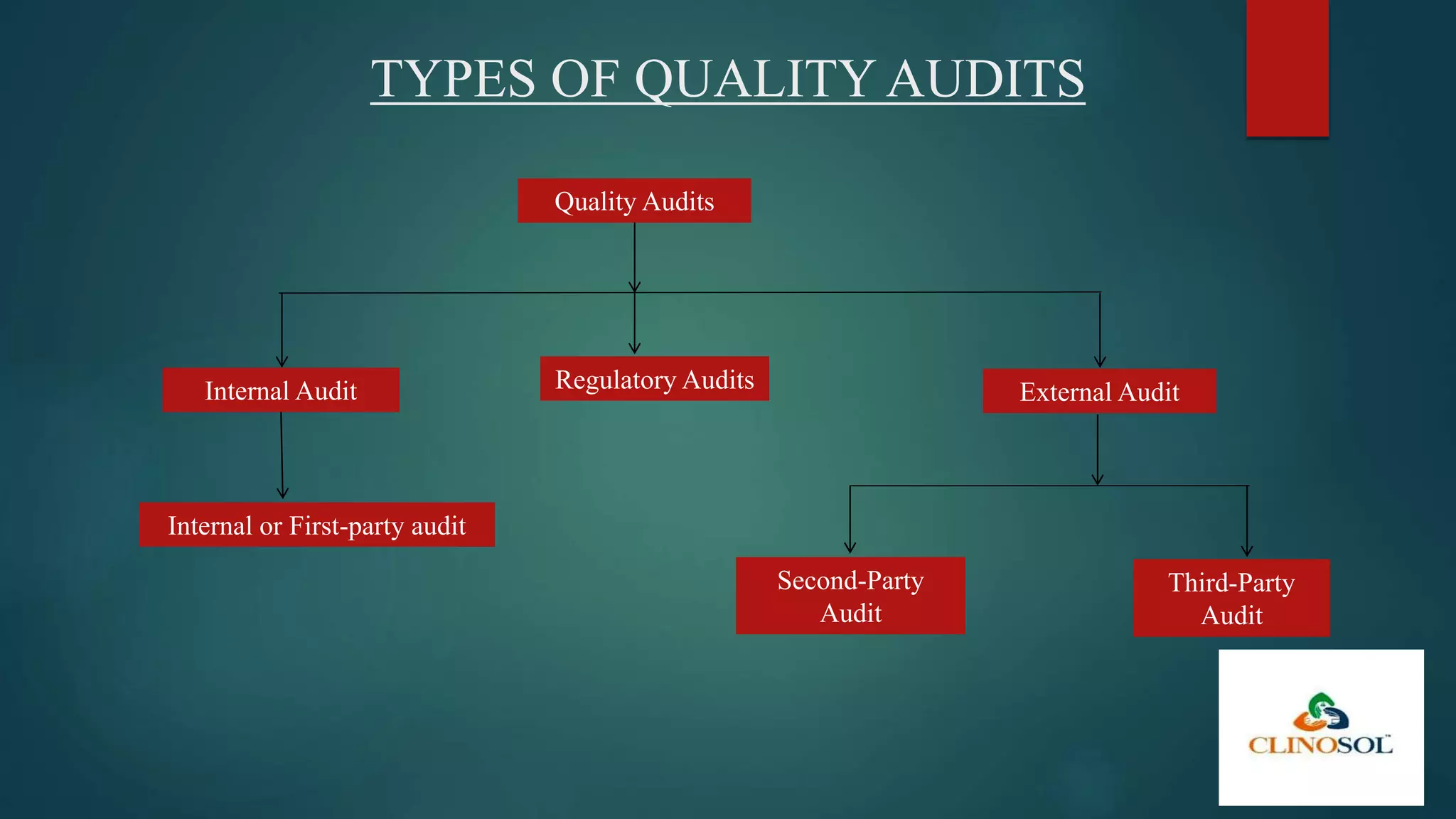
TYPES OF QUALITY AUDITS
Quality Audits
Internal Audit External Audit
Internal or First-party audit
Second-Party
Audit
Third-Party
Audit
Regulatory Audits
INTERNALAUDIT EXTERNALAUDIT REGULATORY AUDIT
To ensure that adequate Quality
systems are maintained.
Confidence in the partnership
arrangement
Networking and confidence-
building between national
inspection authorities
To assess compliance with
GMP’s and firms SOP’s.
Ensuring that requirements are
understood
Development of quality systems
To achieve consistency between
manufacturing and testing
facilities.
Reducing the risk of failure Carried out by regulatory
bodies{MCA,USFDA}
To identify problems internally
prior to a FDA inspection
Carried out by company on its
vendors
Audits may be announced
No legal requirements to
conduct the audit
Who performs an Audit?
[A] Imposed upon
manufacturer or
supplier
[B] Performed by
manufacturer
Regulatory
Customer or
Potential customer
Third party
Internal{Self-
Inspection}
External
• Overall
• Departmental
• Product-based
• System-oriented
• Supplier
• Contract manufacturer
• Packager
MERITS OF GOOD INSPECTION
SYSTEM
 Most effective utilization of resources
 Encourages quality consciousness
 Reduction in production cost
 Improved techniques and methods of production
 Increased sales
 Facilitates price fixation
DEMERITS OF POOR INSPECTION
SYSTEM
 Increase cost of production
 Wastage of resources
 Reputational risk
 Reduce sale
 No further improvement
Role of GMP Audits in Q.A and Q.C
programmes
What is to be audited:-
 Auditors review
SOPs
Employees Practices and behaviour
 Compare master specification against compendial and regulatory requirements
 Verify the test data and validation testing
 Validation test reports are compared against raw data
 Verify corrective actions taken inreaction to audit finding
Benefits which are derived from Audits are
given below
1. Assuring GMP compliance
2. Detecting Potential Problems
3. Effecting Programme improvement
4. Increasing management awareness
1. Assuring GMP Compliance
FDA conducts routine inspections of all pharmaceutical manufacturers to
determine if manufacturing and control procedures conform to GMPs.
FDA investigators make unannounced visits to the manufacturing facilities to
examine facilities, equipment's, personnel and records.
2. Detecting Potential Problems
GMP audits find objectionable condition that is unknown to responsible
production, QC , QA or management personnel.
The auditor will see whether such actions are frequent or not. From this he can
signal other GMP problems.
3.Effecting Programme Improvements
Changing SOPs
Modifying manufacturing equipment or procedure
Upgrading equipment or procedure
Improving employee training programme
4.Increasing Management Awareness
For any given audits there are two outcomes, either problems are found or not
 If the problems are found, management takes an appropriate step to eliminate the
problem
 An audit is not finding any objectionable conditions
Either there were no problems to be found
Auditor failed to detect objectionable condition that were actually present
REFERENCES
 http://www.slideshare.net/HafsaMunir2/quality-audit-
77199521?from_m_app=android
 https://innovareacademics.in/journals/index.php/ijap/article/download/29709/1680
0
 http://www.slideshare.net/mcplamoshi/quality-audits-
172105098?from_m_app=android
 http://www.slideshare.net/Dolita-Shah/quality-audit?from_m_app=android
 https://slideplayer.com/slide/5906538/
THANK YOU
BOLLAM.SARIKA -007/0122
bollamsarika@gmail.com

Quality Audit

  • 2.
    DEFINITION  Quality Auditis termed as a “systematic and independent examination to determine whether activities and related results comply with planned arrangements and whether these arrangements are implemented effectively and are suitable to achieve objectives”.
  • 3.
    Quality audit meansa systematic examination of a quality system. Quality audits are typically performed at defined intervals. Any failure in their proper implementation may be published publicly and may lead to a revocation of quality certififcation.
  • 4.
    SCOPE AND OBJECTIVES -To ensure the quality of product - To access the effectiveness of QA system - It permit timely correction of problem - It establish high degree of confidence - It provide a stimulus for improvement - Build interdepartmental trust , understanding and communication
  • 5.
    Reasons for QualityAuditing  INTERNAL-in order to: • Determine the level of compliance • Build confidence in GMP and the QA system • Determine measures necessary to improve, e.g.,: • Premises, equipment, environment • Operations, actions • Personnel/training • Monitor improvement  EXTERNAL-in order to: • Establish and monitor capability of supplier or contractor to deliver • Goods and services that are fit for purpose • Build mutual confidence • Promote understanding and communication between the parties involved{both sides can learn}
  • 6.
    DIFFERENCES BETWEEN AUDITAND PERIODIC EVALUATION Quality Audit Periodic Evaluation Quality audit is periodic, independent, and documented examination and verification of activities, records and other elements of a quality system to determine their conformity with requirements of a quality standard such as GMP Periodic evaluations are routine reviews and assessments of the quality standards of each drug product that are made to determine the need for changes in drug product specifications or manufacturing or control procedures. Auditors should not have direct responsibilities for the operations they review Audit is the function of Quality assurance Report is prepared by Q.C personnel Employees who directly responsible for system review normally perform periodic evaluations Periodic evaluation is a function of Quality control department Quality control management personnel usually prepared periodic evaluations.
  • 7.
    SELF-INSPECTION PRINCIPLE:-  To evaluatethe manufacturer’s compliance with GMP in all aspects of production and Quality control.  Designed to detect any shortcomings in the implementation of GMP and to recommend the necessary corrective actions  Performed routinely as well as occasionally, e.g. in the cases of product recalls or repeated rejections. ITEMS OF SELF-INSPECTION:-  Personnel  Premises including personnel facilities  Maintenance of buildings and equipment’s  Storage of materials and finished products
  • 8.
     Equipment  Productionand in-process controls  Quality control  Documentation  Sanitation and hygiene  Validation and revalidation programmes  Calibration of instruments  Recall procedures  Complaints management  Labels control  Results of previous self-inspections and any correctives steps taken
  • 9.
    TYPES OF QUALITYAUDITS Quality Audits Internal Audit External Audit Internal or First-party audit Second-Party Audit Third-Party Audit Regulatory Audits
  • 10.
    INTERNALAUDIT EXTERNALAUDIT REGULATORYAUDIT To ensure that adequate Quality systems are maintained. Confidence in the partnership arrangement Networking and confidence- building between national inspection authorities To assess compliance with GMP’s and firms SOP’s. Ensuring that requirements are understood Development of quality systems To achieve consistency between manufacturing and testing facilities. Reducing the risk of failure Carried out by regulatory bodies{MCA,USFDA} To identify problems internally prior to a FDA inspection Carried out by company on its vendors Audits may be announced No legal requirements to conduct the audit
  • 13.
    Who performs anAudit? [A] Imposed upon manufacturer or supplier [B] Performed by manufacturer Regulatory Customer or Potential customer Third party Internal{Self- Inspection} External • Overall • Departmental • Product-based • System-oriented • Supplier • Contract manufacturer • Packager
  • 14.
    MERITS OF GOODINSPECTION SYSTEM  Most effective utilization of resources  Encourages quality consciousness  Reduction in production cost  Improved techniques and methods of production  Increased sales  Facilitates price fixation
  • 15.
    DEMERITS OF POORINSPECTION SYSTEM  Increase cost of production  Wastage of resources  Reputational risk  Reduce sale  No further improvement
  • 16.
    Role of GMPAudits in Q.A and Q.C programmes What is to be audited:-  Auditors review SOPs Employees Practices and behaviour  Compare master specification against compendial and regulatory requirements  Verify the test data and validation testing  Validation test reports are compared against raw data  Verify corrective actions taken inreaction to audit finding
  • 17.
    Benefits which arederived from Audits are given below 1. Assuring GMP compliance 2. Detecting Potential Problems 3. Effecting Programme improvement 4. Increasing management awareness
  • 18.
    1. Assuring GMPCompliance FDA conducts routine inspections of all pharmaceutical manufacturers to determine if manufacturing and control procedures conform to GMPs. FDA investigators make unannounced visits to the manufacturing facilities to examine facilities, equipment's, personnel and records. 2. Detecting Potential Problems GMP audits find objectionable condition that is unknown to responsible production, QC , QA or management personnel. The auditor will see whether such actions are frequent or not. From this he can signal other GMP problems.
  • 19.
    3.Effecting Programme Improvements ChangingSOPs Modifying manufacturing equipment or procedure Upgrading equipment or procedure Improving employee training programme 4.Increasing Management Awareness For any given audits there are two outcomes, either problems are found or not  If the problems are found, management takes an appropriate step to eliminate the problem  An audit is not finding any objectionable conditions Either there were no problems to be found Auditor failed to detect objectionable condition that were actually present
  • 20.
    REFERENCES  http://www.slideshare.net/HafsaMunir2/quality-audit- 77199521?from_m_app=android  https://innovareacademics.in/journals/index.php/ijap/article/download/29709/1680 0 http://www.slideshare.net/mcplamoshi/quality-audits- 172105098?from_m_app=android  http://www.slideshare.net/Dolita-Shah/quality-audit?from_m_app=android  https://slideplayer.com/slide/5906538/
  • 21.