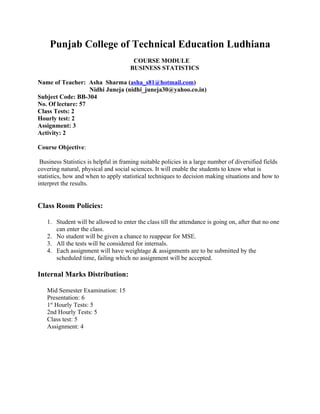
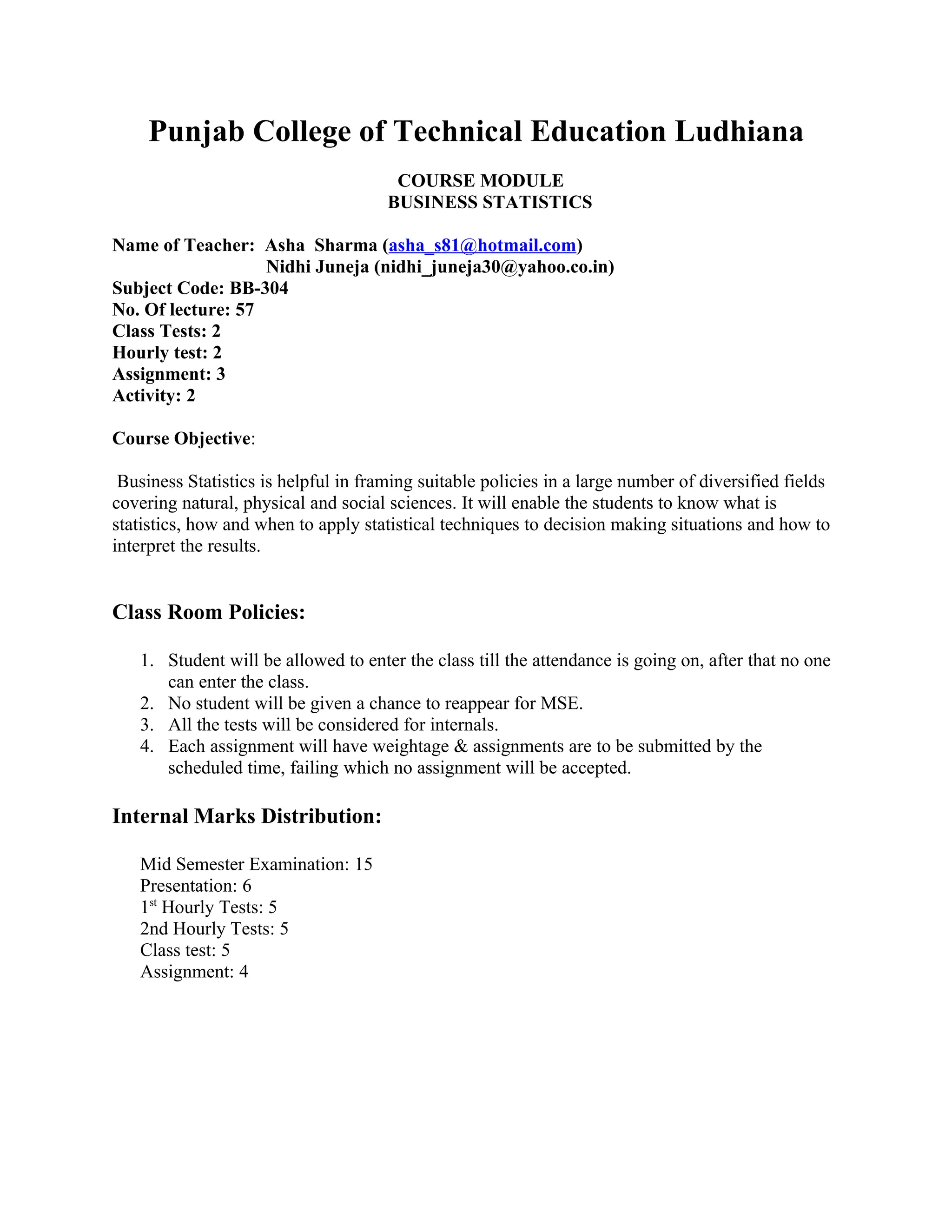
Punjab College of Technical Education Ludhiana
                                       COURSE MODULE
                                      BUSINESS STATISTICS

Name of Teacher: Asha Sharma (asha_s81@hotmail.com)
                   Nidhi Juneja (nidhi_juneja30@yahoo.co.in)
Subject Code: BB-304
No. Of lecture: 57
Class Tests: 2
Hourly test: 2
Assignment: 3
Activity: 2

Course Objective:

 Business Statistics is helpful in framing suitable policies in a large number of diversified fields
covering natural, physical and social sciences. It will enable the students to know what is
statistics, how and when to apply statistical techniques to decision making situations and how to
interpret the results.


Class Room Policies:

   1. Student will be allowed to enter the class till the attendance is going on, after that no one
      can enter the class.
   2. No student will be given a chance to reappear for MSE.
   3. All the tests will be considered for internals.
   4. Each assignment will have weightage & assignments are to be submitted by the
      scheduled time, failing which no assignment will be accepted.

Internal Marks Distribution:

   Mid Semester Examination: 15
   Presentation: 6
   1st Hourly Tests: 5
   2nd Hourly Tests: 5
   Class test: 5
   Assignment: 4
Course Break-Up
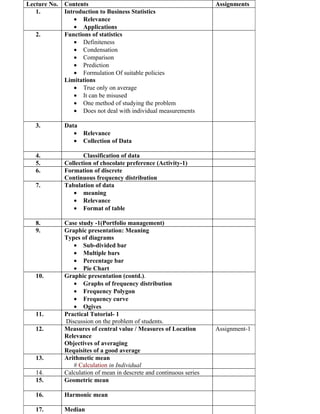
Lecture No.   Contents                                                Assignments
   1.         Introduction to Business Statistics
                  • Relevance
                  • Applications
   2.         Functions of statistics
                  • Definiteness
                  • Condensation
                  • Comparison
                  • Prediction
                  • Formulation Of suitable policies
              Limitations
                  • True only on average
                  • It can be misused
                  • One method of studying the problem
                  • Does not deal with individual measurements

   3.         Data
                 • Relevance
                 • Collection of Data

   4.                Classification of data
   5.         Collection of chocolate preference (Activity-1)
   6.         Formation of discrete
              Continuous frequency distribution
   7.         Tabulation of data
                 • meaning
                 • Relevance
                 • Format of table

   8.         Case study -1(Portfolio management)
   9.         Graphic presentation: Meaning
              Types of diagrams
                 • Sub-divided bar
                 • Multiple bars
                 • Percentage bar
                 • Pie Chart
   10.        Graphic presentation (contd.).
                 • Graphs of frequency distribution
                 • Frequency Polygon
                 • Frequency curve
                 • Ogives
   11.        Practical Tutorial- 1
              Discussion on the problem of students.
   12.        Measures of central value / Measures of Location        Assignment-1
              Relevance
              Objectives of averaging
              Requisites of a good average
   13.        Arithmetic mean
                 # Calculation in Individual
   14.        Calculation of mean in descrete and continuous series
   15.        Geometric mean

   16.        Harmonic mean

   17.        Median
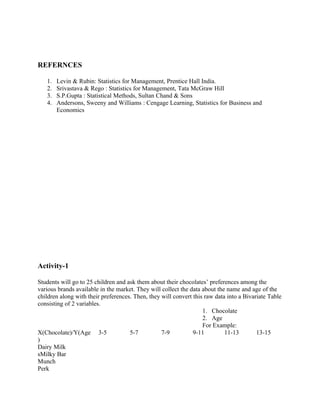
REFERNCES

   1.   Levin & Rubin: Statistics for Management, Prentice Hall India.
   2.   Srivastava & Rego : Statistics for Management, Tata McGraw Hill
   3.   S.P.Gupta : Statistical Methods, Sultan Chand & Sons
   4.   Andersons, Sweeny and Williams : Cengage Learning, Statistics for Business and
        Economics


Activity-1

Students will go to 25 children and ask them about their chocolates’ preferences among the
various brands available in the market. They will collect the data about the name and age of the
children along with their preferences. Then, they will convert this raw data into a Bivariate Table
consisting of 2 variables.
                                                                   1. Chocolate
                                                                   2. Age
                                                                   For Example:
X(Chocolate)/Y(Age 3-5               5-7          7-9          9-11         11-13        13-15
)
Dairy Milk
sMilky Bar
Munch
Perk
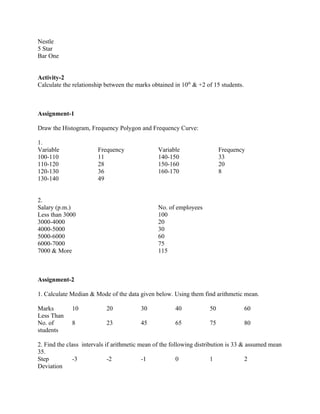
Nestle
5 Star
Bar One


Activity-2
Calculate the relationship between the marks obtained in 10th & +2 of 15 students.


Assignment-1

Draw the Histogram, Frequency Polygon and Frequency Curve:

1.
Variable               Frequency               Variable                  Frequency
100-110                11                      140-150                   33
110-120                28                      150-160                   20
120-130                36                      160-170                   8
130-140                49


2.
Salary (p.m.)                                  No. of employees
Less than 3000                                 100
3000-4000                                      20
4000-5000                                      30
5000-6000                                      60
6000-7000                                      75
7000 & More                                    115


Assignment-2

1. Calculate Median & Mode of the data given below. Using them find arithmetic mean.

Marks        10            20            30           40            50               60
Less Than
No. of       8             23            45           65            75               80
students

2. Find the class intervals if arithmetic mean of the following distribution is 33 & assumed mean
35.
Step          -3             -2            -1            0             1             2
Deviation
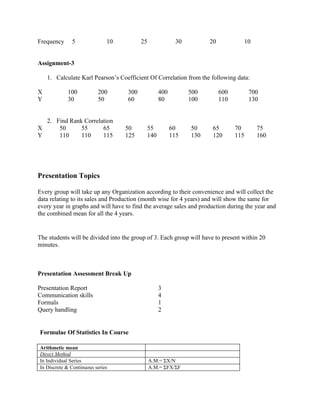
Frequency     5               10          25              30         20            10


Assignment-3

    1. Calculate Karl Pearson’s Coefficient Of Correlation from the following data:

X           100           200       300           400          500        600         700
Y           30            50        60            80           100        110         130


  2. Find Rank Correlation
X     50      55      65           50       55          60     50     65        70      75
Y     110     110     115          125      140         115    130    120       115     160


Presentation Topics

Every group will take up any Organization according to their convenience and will collect the
data relating to its sales and Production (month wise for 4 years) and will show the same for
every year in graphs and will have to find the average sales and production during the year and
the combined mean for all the 4 years.


The students will be divided into the group of 3. Each group will have to present within 20
minutes.


Presentation Assessment Break Up

Presentation Report                               3
Communication skills                              4
Formals                                           1
Query handling                                    2


Formulae Of Statistics In Course

Arithmetic mean
Direct Method
In Individual Series                           A.M.= ΣX/N
In Discrete & Continuous series                A.M.= ΣFX/ΣF
Short Cut Method/ Indirect Method   A.M.= A+ΣFdx/ΣF
Step-deviation Method               A.M.=A+ΣFdx'/ΣF*i

Geometric Mean                      G.M.=√ab
Harmonic Mean
In Individual Series                N/Σ(1/X)
In Discrete & Continuous series     N/Σ(f*1/X)
Median
In Individual & Discrete Series     M=N+1/2, (Nth term+N+1/2)/2
Continuous series                   N1=N/2, M=L+ N1-CF/F*i

Mode
In Individual Series                Maximum repeated term
In Discrete & Continuous series     Groupung Table & Analysis Table, M=
                                    L+D1/(D1+D2)*i

Quartiles
In Individual & Discrete Series     Q1=N+1/4, Q2=2(N+1)/4, Q3=3(N+1)/4


Continuous series                   N1=N/4, Q1=L+(N1-
                                    C.F.)/F*i,N1=3N/4,Q3=L+(N1-C.F.)/F*i


Decile                              N1=N/10, D1=L+(N1-
                                    C.F.)/F*i,N1=9N/10,D9=L+(N1-C.F.)/F*i


Percentile                          N1=10(N/100), P10=L+(N1-
                                    C.F.)/F*i,N1=90N/100,P90=L+(N1-C.F.)/
                                    F*i

Measures of dispersion
Range                               Highest Value-Lowest Value
Quartile Deviation                  Q3-Q1/2
Coeffcient of quartile deviation    Q3-Q1/Q3+Q1

Mean Deviation
In Individual Series                Σ[X-A.M.]/N
In Discrete & Continuous series     ΣF[X-A.M.]/N
Coefficient Of Mean Deviation       M.D./A.M.or M or Z

Standard Deviation
In Individual Series                √Σd²/N-(Σd/N)2
In Discrete & Continuous series     √Σfd²/N-(Σfd/N)2
Coefficient Of Standard Deviation   S.D./A.M.
Variance                            S.D.²
Coefficient of variation            S.D./A.M.*100

Coefficient Of Correlation
Karl Pearson                        r=NΣXY-(ΣX.ΣY)/√(NΣX²-
                                    {ΣX}²).√(NΣY²-{ΣY}²)
Spearman               1-6ΣD²/N³-N When ranks are not
                       repeated
                       1-6[ΣD²+1/12{m³-m}]/N³-N, When ranks
                       are repeated
Concurrent deviation   C √n (2C-n/n)
Standard Error         1-r²/√N
Probable Error         0.6745 (1-r²/√N)

Module stats

  • 1.
    Punjab College ofTechnical Education Ludhiana COURSE MODULE BUSINESS STATISTICS Name of Teacher: Asha Sharma (asha_s81@hotmail.com) Nidhi Juneja (nidhi_juneja30@yahoo.co.in) Subject Code: BB-304 No. Of lecture: 57 Class Tests: 2 Hourly test: 2 Assignment: 3 Activity: 2 Course Objective: Business Statistics is helpful in framing suitable policies in a large number of diversified fields covering natural, physical and social sciences. It will enable the students to know what is statistics, how and when to apply statistical techniques to decision making situations and how to interpret the results. Class Room Policies: 1. Student will be allowed to enter the class till the attendance is going on, after that no one can enter the class. 2. No student will be given a chance to reappear for MSE. 3. All the tests will be considered for internals. 4. Each assignment will have weightage & assignments are to be submitted by the scheduled time, failing which no assignment will be accepted. Internal Marks Distribution: Mid Semester Examination: 15 Presentation: 6 1st Hourly Tests: 5 2nd Hourly Tests: 5 Class test: 5 Assignment: 4
  • 2.
  • 3.
    Lecture No. Contents Assignments 1. Introduction to Business Statistics • Relevance • Applications 2. Functions of statistics • Definiteness • Condensation • Comparison • Prediction • Formulation Of suitable policies Limitations • True only on average • It can be misused • One method of studying the problem • Does not deal with individual measurements 3. Data • Relevance • Collection of Data 4. Classification of data 5. Collection of chocolate preference (Activity-1) 6. Formation of discrete Continuous frequency distribution 7. Tabulation of data • meaning • Relevance • Format of table 8. Case study -1(Portfolio management) 9. Graphic presentation: Meaning Types of diagrams • Sub-divided bar • Multiple bars • Percentage bar • Pie Chart 10. Graphic presentation (contd.). • Graphs of frequency distribution • Frequency Polygon • Frequency curve • Ogives 11. Practical Tutorial- 1 Discussion on the problem of students. 12. Measures of central value / Measures of Location Assignment-1 Relevance Objectives of averaging Requisites of a good average 13. Arithmetic mean # Calculation in Individual 14. Calculation of mean in descrete and continuous series 15. Geometric mean 16. Harmonic mean 17. Median
  • 4.
    REFERNCES 1. Levin & Rubin: Statistics for Management, Prentice Hall India. 2. Srivastava & Rego : Statistics for Management, Tata McGraw Hill 3. S.P.Gupta : Statistical Methods, Sultan Chand & Sons 4. Andersons, Sweeny and Williams : Cengage Learning, Statistics for Business and Economics Activity-1 Students will go to 25 children and ask them about their chocolates’ preferences among the various brands available in the market. They will collect the data about the name and age of the children along with their preferences. Then, they will convert this raw data into a Bivariate Table consisting of 2 variables. 1. Chocolate 2. Age For Example: X(Chocolate)/Y(Age 3-5 5-7 7-9 9-11 11-13 13-15 ) Dairy Milk sMilky Bar Munch Perk
  • 5.
    Nestle 5 Star Bar One Activity-2 Calculatethe relationship between the marks obtained in 10th & +2 of 15 students. Assignment-1 Draw the Histogram, Frequency Polygon and Frequency Curve: 1. Variable Frequency Variable Frequency 100-110 11 140-150 33 110-120 28 150-160 20 120-130 36 160-170 8 130-140 49 2. Salary (p.m.) No. of employees Less than 3000 100 3000-4000 20 4000-5000 30 5000-6000 60 6000-7000 75 7000 & More 115 Assignment-2 1. Calculate Median & Mode of the data given below. Using them find arithmetic mean. Marks 10 20 30 40 50 60 Less Than No. of 8 23 45 65 75 80 students 2. Find the class intervals if arithmetic mean of the following distribution is 33 & assumed mean 35. Step -3 -2 -1 0 1 2 Deviation
  • 6.
    Frequency 5 10 25 30 20 10 Assignment-3 1. Calculate Karl Pearson’s Coefficient Of Correlation from the following data: X 100 200 300 400 500 600 700 Y 30 50 60 80 100 110 130 2. Find Rank Correlation X 50 55 65 50 55 60 50 65 70 75 Y 110 110 115 125 140 115 130 120 115 160 Presentation Topics Every group will take up any Organization according to their convenience and will collect the data relating to its sales and Production (month wise for 4 years) and will show the same for every year in graphs and will have to find the average sales and production during the year and the combined mean for all the 4 years. The students will be divided into the group of 3. Each group will have to present within 20 minutes. Presentation Assessment Break Up Presentation Report 3 Communication skills 4 Formals 1 Query handling 2 Formulae Of Statistics In Course Arithmetic mean Direct Method In Individual Series A.M.= ΣX/N In Discrete & Continuous series A.M.= ΣFX/ΣF
  • 7.
    Short Cut Method/Indirect Method A.M.= A+ΣFdx/ΣF Step-deviation Method A.M.=A+ΣFdx'/ΣF*i Geometric Mean G.M.=√ab Harmonic Mean In Individual Series N/Σ(1/X) In Discrete & Continuous series N/Σ(f*1/X) Median In Individual & Discrete Series M=N+1/2, (Nth term+N+1/2)/2 Continuous series N1=N/2, M=L+ N1-CF/F*i Mode In Individual Series Maximum repeated term In Discrete & Continuous series Groupung Table & Analysis Table, M= L+D1/(D1+D2)*i Quartiles In Individual & Discrete Series Q1=N+1/4, Q2=2(N+1)/4, Q3=3(N+1)/4 Continuous series N1=N/4, Q1=L+(N1- C.F.)/F*i,N1=3N/4,Q3=L+(N1-C.F.)/F*i Decile N1=N/10, D1=L+(N1- C.F.)/F*i,N1=9N/10,D9=L+(N1-C.F.)/F*i Percentile N1=10(N/100), P10=L+(N1- C.F.)/F*i,N1=90N/100,P90=L+(N1-C.F.)/ F*i Measures of dispersion Range Highest Value-Lowest Value Quartile Deviation Q3-Q1/2 Coeffcient of quartile deviation Q3-Q1/Q3+Q1 Mean Deviation In Individual Series Σ[X-A.M.]/N In Discrete & Continuous series ΣF[X-A.M.]/N Coefficient Of Mean Deviation M.D./A.M.or M or Z Standard Deviation In Individual Series √Σd²/N-(Σd/N)2 In Discrete & Continuous series √Σfd²/N-(Σfd/N)2 Coefficient Of Standard Deviation S.D./A.M. Variance S.D.² Coefficient of variation S.D./A.M.*100 Coefficient Of Correlation Karl Pearson r=NΣXY-(ΣX.ΣY)/√(NΣX²- {ΣX}²).√(NΣY²-{ΣY}²)
  • 8.
    Spearman 1-6ΣD²/N³-N When ranks are not repeated 1-6[ΣD²+1/12{m³-m}]/N³-N, When ranks are repeated Concurrent deviation C √n (2C-n/n) Standard Error 1-r²/√N Probable Error 0.6745 (1-r²/√N)