
By:Gaurav Gunjan
B.Tech Final Year
Dept. of Mechanical Engineering
                                  1
Contents:-
1.   Quality
2.   Types Of Inspection
3.   Quality Control
4.   Types Of Quality Control
5.   Analytical Quality Control
6.   Statistical Quality Control
7.   Good Manufacturing Process
8.   Quality Assurance
9.   Conclusion
What Is Quality ?

The quality of a product is the “degree of perfection” i.e. the
totality of features and characteristics of a product or service
that bears on its ability to satisfy the needs of the customers.
                            The quality of a product depends
upon    a   number     of     factors   such   as   design   and
specifications, production process, quality of raw materials
used, quality of machines and equipments, man power
expertise and skill and the inspection.
Types of Inspection:

Depending upon the objective, inspection can be of
two types, namely, preventive and corrective.
                    The primary purpose of it is to
discover the defective parts that have already been
manufactured and prevent their use in the final
product.
                    The idea is to prevent the
inferior parts from further processing down the
production line in order to reduce the cost of
production.
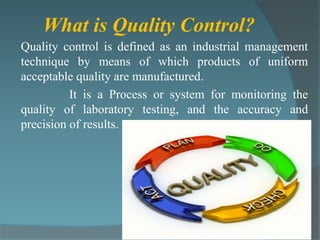
What is Quality Control?
Quality control is defined as an industrial management
technique by means of which products of uniform
acceptable quality are manufactured.
          It is a Process or system for monitoring the
quality of laboratory testing, and the accuracy and
precision of results.
What is the goal of QC?
 To detect
  SIGNIFICANT errors
  rapidly
 Report out good results
  in a timely manner
 Be cost effective and
  simple to use
 If there is an error,
  identify the source of
  the error
What is an error???
  A wrong answer.
A significant error is
 one that changes the
       diagnosis

 Wrong answers can
be caused by random
      errors or by
   systematic errors
Types of Errors
 Random            Systematic
Fluctuations      Reagent problem
Temperature       Device problem
 Personnel
Types of Quality Control:-

Internal Quality Control
When a company institutes protocol to check their system, this is
called internal quality control.


External Quality Control
When products or data is sent to an outside business not affiliated
with the company, this is external control. One example of external
control is in food production.
Analytical Quality Control

Analytical quality control, commonly shortened
to AQC refers to all those processes and procedures
designed to ensure that the results of laboratory
analysis are consistent, comparable,accurate and
within specified limits of precision.

                    In well managed laboratories,
AQC processes are built into the routine operations
of the laboratory often by the random introduction
of known standards in to the sample stream or by
the use of spiked samples.
Statistical Quality Control
(SQC)
A process by which a product/service is checked
during its creation using certain set parameters and
statistical techniques to measure and analyze the
variation within the process.
WHAT IS IT USED FOR:

To monitor the consistency of product/service
quality and maintain processes to a fixed target as
designed.
To drive improvement actions within an
organization.
Advantages of Statistical Quality Control (SQC):

The advantages of SQC are as follows:-

(1) It ensures control, maintenance and improvement in the
quality standards.
(2) It provides better quality assurance at lower cost of
inspection.
(3) It reduces the wastages of time and materials to the
minimum.
 (4) The very presence of SQC policy in an organization
improves and makes them quality conscious.
(5) It provides basis for resolving differences among the
various interests in the organization.
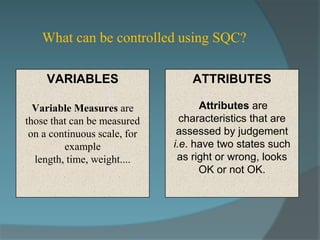
What can be controlled using SQC?

     VARIABLES                    ATTRIBUTES

  Variable Measures are             Attributes are
those that can be measured      characteristics that are
 on a continuous scale, for    assessed by judgement
         example              i.e. have two states such
  length, time, weight....     as right or wrong, looks
                                    OK or not OK.
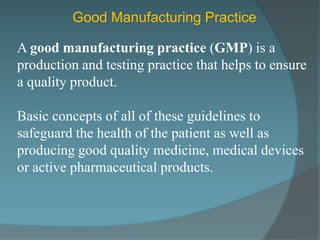
Good Manufacturing Practice

A good manufacturing practice (GMP) is a
production and testing practice that helps to ensure
a quality product.

Basic concepts of all of these guidelines to
safeguard the health of the patient as well as
producing good quality medicine, medical devices
or active pharmaceutical products.
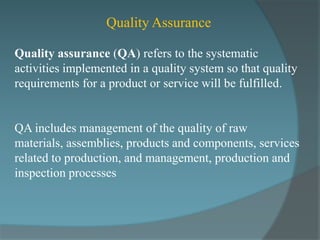
Quality Assurance

Quality assurance (QA) refers to the systematic
activities implemented in a quality system so that quality
requirements for a product or service will be fulfilled.


QA includes management of the quality of raw
materials, assemblies, products and components, services
related to production, and management, production and
inspection processes
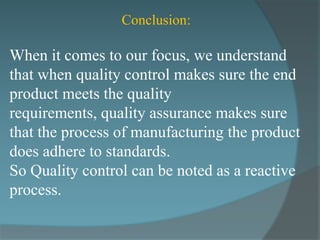
Conclusion:

When it comes to our focus, we understand
that when quality control makes sure the end
product meets the quality
requirements, quality assurance makes sure
that the process of manufacturing the product
does adhere to standards.
So Quality control can be noted as a reactive
process.
ANY
QUERY

Gaurav ppt

  • 1.
    By:Gaurav Gunjan B.Tech FinalYear Dept. of Mechanical Engineering 1
  • 2.
    Contents:- 1. Quality 2. Types Of Inspection 3. Quality Control 4. Types Of Quality Control 5. Analytical Quality Control 6. Statistical Quality Control 7. Good Manufacturing Process 8. Quality Assurance 9. Conclusion
  • 3.
    What Is Quality? The quality of a product is the “degree of perfection” i.e. the totality of features and characteristics of a product or service that bears on its ability to satisfy the needs of the customers. The quality of a product depends upon a number of factors such as design and specifications, production process, quality of raw materials used, quality of machines and equipments, man power expertise and skill and the inspection.
  • 4.
    Types of Inspection: Dependingupon the objective, inspection can be of two types, namely, preventive and corrective. The primary purpose of it is to discover the defective parts that have already been manufactured and prevent their use in the final product. The idea is to prevent the inferior parts from further processing down the production line in order to reduce the cost of production.
  • 5.
    What is QualityControl? Quality control is defined as an industrial management technique by means of which products of uniform acceptable quality are manufactured. It is a Process or system for monitoring the quality of laboratory testing, and the accuracy and precision of results.
  • 6.
    What is thegoal of QC?  To detect SIGNIFICANT errors rapidly  Report out good results in a timely manner  Be cost effective and simple to use  If there is an error, identify the source of the error
  • 7.
    What is anerror??? A wrong answer. A significant error is one that changes the diagnosis Wrong answers can be caused by random errors or by systematic errors
  • 8.
    Types of Errors Random Systematic Fluctuations Reagent problem Temperature Device problem Personnel
  • 9.
    Types of QualityControl:- Internal Quality Control When a company institutes protocol to check their system, this is called internal quality control. External Quality Control When products or data is sent to an outside business not affiliated with the company, this is external control. One example of external control is in food production.
  • 10.
    Analytical Quality Control Analyticalquality control, commonly shortened to AQC refers to all those processes and procedures designed to ensure that the results of laboratory analysis are consistent, comparable,accurate and within specified limits of precision. In well managed laboratories, AQC processes are built into the routine operations of the laboratory often by the random introduction of known standards in to the sample stream or by the use of spiked samples.
  • 11.
    Statistical Quality Control (SQC) Aprocess by which a product/service is checked during its creation using certain set parameters and statistical techniques to measure and analyze the variation within the process. WHAT IS IT USED FOR: To monitor the consistency of product/service quality and maintain processes to a fixed target as designed. To drive improvement actions within an organization.
  • 12.
    Advantages of StatisticalQuality Control (SQC): The advantages of SQC are as follows:- (1) It ensures control, maintenance and improvement in the quality standards. (2) It provides better quality assurance at lower cost of inspection. (3) It reduces the wastages of time and materials to the minimum. (4) The very presence of SQC policy in an organization improves and makes them quality conscious. (5) It provides basis for resolving differences among the various interests in the organization.
  • 13.
    What can becontrolled using SQC? VARIABLES ATTRIBUTES Variable Measures are Attributes are those that can be measured characteristics that are on a continuous scale, for assessed by judgement example i.e. have two states such length, time, weight.... as right or wrong, looks OK or not OK.
  • 14.
    Good Manufacturing Practice Agood manufacturing practice (GMP) is a production and testing practice that helps to ensure a quality product. Basic concepts of all of these guidelines to safeguard the health of the patient as well as producing good quality medicine, medical devices or active pharmaceutical products.
  • 15.
    Quality Assurance Quality assurance(QA) refers to the systematic activities implemented in a quality system so that quality requirements for a product or service will be fulfilled. QA includes management of the quality of raw materials, assemblies, products and components, services related to production, and management, production and inspection processes
  • 16.
    Conclusion: When it comesto our focus, we understand that when quality control makes sure the end product meets the quality requirements, quality assurance makes sure that the process of manufacturing the product does adhere to standards. So Quality control can be noted as a reactive process.
  • 17.