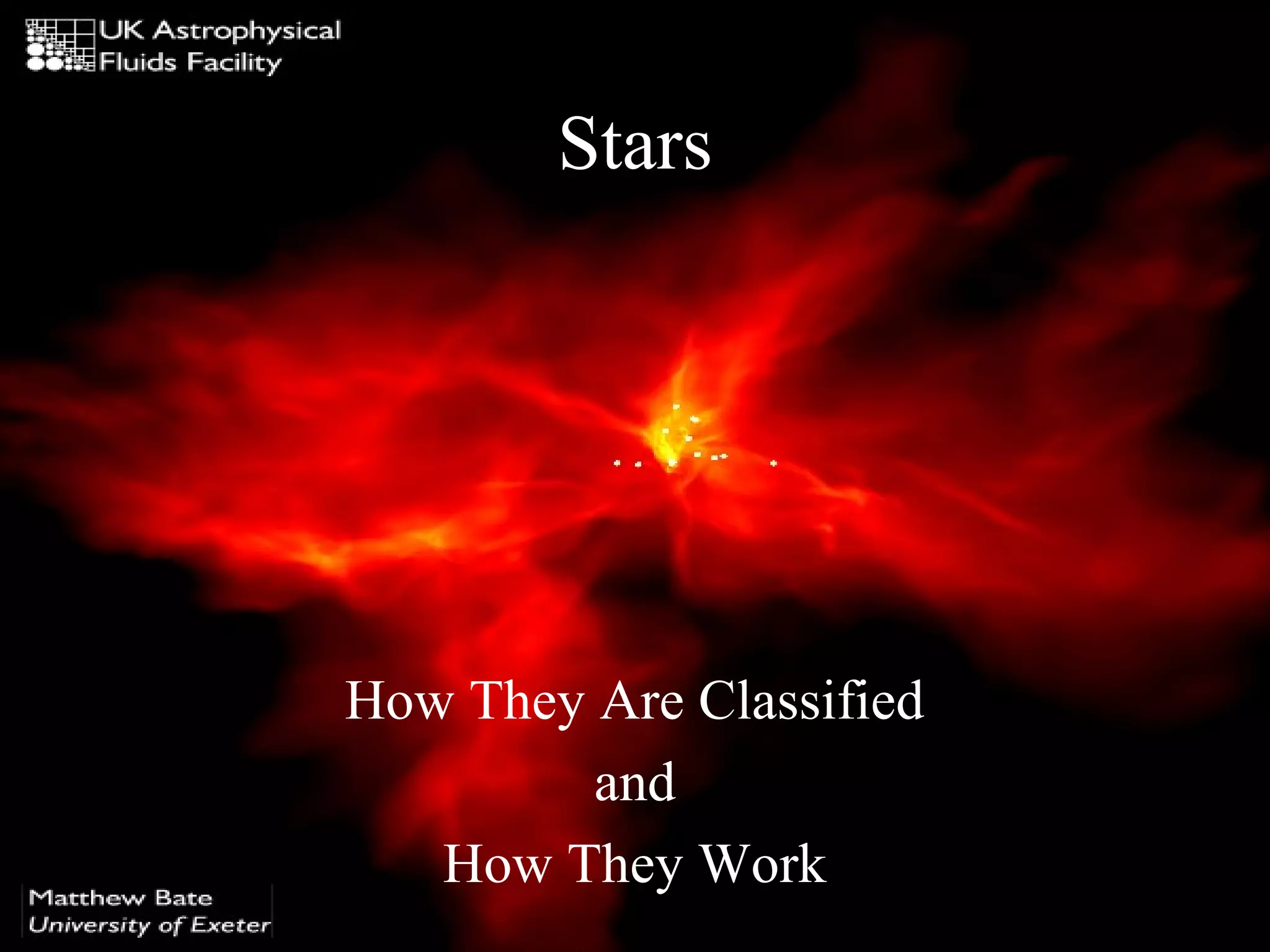
Stars

How They Are Classified
and
How They Work
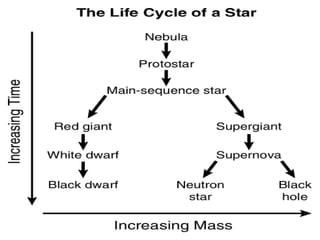
Birth of a Star
• Nebula - a cloud of gas and dust in space.
• Some nebulas are where stars are formed or
are the remains of dead or dying stars
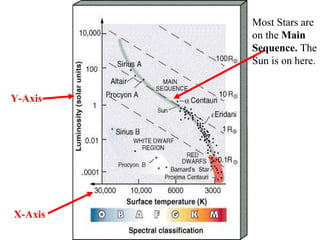
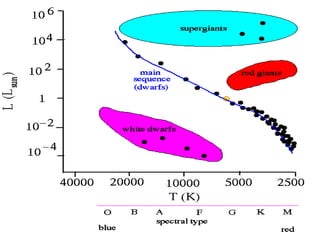
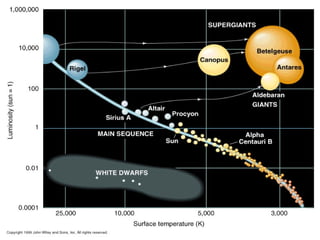
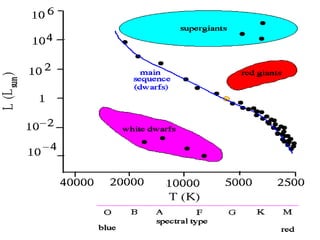
Hertzsprung-Russell Diagram
• Graph showing the luminosity (objects
radiation) of a star as a function of its surface
temperature.
• Luminosity is measured in terms of absolute
magnitude.
• Absolute magnitude is the brightness of a star.
• Brightest stars are of 1st magnitude and the
dimmest stars are of 6th magnitude.
• The sun has a magnitude of -26.8 (really, really,
really bright)
Most Stars are
on the Main
Sequence. The
Sun is on here.
Y-Axis

X-Axis
Absolute versus Apparent Magnitude
Absolute Magnitude:
• The brightness that a
star would have at
distance of 32.6 lightyears from Earth.

Apparent Magnitude:
• The brightness of a
star as seen from the
Earth.
What Fuels Stars?
• Nuclear Fusion - Hydrogen and Helium
coming together to produce energy and
light
• The most well known star that affects our
lives every day is the SUN.
• It take approximately 8 minutes and 18
seconds for light to reach earth from the
sun.
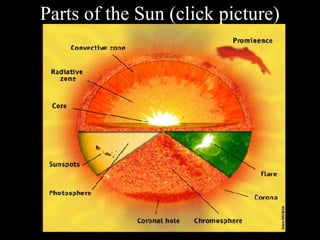
Parts of the Sun (click picture)
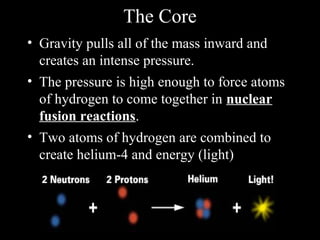
The Core
• Gravity pulls all of the mass inward and
creates an intense pressure.
• The pressure is high enough to force atoms
of hydrogen to come together in nuclear
fusion reactions.
• Two atoms of hydrogen are combined to
create helium-4 and energy (light)
Radiative Zone
• In this zone, the energy from the core is carried
outward by photons.
• As one photon is made, it travels about 1
micron (1 millionth of a meter) before being
absorbed by a gas molecule.
• The gas molecule is heated and re-emits
another photon of the same wavelength.
• The cycle repeats itself until a photon reaches
the convective zone.
Convective Zone
• Dominated by convection currents that carry the
energy outward to the surface (convection
currents are rising movements of hot gas next to
falling movements of cool gas).
• Carry photons outward to the surface faster than
the radiative transfer that occurs in the core and
radiative zone.
• It takes a photon approximately 100,000 to
200,000 years to reach the surface!
The Sun’s Atmosphere
• Photosphere
• Chromosphere
• Corona - extremely hot outermost layer
extending outward from the chromosphere
several million miles or kilometers
Photosphere
• Is the region that can be seen from Earth
• Has an average temperature of 5,800 degrees
Kelvin
• As we pass up through the photosphere, the
temperature drops and does not emit as much
light energy.
• Therefore, the outer edge of the photosphere
looks dark, an effect called limb darkening that
accounts for the clear crisp edge of the sun's
surface.
Chromosphere
• Lies above the photosphere.
• The temperature rises across the
chromosphere.
• Thought to be heated by convection within
the underlying photosphere.
Corona
• Final layer of the sun and extends several
million miles or kilometers outward from the
photosphere.
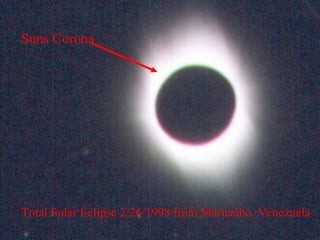
• Can be seen best during a solar eclipse and in
X-ray images of the sun.
• The corona has bright areas (hot) and dark
areas called coronal holes.
• Coronal holes are relatively cool and are
thought to be areas where particles of the solar
wind escape.
Suns Corona

Total Solar Eclipse 2/26/1998 from Maricaibo, Venezuela
Features on the Sun
• Sunspots
• Solar Prominences
• Solar Flare
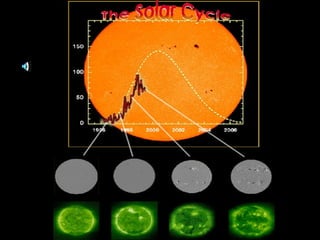
Sunspots
• Dark, cool areas that appear on the photosphere.
• Always appear in pairs.
• Are intense magnetic fields (about 5,000 times
greater than the Earth's magnetic field) that
break through the surface.
• The magnetic field is caused by movements of
gases in the sun's interior
• Sunspots happen in 11-year cycles (it is not
known why they occur in 11-year cycles).
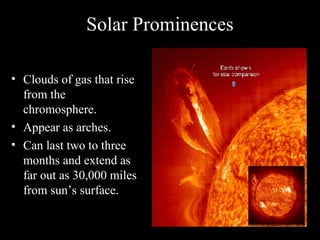
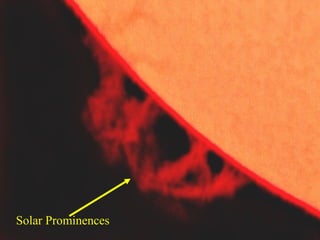
Solar Prominences
• Clouds of gas that rise
from the
chromosphere.
• Appear as arches.
• Can last two to three
months and extend as
far out as 30,000 miles
from sun’s surface.
Solar Prominences
Solar Flares
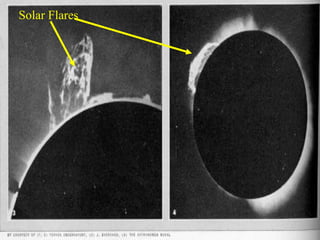
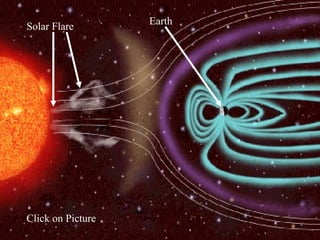
• Violent explosions from the sun.
• Thought to be caused by sudden changes in the
magnetic field where the magnetic field is
concentrated.
• Accompanied by the release of gas, electrons,
visible light, ultraviolet light and X-rays.
• Produce auroras and can disrupt
communications systems on Earth when the
release of energy caused by these violent
eruptions reaches Earth.
Solar Flares
Solar Flare

Click on Picture

Earth
Fate of the Sun
• The sun has been shining for about 4.5 billion
years.
• It has enough hydrogen fuel to "burn" for about
10 billion years.
• The size of the sun is a balance between the
outward pressure made by the release of energy
from nuclear fusion and the inward pull of
gravity.
• When the core runs out of hydrogen fuel, it will
contract under the weight of gravity and expand
becoming a Red Giant.
Fate of the Sun Continued
• When the sun becomes a Red Giant it’s
expansion will reach beyond Earth’s orbit and
therefore, the earth will be vaporized!!!!!
• At some point the helium will fuse into carbon
and when there is no more helium the core will
expand and cool and become a White Dwarf
• After becoming a White Dwarf the sun will
then turn into a Black Dwarf.
• The entire process will take a few billion years.
Stars

Stars

  • 1.
    Stars How They AreClassified and How They Work
  • 2.
    Birth of aStar • Nebula - a cloud of gas and dust in space. • Some nebulas are where stars are formed or are the remains of dead or dying stars
  • 3.
    Hertzsprung-Russell Diagram • Graphshowing the luminosity (objects radiation) of a star as a function of its surface temperature. • Luminosity is measured in terms of absolute magnitude. • Absolute magnitude is the brightness of a star. • Brightest stars are of 1st magnitude and the dimmest stars are of 6th magnitude. • The sun has a magnitude of -26.8 (really, really, really bright)
  • 5.
    Most Stars are onthe Main Sequence. The Sun is on here. Y-Axis X-Axis
  • 8.
    Absolute versus ApparentMagnitude Absolute Magnitude: • The brightness that a star would have at distance of 32.6 lightyears from Earth. Apparent Magnitude: • The brightness of a star as seen from the Earth.
  • 9.
    What Fuels Stars? •Nuclear Fusion - Hydrogen and Helium coming together to produce energy and light • The most well known star that affects our lives every day is the SUN. • It take approximately 8 minutes and 18 seconds for light to reach earth from the sun.
  • 10.
    Parts of theSun (click picture)
  • 11.
    The Core • Gravitypulls all of the mass inward and creates an intense pressure. • The pressure is high enough to force atoms of hydrogen to come together in nuclear fusion reactions. • Two atoms of hydrogen are combined to create helium-4 and energy (light)
  • 12.
    Radiative Zone • Inthis zone, the energy from the core is carried outward by photons. • As one photon is made, it travels about 1 micron (1 millionth of a meter) before being absorbed by a gas molecule. • The gas molecule is heated and re-emits another photon of the same wavelength. • The cycle repeats itself until a photon reaches the convective zone.
  • 13.
    Convective Zone • Dominatedby convection currents that carry the energy outward to the surface (convection currents are rising movements of hot gas next to falling movements of cool gas). • Carry photons outward to the surface faster than the radiative transfer that occurs in the core and radiative zone. • It takes a photon approximately 100,000 to 200,000 years to reach the surface!
  • 14.
    The Sun’s Atmosphere •Photosphere • Chromosphere • Corona - extremely hot outermost layer extending outward from the chromosphere several million miles or kilometers
  • 15.
    Photosphere • Is theregion that can be seen from Earth • Has an average temperature of 5,800 degrees Kelvin • As we pass up through the photosphere, the temperature drops and does not emit as much light energy. • Therefore, the outer edge of the photosphere looks dark, an effect called limb darkening that accounts for the clear crisp edge of the sun's surface.
  • 16.
    Chromosphere • Lies abovethe photosphere. • The temperature rises across the chromosphere. • Thought to be heated by convection within the underlying photosphere.
  • 17.
    Corona • Final layerof the sun and extends several million miles or kilometers outward from the photosphere. • Can be seen best during a solar eclipse and in X-ray images of the sun. • The corona has bright areas (hot) and dark areas called coronal holes. • Coronal holes are relatively cool and are thought to be areas where particles of the solar wind escape.
  • 18.
    Suns Corona Total SolarEclipse 2/26/1998 from Maricaibo, Venezuela
  • 19.
    Features on theSun • Sunspots • Solar Prominences • Solar Flare
  • 20.
    Sunspots • Dark, coolareas that appear on the photosphere. • Always appear in pairs. • Are intense magnetic fields (about 5,000 times greater than the Earth's magnetic field) that break through the surface. • The magnetic field is caused by movements of gases in the sun's interior • Sunspots happen in 11-year cycles (it is not known why they occur in 11-year cycles).
  • 22.
    Solar Prominences • Cloudsof gas that rise from the chromosphere. • Appear as arches. • Can last two to three months and extend as far out as 30,000 miles from sun’s surface.
  • 23.
  • 24.
    Solar Flares • Violentexplosions from the sun. • Thought to be caused by sudden changes in the magnetic field where the magnetic field is concentrated. • Accompanied by the release of gas, electrons, visible light, ultraviolet light and X-rays. • Produce auroras and can disrupt communications systems on Earth when the release of energy caused by these violent eruptions reaches Earth.
  • 25.
  • 26.
    Solar Flare Click onPicture Earth
  • 27.
    Fate of theSun • The sun has been shining for about 4.5 billion years. • It has enough hydrogen fuel to "burn" for about 10 billion years. • The size of the sun is a balance between the outward pressure made by the release of energy from nuclear fusion and the inward pull of gravity. • When the core runs out of hydrogen fuel, it will contract under the weight of gravity and expand becoming a Red Giant.
  • 28.
    Fate of theSun Continued • When the sun becomes a Red Giant it’s expansion will reach beyond Earth’s orbit and therefore, the earth will be vaporized!!!!! • At some point the helium will fuse into carbon and when there is no more helium the core will expand and cool and become a White Dwarf • After becoming a White Dwarf the sun will then turn into a Black Dwarf. • The entire process will take a few billion years.